





Why Personalized Wellbeing Has Become the New Standard
Personalized wellbeing has become a defining expectation for today’s workforce, especially as employees seek support that reflects their real lives. Rather than responding to generic programs, employees now evaluate whether personalized wellbeing actually aligns with their needs, stressors, and goals.
Over the last several years, awareness around wellbeing has grown rapidly. However, awareness alone does not translate into impact. As organizations expand their offerings, personalized wellbeing increasingly separates meaningful support from well-intended noise.
Despite this demand, many HR teams hesitate. While leaders recognize the value of personalized wellbeing, they also fear operational chaos, increased workload, and inconsistent delivery.
This tension creates a familiar dilemma: scale support without scaling complexity.
Why One-Size-Fits-All Wellbeing No Longer Works
For years, organizations relied on standardized wellbeing programs.
A single wellness challenge.
A quarterly webinar.
A static resource library.
While these efforts signaled care, they rarely met employees where they were. Different roles, workloads, life stages, and stressors require different types of support.
When wellbeing feels generic, participation drops. Over time, employees disengage—not because they don’t value wellbeing, but because the support doesn’t feel relevant.
Research supports this shift away from one-size-fits-all approaches. According to Gallup’s State of the Global Workplace, only about 23% of employees globally report feeling engaged at work, with disengagement often tied to unmanaged stress, lack of relevance, and insufficient support. Despite widespread investment in wellbeing programs, most organizations still struggle to meet employees where they are. This gap highlights a critical truth: availability does not equal effectiveness. Relevance does.
The Myth That Personalization Creates Chaos
Many HR teams equate personalization with complexity.
They imagine:
- Endless program variations
- Manual segmentation
- Increased administration
- Inconsistent experiences
As a result, teams default to uniform programs that feel easier to manage. However, this assumption overlooks how technology changes the equation.
Personalization does not have to mean manual work.
Why Personalization Is About Relevance, Not Volume
Personalized wellbeing does not require more programs. Instead, it requires better alignment.
The goal is not to offer everything to everyone. Rather, the goal is to offer the right support at the right moment.
When relevance increases, participation improves naturally. This shift reduces noise rather than adding to it.
How Leading Organizations Rethink Wellbeing Design
Leading organizations approach wellbeing as a system rather than a collection of programs.
Instead of asking:
- What should we add?
They ask:
- How do employees experience support?
- Where does friction exist?
- When do risks increase?
This systems mindset enables personalization without fragmentation.
The Role of AI in Scaling Personalized Wellbeing
AI transforms personalization from a manual process into an automated one.
Rather than relying on HR teams to segment employees, AI identifies patterns across engagement, participation, and behavior. As a result, support adapts dynamically.
AI helps by:
- Matching resources to emerging needs
- Adjusting recommendations over time
- Reducing reliance on static personas
Through automation, personalization scales without increasing workload.
Why Automation Reduces Chaos Instead of Creating It
Automation often gets misunderstood as impersonal.
In reality, automation removes repetitive tasks that drain HR capacity. By handling logistics behind the scenes, automation frees HR to focus on strategy and human connection.
When workflows run automatically:
- Programs stay consistent
- Employees receive timely support
- HR avoids manual follow-up
Order replaces overwhelm.
Personalization Without Segmentation Overload
Traditional personalization relies on rigid segments.
New hires receive one experience. Managers receive another. High-risk employees receive a third.
While segmentation helps initially, it quickly becomes unmanageable. AI-driven personalization adapts continuously without forcing employees into fixed categories.
This flexibility keeps experiences relevant without administrative burden.
Why Timing Matters as Much as Content
Wellbeing support delivered too early feels irrelevant. Support delivered too late feels reactive.
Personalized wellbeing emphasizes timing.
For example:
- Stress resources appear during high-demand periods
- Recovery support surfaces after intense workloads
- Engagement prompts adjust as participation shifts
When timing improves, impact increases.
The Link Between Personalization and Prevention
Preventative wellbeing depends on early signals.
When organizations personalize support based on emerging patterns, they intervene before burnout escalates. Instead of reacting to crises, HR supports resilience proactively.
This approach protects employees while reducing long-term risk.
Why Employees Trust Personalized Support More
Employees notice when support feels generic.
In contrast, personalized wellbeing signals attention and care. When recommendations align with lived experience, trust grows.
Trust encourages participation. Participation improves outcomes. Outcomes reinforce credibility.
This cycle strengthens wellbeing culture over time.
Configurable Programs Keep Strategy Intact
Leading organizations do not abandon structure to achieve personalization.
Instead, they rely on configurable programs that adapt within guardrails. HR sets strategy, priorities, and boundaries.
Within those parameters, personalization adjusts delivery rather than intent.
This balance preserves consistency while allowing flexibility.
Why HR Capacity Improves With the Right System
Without automation, personalization overwhelms HR.
With the right systems, personalization reduces friction.
HR teams spend less time:
- Managing schedules
- Updating lists
- Chasing participation
Instead, they focus on insight, strategy, and continuous improvement.
How Personalization Supports Equity
Generic programs often favor employees with more time, confidence, or access.
Personalized wellbeing improves equity by adapting to different needs and circumstances. When support meets employees where they are, participation broadens.
Equity improves through relevance, not uniformity.
Measuring the Impact of Personalized Wellbeing
Measurement shifts when personalization improves.
Instead of tracking attendance alone, organizations examine:
- Changes in stress trends
- Engagement behavior over time
- Consistency across teams
These indicators reveal whether personalization is working.
Why Personalization Must Integrate With Engagement
Wellbeing does not exist in isolation.
Personalized wellbeing works best when integrated with engagement and recognition. Together, these systems reinforce sustainable behaviors.
Integration reduces fragmentation while amplifying impact.
Avoiding the Trap of Overchoice
More options do not always improve experience.
Personalized wellbeing curates choices rather than expanding them. Employees see fewer, more relevant options instead of overwhelming menus.
This approach simplifies decision-making.
Why Leading Organizations Move Gradually
Successful personalization does not happen overnight.
Leading organizations:
- Start with core journeys
- Test and refine delivery
- Use data to guide expansion
Gradual implementation prevents chaos while building confidence.
The Future of Wellbeing at Scale
As work continues to evolve, personalization will become table stakes.
Organizations that rely on static programs will struggle to keep pace. Those that personalize intelligently will adapt faster and support employees more effectively.
The future belongs to systems that learn.
Where Woliba Fits In
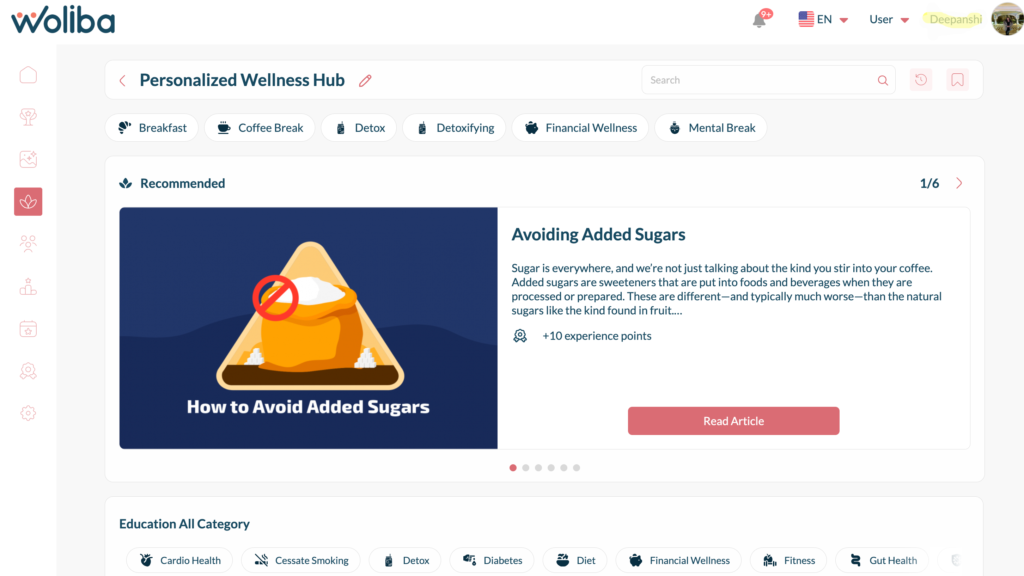
This is where Woliba enables personalized wellbeing without HR chaos.
Through automated personalization and configurable programs, Woliba helps organizations:
- Deliver relevant wellbeing support at scale
- Reduce administrative burden
- Adapt experiences dynamically
- Maintain consistency without rigidity
Rather than choosing between personalization and simplicity, HR teams gain both.
If your wellbeing strategy feels heavy instead of helpful, the problem may not be effort—it may be how personalization is delivered.
Visit woliba.io or book a demo to see how automated personalization can support wellbeing at scale without creating complexity.