





The Pressure Total Rewards Leaders Can’t Ignore
Total Rewards leaders are facing a new mandate—one that demands financial justification, strategic clarity, and measurable outcomes, all without overloading already stretched HR teams.
For Total Rewards leaders, the role has fundamentally changed. What was once centered on administering benefits and managing enrollment is now deeply tied to business performance, workforce risk, and executive decision-making. Total Rewards leaders are expected to explain not just what programs exist, but why they matter—and whether they are worth the investment.
And the pressure is only increasing.
In executive meetings, Total Rewards leaders are being asked harder questions than ever before:
- Are our benefits and wellbeing investments delivering ROI?
- Can we connect rewards to engagement, retention, or health outcomes?
- How do we know this strategy is working?
These questions aren’t unreasonable. But they are often asked without acknowledging the operational strain placed on the teams responsible for answering them.
This is the reality defining today’s Total Rewards function: prove ROI, align with finance, and protect your people from burnout—all at the same time.
A Familiar Story in the Boardroom
Picture this.
You’re a VP of Total Rewards, sitting in a quarterly executive review. A CFO scans the slide deck and pauses on the line item covering benefits, wellbeing programs, and employee rewards.
The question comes quickly:
“Can you show us the return on this investment?”
You can point to participation numbers and reference positive employee feedback, and you may even have survey results showing that people appreciate the programs. Still, that data rarely answers the question leadership is actually asking.
But what leadership really wants to know is simpler—and harder:
Is this making a measurable difference to the business?
For many Total Rewards leaders, this is where the conversation becomes uncomfortable. Not because the strategy lacks value, but because the data needed to prove that value is fragmented, incomplete, or buried across systems.
Why ROI Has Become the Central Expectation
The growing focus on ROI isn’t about distrust in HR. It’s about changing business realities.
Organizations today are navigating:
- Rising healthcare costs
- Persistent burnout and stress
- Increased turnover and disengagement
- Tighter budgets and heightened financial scrutiny
According to Gallup, only 23% of employees worldwide are engaged, while stress levels remain near record highs. At the same time, Deloitte reports that executives increasingly view workforce wellbeing as a material business risk.
In this environment, Total Rewards can no longer be positioned as a cost of doing business. It must be understood as a lever for:
- Risk reduction
- Productivity
- Retention
- Long-term organizational health
That’s why ROI has become non-negotiable—and why Total Rewards leaders are under more pressure than ever before.
The Hidden Cost of Proving ROI the Old Way
When ROI conversations arise, many Total Rewards teams fall into a familiar trap: reporting what is easiest to measure.
This often includes:
- Enrollment rates
- Program participation
- Incentive completion
- Event attendance
These metrics are useful, but they are incomplete. Participation alone does not explain whether programs are improving wellbeing, reducing burnout, or influencing behavior over time.
More importantly, assembling these reports often requires:
- Manual data pulls
- Spreadsheets stitched together from multiple vendors
- Last-minute requests that disrupt already full workloads
The result is a cycle that quietly burns out HR teams while still failing to fully satisfy executive expectations.
Utilization Is Not the Same as Impact
One of the biggest misunderstandings in Total Rewards measurement is the assumption that usage equals success.
A benefit can be widely used and still fail to:
- Improve employee health
- Reduce stress-related risk
- Strengthen engagement or retention
For example, an employee assistance program may show strong utilization, but without insight into outcomes, leaders can’t determine whether it is actually helping employees recover, cope, or stay productive.
Executives aren’t wrong to ask for ROI. But what they are really asking for is confidence—confidence that investments are aligned with outcomes that matter.
The Infrastructure Problem Holding Total Rewards Back
Most Total Rewards leaders are not struggling because they lack strategy. They are struggling because they lack visibility.
In many organizations:
- Benefits live in one system
- Wellness programs live in another
- Recognition tools sit somewhere else
- Engagement data is stored separately
Each platform provides its own reports. None provide the full picture.
When leadership asks a simple question—Is this working?—the answer requires hours or days of reconciliation, interpretation, and translation into financial language.
This fragmentation is more than inconvenient. It prevents Total Rewards leaders from operating proactively and strategically.
What Executives Actually Want to See
Despite common assumptions, executives are not asking HR to calculate perfect ROI formulas for every program.
What they want instead is:
- Clear trends over time
- Early indicators of risk or improvement
- Evidence that investments are intentional and informed
They want to know:
- Where burnout is increasing
- Where engagement is improving
- Which initiatives are influencing behavior
- Where future investment should be focused
In other words, they want insight—not just activity.
Redefining ROI for Modern Total Rewards Leaders
For today’s Total Rewards leaders, ROI must be reframed.
Instead of asking, “What did employees do?” the better question is:
“What changed because we invested here?”
Meaningful ROI indicators may include:
- Reduced burnout risk across key teams
- Improved engagement trends following recognition initiatives
- Increases in preventative wellbeing participation
- Early identification of stress or disengagement patterns
The American Psychological Association consistently links workplace stress to absenteeism, turnover, and healthcare costs. Preventative wellbeing strategies—when measured correctly—help organizations address these risks before they escalate.
This is where modern analytics become essential.
The Power of Unified Dashboards
Unified dashboards change the role of Total Rewards from reactive to strategic.
Rather than pulling reports from multiple systems, leaders can:
- View engagement, wellbeing, and recognition data in one place
- Identify correlations between programs and outcomes
- Share executive-ready insights without manual effort
This shift has two immediate benefits:
- Better conversations with leadership
- Less operational strain on HR teams
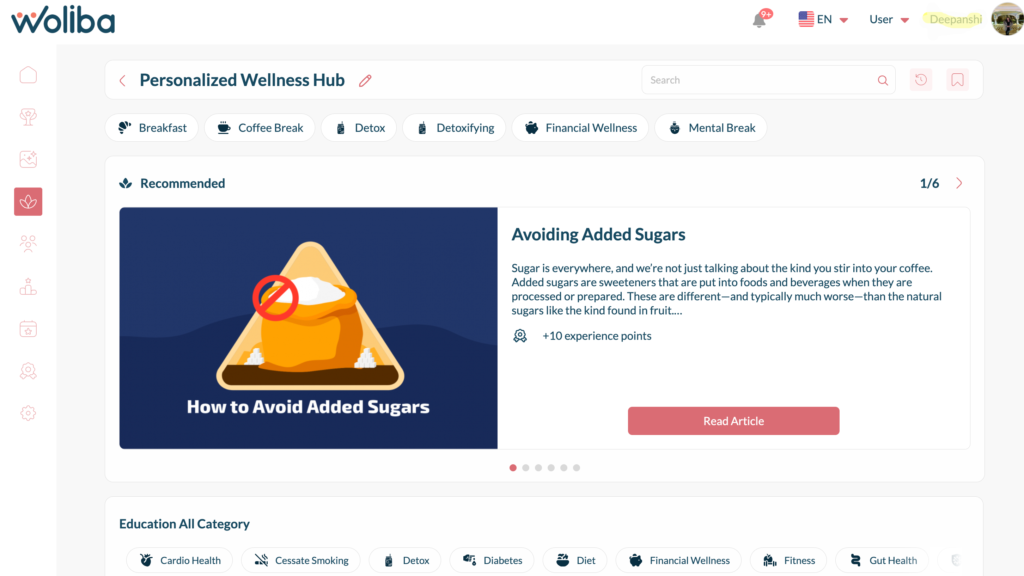
At Woliba, unified dashboards bring together wellness participation, engagement signals, recognition behaviors, and wellbeing trends—creating a more complete picture of workforce health.
The goal isn’t surveillance. It’s clarity.
Wellness ROI Without the Guesswork
Wellbeing is often the hardest area for Total Rewards leaders to defend, despite being one of the most critical.
That’s because traditional wellbeing reporting focuses on:
- Steps taken
- Challenges completed
- Resources accessed
What’s missing is context.
Wellness ROI reporting should help leaders understand:
- Whether stress risk is increasing or decreasing
- How engagement aligns with wellbeing trends
- Where preventative action is needed
When wellbeing data is integrated with engagement and recognition insights, Total Rewards leaders can demonstrate how culture, behavior, and health intersect.
This is how wellbeing shifts from a “nice-to-have” to a strategic investment.
Preventing Burnout—Including in HR
Ironically, the push to prove ROI often creates burnout within the very teams tasked with delivering wellbeing.
Late-night reporting. Endless data requests. Constant justification.
Modern platforms reduce this burden by:
- Automating reporting
- Providing real-time insights
- Eliminating manual data reconciliation
For Total Rewards leaders, this means:
- Faster responses to executive questions
- More time for strategic planning
- Less administrative overload
Protecting HR wellbeing is not separate from proving ROI. It’s part of it.
Speaking the Language of Finance Without Losing Your Purpose
One of the biggest challenges Total Rewards leaders face is translation.
Finance speaks in terms of:
- Risk
- Cost
- Forecasting
HR speaks in terms of:
- Engagement
- Experience
- Culture
Unified analytics bridge this gap by connecting people data to business outcomes.
When Total Rewards leaders can clearly show:
- Risk trends tied to burnout or disengagement
- Preventative actions reducing long-term exposure
- Data-backed recommendations for investment
They stop defending decisions and start influencing them.
The New Standard for Total Rewards Leadership
The most effective Total Rewards leaders today are not managing more programs. They are managing better insight.
They are:
- Moving from participation metrics to outcome trends
- Shifting from reactive reporting to proactive strategy
- Aligning wellbeing, rewards, and engagement under one system
Most importantly, they are doing this without exhausting their teams.
This is the new mandate—and the new opportunity.
A Question Worth Considering
As expectations continue to rise, every Total Rewards leader faces a critical question:
Will your strategy continue to report activity, or will it deliver insight leaders can act on?
What if your rewards strategy spoke the language of the CFO?
Turning Insight Into Action
For today’s Total Rewards leaders, the challenge isn’t a lack of commitment or creativity. It’s operating in a system that wasn’t built to show impact, manage risk, or scale insight without strain.
The organizations that are moving ahead aren’t asking HR to work harder. They’re giving Total Rewards leaders better visibility, clearer data, and tools that translate people investments into business language executives understand.
When rewards, wellbeing, engagement, and recognition are connected—rather than scattered across platforms—ROI conversations change. Teams spend less time justifying spend and more time shaping strategy. Leaders gain confidence. HR regains capacity. Employees benefit from programs that actually work.
If you’re ready to move from reporting activity to managing outcomes, it may be time to rethink the system supporting your Total Rewards strategy.
Explore how Woliba helps Total Rewards leaders unify data, measure wellness ROI, and align with executive priorities—without burning out their teams.
Visit woliba.io to learn more, or book a demo to see how a unified approach can help your rewards strategy speak the language of the CFO.