



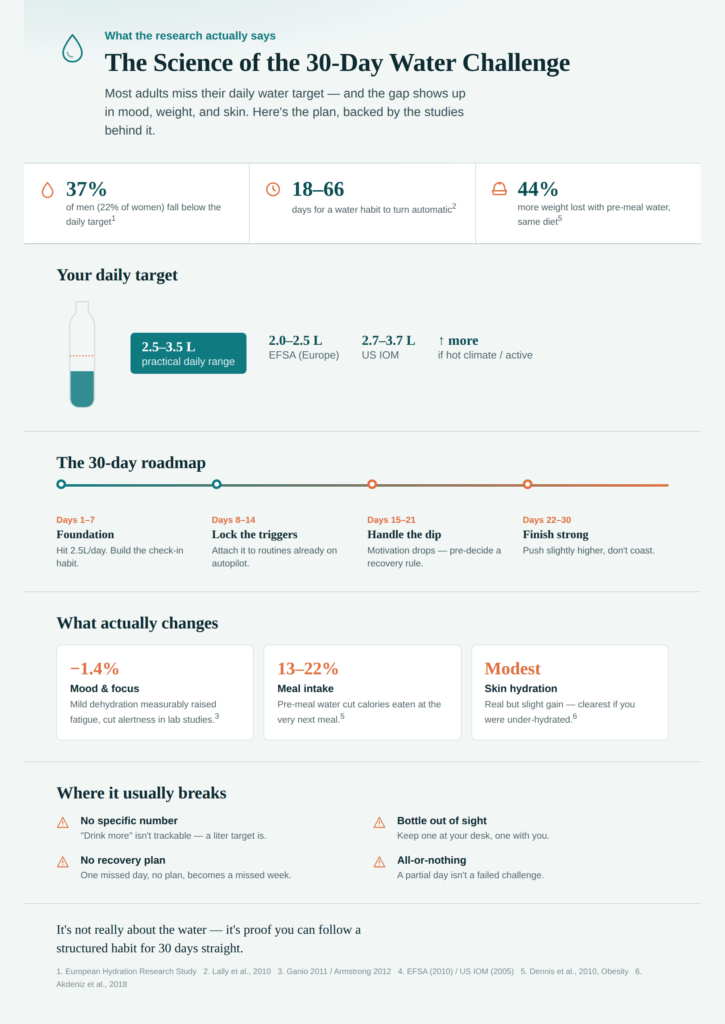
Less than a quarter of adults in most population studies actually hit the water intake their bodies need on a given day — and the shortfall isn’t small. In one large European hydration study, 37% of men and 22% of women fell below the recommended daily total, with some falling short every single day researchers tracked them. Meanwhile, a randomized trial found people who added a simple pre-meal water habit lost 44% more weight than a matched group on the same diet — with no other change. Mild dehydration, at a level most people barely notice, has been shown in lab studies to measurably degrade mood, focus, and short-term memory within hours.
None of that requires a supplement, an app subscription, or a diet overhaul. It requires one thing most people quietly fail at: doing it consistently, every day, long enough for it to stop being a decision. That’s what the 30-Day Water Challenge is built to fix.
Daily water intake calculator
Based on body weight, activity level, and climate.
Daily target
2.6 L
In glasses
10
Estimate for healthy adults. Adjust upward for intense exercise, illness, or pregnancy, and consult a doctor for personalized needs.
Why 30 Days, Specifically
The popular claim that habits take 21 days to form traces back to a 1960s plastic surgeon's casual observation about patients adjusting to new mirror reflections — not a study on habits at all. The actual research, a 2010 UCL study by Dr. Phillippa Lally and colleagues that tracked 96 people building new daily habits, found the average time to reach automatic behavior was 66 days — with a huge range of 18 to 254 days depending on the person and the behavior.
Here's the part that matters for this challenge: simple, well-anchored behaviors — Lally's own examples include drinking a daily glass of water — sit at the fast end of that range, often becoming automatic in under three weeks. Thirty days isn't a magic number, but it's long enough to get most people well past the hardest, most conscious-effort phase and into the "it just happens now" territory — without asking for a 66-plus day commitment upfront.
How Much Water You Actually Need
Skip "8 glasses a day" — it's a rough cultural shorthand, not a clinical guideline. Two major health bodies have published actual reference values:
- EFSA (Europe): 2.5 liters/day total water for men, 2.0 liters/day for women — from all beverages and food combined.
- U.S. Institute of Medicine: roughly 3.7 liters/day total water for men, 2.7 liters/day for women, with about 80% expected to come from drinks and 20% from food.
In practice, that lands most adults at 2.5–3.5 liters of fluid a day, adjusted upward for heat, physical activity, or a higher body weight. If you want a personal number instead of an average, halve your body weight in pounds to get a rough daily ounce target.
What the Research Actually Shows Water Does
Focus and mood. In a controlled study, women who lost as little as 1.36% of body weight to mild dehydration showed measurable increases in fatigue and mood disturbance, alongside reduced vigor — with no illness or extreme heat involved, just everyday under-drinking. A companion study in men found similar drops in concentration and working memory at a comparable dehydration level. The takeaway: the "afternoon slump" many people blame on food or sleep is sometimes just mild, unnoticed dehydration.
Weight management. The most-cited trial here is a 12-week randomized controlled study of adults on a calorie-controlled diet: one group added 500ml of water 30 minutes before each meal, the other didn't. Everything else was identical. The water group lost roughly 44% more weight over the 12 weeks. Other trials on pre-meal water found it reduced the calories eaten at the very next meal by around 13–22%, largely by increasing fullness before eating. It's worth being precise about what this is: an appetite-and-portion effect, not a fat-burning one, the effect is also strongest in older or previously low-water-intake adults, and smaller in people who are already lean, active, or habitual water drinkers.
Skin. A systematic review of the available studies found the evidence here is real but modest: increasing daily water intake produced a slight improvement in skin hydration and a reduction in visible dryness — but the effect was clearest in people who were previously under-hydrated to begin with, and negligible in people already drinking enough. If your skin already gets adequate water, more water alone won't dramatically change it — hydration is a floor to maintain, not a ceiling to push past for extra benefit.
The Week-by-Week Plan
Structure the month into four phases instead of treating it as one long, undifferentiated stretch:
Days 1–7 — Foundation. Just hit your daily liter target. Don't optimize yet — the only goal this week is building the check-in habit itself. Use a bottle with time markings so you're not doing mental math all day.
Days 8–14 — Lock in the triggers. This is where you attach drinking to things you already do — waking up, before each meal, after using the washroom, before or after a workout. Habit-stacking like this outperforms relying on memory or willpower, because it borrows a cue that's already automatic.
Days 15–21 — Handle the dip. Motivation naturally drops once the novelty wears off — this is the exact window where most people quietly stop. Decide your recovery rule before you need it: for example, "if I'm behind by 6pm, I drink an extra glass every hour until bed" rather than writing the whole day off.
Days 22–30 — Finish strong. Optionally push your target slightly higher (3–3.5L, especially relevant in hot climates), and treat the final week as the one that decides whether this becomes permanent, not the one you coast through.
Track It the Same Way, Every Day
Log your intake at a consistent time — ideally right before bed — using a visible tracker: a marked bottle, a habit app, or a simple tally. A visible streak creates loss-aversion; once you've built a chain of ticked-off days, breaking it costs something psychologically that a vague intention never does.
Define in advance what "still on track" means — for example, hitting your target on at least 25 of the 30 days. One missed or partial day shouldn't be allowed to cancel the whole month; that all-or-nothing framing is one of the most common reasons these challenges get abandoned.
Where the Challenge Usually Breaks
- No specific number — "drink more water" isn't trackable; a liter or glass target is.
- One bottle, out of sight — water you can't see, you forget. Keep one at your desk and one you carry.
- No recovery plan — a single missed day without a plan often turns into a missed week.
- Weekends — routines shift, and this is where most people quietly slip.
- All-or-nothing thinking — a partial day isn't a failed challenge unless you decide it is.
If You're Reading This For a Specific Reason
- Trying to manage weight: the pre-meal timing matters more than the total volume — 500ml about 30 minutes before eating is the protocol used in the studies with the clearest results, and the effect is strongest if you're not already a habitual water drinker.
- After better skin: expect a modest, not dramatic, improvement, and only if you're currently under-hydrated — pair this with your existing skincare routine rather than replacing it.
- New to fitness/wellness generally: water is genuinely one of the easiest, lowest-effort habits to build correctly — treat this 30 days as the "warm-up" habit before taking on harder changes like diet or exercise structure.
- Documenting your own challenge: the week-by-week phase structure above doubles as a content outline if you're tracking and sharing your own 30 days.
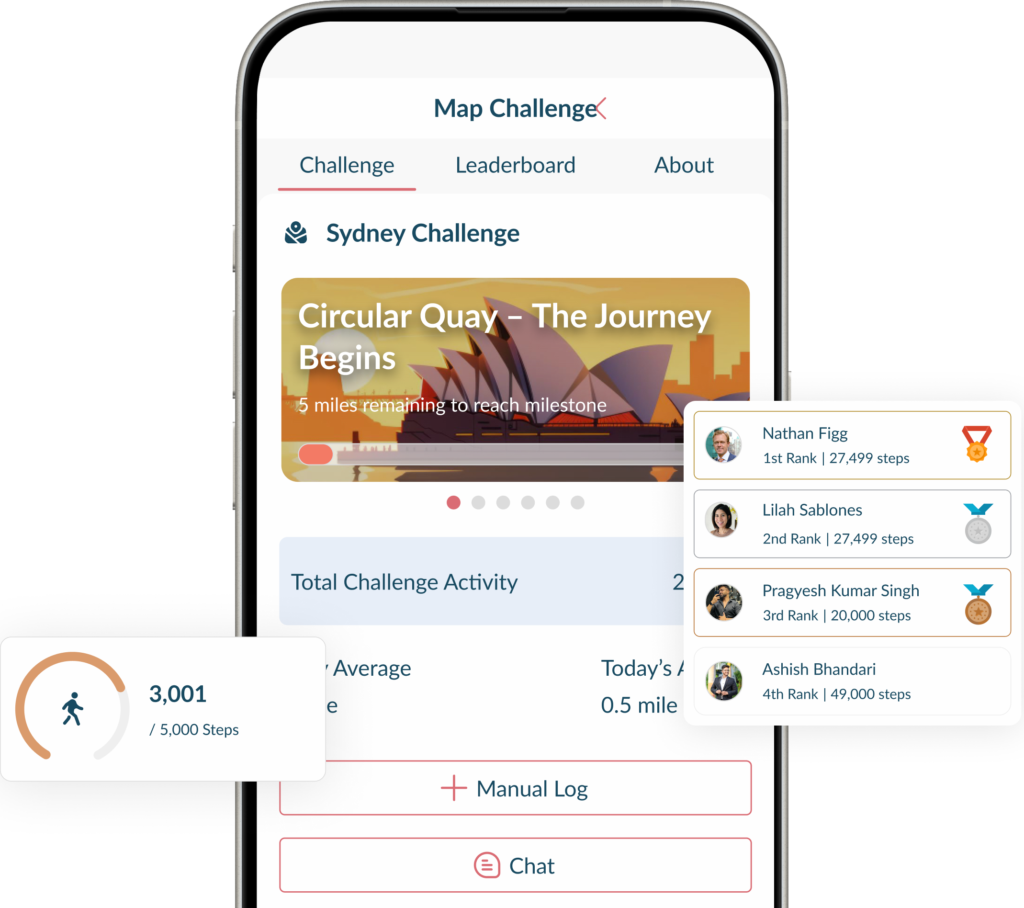
Set Up a Workplace Water Challenge—Minus the Admin Headaches
Woliba starts from just $2/mo/employee.
Final Thoughts
The 30-Day Water Challenge isn't really about water — it's proof you can follow a structured habit for a full month. Set a specific number, break it into checkpoints, track it daily, and decide your recovery rule before you need it. The research suggests that's the entire difference between finishing day 30 and quietly giving up around day 15.
Launch a company step challenge this week.
Teams compete on live leaderboards, employees sync Fitbit, Garmin or Apple Health, and HR sees participation in real time.
No credit card required
Team leaderboard
Example-
1. Operations 412,880
-
2. Finance 389,145
-
3. Customer Success 351,902
Steps this week
Still running recognition, wellness and surveys in separate tools?
Woliba puts recognition, rewards, challenges and pulse surveys behind one login, one contract and one dashboard.
Replaces your separate
Show your CFO what wellbeing is worth.
Quarterly ROI reports in dollars: turnover avoided, absence reduced and vendor savings captured.
- SOC 2
- HIPAA
- GDPR
Average first-year ROI report
$280K
in avoided turnover costs documented by Woliba clients