



Keytake away –
Nurse burnout costs U.S. hospitals over $9 billion annually. Here is how leading health systems are turning employee wellbeing into their strongest retention and patient safety strategy.
Think about who keeps a hospital running. Nurses. Doctors. Lab staff. Cleaners. Admin workers. These people show up every day to take care of others. But here is the problem: nobody is truly taking care of them.
Hospital workers are quitting at record numbers. By 2030, the U.S. will be short more than 1.1 million nurses. Nearly 6 out of 10 doctors say they feel burned out. Over half of all healthcare workers thought about quitting last year. This is not just an HR problem. When hospital staff are exhausted and stressed, patients get hurt too.
The good news? It does not have to be this way. When hospitals invest in the right wellness resources for hospital employees, staff stay longer, call in sick less often, and do their jobs better. Patients are happier too. This guide shows you exactly what is employee wellness, why it works, and how to get started.
The Burnout Crisis Facing Hospital Workers in 2026
Burnout is not new in hospitals. But since the pandemic, things have gotten much worse. There are not enough staff. The ones who are there are overworked. And there is not enough time to rest and recover between shifts.
Here is what makes hospitals different from other workplaces: when a hospital employee burns out, it is not just bad for them. It affects patients too. A major study in the BMJ found something alarming: if a nurse has to care for just one extra patient beyond four, the chance of a patient dying within 30 days goes up by 7%. Tired staff make more mistakes. That is a fact.
Let’s talk numbers: It costs around $46,000 to replace one nurse. A 500-bed hospital that loses just 15 nurses a year is spending nearly $700,000 just to fill those empty seats. A good wellness program that keeps even 5 extra nurses on staff more than pays for itself.
Burnout looks different depending on the role. An ER nurse deals with different pressures than an ICU doctor or a hospital admin worker. That is why a one-size-fits-all wellness program rarely works. You need to understand each group’s specific struggles first.
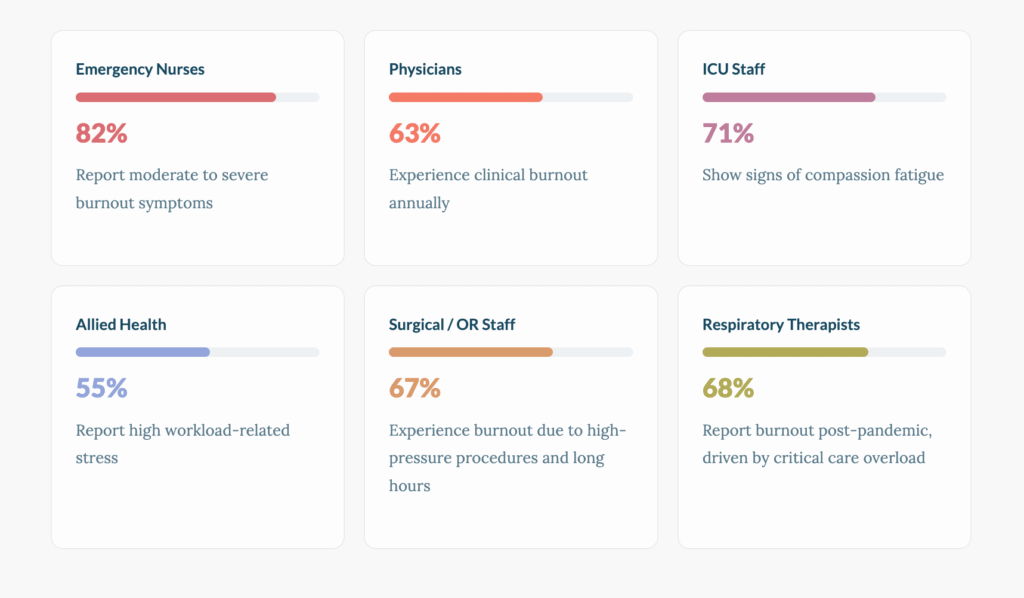
Unique Wellness Challenges in Hospitality Industry
Hospital workers face problems that people in most other jobs simply do not. Before you can build a good wellness program, you need to understand what your team is really going through day to day.
Watching Others Suffer Every Day
Seeing patients in pain, watching people die, and responding to emergencies over and over again takes a serious toll on a person’s mind. This is called secondary traumatic stress. It is what happens when you absorb other people’s pain as part of your job. On top of that, many hospital workers feel trapped between what they know is right for a patient and what the system allows them to do. This is called moral injury. It is one of the biggest reasons healthcare workers burn out and quit, but most wellness programs completely ignore it.
Working Odd Hours and Not Getting Enough Sleep
About 1 in 4 hospital workers does rotating shifts. Night shifts. Weekend shifts. Twelve-hour shifts back to back. This wrecks the body’s natural sleep cycle. Research shows shift workers are 33% more likely to get depressed and 23% more likely to develop heart disease compared to people who work regular hours. And when a nurse or doctor has not slept properly? They are more likely to make mistakes. Poor sleep is not just a personal problem. It is a patient safety issue.
The Physical Toll of the Job
Nurses get injured more often than construction workers. That might surprise you, but it is true. Lifting patients, standing for 12 hours, and doing the same physical tasks over and over leads to serious back pain, joint problems, and long-term injuries. This physical pain does not just hurt the body. It adds to the mental and emotional stress that hospital workers are already carrying. Many leave the profession simply because their body cannot take it anymore.
Running Out of Empathy (Compassion Fatigue)
Hospital workers are expected to be caring, patient, and kind to every person they treat. Even on their worst day. Even after a patient they were close to just died. Over time, constantly giving emotional energy without getting enough back drains a person completely. This is called compassion fatigue. It shows up as feeling numb, becoming cynical, or simply not caring anymore. It is one of the top reasons experienced nurses quit and doctors retire early.
Being Afraid to Ask for Help
There is a strange culture in hospitals. Doctors and nurses are taught to be strong and to take care of others. Asking for help themselves? That feels weak. Many healthcare workers worry that if they admit they are struggling mentally, they could lose their license, face judgment from coworkers, or be seen as unfit for their role. This fear stops a huge number of hospital employees from ever using the mental health resources available to them.
Top Wellness Resources for Hospital Employees in 2026
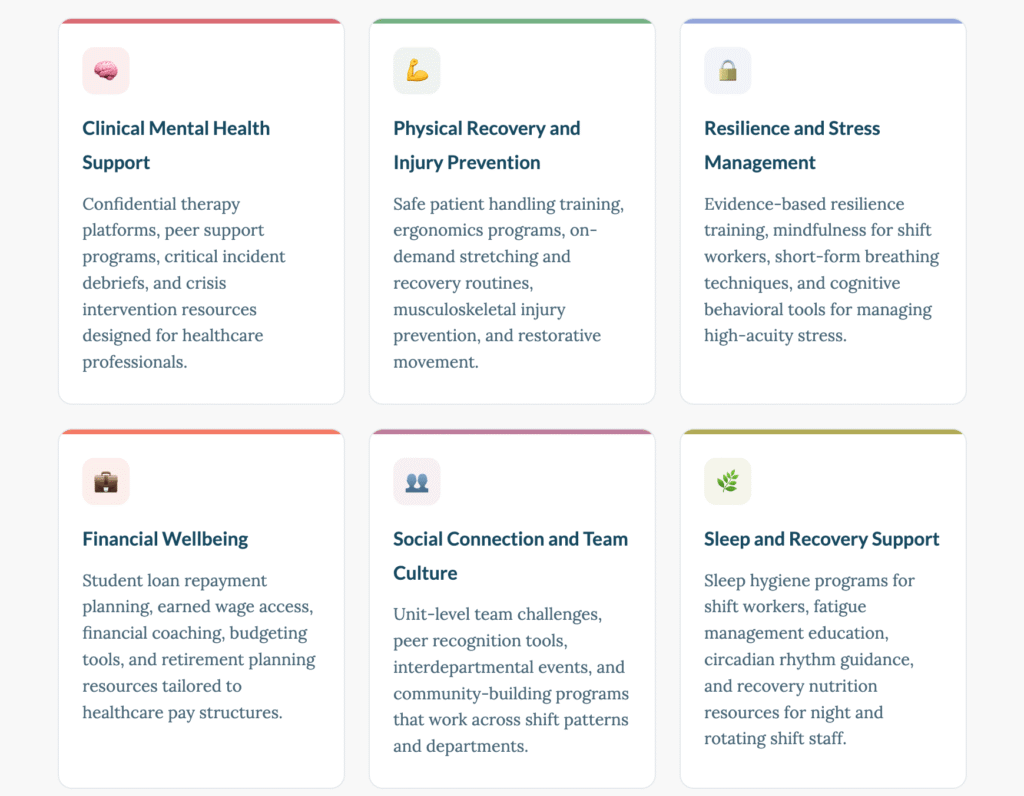
The best wellness resources for hospital staff have three things in common. They are available at any hour, not just 9 to 9. They are built for the real demands of clinical work. And employees can access them without jumping
For a full picture of how these categories integrate into a unified strategy, a holistic approach to employee wellness covers each dimension and how they interact to produce lasting change in workforce wellbeing.
It Has to Work on a Phone
A nurse in the middle of a shift cannot open a laptop. A doctor walking between wards is not going to log into a company intranet. If your wellness program only works on a desktop computer during office hours, most of your hospital staff will never use it. Wellness resources need to be on their phone, easy to open, and quick to use in 5 minutes or less.
Woliba is built exactly for this. It is a mobile-first platform designed for teams that are always on the move. Hospital staff can access wellness content, join team challenges, and get mental health support right from their phone, whether they are on a day shift, a night shift, or anything in between.
Mental Health and Emotional Wellbeing for Healthcare Employees
Mental health is the most important and most ignored part of hospital wellness. Healthcare workers deal with some of the hardest emotional situations of any job. Yet the support systems available to them are often barely functional or go completely unused.
Here is how serious it is: according to the American Foundation for Suicide Prevention, male physicians die by suicide at 1.41 times the rate of the general public. For female physicians, that number is 2.27 times higher. These are not just statistics. They are a wake-up call that mental health in hospitals cannot be treated as an afterthought.
What the research says: A 2023 study found that hospitals with structured peer support programs for clinical staff saw a 32% drop in burnout scores and a 24% reduction in staff who planned to quit, all within just 12 months of launching the program.
Peer Support Programs
Sometimes the best person to talk to is a coworker who truly gets what the job feels like. Peer support programs train certain staff members to listen, offer support, and point colleagues to the right resources. Because it is a coworker and not a manager or therapist, people feel less judged. They are more likely to open up. Research shows hospitals with formal peer support programs see fewer mental health crises and better overall staff wellbeing.
Talking It Out After a Hard Incident
When something really terrible happens at work, like the death of a child or a mass emergency, the team needs space to process it together. That is what critical incident debriefing is. A trained facilitator brings the team together within 72 hours of the event to talk through what happened in a safe, structured way. Studies show this simple step significantly lowers the chances of staff developing long-term trauma or PTSD after a difficult event.
Employee Support Programs That Actually Get Used
Most hospitals already have an Employee Assistance Program (EAP). The problem is that only 4 to 6% of staff ever use it. Why? Because calling a hotline during a 12-hour shift is not realistic. And many workers do not trust that it is truly confidential. A good hospital EAP should be available 24/7 on an app, guarantee privacy, and be simple enough to access in minutes. Managers also need to know how to refer their team members to it, because most staff only reach out after a trusted supervisor suggests it.
“When we invest in the mental health of the people who care for others, we invest in the safety of every patient who walks through our doors.” – Woliba Healthcare Wellness Research Team
How to Build a Hospital Wellness Strategy That Delivers Results
Most hospital wellness programs fail because they are designed for a typical office worker, not for someone doing 12-hour shifts, dealing with trauma, or working through the night. Here is a step-by-step approach that actually works for hospital teams.
1. First, Find Out What Your Team Actually Needs
An ICU nurse and a hospital admin worker face completely different problems. Do not assume you know. Send out a short anonymous survey to every department, every shift. Ask what is stressing them out most. The answers will surprise you, and they will help you choose resources that people will actually want to use.
2. Get Leaders to Lead by Example
If the Chief Nursing Officer talks openly about stress and uses the corporate wellness app, other staff will too. Clinical leaders have a huge influence on the culture of their units. When they take wellness seriously and show it publicly, participation across the team goes up significantly. People follow what they see, not what they are told in an email.
3. Start With Mental Health, Not Gym Discounts
In a hospital, the most urgent wellness need is almost always mental health. Start there. Set up confidential digital therapy. Train peer supporters. Create a clear plan for what happens after a traumatic incident. Get these foundations in place before you start worrying about fitness challenges or nutrition tips. The mental health piece is what will have the biggest impact on your team.
4. Keep Fighting the Stigma Around Mental Health
Changing a culture takes time. It is not a one-off campaign. When leaders speak openly about their own mental health, when wellness is talked about in everyday conversations, and when seeking support is treated as a smart decision rather than a weakness, people start to open up. Plan for at least 12 to 18 months of consistent messaging before the culture truly shifts.
5. Bring Wellness Into the Workday Itself
You cannot ask a nurse to do a 12-hour shift and then expect them to do a wellness activity on their own time. Build short wellness moments into the workday. A 3-minute breathing exercise at the start of a shift briefing. A stretch break built into the schedule. A check-in conversation between a charge nurse and their team. Small things done consistently make a big difference.
6. Measure Results and Connect Them to Patient Care
Track how your wellness program is performing every month. Look at absenteeism rates, how many staff used the wellness tools, and how many are planning to stay. Then connect those numbers to patient outcomes. When staff wellbeing improves, patient satisfaction scores go up and errors go down. Showing hospital leadership that connection makes it much easier to keep the program funded year after year.
The ROI of Hospital Employee Wellness Programs
For anyone managing a hospital budget, it is fair to ask: does investing in wellness actually pay off? The short answer is yes, and the numbers are clear.
Start with the cost of losing staff. Every time a nurse quits, it costs the hospital around $46,000 to replace them. That includes finding someone new, training them, and covering the shift gaps in between. Replace a doctor and you are looking at $500,000 or more. A 300-bed hospital that keeps just 10 extra nurses on staff each year saves $460,000. That alone covers the cost of most wellness programs several times over.
| Wellness Program Area | Measurable Outcome | Supporting Research |
|---|---|---|
| Comprehensive wellness platform | $3.27 return per $1 invested | American Journal of Health Promotion |
| Nurse peer support programs | 32% reduction in burnout scores | JAMA Network Open, 2023 |
| Mental health program investment | 4:1 ROI on absenteeism reduction | Deloitte Global Mental Health Report |
| Nurse retention improvement | $46,000 saved per retained RN | NSI Nursing Solutions, 2024 |
| Ergonomics and injury prevention | $2 to $6 return per $1 spent | OSHA Healthcare Ergonomics |
| Employee engagement improvement | 41% lower patient safety incidents | Gallup Healthcare Workplace Study |
The savings do not stop at turnover. Hospitals with engaged, well-supported staff also score 17 points higher on patient satisfaction surveys. They see fewer patient falls, fewer infections, and fewer medication errors. And hospitals that score well on patient satisfaction surveys get paid more under modern healthcare payment models.
Wellness is not just good for people. It is good for the whole hospital.
Implementation Checklist for Hospital HR and CNO Teams
✓ Send an anonymous survey to every department and shift to find out what your staff actually need
✓ Write down your starting numbers: how many staff quit, how many call in sick, how satisfied patients are
✓ Get your Chief Nursing Officer and senior leaders to publicly support and participate in the program
✓ Train peer supporters in every major department so staff have someone safe to talk to
✓ Set up a clear plan for team debriefs within 72 hours of any traumatic or critical incident
✓ Choose a wellness platform that works on a phone with no complicated logins
✓ Make sure mental health resources are available 24/7 and completely confidential
✓ Add safe lifting and injury prevention training to new staff onboarding
✓ Create a sleep health module specifically for night shift and rotating shift workers
✓ Start a campaign to normalize asking for help and reduce the stigma around mental health
✓ Appoint wellness coaches in each unit who can spread the word and support their teammates
✓ Check program data every month and share the results with staff so they can see the impact
✓ Show hospital leadership how employee wellness connects to better patient outcomes twice a year
Taking Care of Your Team Is the Best Investment You Can Make
Hospital staff are not just employees. They are the reason patients get better, feel safe, and go home to their families. When they are burned out, exhausted, or mentally drained, everyone suffers including the patients they care for.
The challenges are real. Long shifts, physical strain, emotional weight, and a culture that makes it hard to ask for help. But so are the solutions. The right wellness resources, delivered in the right way, can genuinely change things. Staff stay longer. They feel supported. They do their best work. And your patients notice the difference.
You do not need a massive budget to get started. You need a clear plan, leadership that takes it seriously, and tools that actually fit how your team works. Start with one thing, whether that is a peer support program, a mobile wellness app, or simply training your managers to check in better. Then build from there.
The bottom line: Hospitals that invest in employee wellness see less turnover, fewer sick days, safer patients, and better financial performance. It is not a nice-to-have. It is the smartest operational decision a healthcare organization can make in 2026.