



Step challenges are one of the highest-participation activities in corporate wellness — and for good reason. They’re simple, inclusive, and surprisingly effective at building camaraderie across teams. But running one manually? Spreadsheets, endless DMs, and someone inevitably gaming the numbers is not the experience your employees deserve.
That’s where a dedicated employee wellness platform comes in. Whether you’re organizing a 30-day company-wide walking challenge, a department-level competition, or a year-round fitness challenge, leveraging an intuitive platform turns a good wellness challenge idea into an automated, engaging employee wellness program people actually look forward to.
In this guide, we’ve rounded up the 15 best apps for step challenge at work — covering free group options, corporate-grade platforms, and everything in between. We’ll walk you through the key features to look for, compare them side by side, and help you find the best fit for your company.
Key Takeaways
- The best step tracker apps automate tracking, display leaderboards, and connect with wearables like Fitbit, Apple Watch, and Garmin.
- Corporate step challenge apps go beyond counting steps — they layer in rewards, team competitions, and admin reporting.
- Free group step challenge apps exist, but they’re best for small, informal teams — not company-wide programs.
- The top platforms integrate step challenges into a broader recognition program, driving participation and measurable ROI for corporate wellness.
- Woliba stands out as the only platform that combines step challenges, activity tracking, employee recognition, surveys, and burnout prediction in one place.
List of Best Step Tracker Apps:
1. Woliba
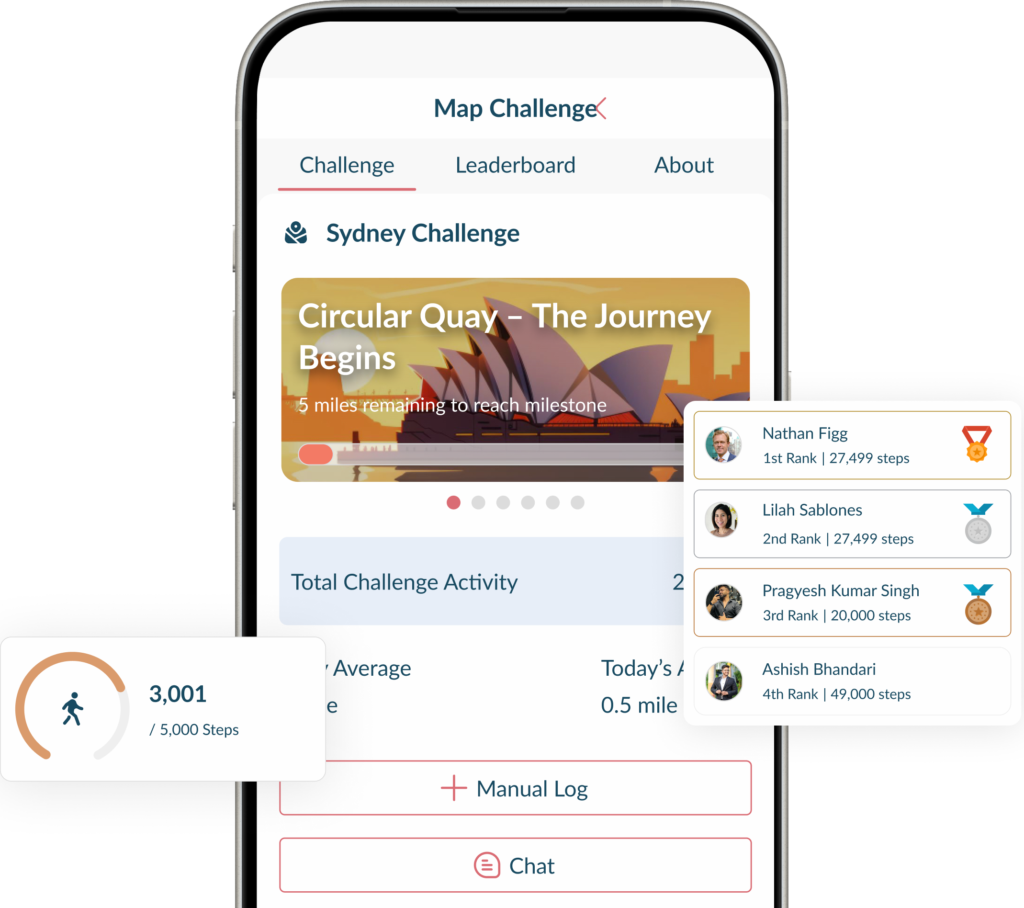
Woliba is a corporate wellness platform whose Activity Challenges module gives HR teams a structured way to run step challenges at work. Admins can set team sizes, challenge duration, step goals and leaderboard rules, while employees follow their progress from the mobile app. Steps earned in challenges feed into Woliba’s rewards and recognition ideas, so everyday movement connects to tangible incentives. It suits companies that want step challenges running alongside their other wellness programs. It also offers NOM-035 compliance support.
Why choose:
- Step challenges connect directly with rewards, recognition, surveys and wellness content in one platform.
- Real-time admin dashboards show participation rates, engagement & corporate wellness trends and departmental breakdowns.
- Billing is based on active users, keeping costs tied to actual engagement.
Ease of use:
- Employees sync Fitbit, Apple Health, Garmin or Google Fit automatically.
- Admins launch and manage every challenge from one central dashboard.
- Multi-language support helps global teams join without friction.
Download: App Store | Google Play
2. StepUp
StepUp is a social pedometer app built entirely around walking with other people. It tracks daily steps, distance and calories, then ranks friends, families and colleagues on daily, weekly and monthly leaderboards. Groups can range from a handful of friends to 15,000 people, which is why offices, schools, gyms and communities use it to run free step challenges. Group chat, a Mystery Mode that hides step counts until the next day, and exportable reports keep competitions lively. Admins can set fixed challenge dates lasting up to a year.
Why choose:
- Completely free, with no subscriptions or features locked behind paywalls.
- Scales comfortably from small friend groups to very large organizations.
- Highly rated, with more than 100,000 App Store ratings.
Ease of use:
- Works with just your phone, so no wearable is required.
- People join groups instantly through a shared invite link.
- Leaderboards update automatically, so nothing needs starting or stopping.
Download: App Store | Google Play
3. Stompers
Stompers turns everyday walking into a competitive game. Instead of simply showing a step count, it lets you create a custom character, called a stomper, and battle friends and family to see who walks the most each day. Playful power-ups let you “whack” rivals with items, adding a layer of fun that plain pedometers lack. Stompers is aimed mainly at friends and families, though it also offers a business option for groups that want a lighter, game-style approach to step challenges.
Why choose:
- Game mechanics like avatars and power-ups make daily walking feel genuinely fun.
- Daily head-to-head competition gives you a fresh reason to move every day.
- Free to download, with an optional upgrade for extra features.
Ease of use:
- Download the app, create your stomper and start walking immediately.
- Invite friends in a few taps to form your crew.
- A home-screen widget shows your standing without opening the app.
Download: App Store | Google Play
4. Pacer
Pacer is one of the most widely used walking and corporate wellness apps, with more than 100 million downloads worldwide. Its step section combines an automatic pedometer, GPS walk mapping, custom step challenges, virtual adventure challenges with collectable medals, and walking clubs. Friends and families can create free step challenges, while Pacer for Teams gives healthy workplaces a dedicated portal for company step challenges with dashboards and reports. It also helps users find nearby parks and trails for walking. Premium members unlock extra challenges, streak bonuses and an AI coach.
Why choose:
- Trusted at huge scale, with millions of active walkers worldwide.
- Covers personal challenges, group challenges and workplace challenges in one app.
- Virtual adventure challenges and medals add long-term motivation.
Ease of use:
- Counts steps automatically using your phone’s built-in sensors.
- Syncs with Apple Health, Google Fit, Fitbit, Garmin and Samsung Health.
- Create a challenge and invite people through a simple link.
Download: App Store | Google Play
5. Stridekick
Stridekick is an app built specifically for step and activity challenges between friends, families and small groups. Its main strength is device flexibility: people can compete together even when they use different fitness trackers or no tracker at all. Users can create Leaderboard, Streak or Target challenges, or join larger community challenges with formats such as Journey, Teams and collective Group Target goals. Stridekick also includes a social feed for messages and following friends’ progress. It has been used for employee walking challenges at universities and workplaces.
Why choose:
- Lets mixed groups compete fairly, whatever wearable each person uses.
- Offers several challenge formats, from competitive leaderboards to collaborative targets.
- Community challenges add variety beyond your own private group.
Ease of use:
- Connect a tracker, use your smartphone or enter activity manually.
- Free challenges are quick to create for up to 10 people.
- Pro plans unlock longer, larger and private challenges.
Download: App Store | Google Play
Planning a Step Challenge?
See how Woliba runs it for your team.
6. Steps Club
Steps Club takes a gentler approach to step tracking by focusing on connection rather than competition. It organizes walking into clubs where couples, families and close friends can see each other’s walks live, even when they are miles apart. Instead of pushing people up a ranking, it encourages them to walk together and stay accountable to people they care about. It is a good fit for long-distance relationships, family groups and friends who find leaderboards stressful. Its guide especially recommends it for couples who want to walk together while apart.
Why choose:
- Puts shared walking and connection ahead of ranking pressure.
- Live walk sharing makes distant friends and family feel closer.
- Suits people who are motivated by togetherness rather than winning.
Ease of use:
- Available on both iOS and Android.
- Create a club and invite your people in minutes.
- A free plan covers small groups, with room to upgrade later.
Download: App Store | Google Play
7. Upkeep
Upkeep is a step challenge app designed for private friend groups that want fair competition. Its standout feature is step verification: it combines GPS plausibility checks, cadence anomaly detection and heart rate data to make it harder for anyone to fake their numbers. Groups of three to twenty friends can compete privately, keeping challenges personal rather than public. It suits competitive friend circles who have been frustrated by suspicious step counts in other apps. Its creators position it as the fairest option for friend groups who want a completely free, private and genuinely cheat-resistant step competition.
Why choose:
- Multi-signal verification discourages cheating and keeps results credible.
- Private groups of three to twenty keep challenges personal.
- Actively developed, with regular updates to features.
Ease of use:
- The core experience, including group challenges, is free.
- Create a private group and invite friends quickly.
- Verification runs in the background, so you simply walk.
Download: App Store
8. WeWard
WeWard is a walk-to-earn app that rewards people for moving more each day. It turns daily steps into points called Wards, which can be exchanged for cash payouts, gift cards and other rewards. Unlike apps that only offer marketplace tokens, WeWard’s ability to pay out real money through PayPal or bank transfer has made it one of the most popular step reward apps, with millions of users. It suits people who want a small, tangible reward for walking. Many users run it alongside other step apps, since a phone’s step counter can feed several apps at once.
Why choose:
- Offers real cash payouts rather than only tokens or discounts.
- Lighter ad load than some competing walk-to-earn apps.
- Large community and challenges add extra motivation.
Ease of use:
- Tracks your steps automatically in the background.
- Points accumulate as you walk, with no logging needed.
- Redeeming rewards takes just a few taps.
Download: App Store | Google Play
9. Sweatcoin
Sweatcoin is one of the original walk-to-earn apps, launched in 2016, and remains among the best known in the category. It tracks your steps and converts them into a digital currency called sweatcoins, at roughly one coin per thousand steps. Those coins can be spent on products, discounts and offers in Sweatcoin’s marketplace. It works best as a light motivational nudge, giving everyday walking a small reward rather than meaningful income. Because it runs in the background, many people keep it installed alongside other step apps for small extra rewards.
Why choose:
- A long-established, widely used app with a large global user base.
- Turns ordinary daily walking into a steady stream of reward coins.
- A broad marketplace offers many ways to spend what you earn.
Ease of use:
- Install it once and it tracks steps passively.
- No wearable is required to start earning.
- Free to use, though rewards accumulate slowly.
Download: App Store | Google Play
10. StepBet
StepBet, originally from WayBetter, takes a different approach to step motivation by putting money on the line. Players join a six-week walking game, stake around $40 and then hit personalized daily and weekly step targets. Everyone who meets their goals splits the pot, which includes money lost by players who fall short. Because goals are based on each person’s own activity history, the challenge is realistic but still demanding. It suits people motivated by financial accountability. Each game has a clear start and end date, so the commitment stays short and manageable.
Why choose:
- Financial stakes create strong accountability to keep walking.
- Personalized targets make the game fair for every fitness level.
- Winners can earn back their stake plus a share of the pot.
Ease of use:
- Connect your fitness tracker and StepBet sets your goals automatically.
- Steps sync without manual logging.
- Clear daily targets show exactly what you need.
Download: App Store
11. StepSetGo
StepSetGo is an Indian step-tracking and walk-to-earn app built for everyday walkers in India. It counts your daily steps and converts them into coins, at roughly one coin for every thousand steps, which can be redeemed for rewards, deals and offers. Its local focus makes it especially relevant for Indian users, who may find global step reward apps less suited to their market. It suits anyone looking for a simple extra push to walk more each day. Like other step reward apps, it works best as motivation rather than an income source.
Why choose:
- Designed specifically for Indian users and the rewards they value.
- Turns daily walking into coins redeemable for real deals.
- A clear coin-per-steps system keeps progress easy to understand.
Ease of use:
- Uses your phone’s step counter, so no wearable is needed.
- Steps convert into coins automatically as you walk.
- Free to download on Android and iOS.
Download: App Store
12. MoveSpring
MoveSpring is a dedicated step and activity challenge platform for organizations. Rather than offering a broad wellness suite, it focuses on making step challenges engaging and inclusive. Companies can run individual leaderboards, collaborative team challenges or Group Target challenges in which the whole organization works toward one shared goal. Scoring can be based on steps, distance or active minutes, so employees who cycle, swim or move differently can still take part meaningfully. Many companies use it to run a standalone step initiative rather than a full wellness program. Reviewers often praise its clear admin dashboard and real-time participation charts.
Why choose:
- Purpose-built for step challenges rather than general wellness.
- Multiple challenge modes support both competition and collaboration.
- Flexible scoring keeps challenges inclusive for every employee.
Ease of use:
- Admins choose a challenge mode and scoring metric quickly.
- Employees sync popular wearables or smartphones.
- Real-time dashboards show participation without manual tracking.
Download: App Store | Google Play
13. YuMuuv
YuMuuv offers a company step challenge designed for HR managers who want an engaging competition without building everything themselves. Each challenge begins with a personalized launch session where the YuMuuv team walks organizers through the platform and tailors the challenge parameters. During the challenge, the platform shares insights and wellness tips that keep participants motivated, and it makes recognizing milestones simple. YuMuuv suits organizations that value expert support alongside a ready-made step competition. Supported devices and engagement features are covered in its FAQ, and the platform also offers other challenge types for teams once your first step challenge ends.
Why choose:
- Hands-on support from the YuMuuv team throughout the challenge.
- Ready-made materials make internal promotion easier.
- Built-in milestones and tips sustain engagement over time.
Ease of use:
- A personalized launch session handles initial setup.
- Organizers receive guidance for introducing the challenge to employees.
- Participants simply connect their device and start walking.
Download: App Store | Google Play
14. A Step Ahead
A Step Ahead is a game-based virtual walking challenge created by veterans of the video game industry. Instead of a plain leaderboard, teams progress through a game driven by their real-world steps, which the company says keeps engagement high for the full challenge. It was designed from the start as a team game, so local, remote and blended teams spread around the world can all compete in the same challenge. Single challenges can also be purchased separately. The company reports 94.4% sustained engagement and says top brands and thousands of small businesses already use its game-based walking challenge series.
Why choose:
- Game design expertise makes walking challenges feel genuinely entertaining.
- Built for teams, encouraging collaboration and physical team-building activities.
- Single challenges are available without a long commitment.
Ease of use:
- Organizers sign up their group and form teams.
- Remote and office teams compete within one challenge.
- Participants join with invite codes.
Download: Google Play
15. Big Team Challenge
Big Team Challenge is a UK-based platform for organizing step challenges for workplaces, charities and community groups. Organizers create a daily step count challenge, and teams progress across a virtual map as they walk. Two map modes let you decide whether teams compete against each other or combine their steps to reach a shared destination. It has supported step challenges for organizations ranging from small UK companies to large Silicon Valley technology firms. It is also suitable for charity fundraisers, where teams combine steps to raise money while walking toward a shared virtual destination together.
Why choose:
- Flexible setup works for employee wellness challenges and charity fundraisers.
- Virtual maps give teams a visual sense of progress.
- Competitive and collaborative modes suit different workplace cultures.
Ease of use:
- Organizers configure challenges to fit their needs.
- Teams track progress on a shared visual map.
- Real people are available to help with setup.
Download: App Store | Google Play
Before publishing, test the WeWard and Sweatcoin Google Play links. They come from my knowledge of the package names rather than a confirmed source.
Planning a Step Challenge?
See how Woliba runs it for your team.
Conclusion: Choosing the Right Step Challenge App
The right step challenge app depends on who’s walking and what you want the challenge to achieve. For friends and families, free social apps like StepUp, Stompers, Pacer, Stridekick and Steps Club make walking more fun without costing anything. If an extra reward helps you get moving, step-reward apps like WeWard, Sweatcoin and StepSetGo turn everyday steps into cash, coins or deals. StepBet suits people who stay motivated when money is on the line.
Workplaces need more than a leaderboard. They need easy setup, reliable tracking across devices, and visibility into who’s taking part. MoveSpring, YuMuuv, A Step Ahead and Big Team Challenge all offer strong options for company-wide step challenges. If you want step challenges to connect with rewards, recognition and your wider wellness program, Woliba brings it all together in one platform.
Whichever app you choose, start simple. Pick one challenge format, invite your group, and keep goals realistic so everyone can take part. The best step challenge is the one people actually stick with, and the right app makes that easy.