


Here’s the uncomfortable truth: restaurant workers experience burnout, injury, and financial stress at rates far above any other industry. Behind every empty shift and no-show is an unaddressed wellness gap. In 2026, restaurant employee wellness isn’t a perk — it’s a survival strategy.
What Is Restaurant Employee Wellness Program?
Restaurant employee wellness is a holistic set of programs, policies, and cultural practices that support the physical health, mental wellbeing, financial stability, and social belonging of food service workers — from line cooks and servers to shift managers and dishwashers.
It goes beyond gym discounts or wellness days. True restaurant wellness addresses the root causes of burnout unique to this industry: high-heat environments, irregular scheduling, tip income volatility, high-pressure service windows, and limited access to traditional healthcare.
Before diving in, the latest employee wellness platform across industries tell a stark story — but restaurant workers consistently rank among the most stressed, most physically burdened, and least supported employees in the American economy.
The Six Pillars of Restaurant Wellness
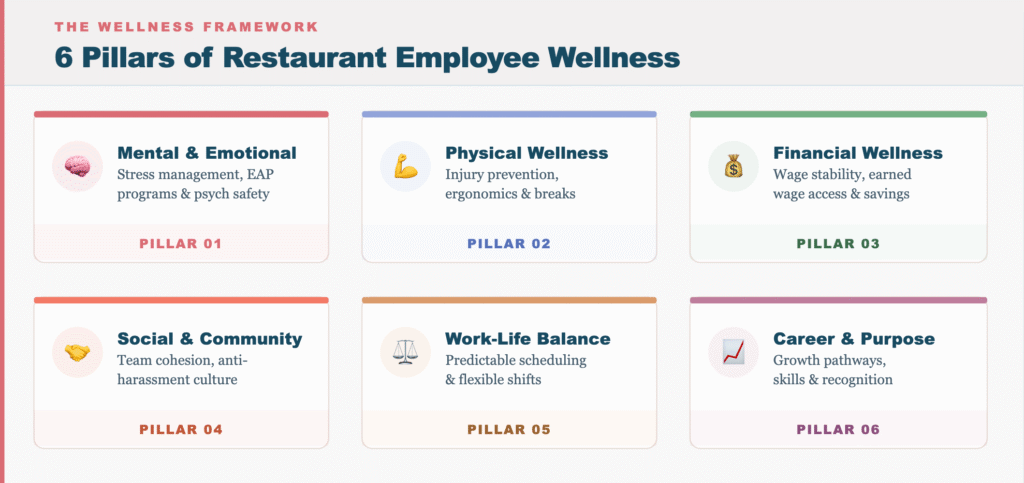
- Mental & Emotional – Stress management, EAP programs, and a culture of psychological safety.
- Physical – Injury prevention, ergonomics, break policies, and occupational health.
- Financial – Wage stability, earned wage access, emergency funds, retirement savings.
- Social & Community – Team cohesion, anti-harassment culture, and peer support systems.
- Work-Life Balance – Predictable scheduling, flexible shift swaps, and adequate rest policies.
- Career & Purpose – Growth pathways, skills training, recognition, and meaning in daily work.

Your Staff Are Burning Out. Start Fixing It Free.
Launch your first staff wellness challenge this week — free 21-day trial, no card needed.
Why Restaurant Employee Wellness Matters More Than Ever
Post-pandemic, the restaurant industry didn’t just recover — it restructured. Employees who left during COVID-19 often didn’t come back. Those who stayed raised their expectations. The labor shortage forced operators to compete not just on wages, but on working conditions.
“Restaurants that invested in employee wellbeing post-COVID reported 34% lower turnover and a measurable improvement in guest satisfaction scores.”— National Restaurant Association, 2024 State of the Industry Report
The Business Case Is Undeniable
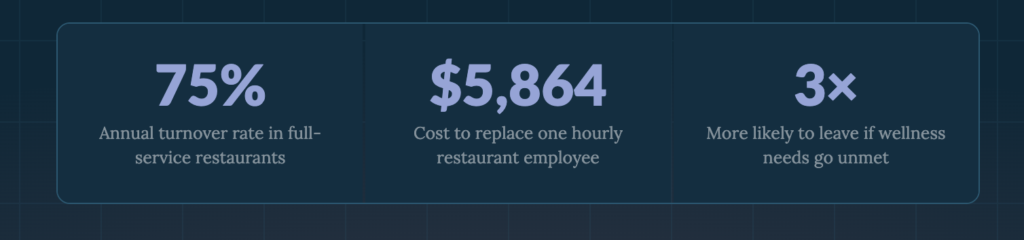
- Turnover costs money: Replacing one hourly employee costs an estimated $5,864. For a 50-person restaurant at 75% turnover, that’s $220,000+ per year.
- Wellness reduces absenteeism: Workers with access to mental health support miss 28% fewer shifts.
- Engaged employees drive revenue: Supported teams deliver better guest experiences, leading to higher check averages and repeat visits.
- Wellness attracts talent: In a candidate-driven market, wellness programs are a measurable recruiting differentiator.
A structured employee wellness program tailored to your restaurant’s size and budget will almost certainly pay for itself within one fiscal year through reduced turnover alone.
Unique Wellness Challenges in the Restaurant Industry
Unlike office or retail workers, restaurant staff face a combination of stressors few industries replicate. Understanding these is the foundation of any effective wellness strategy.
The FOH vs. BOH Divide
One of the most overlooked dynamics is the different experience between Front of House (FOH) and Back of House (BOH). Their wellness needs are not the same — a blanket program that ignores this will fall flat.
| Wellness Dimension | Front of House (FOH) | Back of House (BOH) |
|---|---|---|
| Primary Stressors | Customer aggression, tip variability, emotional labor | Heat, physical exertion, high-speed pressure, noise |
| Mental Health Risks | Anxiety, people-pleasing burnout, harassment exposure | Anger suppression, isolation, substance use patterns |
| Physical Risks | Foot/leg strain, repetitive motion, slip-and-fall | Burns, lacerations, musculoskeletal injury, heat exhaustion |
| Income Stability | Tip-dependent — high variance ceiling | Hourly — more stable but lower ceiling |
| Priority Wellness Need | Emotional resilience training, income smoothing tools | Physical recovery support, mental health access |
Industry-Specific Obstacles
- Irregular hours: Split shifts and late nights disrupt sleep and make standard health appointments nearly impossible.
- Lack of insurance: A significant share of restaurant workers — particularly part-time staff — have no employer-sponsored health coverage.
- High substance use rates: The restaurant industry has one of the highest rates of substance use disorder of any sector, driven by post-shift culture and chronic stress.
- Transient workforce perception: The less you invest, the more transient the workforce — a self-fulfilling prophecy operators must break.
- Thin margins: Operators genuinely can’t always afford premium benefit packages. Wellness must be financially creative.
Mental Health in the Restaurant Workplace
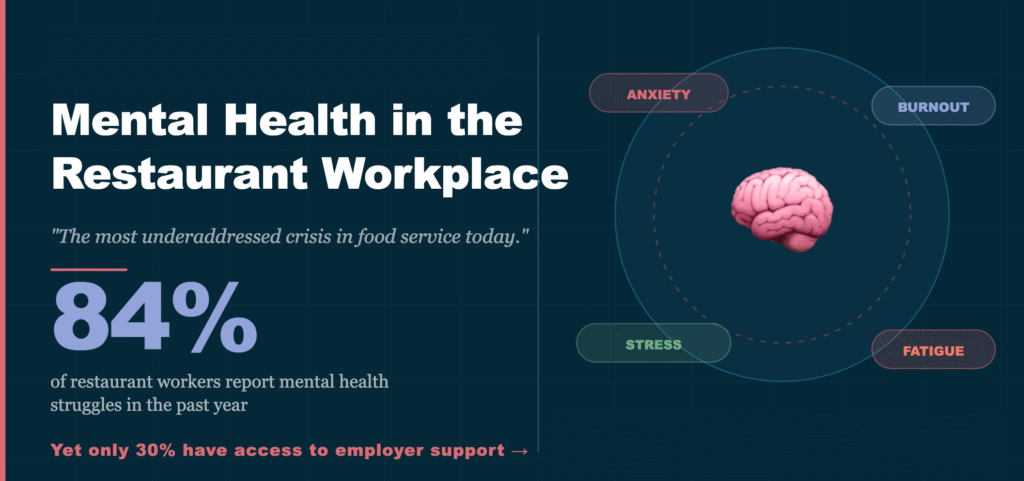
Restaurant workers experience mental health challenges at rates well above the national average. One study found that 84% of restaurant workers reported mental health struggles on the job in the past year — yet fewer than 30% had access to any employer-provided mental health support.
Recognizing Burnout Before It Becomes Resignation
Burnout rarely looks like a meltdown. More often it’s quiet: a previously enthusiastic server becoming curt with guests, a reliable cook calling out more frequently, a shift lead who stopped taking initiative. These are wellness signals — not disciplinary ones.
Practical Mental Health Supports
- Employee Assistance Programs (EAPs): Most offer 3–6 free counseling sessions per employee per year, at just $25–$50/employee annually. The highest ROI wellness investment available.
- Mental health first aid training for managers: Train shift managers to recognize crisis signals and respond with empathy, not discipline.
- Anonymous feedback channels: Simple suggestion tools let staff surface stress triggers before they escalate into resignations.
- Destigmatization from the top: When owners talk openly about mental health, it normalizes help-seeking throughout the team.
- Post-service debrief rituals: A 5-minute team check-in after a brutal Saturday dinner service costs nothing and builds enormous psychological safety.
⚠️ The Burnout Cycle
Chronic stress → presenteeism → declining performance → mistakes → more stress → staff conflict → absenteeism → turnover. Breaking this cycle requires wellness intervention, not just better scheduling.
For a broader library of mental health and engagement tactics, explore our curated employee wellness ideas resource with initiatives applicable across your entire operation.
Your Staff Are Burning Out. Start Fixing It Free.
Launch your first staff wellness challenge this week — free 21-day trial, no card needed.
Physical Wellness for Restaurant Workers
The commercial kitchen is one of the most physically demanding environments in any industry. Line cooks stand in extreme heat for 10-hour stretches. Servers walk 4–7 miles per shift. Physical wellness must meet this reality head-on — not address it with generic gym memberships.
Injury Prevention Comes First
Kitchen injuries cost the restaurant industry an estimated $3.1 billion annually in workers’ comp claims and lost productivity. Prevention is significantly cheaper than treatment.
- Anti-fatigue mats for all standing positions
- Quarterly ergonomic reviews of workstation setup
- Cut-resistant gloves at all prep stations
- Mandatory stretch breaks during long prep shifts
- Non-slip flooring with strict dry floor protocols
- Proper lifting training for staff handling bulk deliveries
Heat Management in Commercial Kitchens
BOH staff regularly work in environments exceeding 100°F near the line. Hydration stations, heat-appropriate uniforms, and mandatory cooling breaks are occupational health requirements — not optional perks.
“Heat stress is the most underreported occupational hazard in food service. Most operators don’t measure it — and most staff don’t report it for fear of appearing weak.”— Occupational Health Review, Foodservice Edition 2024.
Financial Wellness: The Most Overlooked Pillar
Financial stress is the number one driver of workplace anxiety in restaurants. Tipped workers face income volatility that makes budgeting nearly impossible. Hourly BOH workers often earn wages that don’t keep pace with cost of living in major markets.
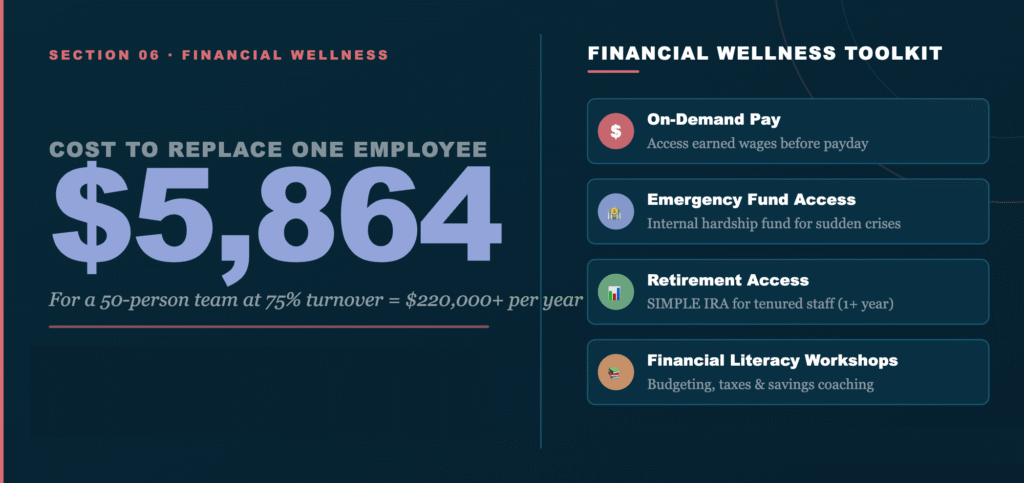
Financial wellness isn’t only about paying people more. It’s about giving employees tools, transparency, and stability around their income so financial anxiety doesn’t compound the stress of an already demanding job.
Financial Wellness Tools That Work
- On-demand pay (earned wage access): Platforms like DailyPay or Branch let workers access earned wages before payday — reducing paycheck-to-paycheck stress immediately.
- Tip transparency: Clear, consistent tip pooling policies reduce friction and anxiety among FOH staff.
- Emergency assistance funds: Even a $500–$1,000 internal hardship fund can fundamentally change an employee’s relationship with their employer.
- Simple retirement access: SIMPLE IRA options can be offered even by independent restaurants — a strong retention lever for tenured staff.
- Financial literacy workshops: Partner with a local credit union or nonprofit coach for free 30-minute sessions on budgeting, taxes, and savings.
💡 Quick Win
Earned wage access providers often charge nothing to the employer. It’s one of the few benefit additions with zero cost to your P&L and high perceived value to hourly staff.
Your Staff Are Burning Out. Start Fixing It Free.
Launch your first staff wellness challenge this week — free 21-day trial, no card needed.
10 Proven Restaurant Employee Wellness Strategies for 2026
Here are ten specific, implementable strategies that leading restaurants are deploying right now — from indie operators to QSR chains. Each is grounded in what the research and the industry’s best operators know to be true.
Implement Predictive Scheduling (2-Week Minimum Notice)
Unpredictable schedules are the single most common complaint among restaurant workers. Publish schedules at least two weeks out. This alone improves sleep quality, reduces financial stress, and signals genuine respect for your team’s lives outside work.
Launch an Employee Assistance Program (EAP)
For $20–$50/employee/year, your team accesses licensed counselors, financial advisors, and legal consultants. Use vendors like Lyra Health or Spring Health who specialize in hourly workforce populations. Highest ROI wellness investment available to restaurant operators.
Build a Formal Recognition System
Go beyond “employee of the month.” Try shift-level shoutouts, peer recognition, milestone bonuses at 90/180/365-day anniversaries, and a public wall of team wins. Recognition costs almost nothing and delivers outsized loyalty returns across both FOH and BOH.
Create a No-Shame Sick Day Culture
Sick employees in food service are both a public health risk and a wellness disaster. Create a genuine sick-leave policy, cross-train staff to fill gaps, and ensure managers never pressure sick employees to come in. This single culture change reduces illness-cascade absenteeism significantly.
Introduce Structured Career Pathways
When employees see a clear path from busser → server → lead → floor manager, they invest in their own growth rather than looking for it elsewhere. Map it. Show it visually. Tie salary increases and expanded wellness benefits to each milestone.
Offer Earned Wage Access
Partner with an earned wage access provider so employees can withdraw earned wages before payday. Financial stress between pay periods is a proven driver of distraction and turnover — and this benefit often costs the employer nothing.
Train Managers in Mental Health First Aid
Your shift managers are the first line of wellness response. A free online Mental Health First Aid certification teaches them to recognize burnout, anxiety, and crisis signals — and respond with empathy rather than discipline. This retains employees through difficult periods that would otherwise end in resignation.
Conduct Regular “Stay Interviews”
Don’t wait for exit interviews to discover why people leave. Run quarterly 15-minute stay conversations: “What’s working? What makes this job hard? What would make you more likely to stay?” The act of asking communicates respect — and the data is actionable intelligence for your wellness strategy.
Create and Enforce a Zero-Tolerance Harassment Policy
Restaurant environments — particularly FOH — have historically been hotbeds of harassment from customers, coworkers, and managers. A clearly communicated, actually enforced policy is a wellness policy. Staff who feel safe perform better, stay longer, and refer better candidates.
Elevate the Staff Meal
Staff meals are a daily touchpoint for wellness. A nutritious, thoughtfully prepared family meal before service communicates care, fuels performance, and builds team culture. It doesn’t need to be elaborate — but it should be more than leftover bread and scraps. Several operators report that upgrading staff meal quality measurably improved pre-service morale.
How to Build a Restaurant Wellness Program from Scratch
Most independent and small-chain operators don’t know where to start. Here’s a phased roadmap that scales with your budget and team size — from zero cost to full investment.
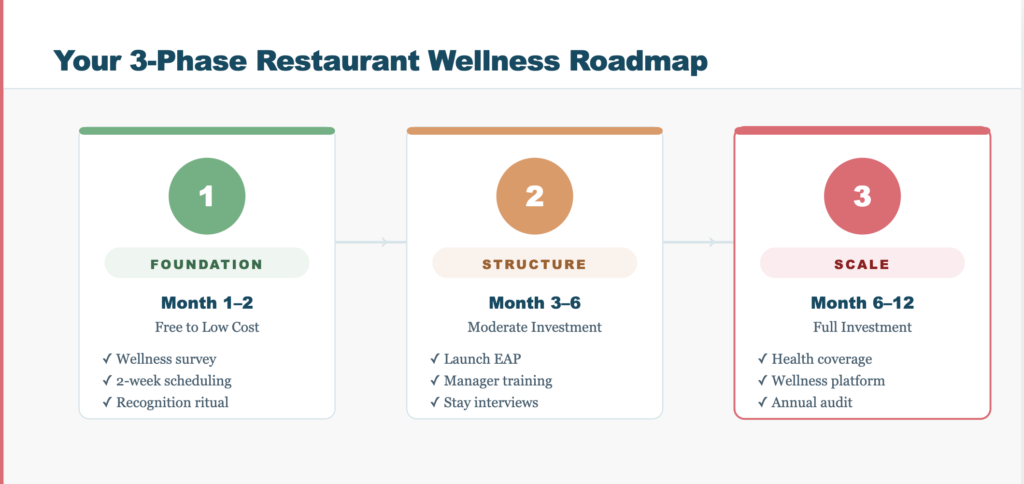
Phase 1 Foundation — Month 1–2 · Free to Low Cost
- Run a team wellness survey with Woliba to understand top stressors
- Publish a 2-week advance schedule — effective immediately
- Create a written sick leave policy, even if informal
- Launch a basic recognition ritual (pre-shift shoutout, Woliba’s social feed, Slack)
- Post mental health resources in the break room (SAMHSA, Crisis Text Line)
- Establish and communicate a zero-tolerance harassment policy at all-hands
Phase 2 Structure — Month 3–6 · Moderate Investment
- Sign up for an EAP ($25–50/employee/year)
- Partner with an earned wage access provider (usually free to employer)
- Train all shift managers in basic Mental Health First Aid (free online)
- Begin quarterly stay interviews with all staff members
- Build a documented career pathway for 2–3 key roles
- Audit anti-fatigue mats, flooring, and ergonomic workstation setup
Phase 3 Scale — Month 6–12 · Full Investment
- Explore group health insurance or ICHRA (Individual Coverage HRA)
- Formalize a staff hardship fund with monthly employer contributions
- Launch quarterly financial wellness workshops via local credit union
- Introduce a SIMPLE IRA for tenured staff (1+ year)
- Deploy a corporate wellness apps to centralize benefits, track engagement, and scale across locations
- Conduct an annual wellness program audit and refresh based on staff feedback
Recommended HR Tech Stack
| Scheduling | 7shifts · HotSchedules · When I Work |
| Earned Wage Access | DailyPay · Branch · Instant Pay |
| EAP Provider | Lyra Health · Spring Health · Magellan |
| Recognition | Woliba · Bonusly |
| Surveys | Woliba · Typeform |
| Wellness Platform | Woliba |
Your Staff Are Burning Out. Start Fixing It Free.
Launch your first staff wellness challenge this week — free 21-day trial, no card needed.
Measuring the Success of Your Wellness Program
What gets measured gets improved. Track these six KPIs to determine whether your wellness investments are actually working — and where to double down.
- 90-Day Retention Rate: The single best indicator of wellness program effectiveness. Improving this number is the clearest sign your investment is working.
- Absenteeism Rate: Track unplanned call-outs per week. A declining trend signals reduced stress and burnout.
- eNPS (Employee Net Promoter Score): Ask quarterly: “How likely are you to recommend working here to a friend?” Track the directional trend.
- Turnover Cost: Calculate all-in turnover cost year-over-year. As wellness investment grows, this should drop measurably.
- Workers’ Comp Claims: Physical wellness programs should reduce injury frequency and severity over 12–18 months.
- Manager Qualitative Feedback: Shift lead reports on team morale and engagement are just as valuable as hard metrics — and available weekly.
Conclusion: Wellness Is the New Retention Strategy
The restaurants that thrive over the next decade won’t just have the best menus or the most efficient kitchens. They’ll be the ones that made working in food service sustainable — physically, mentally, financially, and emotionally.
Restaurant employee wellness is not a trend. It’s a structural response to structural problems the industry has ignored for too long. Turnover is expensive. Burnout is expensive. Toxic kitchen culture is expensive. Doing nothing costs far more than any wellness program.
Start with what you can do today — predictable schedules, a recognition ritual, an EAP number posted in the break room. Build from there. And when you’re ready to scale, explore our full breakdown of employee wellness program frameworks and our comprehensive library of employee wellness ideas to fuel your next initiative.
What is the most impactful wellness benefit for restaurant workers?
Your Staff Are Burning Out. Start Fixing It Free.
Launch your first staff wellness challenge this week — free 21-day trial, no card needed.