



Financial stress is the #1 workplace distraction. Nearly 73% of employees report that money worries negatively affect their job performance — yet most companies still treat financial wellness as an afterthought. The right financial wellness tools change that.
Whether you’re building a financial wellness program from scratch or upgrading what you already offer, this guide covers the best financial wellness tools for employees in 2026 — from holistic all-in-one platforms to niche solutions for budgeting, earned wage access, and financial education.
- 73% Employees cite financial stress affecting productivity
- $1,900 Annual productivity loss per financially stressed employee
- 4× Higher retention among employees with financial benefits
What Are Financial Wellness Tools?
Financial wellness tools are software platforms, applications, or programs designed to help employees improve their financial health. They go beyond traditional benefits like retirement plans — covering everything from day-to-day budgeting to debt management, savings milestones, and financial literacy education.
For HR teams and benefits managers, they serve a dual purpose: reducing the financial stress that erodes productivity and engagement, while differentiating your employer brand in a competitive talent market.
💡 Key Distinction
Not all financial tools are financial wellness tools. A 401(k) platform is a financial benefit. A financial wellness tool actively changes behavior — through education, personalized guidance, goal-tracking, and accountability — leading to better financial outcomes for employees over time.
How to Choose the Right Financial Wellness Tool
With dozens of platforms on the market, narrowing down your options comes down to five core questions:
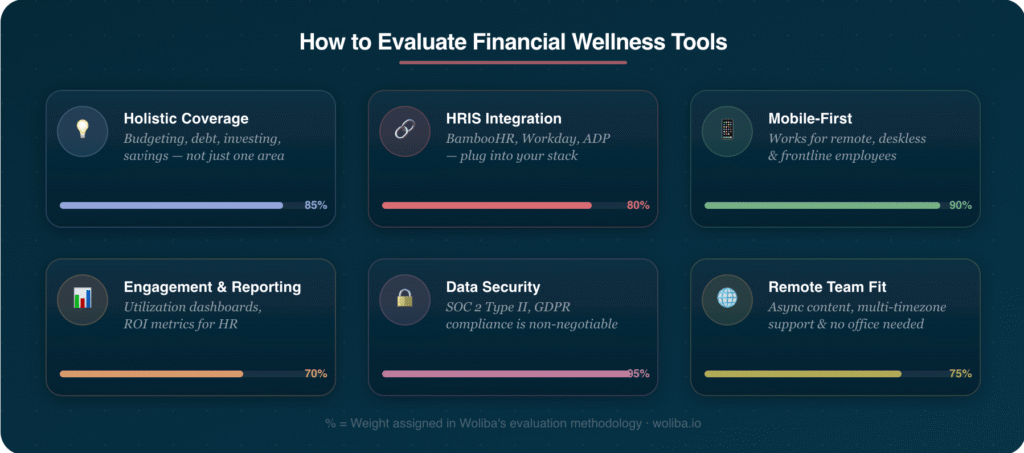
1. What’s Your Primary Employee Pain Point?
Are your employees drowning in student debt? Struggling to build emergency savings? Approaching retirement without a plan? Start with your population’s specific need, then match it to the tool’s core strength. A comprehensive platform like Woliba works across the spectrum; specialist tools like DailyPay or Candidly solve specific, acute problems.
2. Does It Integrate With Your Existing Stack?
Adoption lives or dies on integration. A financial wellness tool that requires a separate login, a different app, and manual data entry won’t get used. Prioritize platforms that connect to your HR tools, payroll, and ideally your Slack or Teams workspace.
3. How Does It Measure Employee Engagement?
If you can’t measure usage, you can’t prove ROI. Look for platforms with robust admin dashboards that surface participation rates, content consumption data, and progress toward financial goals — in aggregate form to protect employee privacy.
4. Is It Genuinely Accessible for All Employees?
Financial wellness tools should serve your frontline hourly worker as effectively as your senior engineer. That means mobile-first design, multilingual support, and content that meets employees at different financial literacy levels.
5. Does It Fit a Holistic Wellness Strategy?
The most effective employer wellness programs address the whole person. A stand-alone financial app delivers value — but a platform that connects financial health to physical, mental, and social well-being creates compound benefits. Employees who feel supported across dimensions are more engaged, more loyal, and more productive.
How we tested: Our team evaluated 30+ platforms against criteria including feature depth, ease of deployment, employee engagement data, integration flexibility, and pricing transparency. We prioritized tools that work equally well for financial wellness tools for remote teams and in-office workforces.
Quick Comparison: Best Financial Wellness Tools (2026)
| # | Tool | Best For | Rating | Pricing | Remote-Friendly |
|---|---|---|---|---|---|
| 1 | Woliba | Holistic Employee Wellness | ★★★★★ 4.9 | Check here | ✅ Yes |
| 2 | BrightPlan | Personalized Financial Planning | ★★★★☆ 4.7 | Per PEPM | ✅ Yes |
| 3 | LearnLux | Financial Education | ★★★★☆ 4.6 | Per PEPM | ✅ Yes |
| 4 | Wellable | Wellness + Financial Combo | ★★★★☆ 4.5 | Custom | ✅ Yes |
| 5 | Vantage Fit | Gamified Wellness Rewards | ★★★★☆ 4.4 | Custom | ✅ Yes |
| 6 | Payactiv | Earned Wage Access | ★★★★☆ 4.4 | Free–$5/mo | ✅ Yes |
| 7 | Advantage Club | Perks & Rewards Programs | ★★★★☆ 4.3 | Custom | ✅ Yes |
| 8 | Salary Finance | Financial Stress Relief / Loans | ★★★★☆ 4.3 | Employer-funded | ✅ Yes |
| 9 | SmartDollar | Debt & Savings Management | ★★★☆☆ 4.1 | Per PEPM | ✅ Yes |
| 10 | Origin | Comprehensive Financial Planning | ★★★☆☆ 4.0 | Per PEPM | ✅ Yes |
1. Woliba — Best for Holistic Employee Wellness
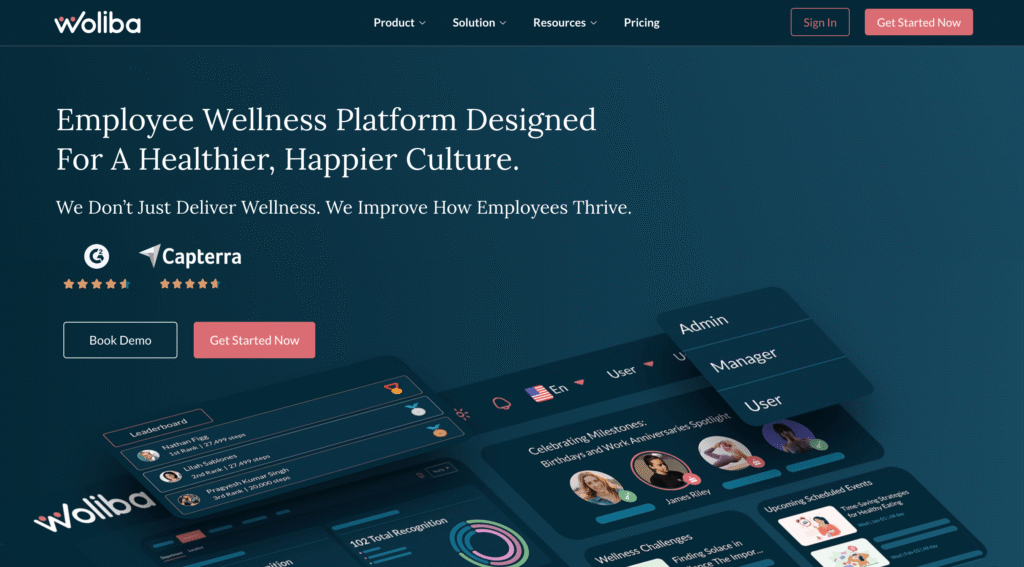
Woliba stands apart by embedding financial wellness within a complete employee wellness ecosystem — connecting financial health to physical, mental, and social well-being in one unified platform. Rather than deploying a stand-alone finance app, HR teams can offer financial wellness content, challenges, and coaching alongside fitness tracking, mental health resources, and team recognition — giving employees a single destination for their whole-person health.
For remote and distributed teams, Woliba’s asynchronous-first design means employees in any time zone can access financial education modules, track progress toward savings goals, and participate in team wellness challenges without being tied to a calendar. The admin dashboard gives HR teams real-time engagement data — so you know what’s actually being used, not just what’s been launched.
Rating – 4.9/10
Key Features
- Health risk assessments & personalized roadmaps
- Budgeting tools, savings trackers & debt paydown planners
- Curated financial education library (videos, courses, articles)
- Wellness rewards & incentive programs tied to financial goals
- Team wellness challenges — including financial literacy events
- HR analytics dashboard with utilization & engagement metrics
- HRIS integration (BambooHR, ADP, Workday, and more)
- Mobile app for iOS & Android — ideal for remote workforces
Pros and Cons
| Pros | Cons |
| All-in-one platform — no stitching together vendors | Custom pricing may require a sales call |
| Highest engagement rates in its category | Smaller companies may not need all features |
| Purpose-built for remote and hybrid teams | |
| Strong HR reporting and ROI dashboard | |
| Wellness rewards tied to financial behavior change | |
| Responsive customer success team |
Why I Picked Woliba as #1
Woliba sits at the top of this list isn’t brand familiarity. It’s that Woliba is the only platform I’ve seen genuinely solve the core problem: employees don’t engage with tools that feel like homework.
01 It’s not a financial tool with wellness bolted on
Most competitors started as fitness apps or perks platforms and added financial content as an afterthought. Woliba was built from day one to treat financial, physical, mental, and social wellness as equally important pillars — not a checklist.
02 Engagement is the product, not a feature
A financial wellness tool only works if employees use it. Woliba’s challenges, rewards, and team-based programming create intrinsic motivation to participate — which is why its engagement numbers consistently outperform point solutions at the 6-month mark.
03 Built for how modern teams actually work
Remote-first, async, mobile — Woliba doesn’t assume your employees sit at a desk 9-to-5. Whether your team is distributed across time zones or on a factory floor, the experience is the same: accessible, personal, and easy to act on.
04 HR teams actually get useful data back
Most wellness tools are black boxes for HR. Woliba’s reporting dashboard gives people teams real visibility into participation rates, financial wellness engagement trends, and program ROI — the kind of data you need to defend budget renewals.
BrightPlan
BrightPlan delivers personalized financial wellness experiences by pairing AI-driven financial planning software with on-demand access to certified financial planners (CFPs). It’s particularly strong for mid-to-large employers who want to offer real 1:1 financial guidance as a benefit — not just generic content. Employees can connect financial accounts, set goals, and get a tailored action plan within minutes.
Rating – 4.7/10
Key Features
- AI-powered financial plan builder
- On-demand CFP access via chat or video
- Goal tracking for retirement, home buying, debt payoff
- Benefits optimization (401k, FSA, HSA guidance)
Pros and Cons
| Pros | Cons |
| Real CFP access sets it apart from self-serve tools | Narrower wellness scope — primarily financial only |
| Strong benefits integration layer | Higher per-employee cost at scale |
| High employee satisfaction scores |
💰 Pricing: Per employee per month (PEPM), custom quote
LearnLux
LearnLux positions itself as a financial education-first platform with a modern, consumer-grade UX. Its strength lies in delivering bite-sized, interactive financial courses covering everything from emergency funds to equity compensation — making it particularly effective as one of the go-to financial wellness tools for remote teams where async learning is the norm. It supplements learning with access to financial planners for live guidance.
Rating – 4.6/10
Pros and Cons
| Pros | Cons |
| Best-in-class financial education content library | Limited budgeting/tracking tools compared to competitors |
| Clean, modern interface employees actually like | No broader wellness modules outside finance |
| Great for diverse & global workforces |
💰 Pricing: PEPM, tiered by company size
Wellable
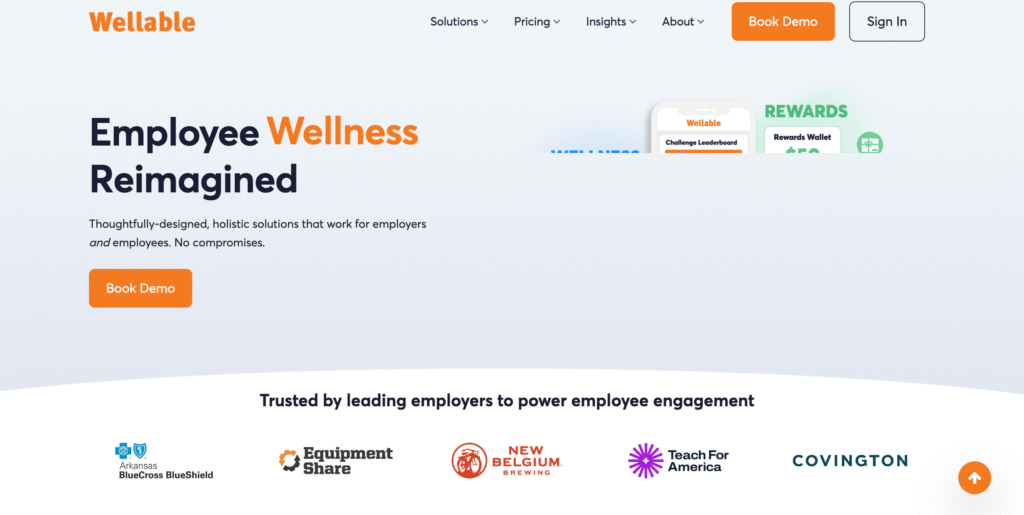
Wellable is a multi-dimensional wellness platform that includes financial wellness as part of a broader health and wellbeing ecosystem. It aggregates content from third-party financial wellness providers and delivers it through a single employee app alongside physical, social, and mental wellness programming. It’s a solid choice for employers who already use Wellable for health challenges and want to layer in financial content without switching platforms.
Rating – 4.5/10
Pros and Cons
| Pros | Cons |
| Broad wellness coverage across all pillars | Financial tools are largely third-party, not native |
| Good partner integrations ecosystem | Less deep on financial planning features |
| Wellness challenges drive engagement | Reporting UI can be complex to navigate |
💰 Pricing: varies by features selected
Vantage Fit
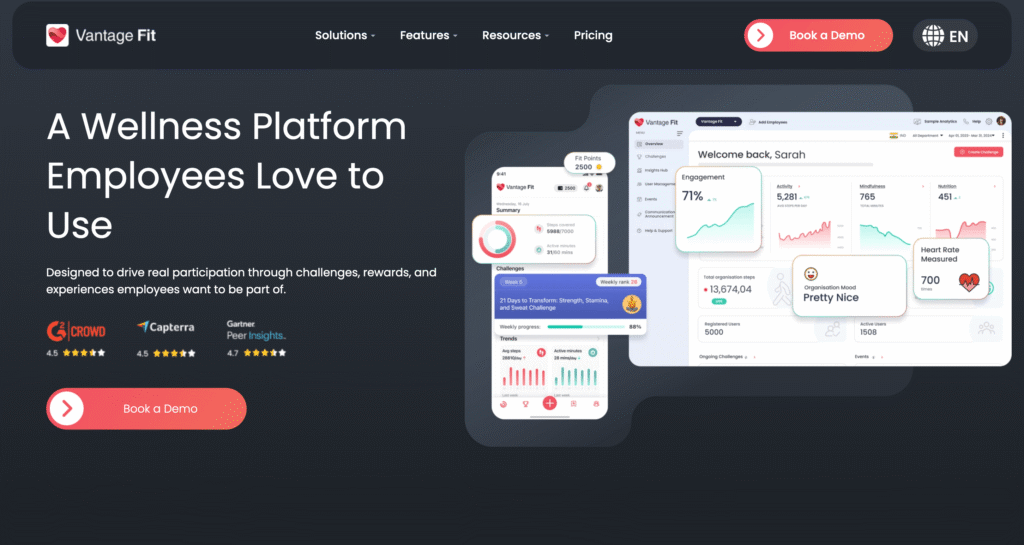
Vantage Fit is a corporate wellness app built around gamification, fitness challenges, and employee rewards. Financial wellness features exist within the platform as educational content and financial habit challenges, though this is not the platform’s core strength. Where Vantage Fit shines is in driving initial engagement through leaderboards, points, and redeemable rewards — which can be used to incentivize financial wellness behaviors indirectly.
Rating – 4.4/10
Pros and Cons
| Pros | Cons |
| Gamification boosts early employee engagement | Financial is secondary to fitness features |
| Wide range of wellness challenges including financial | Limited depth in financial planning or 1:1 guidance |
| Competitive pricing for large teams |
💰 Pricing: Custom quote
Payactiv
Payactiv is the leading earned wage access (EWA) platform, allowing employees to access a portion of their earned wages before payday. Beyond EWA, Payactiv offers financial planning tools, savings features, and a Visa card. For frontline, hourly, and gig workers, Payactiv directly addresses the paycheck-to-paycheck cycle — making it one of the most impactful employee financial wellness tools for reducing short-term financial stress.
Rating – 4.4/10
Pros and Cons
| Pros | Cons |
| Directly addresses acute financial stress | EWA-focused — limited long-term financial planning |
| No-cost option for employees (employer-funded) | Requires payroll system integration |
| Proven impact on retention for hourly workers |
💰 Pricing: Free for employees; employer-funded or $5/mo PEPM
Advantage Club
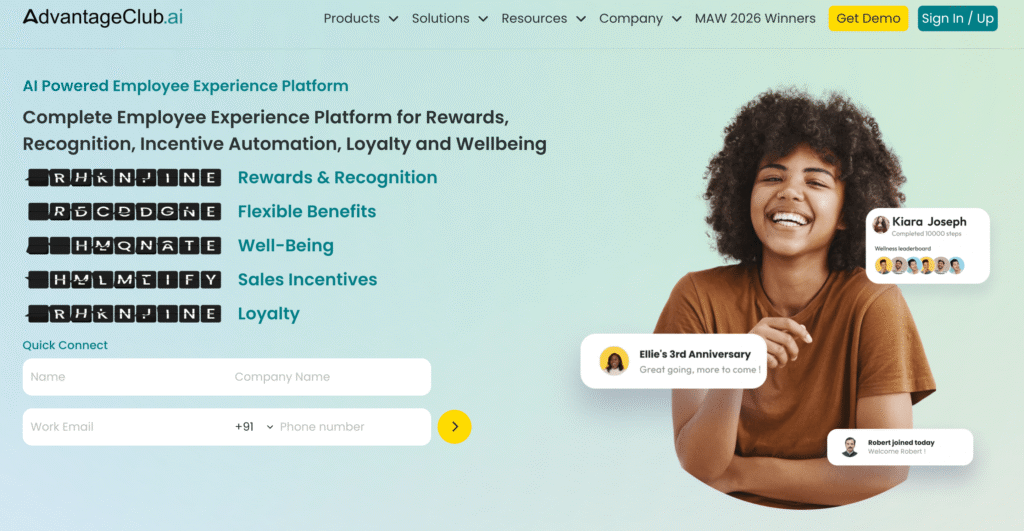
Advantage Club is an employee engagement platform focused on rewards, recognition, and perks that deliver tangible financial value to employees. Its marketplace of corporate discounts, cashback offers, and exclusive deals gives employees real savings on everyday spending. The platform also includes flexible benefits administration and some financial wellness content, though deep financial planning features are limited.
Rating – 4.3/10
Pros and Cons
| Pros | Cons |
| Extensive perks marketplace drives real employee savings | Not a comprehensive financial wellness solution |
| Good for global/multinational teams | Financial education depth is limited |
| Recognition features boost morale alongside financial perks |
💰 Pricing: Custom — contact for enterprise quote
Salary Finance
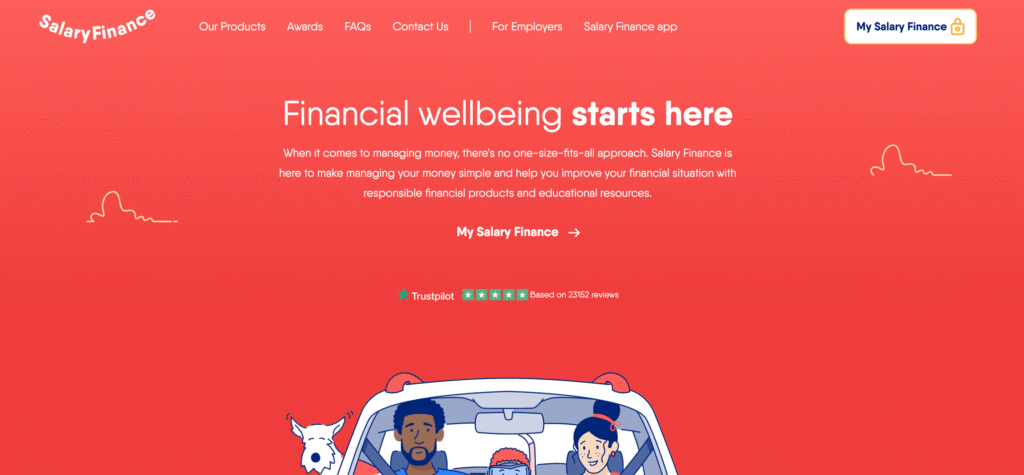
Salary Finance offers salary-linked lending and savings products that help employees escape high-interest debt cycles. By deducting repayments directly from payroll, employees get access to fair-rate credit products — a powerful benefit for financially vulnerable workers. The platform pairs lending with financial education and savings tools to address the full picture of financial stress.
Rating – 4.3/10
Pros and Cons
| Pros | Cons |
| Tackles high-interest debt — a root cause of financial stress | Lending-first model may not suit all employers |
| Payroll-linked repayment is seamless and low-default | Limited wellness programming beyond financial |
💰 Pricing: Typically employer-funded benefit
SmartDollar
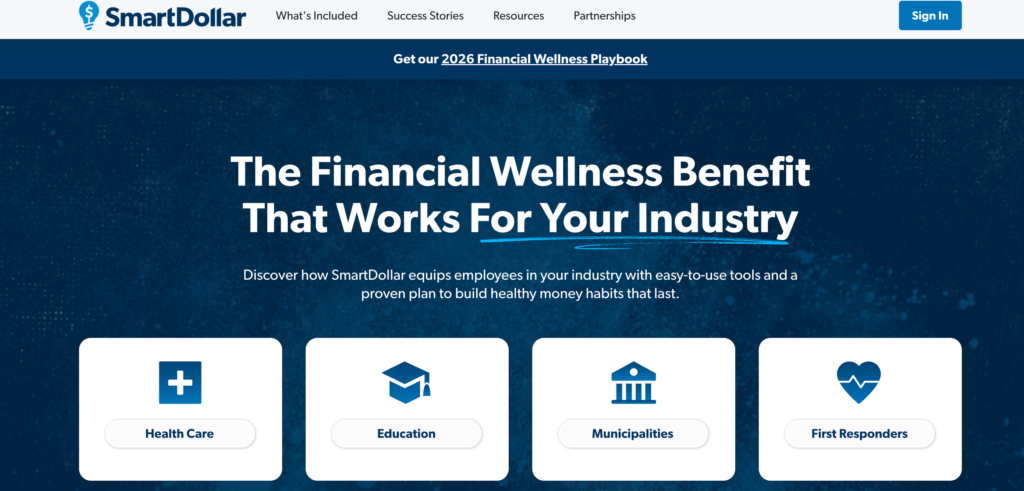
SmartDollar is a Dave Ramsey-based financial wellness platform that guides employees through a step-by-step “Baby Steps” journey — from building an emergency fund to paying off debt and investing. It’s highly structured and works well for employees who need clear, prescriptive financial guidance. Video content and interactive tools make the program engaging, though the singular methodology may feel limiting for employees with different financial philosophies.
Rating – 4.1/10
Pros and Cons
| Pros | Cons |
| Highly structured, easy-to-follow program | One-size-fits-all methodology limits personalization |
| Strong debt-paydown and savings tracking | No broader wellness integration |
💰 Pricing: PEPM; contact for group rates
Origin
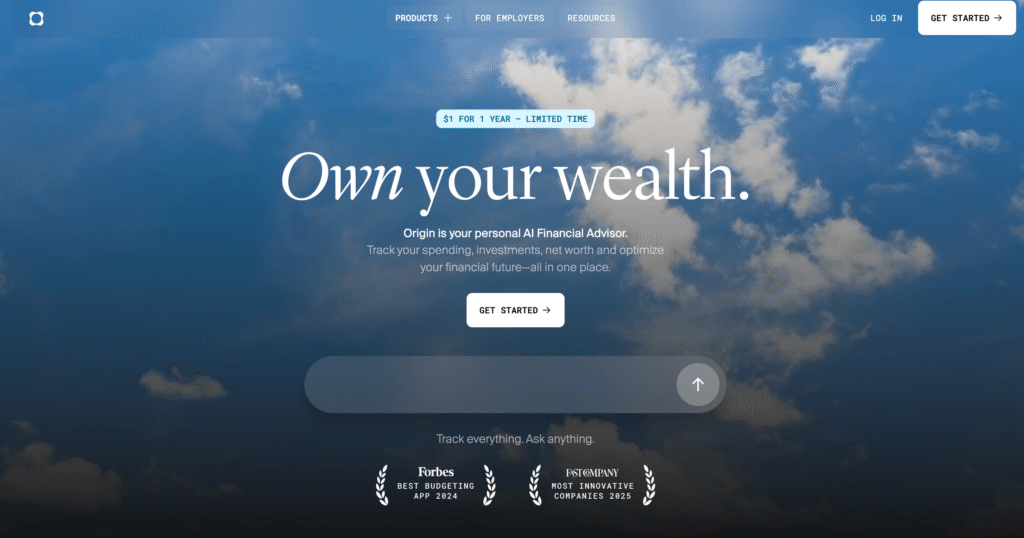
Origin is a modern financial planning platform built for the complexity of tech-sector compensation — equity, RSUs, ISOs, and startup liquidity events. It offers employees access to fiduciary financial planners alongside tools for tax optimization, investment tracking, and long-term financial planning. It’s a strong fit for software companies and startups but may be over-engineered for industries with simpler compensation structures.
Rating – 4.0/10
Pros and Cons
| Pros | Cons |
| Excellent for equity-heavy compensation plans | Overly specialized for non-tech industries |
| Fiduciary planner access builds trust | Premium pricing not suited for all budgets |
💰 Pricing: PEPM; higher tiers for planner access
Woliba in Action: Real Companies, Real Results
Choosing a financial wellness tool for employees is easier when you can see how organizations like yours have made it work. Here’s how companies across industries have used Woliba to build engagement, simplify wellness management, and create lasting cultures of wellbeing.
Alpine Intel
Turned a rewards-driven wellness strategy into company-wide engagement — demonstrating how financial incentives, when tied to meaningful wellness behaviors, drive sustained participation across teams.
“Linking financial rewards to wellness actions creates a self-reinforcing cycle of engagement — employees show up because it pays off.”
Gilsbar
Used Woliba’s analytics and recognition features to strengthen employee engagement and build a measurable culture of wellness — giving HR leaders the data visibility to justify program investment and demonstrate ROI.
“Recognition paired with real data gives HR leaders proof of impact — not just anecdotes.”
Idaho SIF
Replaced a fragmented, multi-vendor wellness setup with Woliba’s all-in-one holistic platform — cutting administrative overhead while driving measurably higher employee engagement across financial, physical, and mental wellness.
“Consolidating wellness into one platform removes friction for both HR teams and employees — and engagement follows.”
Aires
Built wellness momentum across a geographically dispersed global workforce — proving that financial and holistic wellness programs can thrive without a shared physical office, as long as the platform is built for distributed teams.
“Distance is not a barrier to wellness culture — the right platform makes geography irrelevant.”
Final Verdict: Which Financial Wellness Tool Should You Choose?
The market for financial wellness tools has matured significantly. Point solutions that only address one financial stressor — just EWA, just education, just budgeting — are increasingly being replaced by platforms that take a holistic, integrated approach. The benefits of employee wellness programs extend far beyond a single paycheck — they drive better work-life balance, stronger retention, and a healthier, more focused workforce across every dimension.
For most mid-to-large employers building a serious employee wellness program, Woliba stands out as the clear top choice. Its ability to unify financial wellness with physical, mental, and social wellness — while delivering the engagement rates, HR analytics, and remote-first features that modern workforces demand — makes it the most future-proof investment in this category.
If your needs are more specialized — EWA for frontline workers (Payactiv), equity compensation planning for tech teams (Origin), or education-first for a global workforce (LearnLux) — those point solutions are excellent within their lanes. But if you want one platform your employees will actually use, start with Woliba.