


Investing in modern corporate wellness apps is no longer just a perk for forward-thinking HR teams, it is a strategic necessity for managing healthcare costs and team burnout. Recent industry data shows that 87% of employees consider wellness offerings when choosing an employer, while organizations running structured wellness apps see an average 3:1 ROI in reduced medical claims and absenteeism. However, many traditional fitness tools struggle with long-term adoption, often seeing engagement drop off significantly after short-term step challenges end.
To build habits that actually stick, organizations are shifting toward all-in-one corporate wellness platforms that merge health tracking with daily social connection. Today’s top solutions go beyond basic activity logging by integrating real-time peer recognition, automated gift card rewards, and continuous pulse surveys into a single mobile experience. By replacing fragmented systems with a unified digital ecosystem, People Ops leaders can streamline administrative overhead, boost daily active participation, and cultivate a thriving, interconnected workforce year-round.
What are Corporate Wellness Apps?
Corporate wellness apps are digital mobile applications designed to help employers track, incentivize, and improve healthy habits across their workforce. These modern apps replace static intranet portals by delivering wearable device syncing, gamified step challenges, guided mental health tools, and real-time peer recognition directly to employees’ smartphones. By combining physical activity tracking with automated rewards and HR analytics in one easy-to-use hub, corporate wellness challenges apps turn health initiatives into a daily habit that boosts team morale and reduces healthcare costs.
List of 15 Corporate Wellness Apps in 2026 (Quick Overview)
Once you start exploring coporate wellness apps, one thing becomes clear very quickly:
There’s no shortage of options.
In fact, the challenge isn’t finding a solution—it’s figuring out which type of solution you actually need.
To help you navigate the landscape, here’s a quick look at some of the most widely used corporate wellness programs in 2026—and what they’re best known for.
| All-in-One & Apps-Based Solutions | Woliba.io – A comprehensive apps that combines wellness, engagement, surveys, and recognition into a single experience. Designed for organizations looking to centralize their entire wellbeing strategy. Personify Health – Enterprise-level companies offering personalized wellness journeys and global scalability, often used by large organizations with complex needs. Core Health – A modular apps that allows organizations to customize and integrate different wellness components at scale. |
| Fitness & Activity-Focused Tools | Vantage Fit – Known for its strong focus on fitness tracking, gamified challenges, and wearable integrations. Yumuuv – A simpler, budget-friendly option centered around activity tracking and movement-based challenges. GoJoe – Focused on step challenges and basic wellness engagement, ideal for smaller teams or straightforward programs. |
| Engagement, Rewards & Culture Apps | Advantage Club – Combines rewards, recognition, and engagement tools, making it popular among multinational teams. Limeade – Focuses on emotional wellbeing, employee experience, and culture through surveys and insights. |
| Holistic Wellness & Program-Based Solutions | Wellness 360 – Offers a multi-pillar approach to wellness with flexibility for organizations building broader strategies. Well Steps – Provides structured, guided wellness programs, often used by wellness companies just getting started. Wellright – A flexible apps that includes health risk assessments, challenges, and customizable wellness plans. Wellable – Known for its mix of challenges, educational content, and wearable integrations. FitLyfe – Data-driven wellness apps with coaching and analytics for more tailored programs. |
| Content & Experience-Driven Apps | Burnalong – Focuses on on-demand wellness classes, including fitness, mental health, and lifestyle content, making it ideal for organizations prioritizing content and inclusivity. |
1. Woliba.io
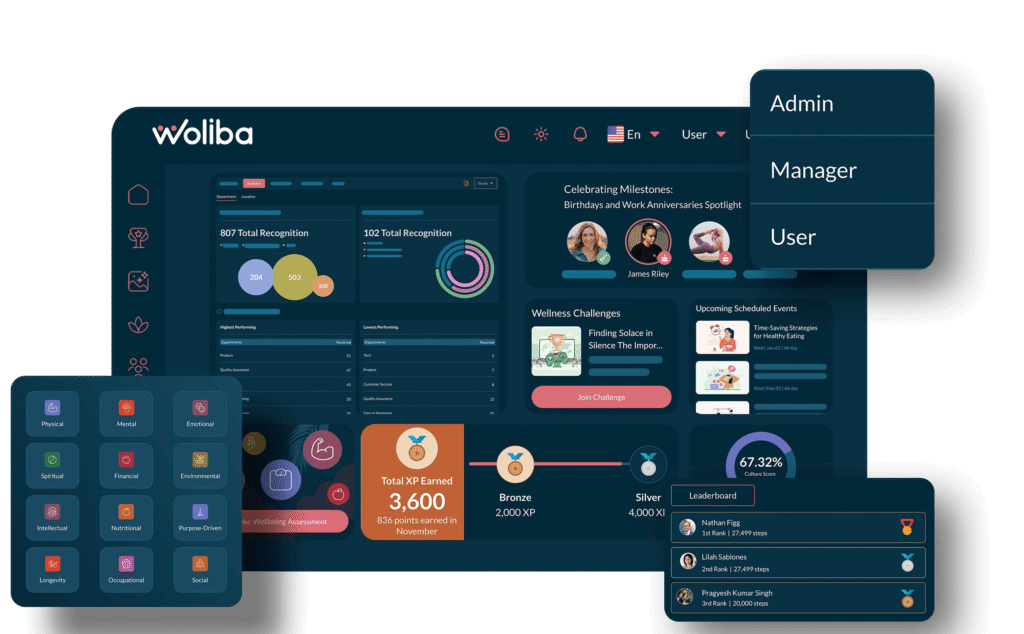
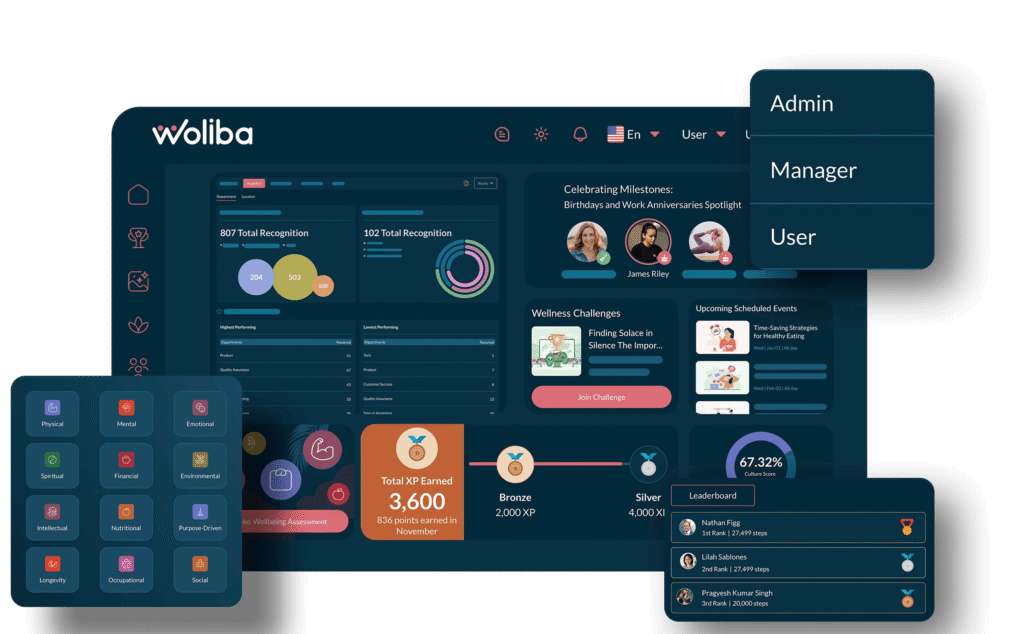
Rather than relying on separate tools for wellness, surveys, recognition, and analytics, organizations can manage all of these through a single centralized app. This makes it particularly valuable for companies looking to move away from fragmented solutions and toward a more cohesive corporate wellness strategy.
Products
- Wellness challenges (including step challenges, mental health, and nutrition)
- Employee engagement surveys and feedback tools
- Recognition and rewards system
- Learning and development content
- Health assessments and analytics dashboard
Key Features
- 300+ customizable wellness challenges across multiple wellbeing areas
- Gamification with leaderboards, rewards, and social engagement features
- Real-time analytics and participation tracking
- Mobile-first experience with wearable integrations
- Built-in recognition, surveys, and engagement tools
- HRIS integrations and single sign-on
Pros and Cons
| Pros | Cons |
| All-in-one app reduces need for multiple vendors | Pricing not fully transparent upfront |
| Strong integration of wellness and engagement tools | May require onboarding to fully utilize features |
| Highly customizable programs and challenges | — |
| Centralized reporting and analytics | — |
| Scalable for mid-size and enterprise teams | — |
Pricing: Woliba uses a flexible, usage-based pricing model designed to scale with adoption.
- Pricing is based on active users rather than total employees
- Organizations can start with core features and expand over time
- Plans typically scale across tiers (starter, growth, enterprise), with advanced analytics and automation available at higher levels
Because pricing is customized based on organization size and feature selection, exact costs are not publicly listed. However, the structure is designed to be more flexible than traditional per-employee pricing.
2. Personify Health (formerly Virgin Pulse)
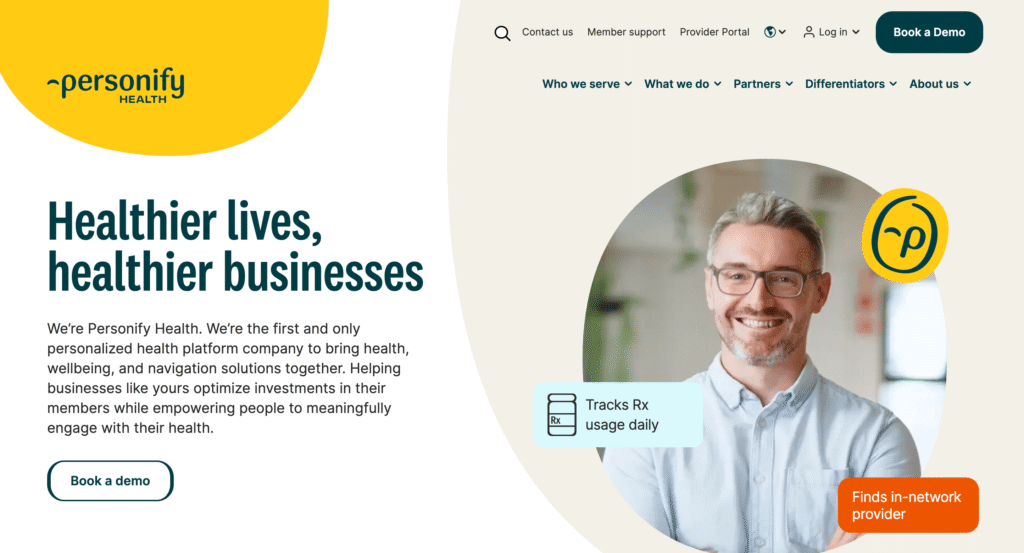
Personify Health is an enterprise-focused wellness app formed through the merger of Virgin Pulse and HealthComp. It combines personalized wellness programs with health plan integration and benefits navigation.
It is commonly used by large organizations with complex workforce and compliance needs.
Features
- Personalized wellness programs
- Health coaching and clinical integrations
- Global workforce support
- Advanced reporting and analytics
Pros and Cons
| Pros | Cons |
| Highly personalized experience | Complex implementation |
| Strong enterprise capabilities | Higher cost |
| Integrates with healthcare systems | Less flexible for smaller teams |
Pricing: Custom enterprise pricing.
3. Vantage Fit
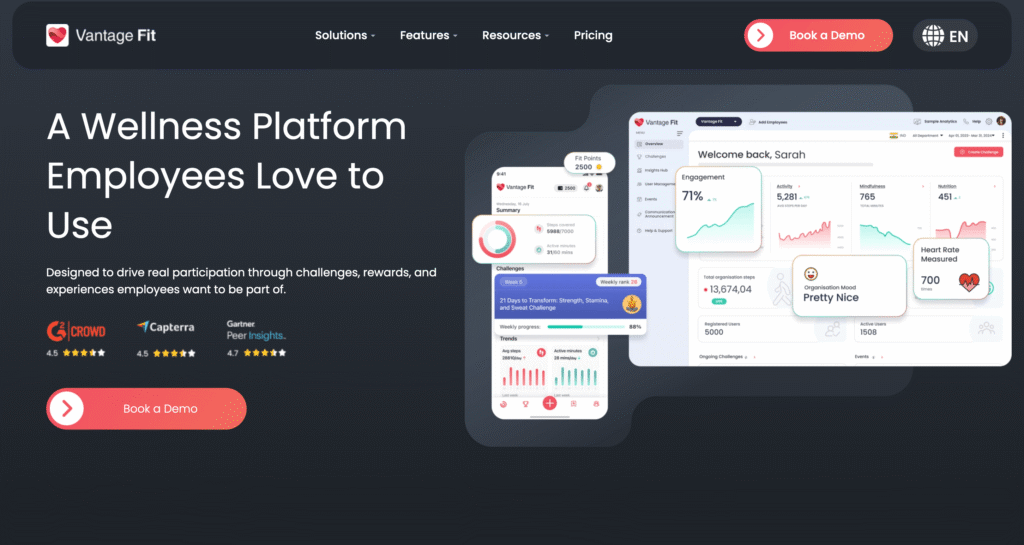
Vantage Fit is a fitness-focused wellness app designed to help individuals and organizations track, analyze, and improve overall health. It typically integrates with wearable devices to monitor activity, workouts, sleep, heart rate, and other health metrics, presenting the data through an easy-to-use dashboard.
Features
- Step challenges and activity tracking
- Wearable integrations
- Gamified leaderboards
- Health insights
Pros and Cons
| Pros | Cons |
| Strong fitness engagement features | Limited beyond physical wellness |
| Easy to launch challenges | Lacks broader engagement tools |
| Good wearable integration | — |
Pricing: Varies based on organization size; typically mid-market.
4. Advantage Club
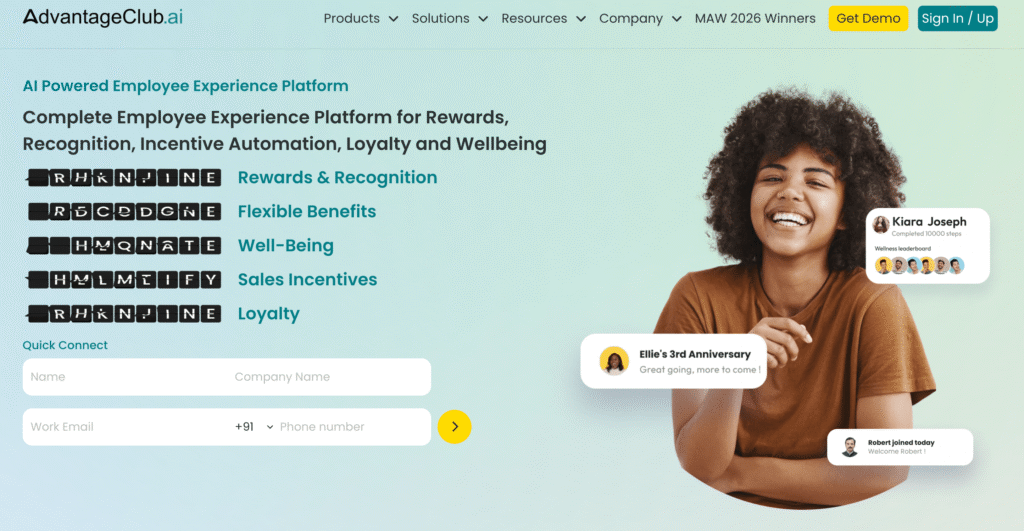
Advantage Club primarily focuses on employee engagement by offering rewards, perks, and recognition programs that help motivate and retain employees. Its core objective is to enhance workplace satisfaction and culture, while wellness initiatives such as fitness and mental well-being programs serve as a supporting, secondary component rather than the main focus.
Features
- Rewards and recognition system
- Employee perks marketplace
- Engagement campaigns
- Analytics dashboard
Pros and Cons
| Pros | Cons |
| Strong engagement and rewards capabilities | Limited wellness depth |
| Effective for multinational teams | Often requires additional tools |
| User-friendly interface | — |
Pricing: Custom pricing based on features and scale.
5. Wellness 360
Wellness 360 offers a focus on multi-dimensional wellbeing and program customization. Instead of focusing on a single aspect like fitness, Wellness 360 programs aim to create sustainable lifestyle improvements through a combination of preventive care, healthy habits, awareness, and ongoing support, often delivered through digital apps, coaching, and organizational initiatives.
Features
- Multi-pillar wellness programs
- Health risk assessments
- Challenges and campaigns
- Reporting tools
Pros and Cons
| Pros | Cons |
| Broad wellness coverage | Interface may feel dated |
| Customizable programs | Less emphasis on engagement tools |
| Scalable for larger teams | — |
Pricing: Custom pri
6. Well Steps
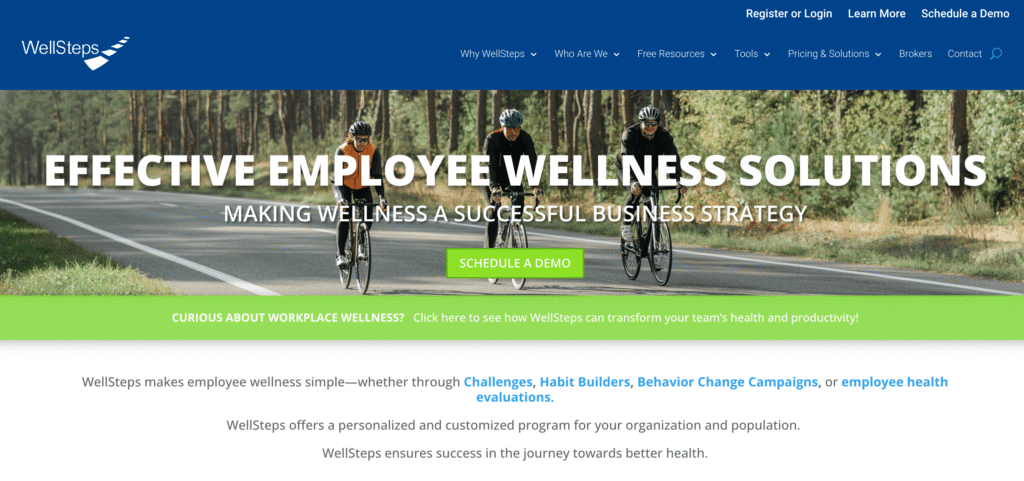
WellSteps provides structured wellness programs designed to help organizations implement guided health initiatives. These programs focus on evidence-based strategies, behavior change, and preventive care, enabling employees to adopt healthier lifestyles through clear frameworks, education, and ongoing support.
Features
- Pre-built wellness programs
- Health education content
- Habit-building tools
- Reporting dashboards
Pros and Cons
| Pros | Cons |
| Strong guided program structure | Less flexibility |
| Good for organizations new to wellness | Limited advanced features |
| Educational focus | — |
Pricing: Custom pricing.
7. Core Health
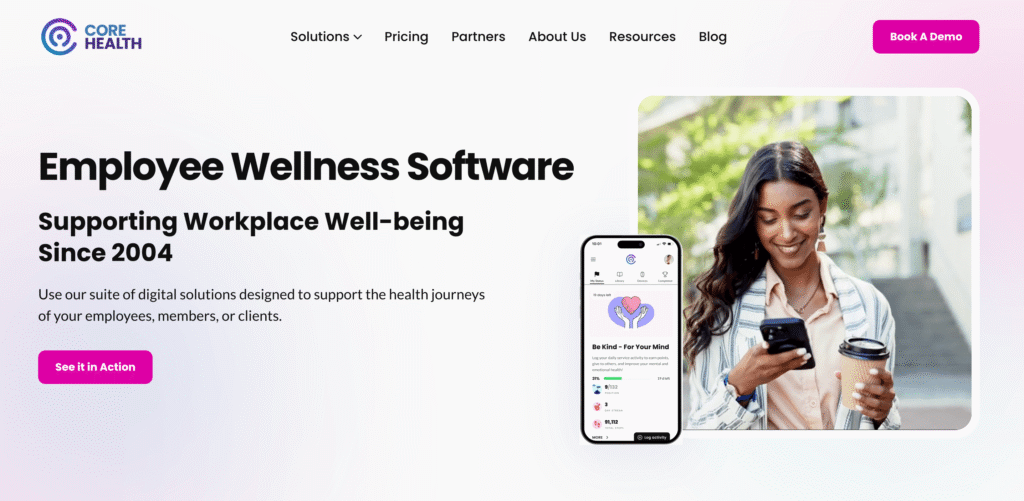
CoreHealth is a modular wellness app that allows organizations to build customized wellbeing programs using integrated components.
It supports multiple wellness dimensions such as physical, mental, and social health through customizable challenges, integrations with health tools, and data-driven insights, helping employers create flexible and engaging wellness initiatives aligned with their workforce needs.
Features
- Modular wellness tools
- Integrations with health systems
- Custom program configuration
- Analytics and reporting
Pros and Cons
| Pros | Cons |
| Highly customizable | Complex setup |
| Strong enterprise integrations | Requires internal resources |
| Flexible architecture | — |
Pricing: Enterprise-level pricing
8. Wellable
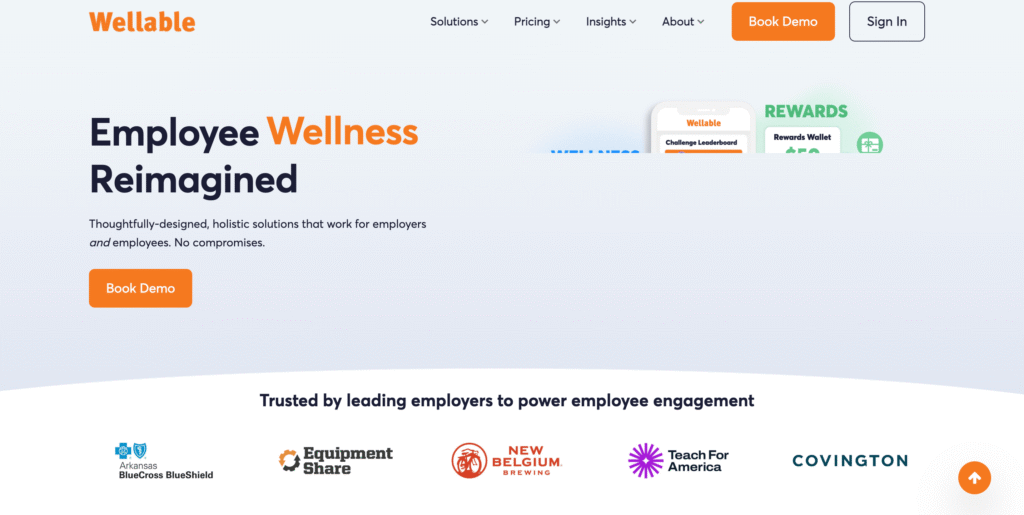
Wellable is a corporate wellness program software that helps organizations support employee well-being through flexible, customizable programs. It offers tools for physical fitness, mental health, nutrition, and engagement activities, along with wellness challenges and incentives, enabling companies to create inclusive and scalable wellbeing initiatives tailored to their workforce.
Features
- Custom wellness challenges
- Educational resources
- Wearable integrations
- Health tracking
Pros and Cons
| Pros | Cons |
| Flexible and easy to customize | Limited advanced analytics |
| Good mix of content and challenges | Less robust engagement features |
| User-friendly | — |
Pricing: Custom pricing.
9. Yumuuv
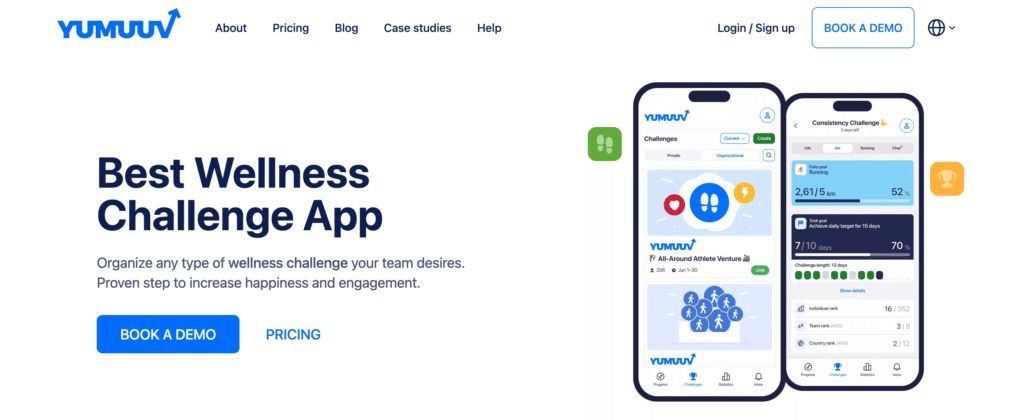
Yumuuv is a lightweight employee wellness app focused on activity tracking and movement-based engagement through team-based challenges. It encourages healthy habits by tracking everyday activities like walking, cycling, and workouts, often integrating with fitness trackers and smartphones. Yumuuv is commonly used by organizations to foster teamwork, motivational tools, and a culture of movement through simple, gamified wellness initiatives.
Features
- Step tracking and activity challenges
- Wearable integrations
- Team competitions
Pros and Cons
| Pros | Cons |
| Simple and easy to use | Limited feature set |
| Budget-friendly | Focused mainly on physical activity |
| Quick setup | — |
Pricing: Lower-cost, scalable pricing.
10. Wellright
Wellright is a corporate wellness app that enables organizations to build personalized and inclusive wellbeing programs across multiple dimensions such as physical, mental, emotional, and financial health. It provides customizable wellness programs with a strong focus on flexibility and user experience, allowing employers to tailor challenges, incentives, educational content, and health initiatives to meet diverse employee needs while supporting long-term, sustainable behavior change.
Features
- Health risk assessments
- Wellness challenges
- Custom program design
- Reporting tools
Pros and Cons
| Pros | Cons |
| Flexible program design | Interface can feel complex |
| Good customization options | Moderate learning curve |
| Scalable | — |
Pricing: Custom pricing.
11. Limeade
Limeade is an employee wellbeing and engagement app that focuses on employee experience, emotional wellbeing, and organizational culture through insights and feedback tools. It supports physical, mental, emotional, and financial wellbeing by combining personalized programs with continuous listening, surveys, and data-driven insights, helping organizations build healthier, more supportive, and people-centered workplaces.
Features
- Engagement surveys
- Emotional wellbeing tools
- Culture analytics
- Communication features
Pros and Cons
| Pros | Cons |
| Strong culture and engagement focus | Limited physical wellness tools |
| Good analytics capabilities | Often paired with other tools |
| Insight-driven approach | — |
Pricing: Custom pricing.
12. FitLyfe
FitLyfe offers a data-driven approach to wellness, combining coaching, analytics, and personalized programs. It builds on this by promoting employee health through fitness-driven and lifestyle-focused initiatives, including wellness challenges and activity tracking, to encourage healthy habits, improve engagement, and support measurable wellbeing outcomes for organizations.
Features
- Health coaching
- Wellness analytics
- Custom programs
- Tracking tools
Pros and Cons
| Pros | Cons |
| Strong analytics focus | Smaller ecosystem |
| Personalized support | Less brand recognition |
| Flexible programs | — |
Pricing: Custom pricing.
13. Burnalong
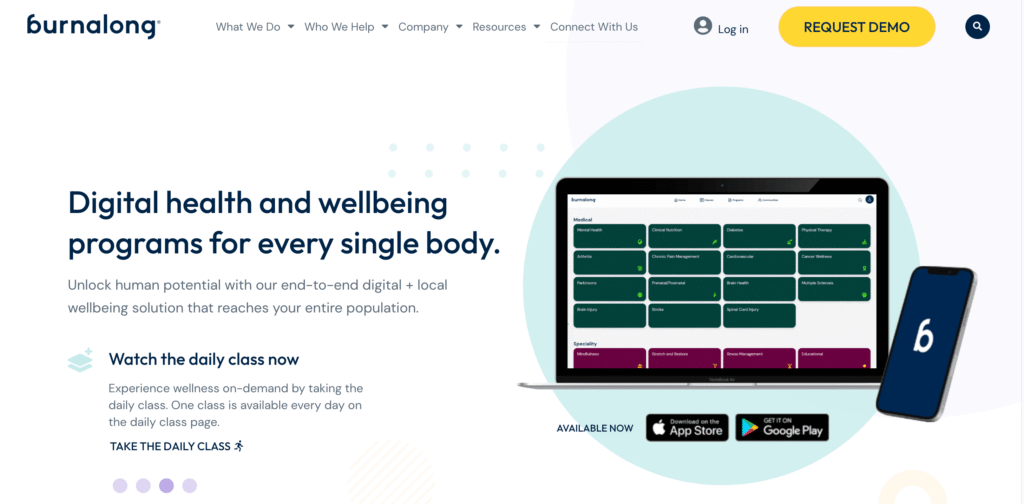
Burnalong provides on-demand wellness classes focused on fitness, mental health, and lifestyle improvement. Burnalong supports organizations by offering inclusive, accessible programs that cater to diverse employee needs and encourage holistic wellbeing through flexible, engaging experiences.
Features
- Live and on-demand classes
- Instructor-led programs
- Wellness content library
Pros and Cons
| Pros | Cons |
| Strong content offering | Not a full app |
| Inclusive class options | Limited analytics and engagement tools |
| Easy to use | — |
Pricing: Subscription-based pricing.
14. GoJoe
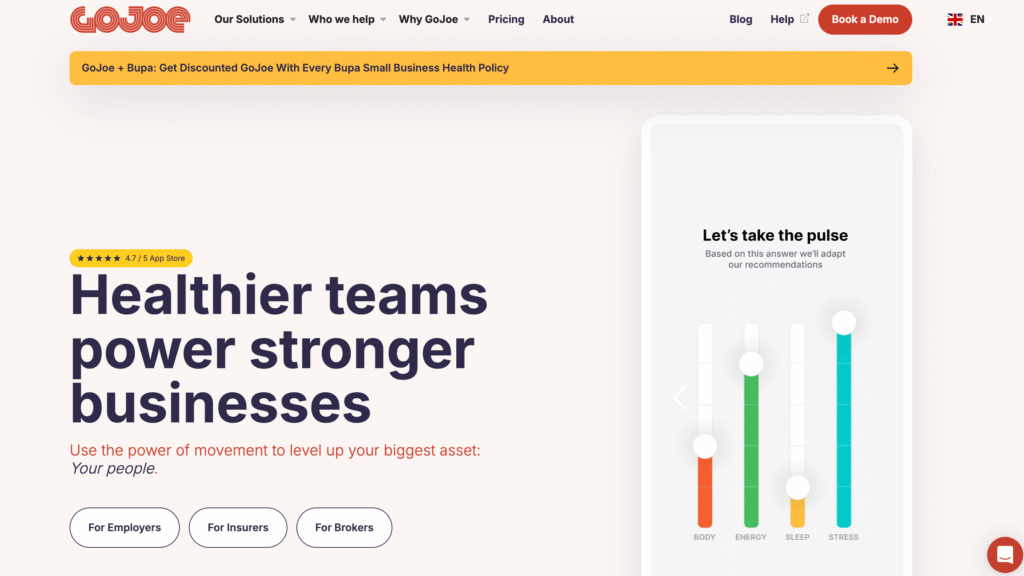
GoJoe is a social fitness and wellness app designed to motivate people through community-driven challenges and gamification. It focuses on making physical activity fun and inclusive by encouraging movement, healthy habits, and team participation, often used by organizations and communities to boost engagement, morale, and overall wellbeing.
Features
- Activity tracking
- Team competitions
- Social engagement features
Pros and Cons
| Pros | Cons |
| Strong social engagement | Limited beyond fitness |
| Simple interface | Not a full wellness app |
| Good for small teams | — |
Pricing: Flexible pricing depending on team size.
Benefits of Joining a Corporate Wellness App
By now, the shift toward app-based wellness solutions is clear. But what does that actually look like in practice?
For most organizations, the biggest change isn’t just operational—it’s experiential.
When everything is connected, wellness stops feeling like a set of disconnected initiatives and starts becoming part of how the company operates day to day.
Here are some of the biggest benefits organizations see when they move to a unified wellness app:
1. Higher Employee Engagement
One of the biggest challenges with traditional wellness programs is participation.
Employees might sign up for a new initiative, but interest often fades quickly—especially when the experience feels repetitive or disconnected from their daily work.
A unified app changes that dynamic.
With features like gamified wellness challenges, step competitions, recognition programs, and personalized experiences, employees are continuously engaged—not just during a one-time campaign.
Instead of asking employees to opt into wellness, the app makes it something they naturally interact with on an ongoing basis.
2. A Truly Centralized Experience
When wellness tools are spread across multiple apps, participation becomes friction-heavy.
Employees have to:
- Remember different logins
- Navigate different interfaces
- Jump between systems
And over time, that friction leads to drop-off.
A corporate wellness app eliminates that problem by creating a single destination for everything—from surveys and recognition to challenges and learning content.
The result is simple but powerful:
When it’s easier to access, more people actually use it.
3. Better Data and Actionable Insights
One of the most overlooked challenges in wellness programs is measurement.
When data is scattered across multiple tools, it’s difficult to answer basic questions like:
- What initiatives are driving participation?
- Where are employees disengaging?
- What’s the real impact on retention or productivity?
A unified app brings all of that data together.
HR teams gain a holistic view of employee wellbeing and engagement, making it easier to identify trends, optimize programs, and demonstrate real business impact.
Instead of guessing what works, organizations can make decisions backed by data.
4. Improved ROI and Operational Efficiency
Managing multiple vendors doesn’t just create complexity—it adds cost.
Each additional tool comes with:
- Licensing fees
- Implementation time
- Ongoing management
And often, overlapping functionality.
By consolidating these tools into a single app, organizations reduce redundancy and streamline operations.
More importantly, they shift from investing in isolated initiatives to investing in a cohesive strategy—which ultimately delivers stronger returns over time.
5. Stronger, More Connected Workplace Culture
Wellness isn’t just about physical health—it’s deeply tied to how employees feel at work.
When wellness, recognition, feedback, and engagement tools live in separate systems, culture becomes fragmented.
A unified app helps bring those elements together.
Employees can:
- Participate in wellness challenges
- Recognize peers
- Share feedback
- Engage with company initiatives
—all within the same environment.
This creates a more connected experience, where wellness is not just a program—but part of the company’s culture.
How to Choose the Right Corporate Wellness App?
Choosing a corporate wellness app isn’t just about comparing features—it’s about finding a solution that actually fits how your organization operates.
With so many tools on the market, it’s easy to get pulled into demos and feature lists. But the most successful decisions start with clarity, not software.
| Evaluation Criterion | What to Look For | Red Flag |
|---|---|---|
| Feature Breadth | Physical, mental, and nutritional wellness offered together in one unified app | Steps-only tools or solutions focused on a single wellness dimension |
| User Experience | Native mobile apps, intuitive navigation, and consumer-grade user experience | Browser-only access, clunky interface, or steep learning curve |
| Gamification | Leaderboards, wellness challenges, streaks, and real rewards to drive engagement | No social features or motivational mechanics |
| Integrations | Seamless wearable integration (Apple Watch, Fitbit, Garmin) and HRIS integration | Manual data entry required |
| Data Privacy | HIPAA compliance, SOC 2 Type II certification, and clear data ownership policies | Vague security claims with no audit documentation |
| Analytics & ROI | Real-time aggregate dashboards and clear engagement benchmarks | No reporting or metrics limited to login activity |
| Scalability | Modular features, multi-region support, and flexible licensing models | Rigid bundles or solutions designed for a single market |
| Pricing | Per-user pricing, predictable total cost of ownership, and no hidden fees | Multi-year lock-in with unclear add-on costs |
1. Start with Your Core Objective
Before looking at apps, take a step back and define what success looks like.
Are you trying to:
- Increase employee engagement?
- Improve health outcomes?
- Strengthen culture and retention?
Most apps can do a little bit of everything—but the right one should align with your primary goal, not just check every box.
2. Map the Wellness Components You Actually Need
Once your goals are clear, identify the areas of wellbeing that matter most for your workforce.
For example:
- Do you need stronger participation in physical wellness (e.g., step challenges)?
- Is mental health support a priority?
- Are engagement and recognition currently lacking?
This step helps you avoid overbuying—or worse, investing in tools that don’t address your biggest gaps.
The key is to look for a app that supports multiple dimensions of wellbeing, not just one isolated area.
3. Decide: App or Point Solutions
This is one of the most important decisions in the process.
You can:
- Piece together multiple point solutions (fitness app, survey tool, rewards app), or
- Choose a unified app that brings everything together
While point solutions can be effective individually, they often create complexity over time—multiple vendors, disconnected data, and inconsistent employee experiences.
If simplicity, scalability, and engagement are priorities, a app approach is usually the stronger long-term choice.
4. Evaluate Integrations and Ecosystem Fit
Your wellness app shouldn’t operate in a vacuum.
Make sure it integrates with:
- HRIS systems
- Communication tools (Slack, Teams, email)
- Benefits apps
Seamless integration reduces friction for both employees and administrators—and increases the likelihood of adoption.
5. Think Beyond Today: Scalability Matters
What works for your organization today might not work a year from now.
As your company grows, your needs will evolve:
- More employees
- More diverse wellbeing needs
- More complex reporting requirements
Choose a app that can scale with you—both in terms of features and user experience—so you don’t have to restart the process later.
6. Prioritize the Employee Experience
This is often overlooked, but it’s critical.
Even the most feature-rich app will fail if employees don’t use it.
Ask:
- Is the interface intuitive?
- Does it feel engaging or like another HR tool?
- Is it something employees will come back to regularly?
Adoption is what drives results—and adoption is driven by experience.
Final Thoughts
The employee wellness landscape isn’t just growing—it’s fundamentally changing.
What started as a collection of isolated initiatives has evolved into something much more strategic. Organizations are no longer asking, “Should we offer wellness programs?” They’re asking, “How do we create an experience that actually supports our people—and delivers measurable impact?”
That shift is important.
Because while point solutions still have their place, they often reflect an older way of thinking—one where wellness, engagement, and culture are treated as separate priorities. In reality, they’re deeply connected.
Employees don’t experience work in silos.
They experience it as a whole.
And when the tools designed to support them are fragmented, that experience breaks down.
This is why the move toward integrated apps is gaining momentum.
By bringing wellness, engagement, recognition, and insights into a single ecosystem, organizations are able to simplify their approach while creating something far more effective. Participation improves. Visibility increases. And wellness becomes less of a program—and more of an ongoing, embedded part of the employee experience.
At the same time, expectations are rising.
Employees want more than access to tools—they want experiences that feel intuitive, relevant, and worth coming back to. HR teams need solutions that don’t just launch successfully, but continue to drive engagement over time. And leadership is looking for clear outcomes tied to retention, productivity, and culture.
Meeting all of those expectations with disconnected systems is difficult.
That’s where app-based approaches stand out.
For organizations looking to reduce complexity, align their strategy, and create a more cohesive employee experience, integrated solutions offer a clear path forward. apps like Woliba are part of this shift—bringing together multiple dimensions of wellbeing into a scalable, unified system.
Because ultimately, the goal isn’t just to invest in wellness.
It’s to build something that works—for your employees, your teams, and your business as a whole.