


Proposals from employee engagement survey vendors are notoriously hard to compare. One vendor quotes per employee per year, another per module, a third a flat annual fee with unlimited surveys. One includes onboarding and survey design; another prices them as services. One contract runs a year, another three. Put the headline numbers side by side and you end up comparing packaging rather than cost.
The fix is to structure the evaluation before the proposals arrive: decide what you are buying, ask every vendor the same questions, and convert every quote into the same multi-year view. This guide to employee engagement survey vendors offers an RFP checklist for doing that, then compares six vendors that commonly appear on enterprise and mid-market shortlists: Woliba, CultureMonkey, Culture Amp, Workday Peakon, Quantum Workplace, Workleap Officevibe, and Lattice.
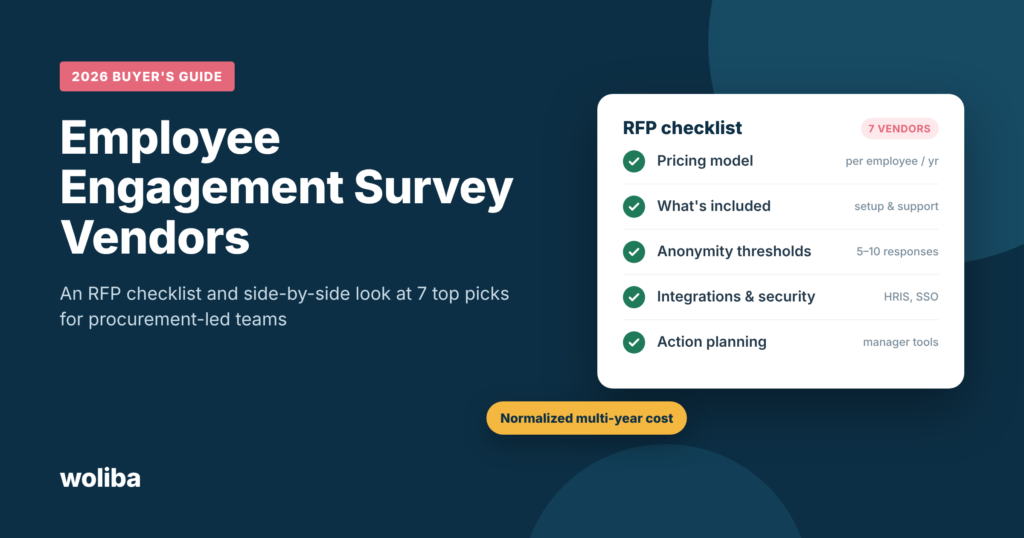
What to Evaluate in Employee Engagement Survey Vendors
- Pricing model. Per-employee, per-module, tiered, subscription, and consultative models all exist. Know which you are being offered and how it scales with headcount.
- What is included. Implementation, change management, manager enablement, internal administration, and compliance oversight are the common hidden costs. Ask which are in the price.
- Strategy fit. Anchor selection in outcomes such as attrition, manager effectiveness, and accountability, not in feature grids.
- Anonymity and data ownership. Thresholds typically sit between 5 and 10 responses per segment. Confirm who owns the data and how it is exported at exit.
- Actionability and the manager experience. A dashboard is not actionability. Look for manager recommendations, ownership, follow-up pulses, and closing the loop.
- Integrations. HRIS, SSO, collaboration tools, and BI systems.
Try Woliba free for 21 days
Run your first engagement survey before the RFP closes
Test anonymous pulse and engagement surveys, manager dashboards and action planning with your own team, so you know exactly what good looks like when vendor proposals arrive.
Start your 21-day free trial No credit card required7 Employee Engagement Survey Vendors Compared
1. Woliba
Best for: Organizations that want engagement surveys as part of a broader wellbeing, recognition, and rewards program instead of a standalone survey tool.
Overview
Woliba is an employee wellbeing, engagement, and recognition platform. It combines engagement and pulse surveys with wellness challenges, peer and manager recognition, rewards, coaching, events, and health resources in one mobile-friendly app. For procurement teams, the key difference is scope. Woliba isn’t priced as a survey tool with add-on modules. It replaces several point solutions (survey, recognition, wellness), which matters when you normalize quotes into a three-year view. It also publishes a starting per-employee rate, which few vendors on this list do.
Key Features
- Engagement and pulse surveys with customizable questions, templates, and a question library
- Wellness and activity challenges with gamification, leaderboards, and wearable integration
- Peer-to-peer and manager-to-employee recognition with a rewards catalog and gift card management
- Coaching, events, and wellness resources in the same employee portal
- Customizable branding, reporting, and access controls
- Mobile app on iOS and Android
Pricing
From $2 per employee per month. Final pricing depends on the features selected.
Pros
- Published starting rate makes early budgeting easier
- One platform can replace separate survey, recognition, and wellness vendors, reducing integration and admin costs
- Gamified challenges drive participation, which supports survey response rates
Cons
- Woliba started in wellness, so teams needing deep survey analytics or large external benchmarks may find dedicated survey platforms stronger on that dimension.
- With a broad feature set, some users say certain features take time to find.
Try Woliba free for 21 days
Want surveys, recognition and wellbeing in one contract?
Woliba bundles engagement and pulse surveys with recognition, rewards and wellness challenges, from $2 per employee per month. See how it fits your shortlist.
Start free trial No credit card required2. CultureMonkey
Best for: Enterprise organizations with global, multilingual, or frontline-distributed workforces (500+ employees, particularly in manufacturing, retail, hospitality, healthcare, and logistics).
Overview
CultureMonkey is an employee engagement survey software covering engagement, pulse, lifecycle, onboarding, and exit surveys, with manager-assigned action planning, major native HRIS integrations, AskCooper AI, and a People Science benchmark of 10M+ anonymized responses across 15+ industries and 4 global regions. For procurement teams, its proposal structure is straightforward: multilingual surveys, white-glove onboarding, people-science-backed reporting, and enterprise-grade security are included, with no hidden module layers. Implementation is a 5-week structured launch with data migration included. Delivery spans email, Slack, Teams, WhatsApp, text messages, QR codes, and kiosk mode in 100+ languages, and anonymity is configurable with admin controls and three anonymity models.
Key Features
- Engagement, pulse, lifecycle, onboarding, and exit surveys without separate module pricing
- White-glove onboarding and people-science-backed reporting included
- Manager-assigned action planning with Kanban-board tracking
- Configurable anonymity thresholds with admin controls and three anonymity models
- Multi-channel delivery: email, Slack, Teams, WhatsApp, text messages, QR codes, kiosk mode
- Major native integrations: Workday, SAP SuccessFactors, ADP, Oracle HCM, and others
Pricing
Contact sales; no published per-user rate. Aujan Group launched to 2,000 employees across 5 languages in 7 days.
Pros
- Fewer hidden cost lines to normalize in a quote comparison
- Fast implementation reduces the internal cost of rollout
- G2 4.7; SOC 2 Type II, ISO 27001, and GDPR
Cons
- Sales-led pricing; no published per-user rate, so buyers running short evaluation cycles will need to engage sales early.
- Best fit for organizations of 500+ employees; less suited to small teams under 100.
3. Culture Amp
Best for: Desk-based mid-market organizations prioritizing benchmarks.
Overview
Culture Amp offers science-backed templates, AI comment summaries, Focus Areas for managers, and a benchmark covering 1.61 billion survey questions answered. Pricing is set by employee count, product selection, and service tier, billed annually.
Key Features
- 1.61 billion-question benchmark dataset
- Templates from organizational psychologists
- AI comment summaries and Focus Areas
Pricing
Contact sales; billed annually.
Pros
- The largest benchmark dataset in this group
- G2 4.5
Cons
- Service tier affects price, so confirm what support is included when comparing quotes.
- Email-and-web delivery limits reach for frontline workforces.
4. Workday Peakon (Employee Voice)
Best for: Organizations whose HCM is Workday.
Overview
Workday Peakon offers continuous listening with native Workday HCM integration, an 11-point engagement scale, and survey questions in 65 languages. Pricing often sits within the broader Workday relationship.
Key Features
- Native Workday HCM integration
- Continuous listening on an 11-point scale
- 65 languages for survey questions
Pricing
Contact sales. Implementation typically runs 60-90 days.
Pros
- No separate integration project for Workday customers
- G2 4.6
Cons
- Value drops sharply outside the Workday ecosystem, which ties the renewal to the HCM contract.
- Custom survey design is limited.
5. Quantum Workplace
Best for: U.S. mid-market organizations wanting a clear contract floor.
Overview
Quantum Workplace runs a validated engagement model with peer benchmarks, demographic filters, and action planning with follow-through tracking. Its pricing page is unusually clear about the commitment.
Key Features
- Validated engagement model with peer benchmarks
- Demographic filters
- Action planning with follow-through tracking
Pricing
Contact sales; $15,000 minimum annual contract, base pricing by total employee count, and no implementation fee.
Pros
- A published minimum and no implementation fee simplify budgeting
- Validated methodology
Cons
- Some users report the interface is less intuitive than newer platforms.
- No WhatsApp or frontline delivery.
6. Workleap Officevibe
Best for: Smaller organizations wanting a fixed annual bundle.
Overview
Officevibe runs weekly pulse nudges in Slack or Teams with a manager-first dashboard. Pricing is sold as annual bundles rather than per user.
Key Features
- Weekly pulse nudges in Slack or Teams
- Manager-first dashboard
- Anonymous messaging
Pricing
Standard from $4,999/yr, Pro from $11,999/yr, Enterprise (250+ employees) quoted on request, billed annually.
Pros
- Fixed bundles are easy to budget
- Very fast launch
Cons
- Limited analytics depth for enterprise reporting.
- No HRIS sync for automated roster management.
7. Lattice
Best for: Mid-market teams buying engagement as one module of a people suite.
Overview
Lattice publishes a per-module rate card. The Engagement module covers pulse and engagement surveys, onboarding and exit flows, eNPS, and AI analysis, and sits beside separately priced Performance and Goals modules.
Key Features
- Engagement module with pulse, eNPS, and AI analysis
- Unified record with reviews and goals
- Integrations with BambooHR, Workday, and Rippling
Pricing
Engagement from $4/seat/mo, billed annually, with a $4,000 minimum annual agreement. Performance $10 and Goals and OKRs $8 per seat per month.
Pros
- Transparent module pricing
- G2 4.7
Cons
- Adding modules raises the effective rate, so model the full scope you expect to buy.
- No frontline or WhatsApp delivery.
Employee Engagement Survey Vendor RFP Checklist
- Contract structure. Term length, renewal caps, and exit terms, including data export at the end.
- Feature inclusion. Which survey types, languages, channels, and analytics are in the base price.
- Operational responsibility. Who designs surveys, configures permissions, and supports managers: you or the vendor.
- Scalability. How price changes as headcount grows by 20% or a new region is added.
- Strategic alignment. How the vendor proves improvement after action, not just sentiment.
- Normalization. Convert every proposal into the same three-year view with implementation and services included.
Final Thoughts
The cheapest proposal is rarely the cheapest program. Implementation, manager enablement, and internal administration often cost more over three years than the license difference between vendors, and they rarely appear on the first page of a quote.
Run the evaluation so those costs are visible. Ask every vendor the same questions, normalize every quote into one multi-year view, and score vendors on outcomes rather than feature counts. Watch for overly complex dashboards, vague answers on anonymity, heavy reliance on consultants, and missing action planning; when vendors avoid specifics, the problems usually appear after launch.
A well-run RFP narrows the field to vendors who can show how a survey turns into change, and then lets price decide among them.
Try Woliba free for 21 days
Put Woliba on your shortlist with a hands-on trial
Launch a pulse survey, review results by team and build an action plan in minutes. Score it against the RFP checklist above before you commit to a multi-year contract.
Start your 21-day free trial No credit card required