


The short version
Most workplace problems in 2026 aren’t twelve separate fires — they’re symptoms of three gaps: people feel disconnected, unsupported, or unheard. Fix the gap and the surface problems quiet down. Below are the ten most common problems managers and HR teams keep running into this year, with a simple, proven fix for each.
The workplace shifts every year, and 2026 is no different. Remote and hybrid setups are the default for most knowledge work, AI has quietly changed how teams operate, and retention has moved from an HR concern to a line on the executive scorecard.
The good news: the problems below aren’t theoretical, and none of them need a fancy new framework to solve. They need attention, a bit of structure, and — in most cases — a genuine investment in the people doing the work. Many of them trace back to a single root cause: a workforce that’s stretched thin and doesn’t feel looked after. That’s exactly where a well-run employee wellness program earns its keep.
Let’s start with the skill that prevents most problems from ever becoming disputes: spotting them early.
How to identify problems in the workplace early
Problems rarely announce themselves. They show up quietly first — in a skipped one-on-one, a dip in a team’s output, a good person who suddenly goes silent in meetings — and get loud only once someone resigns. By then it’s expensive.
The teams that stay healthy don’t have fewer problems; they just notice them sooner. Three signals are worth watching, and all three become visible when you actually measure them instead of guessing. If you want a repeatable system for this, start with how you measure and improve employee engagement.
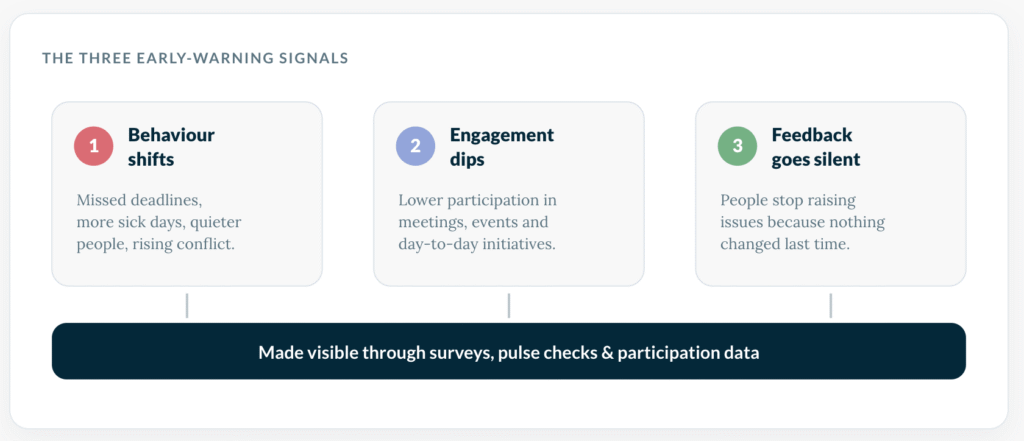
The pattern is simple: gut feel tells you something is off; data tells you what, where, and how fast it’s spreading. Anonymous surveys and pulse checks turn a vague worry into a fixable problem — and give you a baseline to prove the fix worked.
Group A · Communication & connection
When people can’t reach each other
PROBLEM 01
Communication problems in the workplace
Poor communication usually traces to one of three causes: the wrong channel for the message (decisions buried in a chat thread), missing context (people downstream don’t know why a call was made), or unspoken assumptions across time zones. Each one quietly compounds into rework and missed deadlines.
For companies expanding across borders, communication challenges can also arise when teams are hired in different countries and managed under different employment requirements. An Employer of Record can simplify international hiring and employment administration, allowing HR teams to focus on building connected, productive teams.
Only ~1 in 5 employees say their manager gives them useful feedback each week — while half of managers think they do.
How to fix it
- Match the channel to the message: quick queries in chat, decisions in a documented place everyone can find later.
- Set a light, predictable cadence — a short weekly check-in beats a flood of ad-hoc pings.
- Write down the “why” behind decisions so context travels with the work, not just the instruction.
Your best people are quietly checking out. Start turning it around — free.
Launch your first wellness challenge this week and watch engagement climb. Teams like Gilsbar went from 55% to 90% participation. See what yours can do.
Start Free TrialPROBLEM 02
Remote & hybrid disconnection
Roughly half of remote-capable employees are now hybrid to some degree — which is great for flexibility and hard on belonging. Remote staff can slowly become a second tier: out of sight in the informal moments where trust is actually built.
This is one place a shared, social layer genuinely helps. Love & Company, a fully remote-and-hybrid agency, used team challenges and a peer recognition feed to reconnect people — turning wellness into one of the few things the whole distributed team did together. If your team is spread out, structured wellness activities for remote workers give people a low-pressure reason to interact.
How to fix it
- Give remote employees the exact same access to resources, recognition programs and events as in-office staff.
- Create shared, opt-in activities (challenges, shout-outs) that don’t depend on being in the building.
- Protect a little unstructured connection time — not every interaction has to be a status update.
PROBLEM 03
Constant phone & notification distraction
Phones are the easy villain — but the problem isn’t the device, it’s the constant, unstructured pull on attention. Fighting it with bans rarely works. Redirecting it does: the same phone that fragments focus can carry a two-minute wellbeing habit that actually helps.
How to fix it
- Agree on “focus” norms as a team (no-meeting blocks, response-time expectations) instead of policing screens.
- Turn the phone into an ally — mobile-first tools meet people where they already are, in short bursts.
- Model it from the top: managers who protect their own focus give everyone permission to.
Group B · Engagement & wellbeing
When people quietly check out
PROBLEM 04
Low engagement — the “Great Detachment”
Unlike the Great Resignation, people aren’t quitting in droves this time — they’re staying and disengaging. Gallup calls it the Great Detachment: workers feel stuck, disconnected from the mission, and unsure their employer cares. That’s a slow, expensive leak.
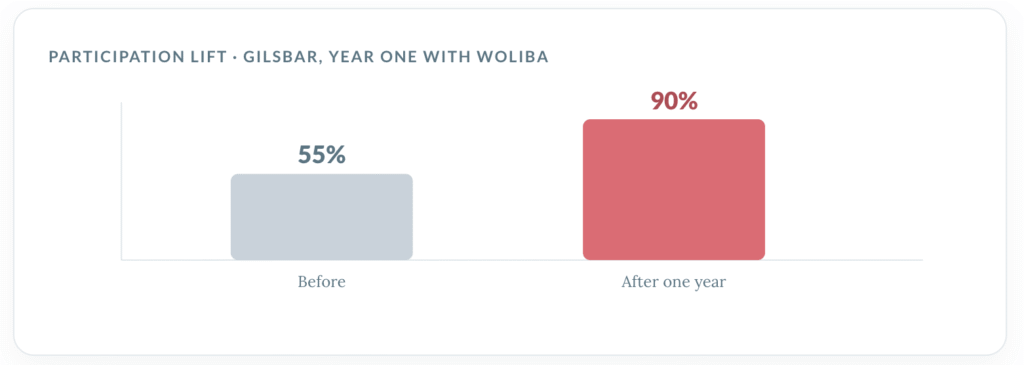
Engagement responds to consistent, visible programming far more than to one-off perks. When Gilsbar gave people a single hub for wellness and recognition, challenge participation jumped from 55% to 90% in a year. The lift below is what “consistent” looks like. For a fuller playbook, see these employee engagement strategies.
How to fix it
- Give engagement a home — one place for challenges, recognition and resources, not scattered emails.
- Make it year-round, not an annual “wellness week” nobody remembers by October.
- Connect activity to a shared team goal so effort is visible and social, not solitary.
PROBLEM 05
Employees who feel unappreciated
Recognition is one of the biggest gaps between what managers think they do and what employees actually feel. It’s also one of the cheapest fixes with the highest return — and most companies get it wrong simply by not asking people how they’d like to be recognised.
Only ~12% of employees say they’ve been asked how they prefer to be recognised. Recognition done well can unlock tens of millions in productivity at large employers.
How to fix it
- Make recognition peer-to-peer, not just top-down — a public shout-out from a colleague lands hardest.
- Ask people how they like to be recognised, then honour it. (Some want a stage; some want a quiet note.)
- Keep it frequent and visible — a live feed of appreciation beats a once-a-year award.
PROBLEM 06
Burnout & poor work-life balance
Burnout is now formally recognised by the WHO as an occupational phenomenon — not a personal failing. It’s driven by heavy workloads, tight deadlines and always-on connectivity, and it shows up as errors, disengagement and, eventually, exit. Handing someone a meditation app while their workload stays crushing is a bucket on a sinking ship.
The fix is a pairing: real structural relief (realistic deadlines, protected time) plus genuine support. That’s the difference between saying you care and building it in — a core reason to prevent employee burnout before it spreads.
How to fix it
- Fix the workload first — protected focus time and realistic deadlines beat any app on its own.
- Pair it with accessible support: mental wellbeing resources, coaching and a culture that says taking breaks is fine.
- Watch the data — rising absences and falling participation are your early burnout alarm.
Your best people are quietly checking out. Start turning it around — free.
Launch your first wellness challenge this week and watch engagement climb. Teams like Gilsbar went from 55% to 90% participation. See what yours can do.
Start Free TrialPROBLEM 07
High turnover & retention risk
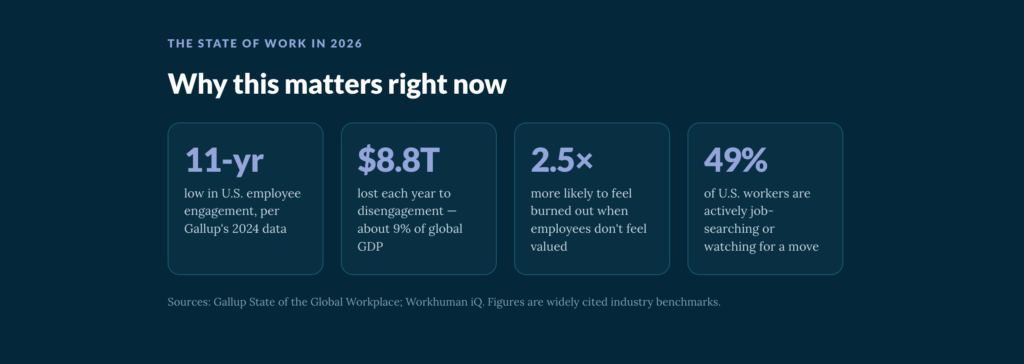
With half the workforce keeping an eye on the exit, retention is now a numbers game leadership actually watches. Every departure piles work onto whoever stays — which accelerates the next departure. And replacing people is far pricier than keeping them engaged.
This is where wellbeing stops being “nice to have” and becomes a business case. Engaged, supported employees stay longer, take fewer sick days, and cost less to insure — the heart of the ROI of an employee wellness program.
How to fix it
- Track retention, absence and engagement together — they move as a system.
- Invest in the leading indicators (engagement, recognition, wellbeing), not just the lagging one (attrition).
- Make your investment visible to staff and leadership every quarter so it survives budget season.
Group C · A changing workforce
When the workplace changes faster than the culture
PROBLEM 08
Multigenerational friction (and problems with Gen Z)
Up to five generations now share the same workplace, and the loudest debate is about Gen Z — accused of everything from wanting too much flexibility to communicating differently. Most of the “problem” is really a mismatch of expectations around feedback, growth and meaning, not a character flaw.
How to fix it
- Design for the whole range — offer challenges and activities that work for every age, ability and schedule, not just the gym crowd.
- Give younger employees the frequent feedback and clear growth paths they consistently ask for.
- Mix teams deliberately so knowledge and energy flow both ways instead of hardening into camps.
PROBLEM 09
Diversity & inclusion gaps
Inclusion problems rarely arrive as dramatic events. They show up in who gets asked to speak, whose ideas get credited, and whose calendar gets blocked for someone else’s convenience. Together, those small patterns are how a diverse team quietly stops feeling inclusive.
How to fix it
- Make the patterns visible to managers who genuinely didn’t see them happening.
- Create real channels for people to share experiences — and act on what you hear.
- Build belonging into everyday rituals (inclusive events, recognition for everyone) as part of improving your workplace culture.
PROBLEM 10
Problems with AI in the workplace
AI arrived faster than most teams could absorb it. Two problems dominate: adoption stalls because people don’t get clear direction or training, and anxiety rises because employees quietly fear for their jobs — or feel pressure to always be “on.” Left unaddressed, both erode trust.
How to fix it
- Explain the “why” and give real training — resistance is usually fear of the unknown, not stubbornness.
- Frame AI as support for people’s work, not a replacement for the people.
- Watch for the always-on creep AI can encourage, and protect genuine downtime to guard against burnout.
The thread running through all ten
Read the list again and a pattern appears: almost every problem here gets worse when people feel disconnected, unsupported or unheard — and better when they don’t. You can’t fix ten things at once, so don’t try. Pick the one that feels most urgent, measure it honestly, and run one good fix all the way through.
A modest program with 70% participation beats an ambitious one with a beautiful plan and an audience of six. The companies that treat wellbeing as core infrastructure — not an annual gesture — are the ones that see it pay off in engagement, retention and culture for years. That’s the whole idea behind a corporate wellness program that actually sticks.
Your best people are quietly checking out. Start turning it around — free.
Launch your first wellness challenge this week and watch engagement climb. Teams like Gilsbar went from 55% to 90% participation. See what yours can do.
Start Free TrialFrequently asked questions
What are the most common workplace problems in 2026?
The problems that come up most often are poor communication, remote and hybrid disconnection, low engagement (the “Great Detachment”), employees feeling unappreciated, burnout, high turnover, multigenerational and Gen Z friction, diversity and inclusion gaps, and the friction that comes with adopting AI. Most are symptoms of people feeling disconnected, unsupported or unheard.
How do you identify problems in the workplace before they escalate?
Watch three early signals: behaviour shifts (missed deadlines, more sick days, quieter people), engagement dips (falling participation in meetings, events and initiatives), and feedback going silent. All three become measurable through anonymous surveys, pulse checks and participation data — which turn a vague worry into a fixable problem.
How do you fix communication problems in the workplace?
Match the channel to the message (quick questions in chat, decisions documented where people can find them), set a predictable check-in cadence instead of ad-hoc pings, and always share the “why” behind decisions so context travels with the work. Frequent, meaningful feedback from managers is the single biggest lever.
What’s the best way to prevent employee burnout?
Fix the workload first — protected focus time and realistic deadlines matter more than any wellness app on its own. Pair that structural relief with accessible support (mental wellbeing resources, coaching, a culture that treats breaks as normal), and monitor absences and participation as early warning signs.
Can an employee wellness platform actually solve these problems?
Not on its own — culture change still needs leadership and structural fixes. But a good platform gives you the infrastructure: one place for challenges, recognition, wellbeing resources and surveys, so engagement is visible, problems surface early, and remote staff stay connected. Companies like Gilsbar and Alpine Intel used exactly this to lift participation and rebuild culture.