



Intellectual wellness is the habit of keeping your mind active, curious, and open to new ideas. It means learning new skills, thinking creatively, solving problems, and seeking out perspectives that challenge your own, both at work and in everyday life.
For employers, intellectual wellness is one of the most practical parts of a corporate wellness program. People who feel challenged and keep learning tend to stay more engaged, adapt faster to change, and see a future with the company.
This guide explains what intellectual wellness means at work, why it matters, the signs it’s slipping, and eight ways HR can help improve intellectual wellness across in-office, remote, and frontline teams.
What Intellectual Wellness Means at Work
Intellectual wellness is one of the core dimensions of wellness. In a workplace context, it’s less about formal education and more about whether people feel mentally engaged and able to grow.
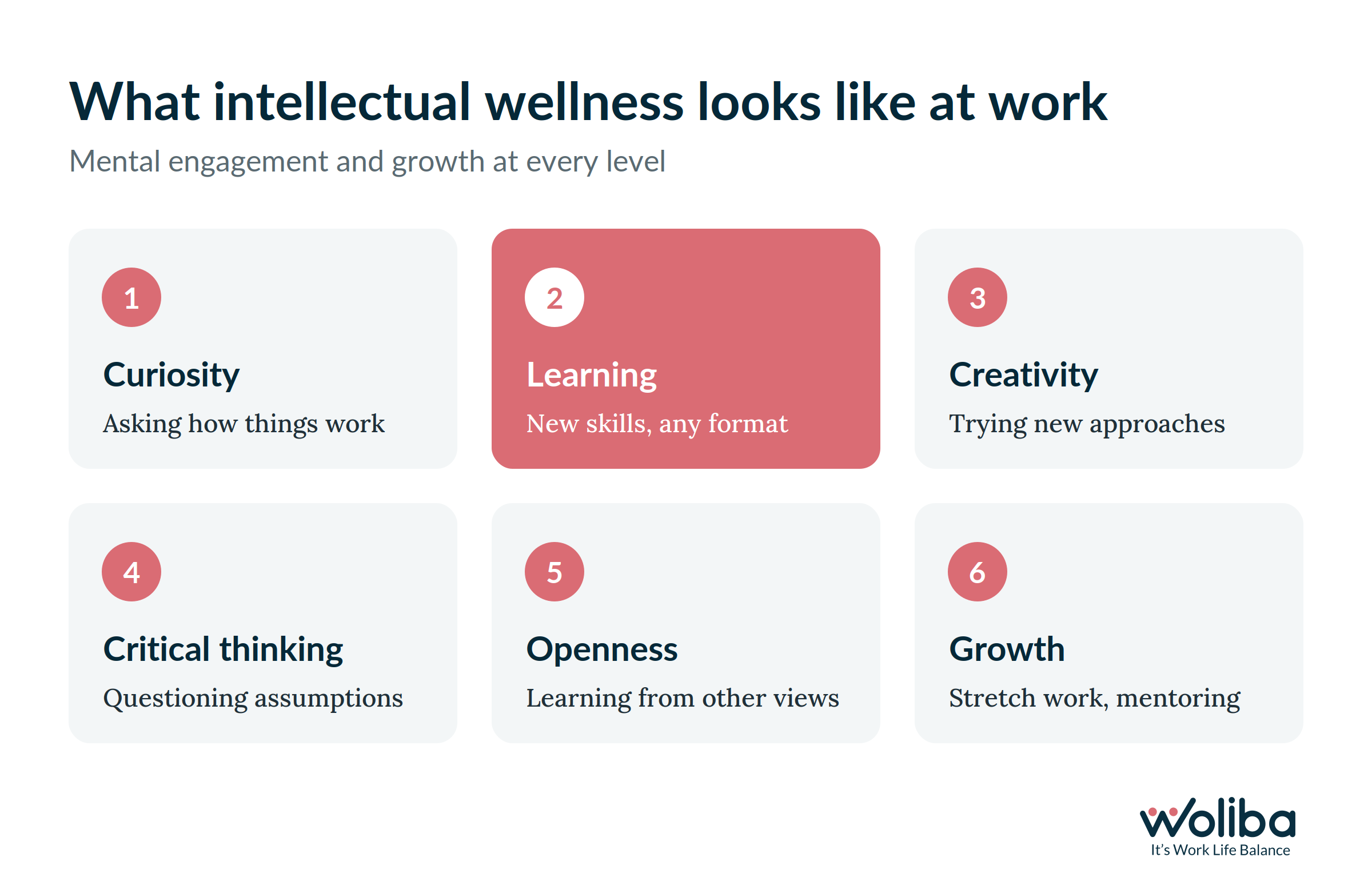
It usually shows up in five ways:
| Element | What it looks like at work |
|---|---|
| Curiosity | Asking questions, exploring new tools, and wanting to understand how things work |
| Learning | Building new skills through courses, mentoring, reading, or hands-on practice |
| Creativity | Suggesting new ideas and trying different approaches to old problems |
| Critical thinking | Weighing evidence, questioning assumptions, and making sound decisions |
| Openness | Seeking out perspectives that differ from your own and learning from them |
Intellectual wellness isn’t the same as intelligence or job title. A warehouse lead who teaches themselves a new inventory system and a marketing manager who learns data analysis are both building intellectual wellness. What matters is whether people keep stretching, at any level.
Building a learning culture is one part of a broader strategy for intellectual wellbeing at work.
Make learning part of every week
Share on-demand wellbeing content, host live sessions, and run learning challenges in one platform.
Start Your 21-Day Free TrialWhy Intellectual Wellness Matters for Employers
Learning and growth are closely tied to retention and engagement.
| Finding | Source |
|---|---|
| 88% of organizations are concerned about employee retention, and providing learning opportunities is their number one retention strategy | LinkedIn Workplace Learning Report, 2025 |
The US Surgeon General’s Framework for Workplace Mental Health and Well-Being lists opportunity for growth as one of five essentials for a healthy workplace. It points to training, mentoring, clear pathways for advancement, and feedback as practical ways employers can support it.
When intellectual wellness is low, the cost shows up quietly. People stop suggesting ideas, disengage from their work, and start looking for growth somewhere else. When it’s strong, employees bring more energy to problems and adapt more easily to new tools and processes.
Intellectual wellness also overlaps with occupational wellness. Both depend on whether work feels meaningful and offers room to grow.
Signs Intellectual Wellness Is Slipping
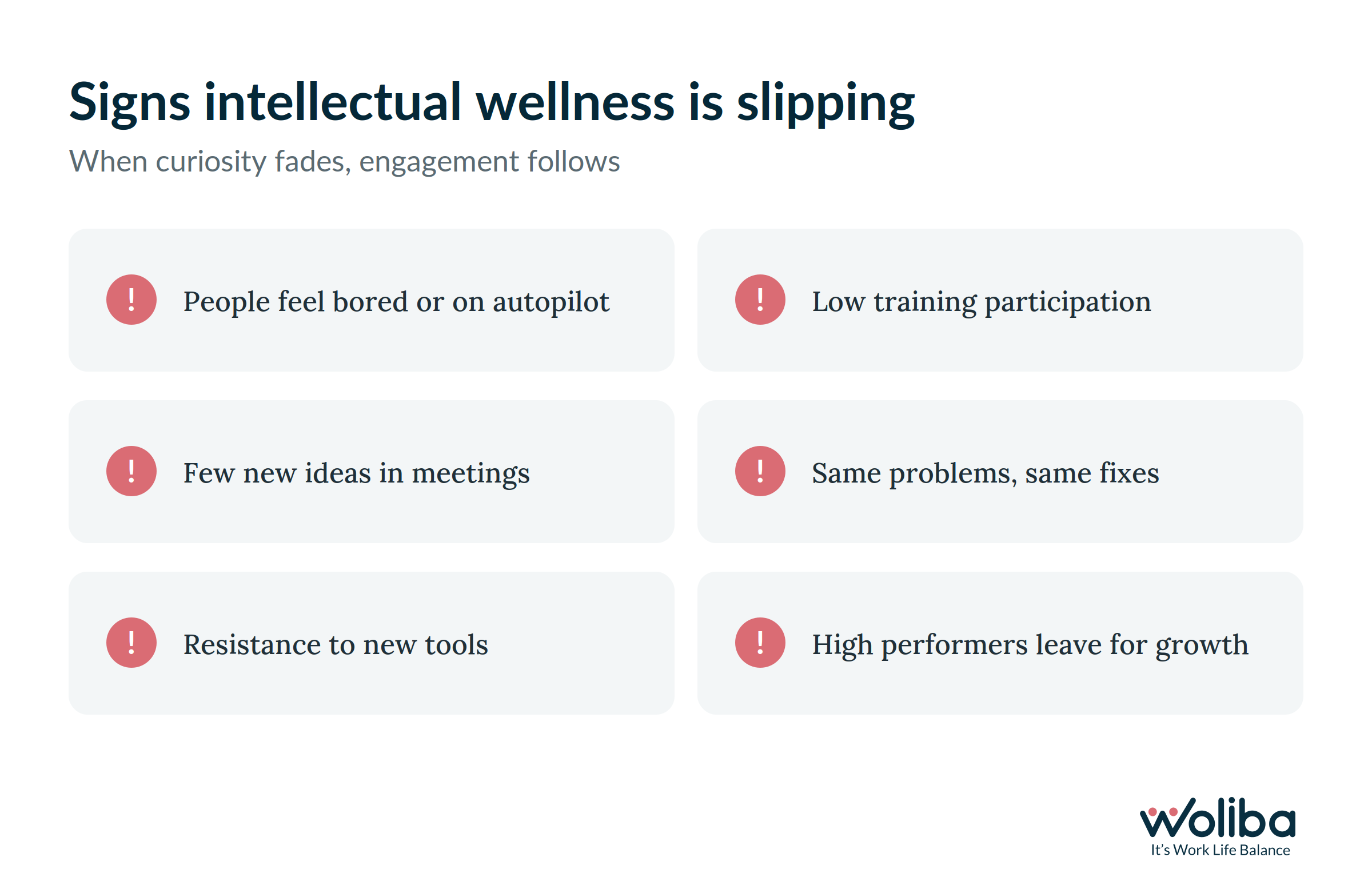
These patterns often point to low intellectual wellness on a team:
- Employees say they feel bored, stuck, or on autopilot
- Few people take part in training or learning opportunities
- New ideas rarely come up in meetings
- The same problems get solved the same way every time
- People resist new tools or processes
- High performers leave for roles with more growth
Intellectual Wellness Examples
Intellectual wellness looks different for each person. Here are examples from both sides:
| What employees do | What employers can offer |
|---|---|
| Take an online course or earn a certification | A learning budget or curated course library |
| Read books or articles on new topics | A shared reading list or book club |
| Learn from a mentor or colleague | Mentoring and reverse-mentoring programs |
| Try a stretch project | Rotations, job shadowing, and cross-team projects |
| Share ideas in meetings | Brainstorming sessions and idea channels |
| Solve puzzles, play strategy games, or learn a language | Trivia, puzzles, and learning challenges |
| Attend talks and workshops | Lunch-and-learns and expert-led sessions |

Free HR playbook
12 Dimensions of Wellness at Work
Signs each dimension needs attention, practical HR actions, challenge ideas, a scorecard, and a 90-day plan. 17 pages, free.
Thanks! Your guide is ready.
Download the PDFHow to Improve Intellectual Wellness: 8 Steps for Employers
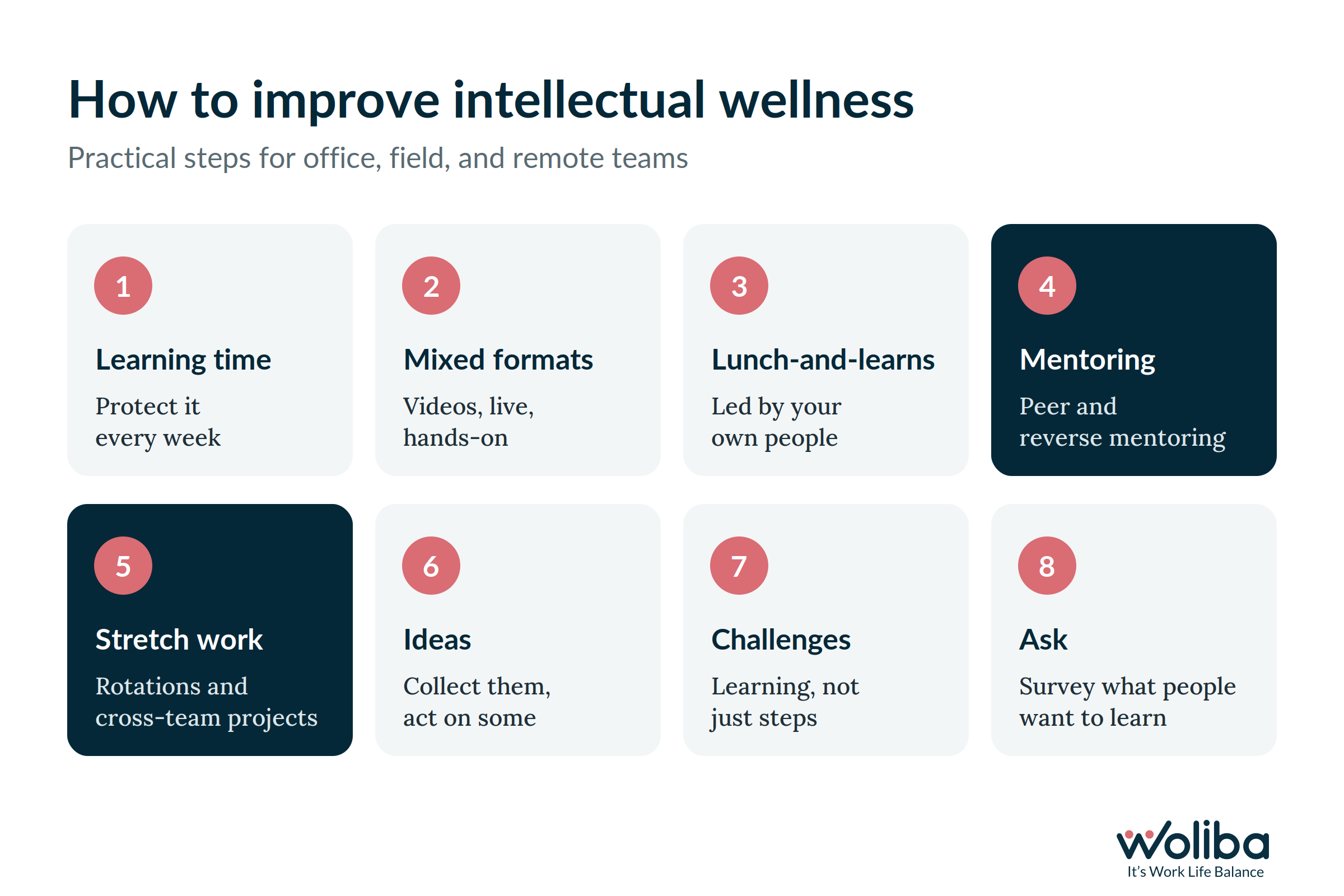
1. Make learning part of the workweek
The biggest barrier to learning is time. Protect a small block each week or month for learning, and make it clear that using it is expected, not a perk people have to justify.
2. Offer a mix of learning formats
People learn differently. Combine short on-demand videos, live sessions, articles, and hands-on projects so everyone can find a format that fits their schedule and role.
Lyon Waugh Auto Group, a multi-location dealership group, saw on-demand video views on Woliba grow from 68 in all of 2024 to 364 in just the first five months of 2026.
Abacus Technology, a desk-focused technology team, grew event attendance from 6 in 2024 to 62 in 2025 and watched 247 on-demand videos in 2025.
3. Run lunch-and-learns led by employees
Your own people are one of your best learning resources. Invite employees to teach a short session on a skill, a hobby, or a lesson from a recent project. It builds intellectual wellness for both the teacher and the audience.
4. Build mentoring and peer learning
Pair experienced employees with newer ones, and try reverse mentoring where junior employees teach senior colleagues about new tools or trends. Strong talent management keeps these relationships from depending on luck.
5. Create stretch opportunities
Rotations, cross-team projects, and job shadowing help people build skills outside their usual lane. Even a small stretch project can reignite curiosity for someone who feels stuck.
6. Encourage new ideas, and act on some of them
Set up simple ways to share ideas, like an idea channel or a quarterly brainstorm. The key is following up. When people see good ideas put into practice, they keep contributing.
7. Add learning to wellness challenges
Not every challenge needs to be physical. Learning challenges, like reading a set number of articles, finishing a short course, or learning a new skill each week, give people a fun reason to stretch their minds. Quick brain break activities also help people reset during long workdays.
8. Ask what people want to learn
A short employee pulse survey can show which skills and topics matter most to your team. Use the results to shape your learning calendar instead of guessing.
Make learning part of every week
Share on-demand wellbeing content, host live sessions, and run learning challenges in one platform.
Start Your 21-Day Free TrialIntellectual Wellness Activities for Employees
These team building activities are easy to run and work for most teams:
- Lunch-and-learn sessions on work and non-work topics
- Book or podcast clubs
- Skill-sharing sessions led by employees
- Learning challenges with points or prizes
- Puzzle, trivia, or strategy game breaks
- Language-learning groups
- Innovation or idea days
- Job shadowing in another department
- Workshops with outside experts
- Reflection prompts at the end of team meetings
How Employees Can Improve Their Own Intellectual Wellness
Employers set the conditions, but employees can build intellectual wellness on their own too:
- Set one learning goal each quarter
- Read for 15 to 20 minutes a day on any topic
- Take a short online course in a skill you’re curious about
- Ask colleagues in other teams how their work gets done
- Try a creative hobby, like music, art, or writing
- Play games that challenge your thinking, like puzzles or strategy games
- Seek out views that differ from yours and listen with an open mind
How to Measure Intellectual Wellness
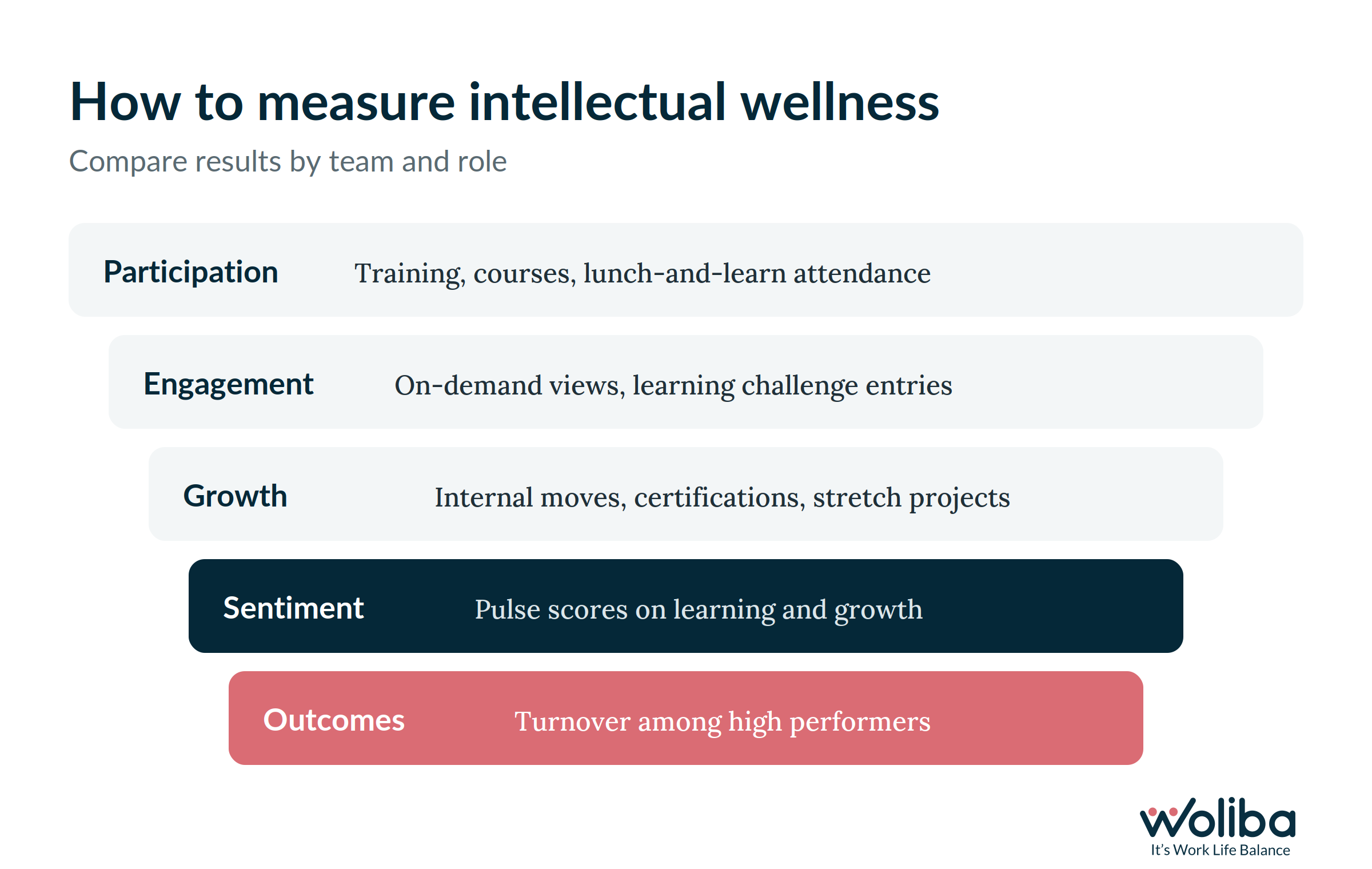
Track a mix of participation and sentiment:
| What to track | Example measures |
|---|---|
| Participation | Training enrollment, course completions, lunch-and-learn attendance |
| Engagement | On-demand content views, learning challenge entries |
| Growth | Internal moves, new certifications, stretch project participation |
| Sentiment | Pulse survey scores on learning, growth, and feeling challenged |
| Outcomes | Voluntary turnover, especially among high performers |
The same segmented approach works for broader employee wellbeing metrics. Compare results by team and role so you can see where people feel stuck.
How Intellectual Wellness Connects to Other Dimensions
Intellectual wellness supports almost every other part of wellbeing. Learning new skills strengthens occupational wellness. Sharing ideas and teaching others builds social connection. A calm, well-designed workspace supports focus, which ties it to environmental wellness. And regular movement and good sleep help people think clearly, linking it to physical wellness at work. Staying mentally engaged also supports emotional wellbeing: making progress on something new gives people a sense of accomplishment, while long stretches of boredom can wear on mood.
Keep Your Team Curious
Intellectual wellness grows when curiosity is welcomed and learning is part of the normal workweek. Start small: protect learning time, run one employee-led session, and ask your team what they want to learn next.
Over time, those small habits add up to a team that keeps growing, adapts faster, and wants to stay.
Support every dimension of wellbeing in one platform
Run challenges, host events and lunch-and-learns, share content, and track engagement by team. Try Woliba free for 21 days.
Start Your 21-Day Free Trial