

Physical wellness is the ongoing practice of caring for your body through regular movement, enough sleep, balanced nutrition, hydration, and preventive health care. It isn’t a fitness level or a number on a scale. It’s the set of daily habits that gives people the energy to do their jobs and live their lives.
For HR teams, it’s also a workforce issue. Only about one in four US adults meets federal guidelines for both aerobic and muscle-strengthening activity, according to the CDC. Nearly a third sleep less than seven hours a night. Those habits follow people to work as low energy, sick days, and health plan costs.
The hard part is that one program rarely fits everyone. A software developer, a site supervisor, and a night-shift nurse face very different physical demands and very different barriers.
This guide explains what physical wellness means in a workplace context, gives real examples for desk, field, and shift teams, and lays out eight steps HR can take to improve it. It also covers what works at different company sizes and how to measure progress.
What Physical Wellness Means in a Workplace Context
Physical wellness is one of the core dimensions of wellness, alongside emotional, social, mental, and occupational wellbeing. Most wellness models treat it as the foundation, because sleep, movement, and nutrition affect how people think, feel, and handle stress.
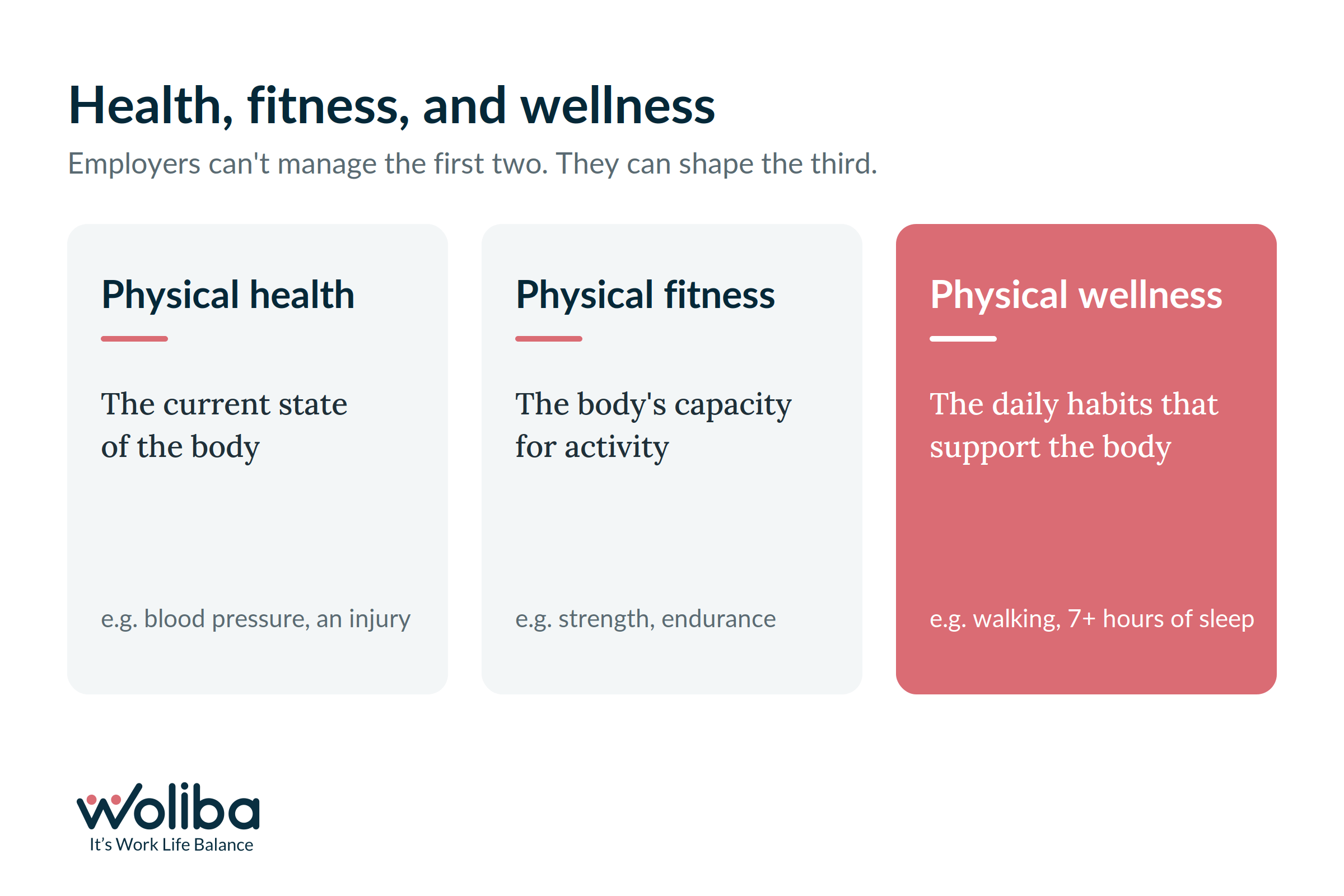
Three related terms often get used interchangeably. They mean slightly different things:
| Term | What it describes | Example |
|---|---|---|
| Physical health | The current state of the body, including any conditions or illnesses | Blood pressure, a back injury, a chronic condition |
| Physical fitness | The body’s capacity for activity | Endurance, strength, flexibility |
| Physical wellness | The habits and choices that support the body over time | Walking daily, sleeping 7+ hours, getting annual checkups |
The distinction matters for HR. Employers shouldn’t try to manage anyone’s health status or fitness level. That’s personal and, in many cases, protected information. What employers can shape is the environment where habits form: how the workday is structured, what resources people can access, and whether healthy choices are easy or hard to make at work.
Physical wellbeing is also not just about people who “like to exercise.” A warehouse associate who walks 15,000 steps a shift may still struggle with sleep or back pain. A remote analyst may hit the gym every morning and then sit for nine straight hours. A good workplace approach meets each of them where they are.
That’s why this guide treats physical wellness as a set of conditions HR can influence, not a fitness standard employees have to meet.
Make physical wellness easy to run, and easy to join
Launch step, hydration, and sleep challenges, track participation by team, and reward healthy habits in one platform. Try Woliba free for 21 days.
Start Your 21-Day Free TrialThe Core Components of Physical Wellness at Work
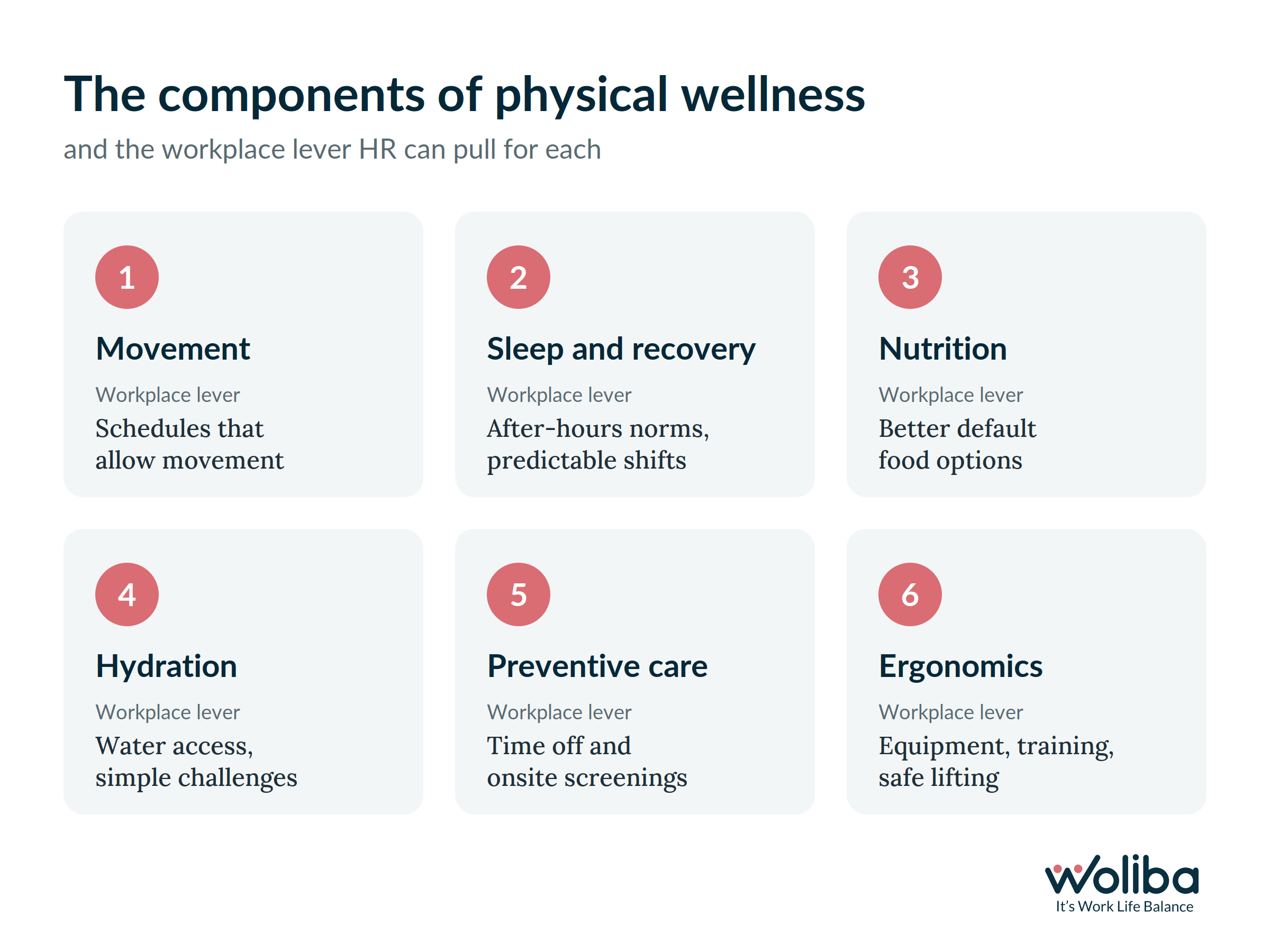
Physical wellness has six core components. Each one has a workplace lever HR can pull without crossing into anyone’s private medical decisions.
1. Movement and physical activity
The federal Physical Activity Guidelines recommend at least 150 minutes a week of moderate-intensity activity, such as brisk walking, plus muscle-strengthening activity on two or more days. Movement doesn’t need to happen in a gym. Walking meetings, stair use, and short movement breaks all count toward the total.
Workplace lever: schedules that allow movement, plus activities people can join from anywhere.
2. Sleep and recovery
Adults need at least seven hours of sleep in a 24-hour period. Workload, late-night messages, and rotating shifts are some of the biggest threats to sleep that employers directly control.
Workplace lever: after-hours communication norms, predictable scheduling, and sleep education.
3. Nutrition
Balanced eating supports steady energy through the day. At work, the food environment matters: what’s in the break room, what gets ordered for meetings, and whether people have time to eat at all.
Workplace lever: better default options, from healthy snacks for work to meeting catering.
4. Hydration
Mild dehydration can leave people tired and unfocused. It’s also one of the easiest habits to build as a group, which makes it a popular starting point for team challenges.
Workplace lever: easy water access and simple tracking hydration challenges.
5. Preventive care
Annual physicals, screenings, and vaccinations catch problems early. Many employees skip them because of time, cost, or simple procrastination.
Workplace lever: time off for appointments, onsite or virtual biometric screening events, and incentives for completing preventive steps.
6. Ergonomics and injury prevention
Posture, lifting technique, workstation setup, and repetitive motion all affect how people feel at the end of a shift. This applies to desk and field roles alike.
Workplace lever: proper desk equipment, workplace ergonomics training, and safe-lifting practices for physical roles.
Physical Wellness Examples at Work: Desk, Field, and Shift Teams
Physical wellness at work looks different depending on the job. The Bureau of Labor Statistics found that US civilian workers spent an average of 44.9% of the workday sitting and 55.1% standing in 2025. That average hides huge gaps: file clerks sat for 79.1% of the workday, while pharmacy technicians sat for just 13.6%.
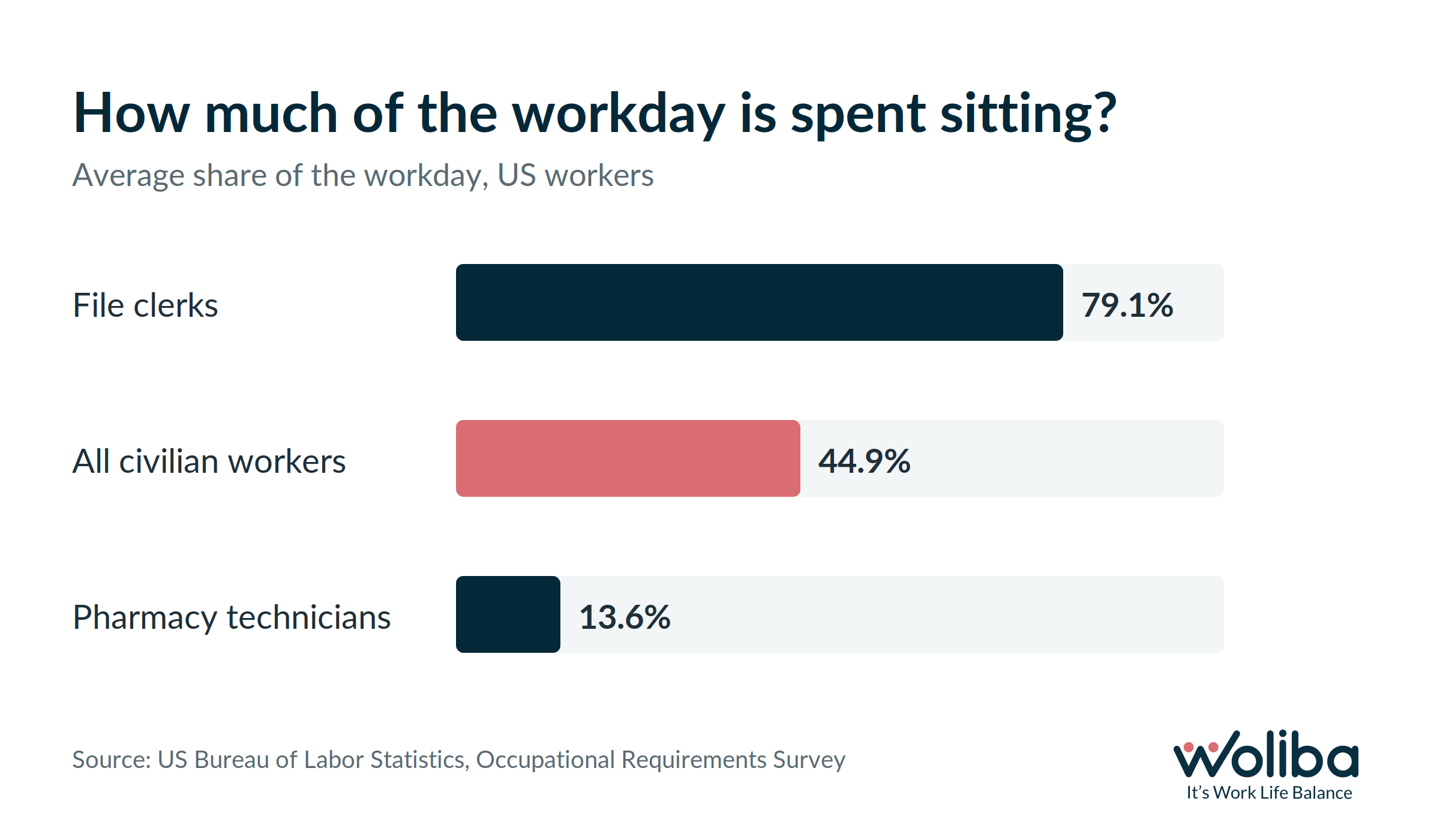
In other words, many workforces aren’t simply “too sedentary.” Some people sit too much, some stand or lift too much, and many deal with irregular hours that disrupt sleep and meals. The examples below are grouped by the main challenge each team faces.
| Workforce segment | Main physical challenge | Physical wellness examples that fit |
|---|---|---|
| Desk-based (office, hybrid, remote) | Long periods of sitting, screen fatigue, eye and neck strain | Walking 1:1s, standing breaks every hour, desk exercises, sit-stand workstations, step challenges |
| Field and frontline (construction, service, retail) | Repetitive strain, heavy lifting, long standing, heat exposure | Stretch-and-flex before shifts, hydration stations, safe-lifting refreshers, recovery and sleep education |
| Shift workers (healthcare, manufacturing, transport) | Disrupted sleep, irregular meals, limited time for appointments | Sleep hygiene resources, healthy options for night-shift meals, flexible preventive care scheduling |
| Remote employees | Isolation from group activity, blurred work-life boundaries | Virtual team challenges, work from home exercises, clear end-of-day norms |
A few examples work across almost every role:
- Team step challenges that count any kind of movement, not just steps from running
- 30-day hydration challenges where teams log daily water intake
- Sleep challenges that track consistent bedtimes rather than total hours
- Preventive care campaigns that reward annual physicals or screenings
- Movement micro-breaks of 2–5 minutes built into long meetings
The common thread is inclusivity. The best examples let a 25-year-old marathoner and a 58-year-old with knee pain both participate and feel successful.
Make physical wellness easy to run, and easy to join
Launch step, hydration, and sleep challenges, track participation by team, and reward healthy habits in one platform. Try Woliba free for 21 days.
Start Your 21-Day Free TrialWhy Physical Wellness Matters to the Business
Physical wellness affects three things every leadership team tracks: health care costs, attendance, and day-to-day energy at work. The national data shows how much room there is to improve.
| Indicator | Latest US figure | Source |
|---|---|---|
| Adults meeting both aerobic and muscle-strengthening guidelines | 24.2% (2020) | CDC, NCHS Data Brief 443 |
| Adults meeting neither guideline | 46.3% (2020) | CDC, NCHS Data Brief 443 |
| Adults sleeping less than 7 hours | 30.5% (2024) | CDC, NCHS Data Brief 559 |
| Adults living with a chronic disease | About 1 in 2 | CDC |
| Annual US health care costs associated with inadequate aerobic activity | $192 billion | CDC |
For CFOs and benefits leaders: health care costs
The CDC estimates that getting enough physical activity could prevent 1 in 12 cases of diabetes and 1 in 15 cases of heart disease. Those are among the conditions that drive employer claims. For self-funded and level-funded plans, those costs land directly on the company’s books.
A workplace program won’t erase chronic disease, and no honest vendor should promise a specific savings figure. But preventive care and everyday activity are among the few levers employers can actually influence before a claim happens.
For HR and People Ops: energy, attendance, and burnout
Sleep is the clearest example. When nearly a third of adults sleep less than seven hours, some of your team is starting most days already tired. Fatigue, poor sleep, and physical strain also overlap with employee burnout, which shows up in absences, mistakes, and turnover.
The relationship runs both ways. Heavy workloads and rigid schedules make healthy habits harder, and unhealthy habits make demanding work harder to sustain.
For CEOs: culture and retention
Visible support for physical wellness signals that leadership cares about people as people. Shared activities like team challenges also give employees across departments a reason to connect, which matters more as workforces spread across sites, shifts, and home offices.
These benefits are real but hard to isolate. A credible case for the ROI of employee wellness programs tracks participation and leading indicators first, then looks at absence, retention, and claims trends over time.
How to Improve Physical Wellness Across Your Workforce: 8 Steps
Improving physical wellness at work comes down to making healthy choices easier and more social. These eight steps work in order, but you don’t need all of them on day one.
1. Start with a baseline
Before choosing activities, find out where people are. A short health risk assessment or an anonymous employee pulse survey can show which issues matter most, whether that’s sleep, back pain, stress eating, or lack of time.
Look only at aggregated, anonymized results. HR should never see individual health data, and employees should know that before they’re asked to share anything.
2. Segment by how people work
Use the desk, field, shift, and remote groupings from earlier. A lunchtime yoga class does nothing for a night-shift team, and a step challenge may feel pointless to warehouse staff who already walk 12 miles a shift. Give each group at least one option that fits their day.
3. Build movement into the workday
The easiest activity is the one that doesn’t require extra time. Encourage walking 1:1s, end meetings five minutes early, and let people take short movement breaks without explaining themselves. For field teams, a five-minute stretch before the shift often lands better than a separate exercise program.
4. Run inclusive challenges
Challenges turn private habits into shared goals. The best ones reward consistency over intensity, count many types of activity, and offer team formats so less active employees aren’t left behind. Team totals and streak-based goals are among the most dependable workplace fitness challenge ideas for mixed-ability groups. Rotate themes through the year, from movement to hydration to sleep, so the same people don’t win every time.
5. Remove barriers to preventive care
Time is the most common barrier. Give paid time for annual physicals, bring screenings onsite or to a convenient virtual format, and remind people when preventive benefits reset. Small rewards for completing a checkup can tip procrastinators into action.
6. Protect sleep and recovery
This is the step most programs skip, and it’s the one employers influence most directly. Set norms for after-hours messages. Give shift workers schedules far enough ahead to plan sleep. Watch for teams where overtime has quietly become the default.
7. Use incentives and recognition with care
Points, rewards, and public recognition can lift participation, especially early on. Tie wellness program incentives to participation and effort rather than outcomes like weight or blood pressure. Outcome-based rewards can feel unfair and raise legal questions under wellness program rules.
8. Activate managers and wellness champions
People follow what their manager does more than what HR announces. Ask managers to join challenges and protect time for breaks. Recruit wellness champions from different departments and shifts to promote activities in their own groups, where peer influence works better than an email blast.
Make physical wellness easy to run, and easy to join
Launch step, hydration, and sleep challenges, track participation by team, and reward healthy habits in one platform. Try Woliba free for 21 days.
Start Your 21-Day Free TrialWhat Works at 50, 500, and 5,000 Employees
The right physical wellness approach depends heavily on company size. Budget matters, but admin capacity and how spread out your workforce is matter just as much. Here’s what tends to work at each stage, with examples from Woliba customers.
50–200 employees: keep it simple and social
At this size, wellness usually sits with one HR generalist who has ten other priorities. You can’t run separate programs for every group, so pick a format that works for everyone and runs on a predictable monthly rhythm. Fitness challenges are often the easiest entry point because they build on habits people already have. Planning a small business wellness program around that starting point keeps the admin load realistic.
- Lyon Waugh Auto Group (96 employees, auto dealerships across the Boston area) launched with fitness activities and challenges. Active participation grew from 55% in 2024 to 67% in 2025, then reached 99% (95 of 96 employees) from January to May 2026.
- Doran Companies (77 employees, real estate and construction in Minnesota) activated 57 of 77 employees in its first year. The team walked 71.5 million steps in 2025, and the Construction department ranked in the top three for engagement, a surprise to the admin team.
- Abacus Technology (87 employees, a desk-focused technology team in Rockville, Maryland) used fitness as the entry point. Active employees grew from 62% in 2024 to 69% in 2025, and every employee earned points from January to May 2026.
200–1,000 employees: segment and automate
Mid-sized companies often have multiple sites or shifts and a part-time wellness owner. Two things matter most here: offering options for different work patterns, and cutting the manual tracking that eats an admin’s week.
- Richardson Industries (201–500 employees, manufacturing in Wisconsin) needed a program that reached across departments and shifts. Platform participation rose from 76% to 83% by Q1 2025, and challenge participation held steady at 66–68%.
- Idaho SIF (201–500 employees, insurance) moved from a platform with no admin dashboard. Challenge participation grew from 57% in Q1 to 78%, and completed challenges rose from 121 to 357. One admin noted the reporting tools save the team 2–3 hours a week.
1,000–5,000 employees: build for a dispersed workforce
Larger organizations face field crews, multiple locations, and wide differences in fitness and interest. What works is a steady calendar of varied challenges, ways to earn points that don’t depend on physical ability, and reporting that shows results by site or department.
- E-J Electric (3,500+ employees, electrical contracting) has crews spread across job sites nationwide. Challenge participation rose from 14% to 38% as the company expanded from 3 to 25 annual campaigns and added non-physical ways to earn points, like quizzes.
- Alpine Intel (1,000–5,000 employees, insurance) grew challenge participation from 17% in Q1 2024 to 59% by Q4 2024. Its wellness admin reports saving upwards of eight hours a week on program management.
These results reflect each organization’s own program, workforce, and time period. They show what’s possible, not a guaranteed outcome.
How to Measure Physical Wellness Program Results
Measure physical wellness in layers: participation first, behavior next, business outcomes last. Expecting claims savings in the first quarter sets a program up to look like a failure when it’s actually working.
| Layer | What to track | When it moves |
|---|---|---|
| Participation | Enrollment, monthly active users, challenge entries, participation by department or shift | First 30–90 days |
| Behavior | Average activity per user, challenge completion, preventive care completions, assessment completion rates | 3–6 months |
| Experience | Pulse survey scores on energy, sleep, and whether employees feel supported | Each quarter |
| Business outcomes | Absence trends, voluntary turnover, health plan claims trends (aggregated) | 12 months or more |
A few practical tips:
- Break results down by segment. A 60% company-wide participation rate can hide a night shift at 10%.
- Compare against your own baseline, not industry averages. Your first assessment or survey is the benchmark that matters.
- Report participation honestly. Count active users, not just sign-ups.
- Keep health data aggregated. Report trends only for groups large enough that no individual can be identified.
If you run challenges, set goals for each one before it launches. That makes it much easier to measure the success of wellness challenges and decide which ones to repeat.
How Physical Wellness Connects to the Other Dimensions of Wellness
Physical wellness rarely moves on its own. It’s tied closely to how people feel, think, and connect, which is why programs that only count steps tend to plateau.
- Emotional and mental wellbeing: sleep and regular activity are linked with better mood and stress management. Physical activity is also a common, low-stigma first step into broader emotional wellness and mental wellness support.
- Social wellbeing: team challenges and walking groups create easy, low-pressure reasons for coworkers to connect. That’s especially useful for remote and multi-site teams, where social wellness often suffers first.
- Nutritional wellbeing: energy for movement depends on what and when people eat. Shift workers and field crews in particular need practical nutritional wellness support, not generic diet tips.
- Occupational wellness: workload, schedule control, and job design shape whether healthy habits are even possible. Strong occupational wellness makes every physical wellness effort easier.
For HR, the takeaway is to treat physical wellness as an entry point into a broader program, not a standalone perk. Clear movement, sleep, and nutrition policies are what turn physical wellness at work into a long-term strategy rather than a one-off campaign.
Frequently Asked Questions About Physical Wellness
What are some examples of physical wellness?
Common examples include walking daily, getting at least seven hours of sleep, drinking enough water, eating balanced meals, stretching, and keeping up with annual checkups. At work, examples include walking meetings, movement breaks, ergonomic workstations, team step challenges, and onsite health screenings.
What are the 7 types of wellness?
Models vary, but a common seven-part version includes physical, emotional, social, intellectual, spiritual, environmental, and occupational wellness. Some frameworks add financial wellness or break the categories down further. Physical wellness is usually treated as the foundation because it affects energy for everything else.
What are the healthiest habits to follow daily?
For most adults, the core daily habits are moving regularly, sleeping seven or more hours, staying hydrated, eating mostly whole foods, and breaking up long periods of sitting. Small daily habits are also easier to sustain than occasional bursts of hard exercise.
What are simple ways to take care of your body during the workday?
Stand or walk for a few minutes every hour, set up your workstation so your screen is at eye level, keep water at your desk, take a real lunch break, stretch before physical tasks, and log off at a consistent time. For shift workers, protecting a regular sleep window is one of the most valuable habits.
Why is physical wellness important for employers?
Physical wellness affects energy, attendance, and health care costs. According to the CDC, about one in two US adults lives with a chronic disease, and inadequate aerobic activity is associated with $192 billion in annual health care costs. Supporting healthy habits is one of the few ways employers can influence those trends before a health issue becomes a claim.
How can employers support physical wellness?
Start with a baseline survey, then offer options that fit how different teams work. Effective steps include building movement into the workday, running inclusive challenges, removing barriers to preventive care, protecting sleep with reasonable scheduling, and recruiting managers and wellness champions to lead by example.
Build Physical Wellness Into How Your Team Works
Physical wellness isn’t something HR can hand to employees in a brochure. It grows out of the workday itself: whether people have time to move, whether schedules allow real sleep, and whether preventive care is easy to fit in.
The practical path is to start small. Get a baseline, pick one activity that fits each major part of your workforce, and measure participation before expecting bigger outcomes. If you’re building a program from scratch, the same principles apply to how to start a corporate wellness program more broadly.
The companies that see the strongest participation make physical wellness social, inclusive, and easy to run. That’s exactly what a good platform should take off HR’s plate.
Make physical wellness easy to run, and easy to join
Launch step, hydration, and sleep challenges, track participation by team, and reward healthy habits in one platform. Try Woliba free for 21 days.
Start Your 21-Day Free Trial