

Flexibility is the most in-demand workplace perk of 2025 — and microshifting is the trend at the center of that conversation. Some HR experts champion it as a smarter, more human way to work. Others warn that without the right guardrails, it quietly turns into an always-on workday with no real end. So which is it? The honest answer is both — and it depends entirely on how HR chooses to implement it.
What Is Microshifting?
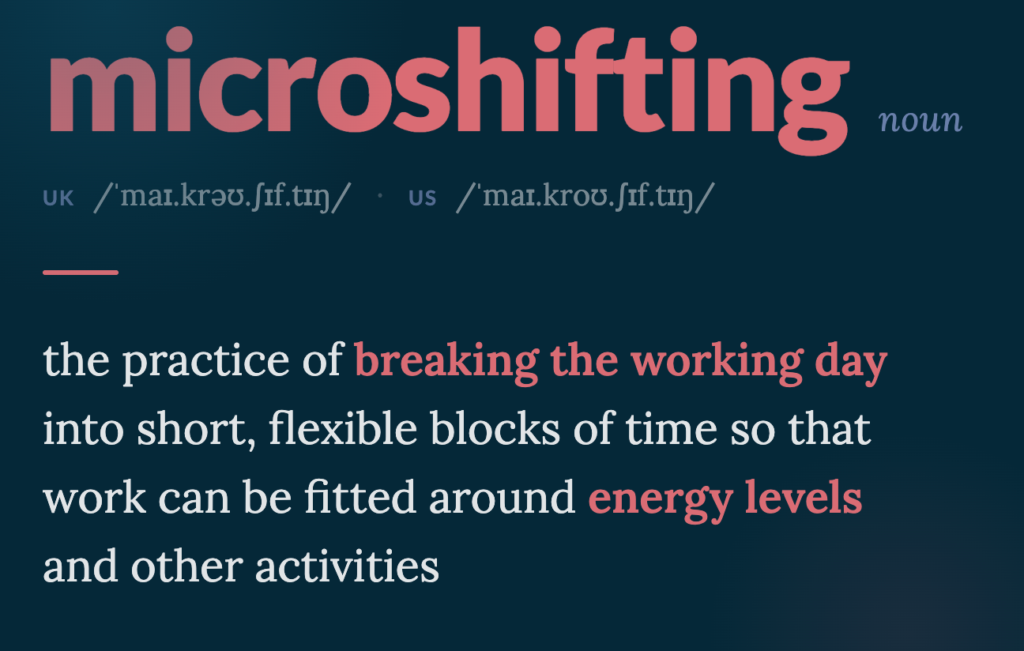
Microshifting is the practice of breaking the workday into flexible, self-directed blocks — working in short, high-focus bursts at the times when you’re most productive, rather than grinding through a fixed eight-hour window regardless of your energy levels.
Instead of waiting for the “right time” to focus, microshifters tackle high-priority tasks in the windows where they naturally have the most mental energy — whether that’s 7am before the kids wake up, a focused 90 minutes between two afternoon meetings, or a final push at 9pm when the house is quiet.
Inc describes it as managers encouraging workers to “tackle tasks in short bursts, whenever and wherever possible” instead of forcing productivity into a rigid schedule that doesn’t match how human attention actually works.
“Microshifting is a great way for employees to balance their personal responsibilities alongside work. Let your manager and team know when you’ll be available so everyone can plan around your schedule. Using a shared calendar to log your working hours and breaks can help keep things running smoothly.”
— Peter Duris, CEO & Co-founder, Kickresume
It’s worth noting: microshifting isn’t a brand new concept. Microsoft researchers documented this shift as far back as 2022 — calling it the “triple-peak day.” Workers were most active before lunch, after lunch, and then again in a third surge around 9–10pm. Owl Labs would call that microshifting in action. The behavior was already happening. The question is whether organizations choose to acknowledge and support it — or ignore it and lose the productivity and trust gains that come with doing so.
How Microshifting Differs from Remote Work
Microshifting is often confused with remote work — but they’re not the same thing. Remote work answers the question of where you work. Microshifting answers the question of when. An employee can microshift entirely from an office desk — choosing their most focused hours for deep work and using the rest for meetings and collaboration. Location is irrelevant. What changes is the employee’s control over their own schedule.
Microshifting vs. RTO Mandates
There’s a quiet irony in the fact that microshifting is gaining traction at the exact same time many organizations are doubling down on Return to Office requirements. RTO mandates and microshifting represent two fundamentally different philosophies about people: one says “we need to see you working,” the other says “we trust you to deliver.” When employees are given genuine scheduling autonomy, they feel respected — and that sense of being valued is one of the strongest drivers of engagement and retention that HR has access to.
The Connection to Task Masking
One behavior that microshifting directly addresses is task masking — a pattern where employees perform busyness rather than actual productivity. They keep unnecessary tabs open, respond to low-priority messages immediately, and make sure to always look occupied — not because they have work to do in that moment, but because they’re afraid of what “not looking busy” might signal to management.
Task masking is a symptom of a low-trust environment. When employees know their manager will judge them on output rather than optics, the performance of busyness becomes pointless. A microshifting culture — built on autonomy, clear expectations, and results-based accountability — removes the anxiety that makes task masking feel necessary in the first place.
| Dimension | Traditional Work Model | Microshifting Model |
|---|---|---|
| Schedule | Fixed 9–5, uniform | Flexible, energy-based blocks |
| Focus type | Slow and steady across hours | Short, high-intensity bursts |
| Location | Office-first | Office or remote — either works |
| Trust level | Presence = productivity | Output = productivity |
| Employee autonomy | Low | High |
| Manager style | Supervision-based | Outcome-based |
The Science Behind Why It Works
Neuroplasticity
Repeated focused bursts physically reshape neural pathways, making deep work progressively more natural and automatic over time.
Dopamine Loop
Completing a focused micro-task releases dopamine — a reward signal that motivates the next action and builds positive work momentum.
Cognitive Energy
Working at peak energy times conserves willpower. Low-energy periods are reserved for lighter tasks — preserving mental fuel for high-stakes work.
Ultradian Rhythms
The brain naturally cycles through 90–120 minute focus windows followed by rest. Microshifting works with these rhythms rather than against them.
Why Organizations Need to Take Microshifting Seriously
Microshifting isn’t just a trendy employee perk. It’s a strategic response to how modern work has actually evolved — and organizations that ignore it risk losing productivity, trust, and top talent to companies that don’t.
Employee Expectations Have Fundamentally Shifted
Gen-Z and Millennial workers increasingly prioritize work-life balance over salary. Nearly 37% of employees say they would decline a job that doesn’t offer scheduling flexibility. For organizations trying to attract and retain talent, microshifting-friendly cultures are becoming a competitive advantage — not a nice-to-have.
Rigid Schedules Are Killing Productivity, Not Protecting It
Forcing employees to sit at a desk for eight hours doesn’t create eight hours of output. Research consistently shows that knowledge workers are genuinely productive for only 2–4 hours of a traditional workday. Microshifting restructures the day around those actual productive windows — compressing real work into fewer, more focused hours instead of stretching mediocre output across a full day.
It Builds the Trust That Drives Engagement
At its core, microshifting is a trust signal. It says: we believe you can manage your own time and deliver results. Research consistently shows that employee autonomy is one of the strongest drivers of engagement, motivation, and loyalty. In contrast, rigid RTO mandates and surveillance-heavy management communicate the opposite — and employees notice. Organizations offering microshifting are building the psychological safety that modern teams need to perform.
It Supports Genuine Wellness — Not Just Participation Metrics
Traditional wellness programs ask employees to add healthy behaviors on top of an already stressful day. Microshifting restructures the day itself — creating space for movement, rest, and recovery as part of the work rhythm rather than as an afterthought. When employees have real scheduling autonomy, they can actually use it to take a walk, eat lunch away from a screen, or attend a medical appointment without guilt.
The Alternative Is Already Happening — Without Structure
Here’s the honest truth: employees are already microshifting — with or without HR’s blessing. Microsoft’s triple-peak day data shows workers logging back in at 9–10pm. The question isn’t whether it happens. It’s whether your organization has the frameworks (shared calendars, core hours, clear boundaries) to make it healthy and sustainable — or whether it quietly turns into “always-on” overwork that breeds burnout.
“The appeal of microshifting is obvious. The ability to step out for real-life obligations and make them up another time makes the juggle massively easier — but making the workday amorphous also comes with costs that organizations need to design against.”
— Jessica Stillman, Inc.com
8 Challenges HR Teams Face When Implementing Microshifting
Microshifting sounds simple in theory. In practice, rolling it out across a diverse workforce — without it dissolving into “always-on” chaos or untracked disengagement — is one of the hardest things HR teams currently navigate. Here are the eight most common barriers, and what to do about each one.
Too Small to Matter” Skepticism
When HR introduces a two-minute breathing exercise or a “stand up once an hour” nudge, employees and managers often dismiss it entirely. The gap between what microshifts feel like (trivial) and what they actually do (compound meaningfully over time) is enormous — and HR rarely has the right framing to bridge it at launch.
✅ Lead with the compounding math before the behavior.
Show employees what a 1% daily improvement equals over 12 months. Frame it as a “30-day experiment,” not a permanent policy. Let early adopters share results publicly so skeptics see peer-validated proof.
No Time, No Bandwidth
Even two-minute microshifts fail if they’re not anchored to something employees already do. Programs launched as standalone activities — requiring employees to remember, log in, and act — add friction to an already packed day. Busy employees don’t skip wellness because they’re lazy. They skip it because there’s no natural entry point.
✅ Stack microshifts onto existing routines.
Pair each microshift with a daily trigger — end of standup, first Slack message of the day, after lunch. Embedded cues require zero willpower. The behavior happens because the context demands it.
One-Size-Fits-All Design
A microshift that works for a remote developer in Austin won’t land the same way for a night-shift nurse in Mumbai. HR teams often apply a single program uniformly — missing the fact that microshifting’s power comes from personal relevance. When employees can’t see themselves in the microshift, they don’t try it.
✅ Offer a menu, not a mandate.
Build 3–5 options per wellness dimension (physical, mental, social, financial). Let employees choose based on role, schedule, and personal goals. Self-selected behaviors have dramatically higher completion rates.
All-or-Nothing Tracking
Traditional wellness tracking is binary: hit the goal or you didn’t. Miss a day and the streak resets to zero. This model is catastrophic for microshift culture — where the whole point is consistency over time, not perfection every day. HR teams often inherit tracking systems that punish imperfection, destroying the momentum microshifting is designed to build.
✅ Measure trends, not individual days.
Replace streak-based metrics with rolling averages. Celebrate “8 of 10 days” as loudly as “10 of 10.” Build dashboards that show direction of travel. Forgiveness mechanics — where one missed day doesn’t reset everything — are non-negotiable.
Manager Buy-In and Modeling
HR can design a perfect microshift program and watch it die quietly — if middle managers don’t visibly participate. Employees watch their direct managers more than they read internal comms. If a manager never mentions microshifts, never participates, and still schedules back-to-back meetings with no breaks, the message is clear: this doesn’t matter here.
✅ Give managers one specific, visible action.
Don’t ask managers to “champion wellness.” Ask them to do one thing: open a weekly meeting with a 60-second stretch, or share their microshift in team Slack on Fridays. Visible behavior from managers changes culture faster than any email campaign.
Week-Three Drop-Off
The first two weeks of any new wellness initiative see strong engagement. Week three is where programs go to die. Novelty fades, competing priorities resurface, and without structural mechanisms to keep microshifts visible and socially reinforced, participation quietly collapses. HR teams often mistake early enthusiasm for adoption — and are blindsided when numbers fall.
✅ Build social accountability in from day one.
Weekly team check-ins, peer recognition, shared leaderboards, and cohort-based challenges create the social pressure that sustains behavior past the novelty window. Community is the best substitute for willpower.
Proving ROI to the C-Suite
“We launched a microshift program” is a hard sell when the CFO wants to know what it’s doing for productivity, retention, or healthcare costs. Microshifting works over months and years — not quarters. HR leaders are stuck trying to attribute long-term behavioral outcomes to short-term reporting cycles, and without the right framework, the program looks like it’s producing nothing when it’s actually building a foundation.
✅ Define leading indicators alongside lagging outcomes.
Track participation rates, completion frequency, and sentiment scores alongside absenteeism and turnover. Build a 6-month ROI narrative: “X employees completed Y microshifts → Z% improvement in engagement scores.” Benchmark against industry data for external credibility.
Employees Gaming the Program
When microshifts are tied to rewards, employees quickly find the fastest path to the prize — logging a “2-minute walk” to the coffee machine, checking off a gratitude journal without writing a word, or marking a breathing exercise complete while still answering Slack. On paper, participation looks great. In reality, the behavior change never happened. High completion rates masking zero actual impact is one of the most demoralizing outcomes for HR teams.
✅ Design for intent, not just completion.
Shift reward structures toward reflection prompts, peer sharing, and outcome-based signals. Use pulse surveys to correlate microshift activity with actual wellbeing scores. Make the intrinsic value visible — employees who understand why a microshift matters are far less likely to fake it, because they genuinely want the benefit.
Microshifting Is Here. The Question Is Whether You’re Ready for It.
Microshifting isn’t a fad. It’s a structural response to how work has permanently changed — and the data on employee demand, productivity, and wellbeing all point in the same direction. Employees want it. Many are already doing it. The organizations that win are the ones that build the infrastructure to make it sustainable, healthy, and measurable.