



The workplace has changed forever. With millions of employees splitting their time between the office and home, companies are now facing a critical question: how do you build a hybrid employee health and wellness program that actually works for everyone — whether they’re at a standing desk on the 14th floor or sitting at a kitchen table at home?
The traditional employee wellness program was designed for a 9-to-5, in-office workforce. But that model is outdated. Today’s hybrid teams need a different approach — one that supports physical health, mental well-being, financial resilience, and social connection across locations and time zones.
In this guide, we’ll walk you through everything you need to know about designing, launching, and sustaining a hybrid employee health and wellness program that drives real results for your organization.
What Is a Hybrid Employee Health and Wellness Program?
A hybrid employee health and wellness program is a structured initiative designed to support the physical, mental, emotional, and social well-being of employees who work in a mix of remote and in-office environments.
Unlike a traditional wellness program that focuses primarily on on-site amenities — like gym access or in-office health screenings — a hybrid wellness program is built to be location-agnostic. It delivers equal value to the employee working from the corporate office and the one working from a coffee shop in Austin.
Key pillars of a hybrid employee wellness program typically include:
- Physical wellness — fitness challenges, ergonomic support, nutrition resources
- Mental health support — EAP access, stress management tools, mindfulness programs
- Financial wellness — budgeting workshops, student loan support, financial coaching
- Social connection — virtual team events, peer recognition, community building
- Work-life balance — flexible scheduling, burnout prevention, PTO encouragement
Why Hybrid Work Demands a Different Wellness Approach
Hybrid work has created a two-tiered wellness experience inside most organizations. In-office employees have access to on-site perks, face-to-face connection, and visible management support. Remote employees often feel disconnected, overlooked, and underserved by programs designed for a different era.
Research consistently shows how hybrid work affects employee wellness:
- Isolation and loneliness are among the top mental health challenges for remote and hybrid workers — 55% of hybrid and 50% of remote employees feel lonelier than before going remote.
- Blurred work-life boundaries lead to longer hours and higher rates of burnout among remote employees — 81% of remote workers check work emails outside work hours, and 1 in 5 report feeling burnt out.
- Communication gaps — 38% of hybrid employees say their biggest challenge is knowing when and why to come into the office, yet only 28% of companies have team agreements to address this.
A well-designed hybrid employee health and wellness program directly addresses all of these challenges — creating a level playing field where every employee, regardless of location, feels supported and valued.
Key Components of an Effective Hybrid Employee Wellness Program
Building a successful hybrid wellness initiative requires thinking beyond one-size-fits-all solutions. Here are the essential components your program should include:
1. Flexible, Digital-First Wellness Resources
Your wellness program must be accessible from anywhere, on any device. This means investing in a digital wellness platform that employees can access whether they’re in the office, at home, or traveling. Think on-demand fitness classes, digital meditation libraries, and mobile-friendly health challenges.
2. Mental Health Support at Scale
Mental health support is no longer optional — it’s a baseline expectation. For hybrid teams, this means providing:
- Access to Employee Assistance Programs (EAPs) with virtual counseling
- Stress management workshops available on-demand
- Manager training on recognizing and addressing burnout
- Psychological safety initiatives that normalize mental health conversations
3. Social Wellness and Team Connection
One of the biggest risks in hybrid environments is team fragmentation. Employees who work remotely can quickly feel like outsiders. A strong hybrid wellness program actively counteracts this by building structured opportunities for connection:
- Virtual wellness challenges that bring remote and in-office employees together
- Peer recognition programs accessible on any device
- Digital team-building activities and social events
- Cross-location mentorship and buddy programs
4. Physical Health and Ergonomics
Physical wellness in a hybrid model extends beyond the office gym. Consider:
- Home office stipends to improve ergonomic setups
- Standing desk programs for remote employees
- Virtual fitness challenges (step counts, workout streaks, yoga challenges)
- Nutrition programs with virtual cooking demos or meal planning resources
- On-site fitness benefits that remote employees can access at local gyms via gym membership reimbursement
5. Financial Wellness
Financial stress is one of the leading drivers of employee disengagement and poor health outcomes. Your hybrid wellness program should include virtual financial wellness workshops, access to financial coaching, student loan repayment support, and retirement planning resources.
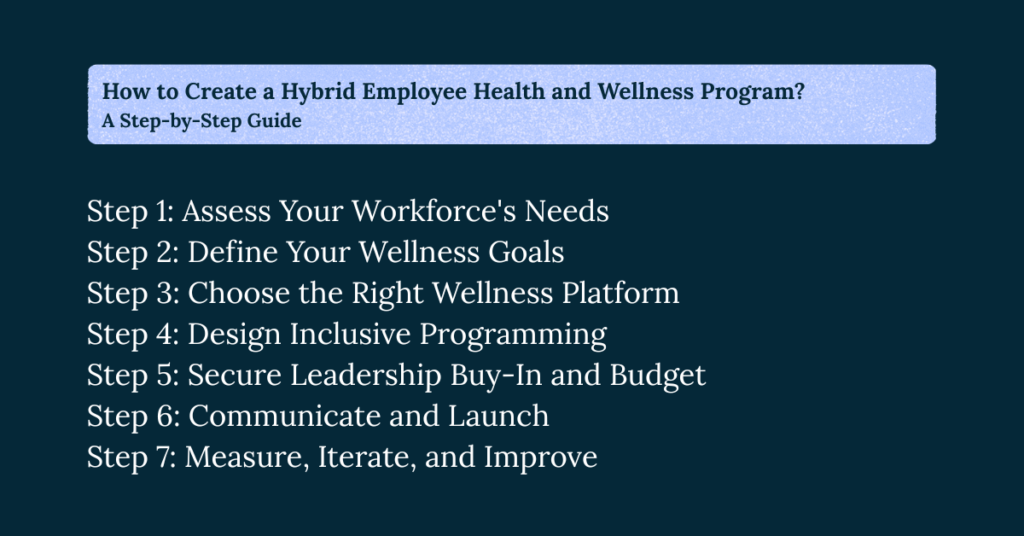
How to Create a Hybrid Employee Health and Wellness Program: A Step-by-Step Guide
Ready to build or revamp your employee wellness program? Here’s a proven framework to follow:
Step 1: Assess Your Workforce’s Needs
Before building anything, understand what your employees actually need. Send out a wellness survey segmented by work location (remote, hybrid, in-office). Ask about physical health challenges, mental health concerns, financial stressors, and what types of support they wish they had. The data will guide every decision that follows.
Step 2: Define Your Wellness Goals
Align your program goals with your broader organizational objectives. Are you trying to reduce healthcare costs? Improve employee engagement? Lower absenteeism? Boost retention? Define 2–3 measurable goals so you can track progress and demonstrate ROI to leadership.
Step 3: Choose the Right Wellness Platform
A hybrid-ready wellness platform is the backbone of your program. Look for a solution that offers digital health challenges, mental health content, social recognition features, and data analytics — all accessible remotely. Platforms like Woliba are specifically designed to support hybrid and distributed teams with an all-in-one employee wellness solution.
Step 4: Design Inclusive Programming
Every initiative in your program should be designed with inclusivity in mind. Ask yourself: can a fully remote employee participate in this activity equally? If the answer is no, redesign it. This might mean shifting in-person lunch-and-learns to hybrid webinars, or converting on-site fitness classes to virtual ones with an in-person option.
Step 5: Secure Leadership Buy-In and Budget
Present your wellness strategy as a business investment, not a “nice to have.” Quantify the ROI: research shows that every dollar invested in employee wellness returns $3–$6 in reduced healthcare costs and improved productivity. Present your needs assessment data, program design, and projected outcomes to leadership to secure the budget you need.
Step 6: Communicate and Launch
Build buzz before your launch. Use multiple communication channels — email, Slack, your intranet, and team meetings — to announce the program, explain the benefits, and show employees how to get started. Make the onboarding process simple and mobile-friendly.
Step 7: Measure, Iterate, and Improve
Track your key metrics continuously: participation rates, health challenge completion, employee satisfaction scores, EAP utilization, and any measurable health or engagement outcomes. Use this data to refine your program quarterly. The best hybrid wellness programs are never truly “finished” — they evolve with your workforce.
15 Hybrid Employee Wellness Program Ideas That Actually Work
Looking for fresh ideas to bring your program to life? Here are 15 proven initiatives that work especially well for hybrid and remote teams:
- Virtual Step Challenges — Track steps via a mobile app and let remote and in-office employees compete together
- Mental Health Mondays — Weekly mindfulness or stress relief content delivered digitally
- Home Office Ergonomics Stipend — A monthly or annual allowance for ergonomic equipment
- Digital Peer Recognition Program — Let employees recognize each other’s contributions in real-time via an app
- Virtual Fitness Classes — Live-streamed yoga, HIIT, or meditation sessions anyone can join
- Financial Wellness Webinars — Monthly virtual sessions on budgeting, investing, and debt management
- Wellness Reimbursement Program — Allow employees to claim expenses for gym memberships, fitness apps, or therapy
- Hybrid Team Wellness Challenges — Month-long challenges (hydration, sleep, screen breaks) with team-based leaderboards
- Virtual Cooking & Nutrition Classes — Invite a nutritionist for live cooking demos over Zoom
- Manager Wellness Training — Teach managers to spot burnout signs and have supportive conversations
- No-Meeting Fridays or Afternoons — Protect focused work time and reduce meeting fatigue
- Digital Wellness Library — A curated hub of articles, videos, and resources on health topics
- Employee Assistance Program (EAP) Promotion — Actively remind employees about available counseling and support services
- Volunteer Days — Paid time off for community involvement, available to remote employees via virtual volunteering
- Annual Wellness Survey — Gather feedback and make employees feel heard and involved in shaping the program
How to Measure the Success of Your Hybrid Wellness Program
Measuring wellness program success requires tracking both participation metrics and outcome metrics. Here’s what to watch:
Participation Metrics
- Program enrollment rate (% of eligible employees)
- Activity completion rates by location (remote vs. in-office)
- Feature usage by category (fitness, mental health, social, financial)
Outcome Metrics
- Employee engagement scores (pre vs. post program)
- Voluntary turnover rates
- Absenteeism and presenteeism trends
- Healthcare claims data (year-over-year)
- eNPS (employee Net Promoter Score)
Reporting these metrics quarterly to HR leadership and executives helps maintain program funding and demonstrates the clear link between employee health investment and business performance.
Common Mistakes to Avoid When Building a Hybrid Wellness Program
Even well-intentioned wellness programs can fall flat. Here are the most common pitfalls — and how to avoid them:
- Designing for in-office employees only. If your program relies heavily on on-site perks, remote employees will disengage quickly. Always build with inclusivity as the default, not an afterthought.
- Skipping the needs assessment. Launching programs without understanding what employees actually want leads to low participation and wasted budget.
- Treating wellness as a one-time initiative. A wellness program is a sustained commitment, not a benefits fair. It requires consistent communication, new content, and ongoing investment.
- Failing to involve managers. Managers are the bridge between leadership intent and employee experience. Without manager buy-in and training, wellness programs rarely gain traction.
- Ignoring data. If you don’t track participation and outcomes, you can’t improve. Set up your metrics from day one.
How Woliba Supports Hybrid Employee Wellness
At Woliba, we built our platform specifically for the realities of today’s hybrid workforce. Our all-in-one employee wellness solution includes:
- Digital wellness challenges — step contests, hydration trackers, mindfulness streaks — accessible from any device
- Employee recognition tools — peer-to-peer recognition that builds culture across locations
- Mental health and well-being content — on-demand resources for stress management, resilience, and work-life balance
- Health assessments — personalized wellness journeys based on individual employee needs
- Analytics and reporting — real-time dashboards showing program participation and ROI by team, location, and department
Whether your team is 50 people or 5,000, Woliba scales to meet you where you are — and ensures no employee gets left behind because of where they work.
The Bottom Line
The shift to hybrid work is permanent — and your employee wellness strategy needs to reflect that reality. A hybrid employee health and wellness program isn’t just a nice benefit to offer. It’s a strategic investment in your people, your culture, and your business results.
When every employee — regardless of where they work — feels genuinely supported, engaged, and valued, the entire organization wins. Retention improves. Productivity rises. Healthcare costs fall. And your employer brand becomes something people actually want to be part of.