


Getting employees to actually engage with a wellness program is one of the hardest parts of an HR leader’s job. People sign up, forget, and quietly drop off by week two — and “we sent a reminder email” doesn’t count as an intervention.
Wellness bingo fixes that by turning healthy habits into a simple, visual, low-pressure game that people actually want to finish, cover, and (fingers crossed) shout about when they win.
This guide covers what wellness bingo actually is and why it works, a full step-by-step playbook for running a challenge, the mistakes that quietly kill participation, more than 25 card ideas, a free template, how to keep it inclusive, and how to prove it moved the needle when your CFO asks.
What is Wellness Bingo?
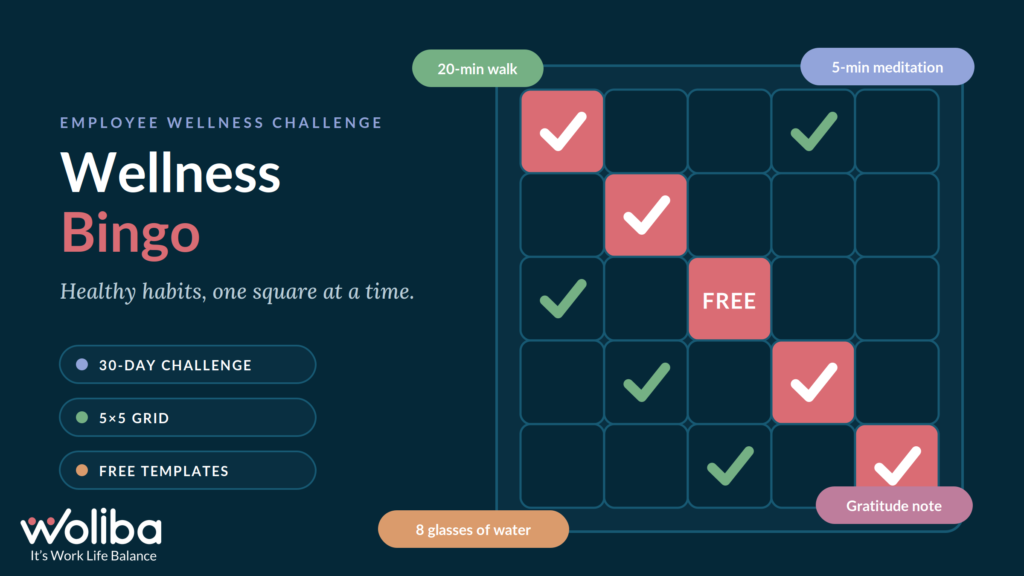
Quick answer: Wellness bingo is a workplace wellness challenge that replaces a bingo card’s numbers with real health activities — like drinking water, taking a walk, or meditating — arranged in a 5×5 grid. Employees mark a square each time they complete an activity, and filling a row, column, or the whole card counts as a win, usually within a 2-4 week challenge window.
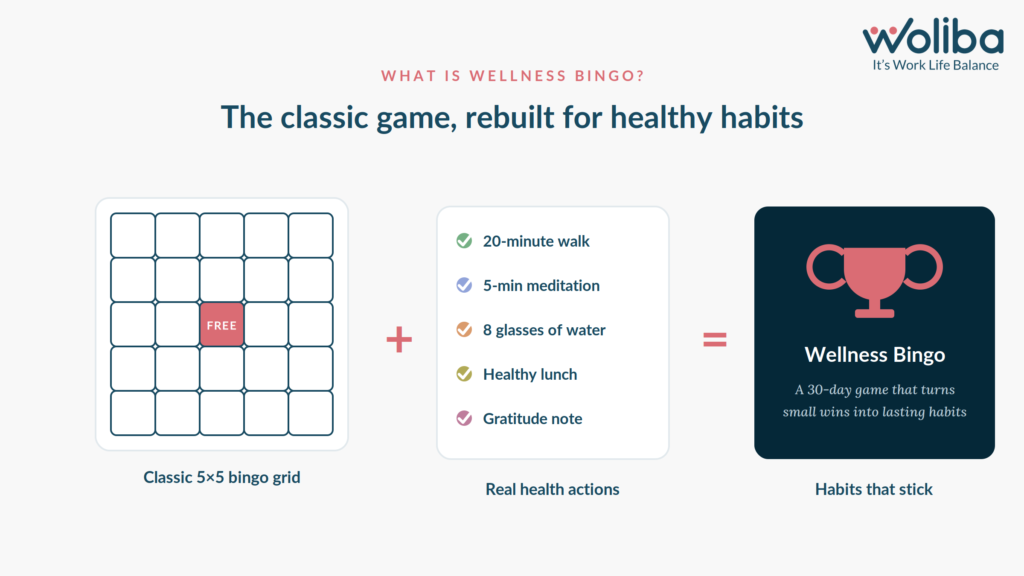
It’s the rare health and wellness bingo format that needs zero explanation. No app training, no gym membership, no equipment. If someone has ever seen a bingo card — and everyone has — they already know the rules.
What is health and wellness bingo?
A health and wellness bingo is a version of the classic bingo game where each square contains a healthy habit or self-care activity instead of numbers. Players complete activities to mark off squares, with the goal of getting a row, column, diagonal, or even filling the entire card.
How the game works?
Every player gets the same card (or a shuffled variation of it). Activities range across physical, mental, social, and financial wellness: a lunchtime walk, a 5-minute meditation, a gratitude note, a no-spend day. Players self-report or log completions, and wins are announced as they happen — first line, first full card, most squares overall.
Why a 30-day format works best
Behavioral science gives us the timeframe. Research on habit formation (Lally et al., 2010) shows that habits begin forming within a few weeks, while full automaticity often takes 60+ days. Thirty days is the sweet spot: long enough for repetition to take hold, short enough that motivation doesn’t run out before the finish line.
Individual vs. team play
Run it solo when you want personal, private habit-building — each employee plays their own card. Run it in teams of 4–8 when you want energy and accountability: shared cards, shared wins, and gentle peer pressure that keeps people showing up. Hybrid and remote teams almost always do better with the team format, because the social loop replaces the in-office buzz.
Why Does Wellness Bingo Work So Well?
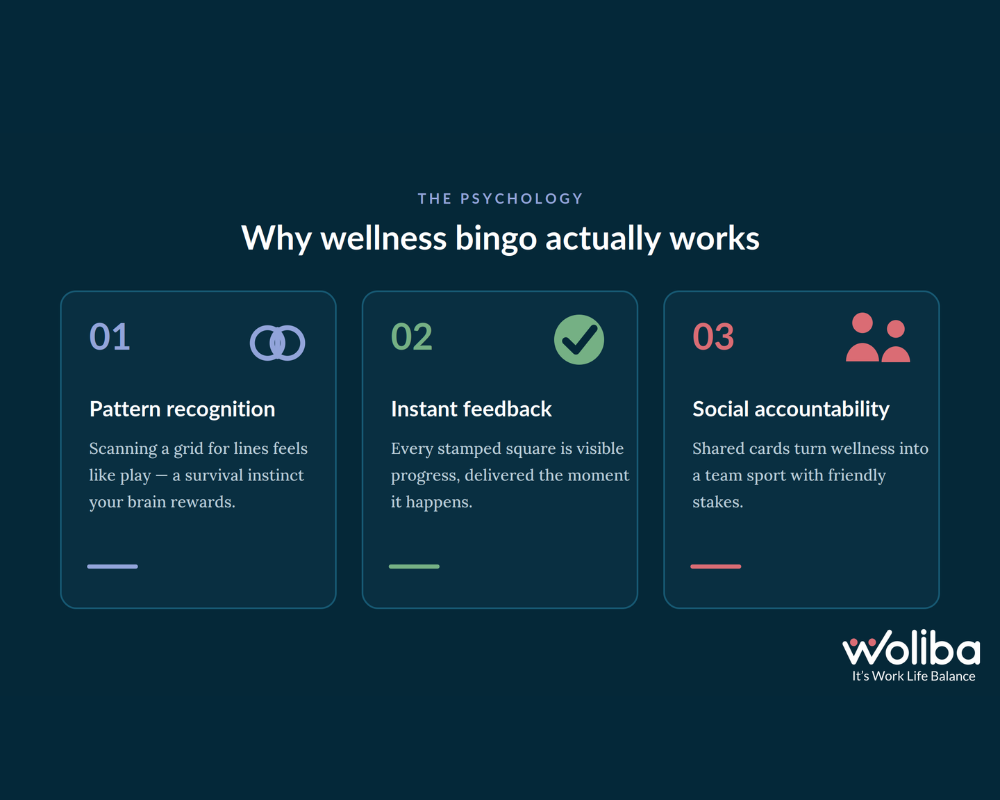
Most wellness initiatives fail quietly around week two. Health bingo tends to survive that dip, and the reason comes down to three mechanisms.
Your brain rewards pattern-spotting
Pattern recognition is a survival mechanism baked into human cognition. When you scan a grid looking for a line, you’re engaged in a way a checklist never triggers. One feels like a game. The other feels like a chore. That reframe alone changes whether people open the card on day 14.
Small wins compound into habits
Each stamped square is instant, visible progress — a micro-reward that arrives the moment the behavior happens, not at the end-of-quarter wellness report. Those small wins build what psychologists call behavioral momentum: yesterday’s easy win makes today’s slightly harder activity feel achievable.
Social accountability keeps people in the game
Knowing colleagues are playing the same card turns wellness from a private resolution into a shared effort. In team formats, collective progress and light-hearted rivalry do the motivational heavy lifting that reminder emails never could.
How to Run a Workplace Wellness Bingo Challenge (Step by Step)
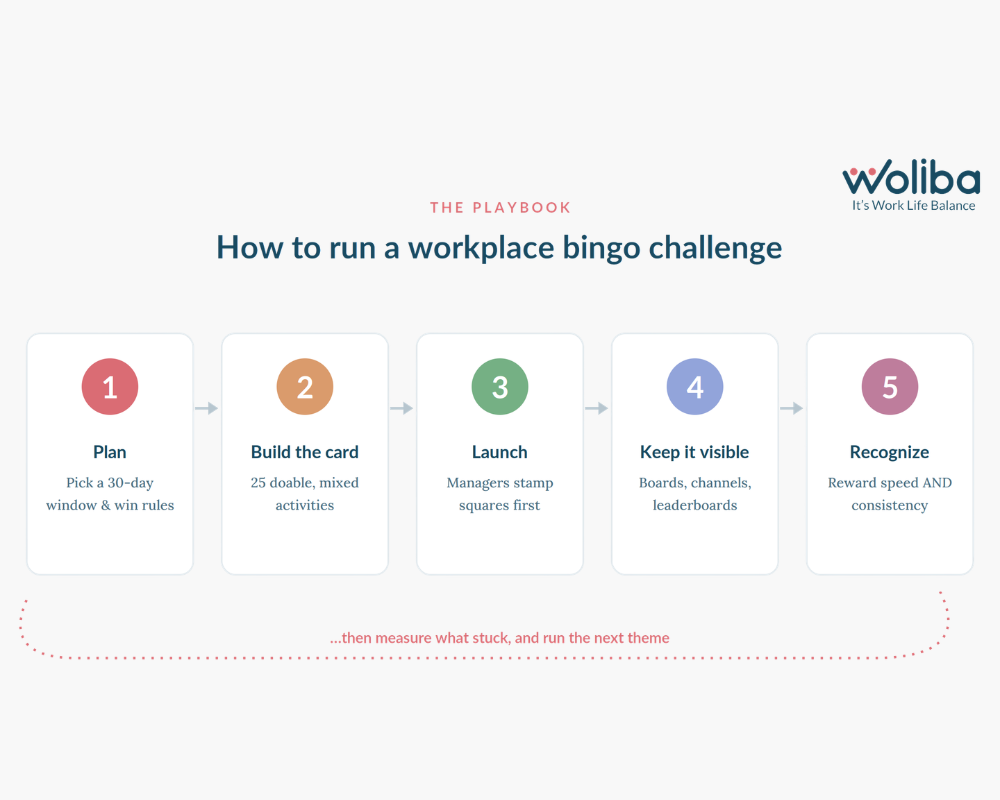
The loop is simple: pick a timeframe, build a 5×5 card of doable activities, get managers visibly involved, make progress public, and reward more than just the fastest finisher. Underneath that simplicity sits real behavioral design. Here’s the full playbook.
1. Win over managers before employees
Illustration: a team lead marking a square on a shared board while the team watches/joins. Caption idea: “Participation beats enforcement.”
A wellness challenge loses credibility the moment managers treat it as HR’s project. Team leads control psychological permission — they decide whether Wednesday morning is “we take a walk” or “we pretend this didn’t happen.”
Before launch, brief your managers with one message: your participation matters more than your enforcement. When a team lead marks off a meditation square publicly, the team follows without being asked.
2. Keep the barrier to entry near zero
Complexity kills adoption. The beauty of workplace bingo is that people already understand it — you share the card, explain the rules in three sentences, and you’re live. No downloads required, no fitness level assumed. Someone hates meditation? Yoga counts. Someone can’t walk due to injury? Stretching works. Meet people where they are, not where the poster says they should be.
3. Build your 5×5 wellness bingo card
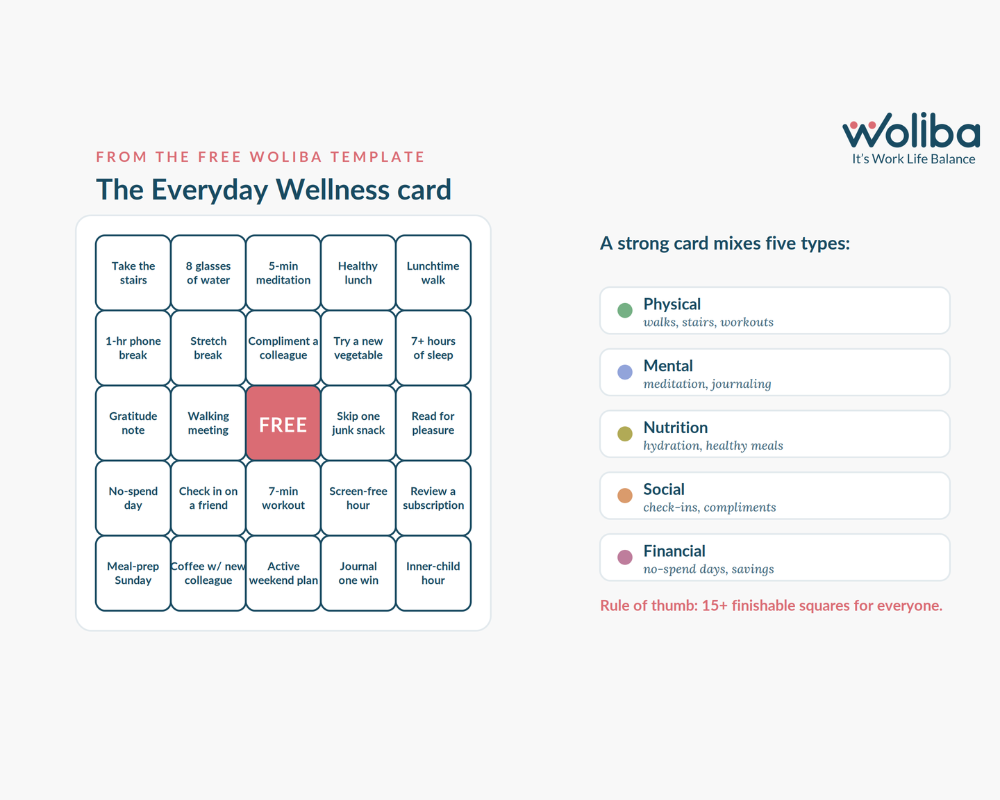
Woliba-branded sample card (from the free template): “Everyday Wellness” 5×5 grid with mixed activities and a coral FREE center square.
The card is your engagement engine, so mix it deliberately. A strong workplace wellness bingo card blends:
- Physical — a 20-minute walk, stretching, taking the stairs
- Mental — 5-minute meditation, journaling one win, a screen-free hour
- Nutritional — packing a healthy lunch, trying a new vegetable, hitting hydration goals
- Social — coffee with a new colleague, shouting out a teammate
- Financial — reviewing one subscription, a no-spend day
Variety is what keeps a health and wellness bingo card from feeling narrow by week two. Aim for a spread where every employee can see at least 15 squares they could genuinely finish.
4. Theme cards around what your team actually needs
Theming turns a generic grid into a card that speaks to your people. The fastest route to fresh wellness bingo card ideas is to pick the theme first, then fill the 25 squares to match.
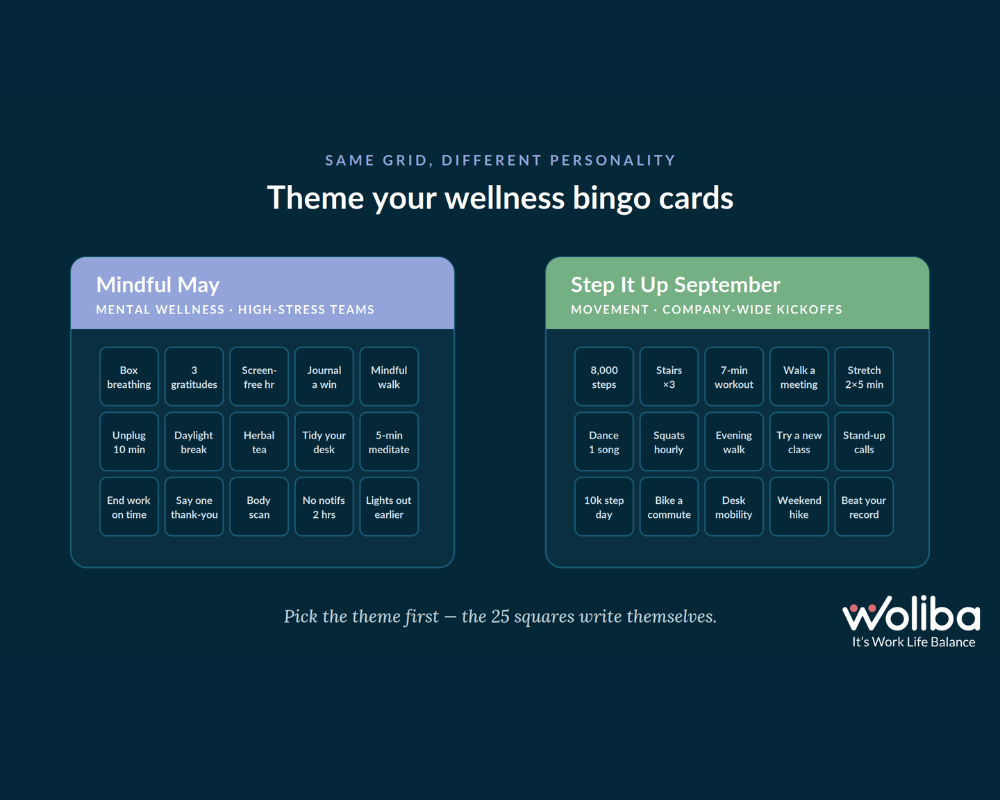
Side-by-side of two themed Woliba cards: “Mindful May” (mental wellness) vs “Step It Up September” (movement) — showing how the same grid changes personality by theme.
5. Sequence activities from easy to ambitious
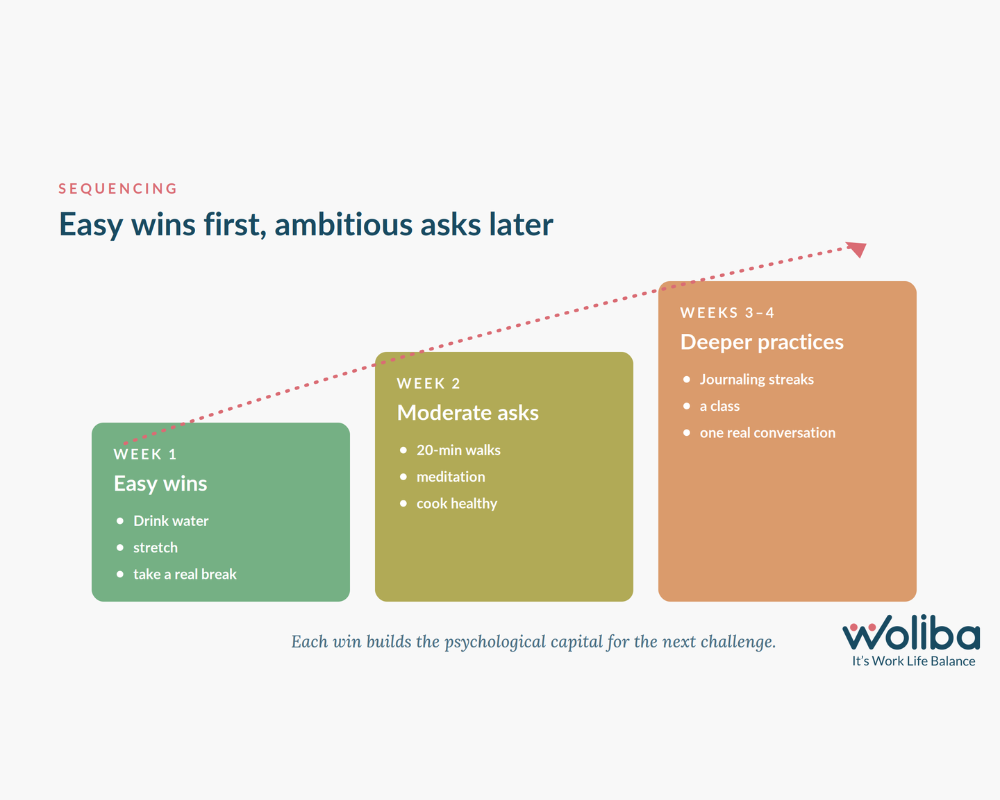
Staircase graphic: Week 1 “easy wins” → Week 2 “moderate” → Weeks 3–4 “deeper practices.” Green ascending steps, Lato labels.
Most programs treat every activity as equally doable — that’s where engagement breaks. Effective bingo builds confidence in steps:
- Week 1: easy wins — drink water, stretch, take a real break. Momentum first.
- Week 2: moderate asks — 20-minute walks, meditation sessions, cooking something healthy.
- Weeks 3–4: deeper practices — journaling streaks, a fitness class, one meaningful conversation.
Each win builds the psychological capital for the next challenge. Nobody jumps into cold water; we wade in.
6. Design multiple ways to win
Podium graphic with three different trophies: “First Line” (speed), “Most Squares” (effort), “80% Days Streak” (consistency). Tan/green/coral trophy colors.
Layer your victory conditions so different personalities all have something to play for:
- The first line completed gets announced as the early winner.
- The most squares completed over 30 days gets recognized for effort.
- Anyone active on 80%+ of days gets a consistency shout-out.
The competitive salesperson wins on speed. The quiet analyst who never misses a meditation wins on consistency. Both feel seen — and that’s the point.
7. Make progress visible every single day
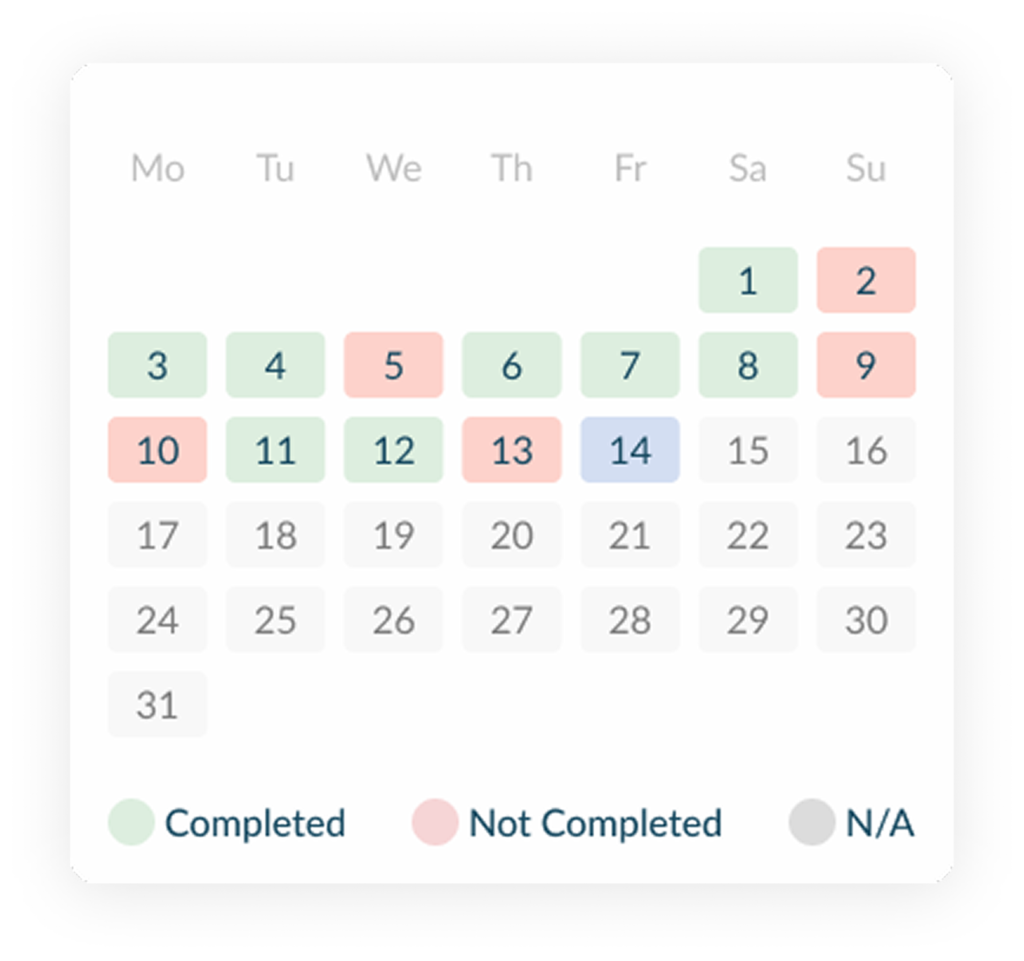
Brains crave feedback — constant, immediate feedback. Without it, motivation evaporates around week two. In offices, a whiteboard where people stamp squares publicly works brilliantly. For remote teams, a dedicated Slack or Teams channel with daily check-ins does the same job.
A wellness platform removes the manual effort entirely: with Woliba, activity logs, points, and leaderboards update in real time, so every marked square triggers that small, visible moment of progress — automatically.
8. Build flexibility into the rules
Employees who can’t complete a square exactly as written tend to drop out entirely — so allow substitutions from day one. Injured and can’t walk? Chair yoga counts. Networking square feels impossible for someone with social anxiety? A call with a friend counts. Say it explicitly at launch: “We’re not policing behavior. We’re building habits that work for you.”
9. Verify without policing
How do you know someone actually meditated? Keep verification proportional to the activity. Honor-system self-reporting works for low-friction squares (water, stretching) and keeps admin near zero. For bigger commitments (signing up for a fitness class), a screenshot or one-line note is plenty. The verification system should never become the barrier.
10. Balance intrinsic and extrinsic rewards
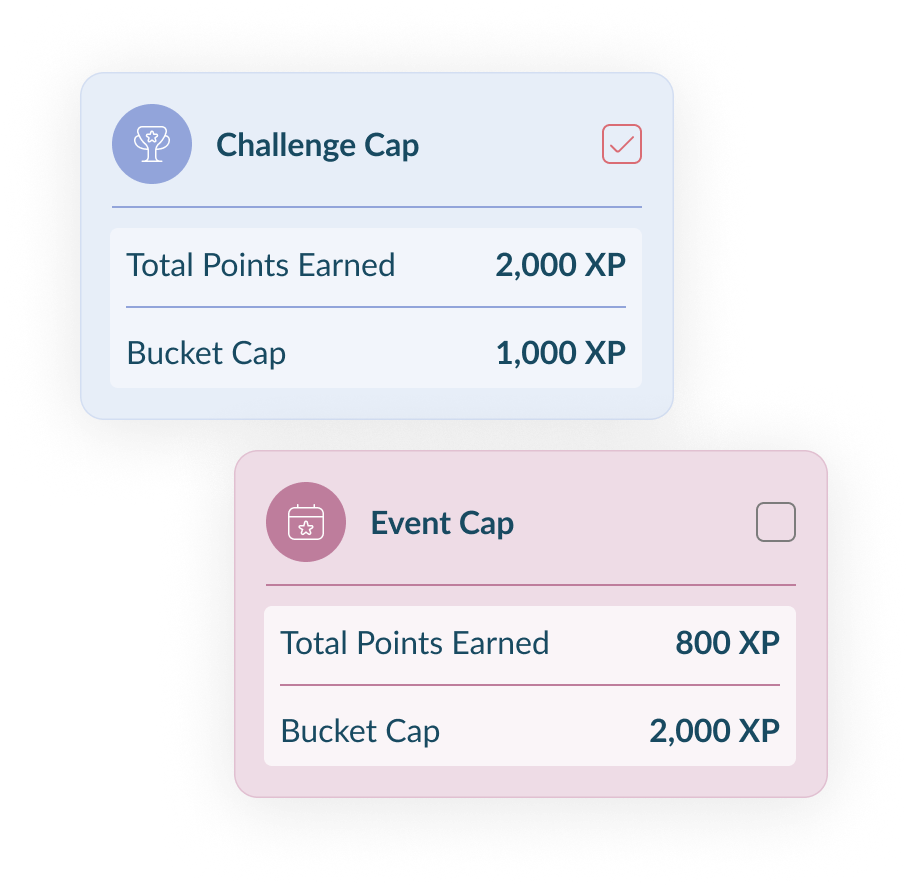
External rewards — gift cards, PTO hours, reward points — kickstart participation, especially for employees who wouldn’t join on their own. But stickiness comes from intrinsic payoff: better sleep, steadier energy, the satisfaction of a 30-day streak.
The framing formula: instead of “win a gift card,” try “finish your card, earn recognition, and walk away with habits that make your workday genuinely better.” Woliba’s points-and-rewards engine handles the extrinsic side automatically — employees earn points per activity and redeem prizes they actually want.
11. Share progress stats weekly
Weekly updates keep the challenge top-of-mind without nagging:
- Week 1: “82% of the company has stamped their first square.”
- Week 2: “First three lines completed — congrats Priya, Marcus, and the CX team!”
- Week 3: “Players are reporting better sleep and fewer 3pm crashes.”
- Week 4: “Final week — every square counts. Blackout winners announced Friday.”
12. Recognize more than the fastest finisher
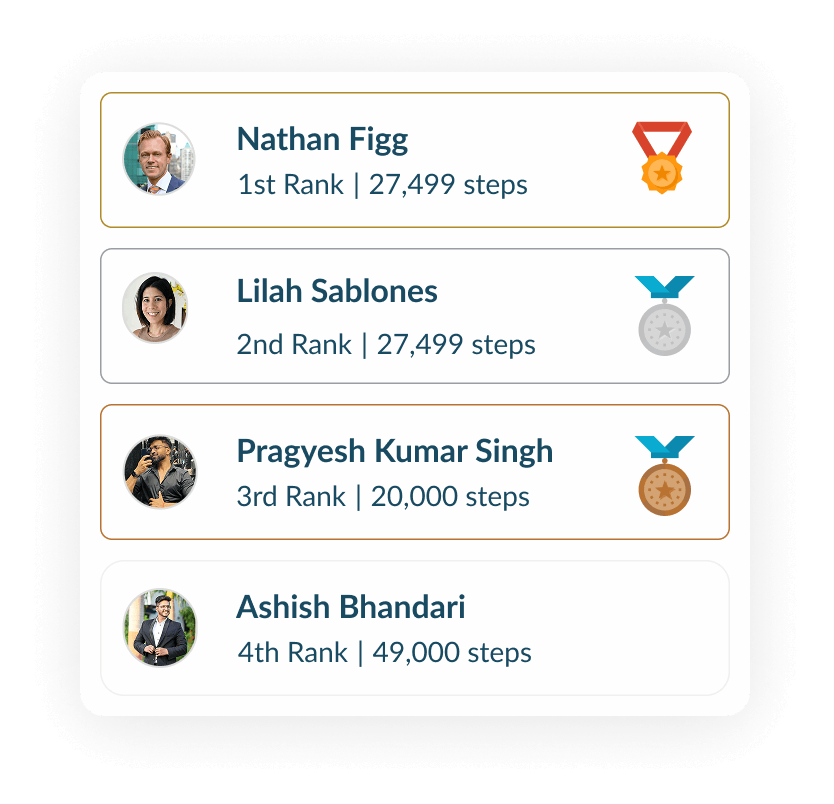
Make recognition multi-layered. Celebrate the first finisher publicly — but also the quiet teammate who completed their card solo, the manager who got their whole team playing, and the person who missed week one and still came back. Multiple recognition pathways ensure the psychological reward reaches every employee segment, not just the naturally competitive ones.
13. Measure what sticks after day 30
The real test comes after bingo ends. Sixty days later, ask: are people still walking? Still meditating? Which squares became real habits versus “bingo activities”? That data tells you what your specific culture will sustain — and it’s exactly what your CEO wants to see next to the participation numbers.
What to do if participation drops mid-challenge
If engagement dips, it’s almost always one of four things — and the fix is rarely another reminder email:
- The activities feel too hard. Loosen the rules. Let people swap any square for an easier equivalent.
- Progress is invisible. Move the tracker somewhere people actually see it daily — a pinned Slack message, a shared doc, a physical board.
- There’s no social pull. Move solo players into small groups of four to eight. Peer accountability restarts momentum faster than any prize does.
- The rewards stopped landing. Add a mid-challenge win condition — “most improved” or “best comeback” — so people who fell behind still have something to play for.
Most drop-off happens right around week two, exactly when novelty wears off. A small nudge at that point — a fresh theme, a surprise shout-out, a manager check-in — is usually enough to carry the group the rest of the way.
Common mistakes to avoid when running wellness bingo
A few avoidable errors show up again and again in poorly performing challenges. Catch these before launch, not after.
Making Every Square About Fitness
A card stacked with runs, gym sessions, and step counts quietly tells less-active employees the challenge isn’t for them. Balance physical squares with mental, social, nutritional, and financial ones so more of your team can genuinely compete.
Skipping a Trial Run
Send the card to two or three people before company-wide launch. They’ll catch the ambiguous square (“be healthy” is not an activity) and the accidentally-excluding one before hundreds of employees do.
Setting the Bar Too High to Win
Requiring a full blackout as the only win condition guarantees most people never win anything. Layer in easier win conditions (see step 6) so effort gets rewarded at more than one finish line.
Ignoring Time Zones and Shift Schedules
A “join the 9am walk” square quietly excludes night-shift workers and anyone three time zones away. Write squares around outcomes (“take a 10-minute walk sometime today”), not fixed windows, unless the whole team shares a schedule.
Letting the Challenge End Without a Debrief
Cards that just quietly stop leave no record of what worked. A short wrap-up — completion rate, a few employee shout-outs, what people plan to keep doing — is what turns a one-off activity into evidence for next quarter’s budget.
Wellness Bingo Card Ideas You Can Steal
Stuck staring at a blank grid? Start from a theme, then fill the squares. Here are ten office bingo ideas that work across most teams — including remote ones.
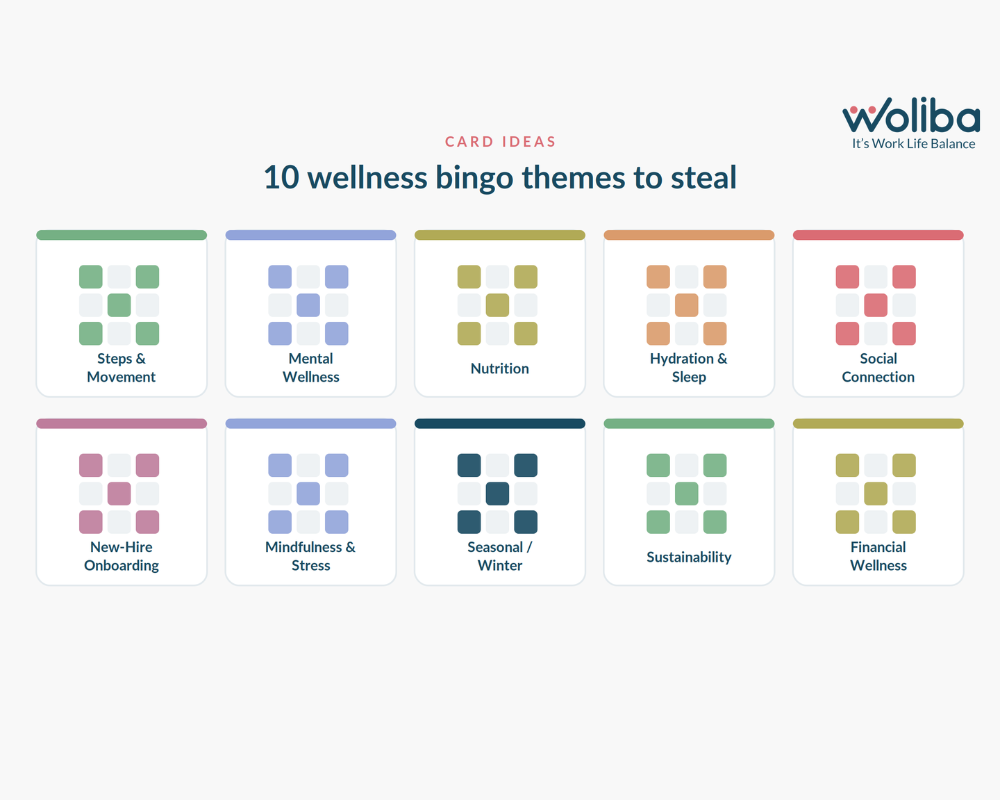
10 card themes for any team
| Card theme | Sample squares | Best for |
|---|---|---|
| Steps & movement | 8,000 steps · take the stairs · walk a meeting · 7-minute workout | Company-wide kickoffs and step challenges |
| Mental wellness | 5-min meditation · three gratitudes · screen-free hour · journal one win | High-stress teams, Mental Health Month |
| Nutrition | Pack a healthy lunch · try a new vegetable · swap healthy snack · eat the rainbow | Desk-bound teams |
| Hydration & sleep | 8 glasses of water · no caffeine after 3pm · 7+ hrs sleep · no screens before bed | Shift workers, recovery focus |
| Social connection | Coffee with a new colleague · shout out a teammate · group walk · lunch together | Hybrid and newly merged teams |
| New-hire onboarding | Meet another team · ask a manager one question · set a wellness goal | First-90-days cohorts |
| Mindfulness & stress | Box breathing · mindful walk · 10-min unplug · single-task for an hour | Crunch periods |
| Seasonal / winter | 15 min of daylight · vitamin-D meal · plan a weekend activity | Winter months, SAD-prone climates |
| Sustainability | Plastic-free day · public transport · meatless meal · pick up litter | Values-driven cultures, Earth Month |
| Financial wellness | Review a subscription · savings goal · no-spend day · list 3 things money can’t buy | Broader wellbeing programs |
Each row is a ready-made starting point for work bingo ideas: pick the theme that fits, drop its squares onto a blank 5×5 grid, and you have a working card in minutes.
Read nextLooking for more challenge formats? Try our guides to office weight-loss challenges and 5-minute team building activities.
Not sure what to put in each square? Here’s a bank of workplace wellness bingo ideas, organized by category, so you can mix and match for a balanced card.
| Physical Wellness | Take a 10-minute walk outside Stretch for 5 minutes at your desk Take the stairs instead of the elevator Try a new workout class Get 7+ hours of sleep |
| Mental Wellness Bingo Squares | Practice 5 minutes of deep breathing Write down 3 things you’re grateful for Take a full lunch break away from your screen Try a guided meditation app Say no to one thing that doesn’t serve you |
| Nutrition | Drink 8 glasses of water Eat a fruit or vegetable with every meal Pack a lunch instead of ordering out Try a new healthy recipe Skip the afternoon vending machine run |
| Social Wellness | Compliment a coworker Eat lunch with a colleague instead of at your desk Send a thank-you note to a teammate Join a company event or ERG meeting Check in on a friend or family member |
| Financial Wellness | Review your budget for the month Set up or check your retirement contribution Skip one non-essential purchase Automate a savings transfer Attend a financial wellness webinar |
Mix five from each category — or weight it toward whatever your team needs most this quarter — to build a wellness bingo card ideas grid that feels achievable, not overwhelming.
Free Wellness Bingo Template
Here’s a simple structure you can copy into a spreadsheet or design tool to build your own wellness bingo template. Dab a square, not a donut:
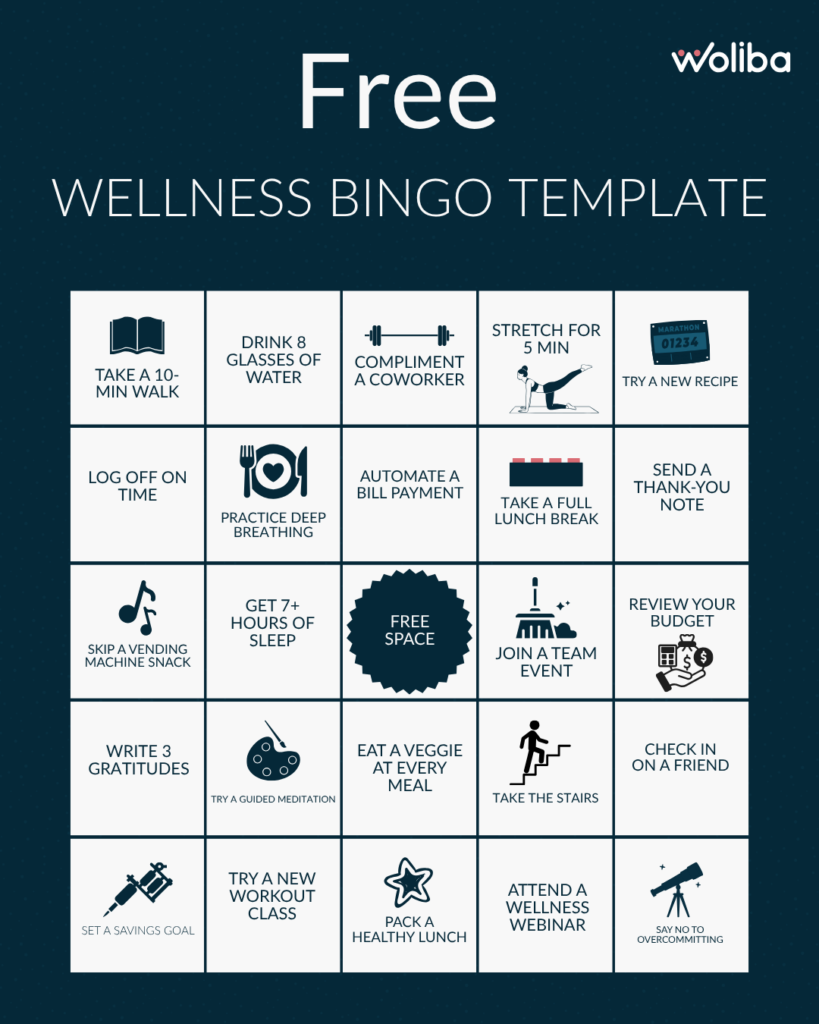
Swap squares based on your team’s interests, season, or company priorities (mental health month, financial literacy month, and so on).
Health and Wellness Bingo: Keeping It Inclusive
The biggest mistake companies make with health and wellness bingo is filling the card entirely with fitness tasks. That approach rewards employees who are already active and quietly excludes everyone else.
To keep it inclusive:
- Include at least one square from each wellness pillar (physical, mental, financial, social, nutritional)
- Offer alternatives for employees with disabilities or mobility limitations (e.g., “stretch at your desk” instead of “run a mile”)
- Avoid squares tied to weight loss or body image
- Make squares achievable during a normal workday, not just evenings and weekends
- Write squares that work for remote and hybrid employees too — “grab coffee with a coworker” doesn’t work for everyone on a fully distributed team
How to Measure the ROI of Your Wellness Bingo Challenge
A wellness bingo challenge is cheap to run, but “cheap” isn’t the same as “worth repeating.” Before your next budget conversation, track these four numbers.
Participation Rate
The share of eligible employees who started the challenge at all. Low participation usually points back to communication or manager buy-in (steps 1 and 11), not the card itself.
Formula: employees who marked at least one square ÷ total eligible employees.
Completion Rate
The share of participants who hit at least one win condition (a line, or a full card). This is your clearest signal of whether the difficulty curve (step 5) and win conditions (step 6) were actually achievable.
Formula: participants who completed a line or card ÷ total participants.
60-Day Habit Retention Check-In
A short, anonymous pulse survey 60 days after the challenge ends, asking which activities people are still doing without being prompted. This is the number that tells you whether you ran a habit-building program or a one-time engagement stunt.
Employee Sentiment (Pulse Survey or eNPS Shift)
Compare a quick wellbeing or engagement pulse score before and after the challenge. Even a modest, statistically-noisy bump is useful evidence — pair it with the qualitative shout-outs from step 12 to make the case to leadership in language they’ll actually act on.
Make Wellness Bingo Effortless With Woliba
Full disclosure: I’ve now typed the word “bingo” so many times it’s stopped looking like a real word. Occupational hazard of writing about wellness bingo, not a square on anyone’s card.
Wellness bingo is one of the easiest wellness activities to launch, but scaling it across a growing or hybrid team is where spreadsheets and honor-system tracking fall apart. Woliba lets you build custom wellness challenges — including bingo-style ones — with automatic progress tracking, built-in rewards, and reporting that shows you exactly how engaged your team really is, so the ROI numbers above are one export away instead of a manual spreadsheet exercise.