


Key Takeaways
- 30 team-building activities across 7 categories — icebreakers, trust-building, communication, problem-solving, outdoor, creative, and virtual/remote.
- “Activities” and “exercises” mean the same thing — pick based on your team’s actual goal, not the label.
- Low-pressure, voluntary activities work better than mandatory ones.
- The debrief afterward matters more than the activity itself.
- Most high-impact activities are free.
- Strong team relationships link to 21% higher productivity and 41% fewer safety incidents (Gallup).
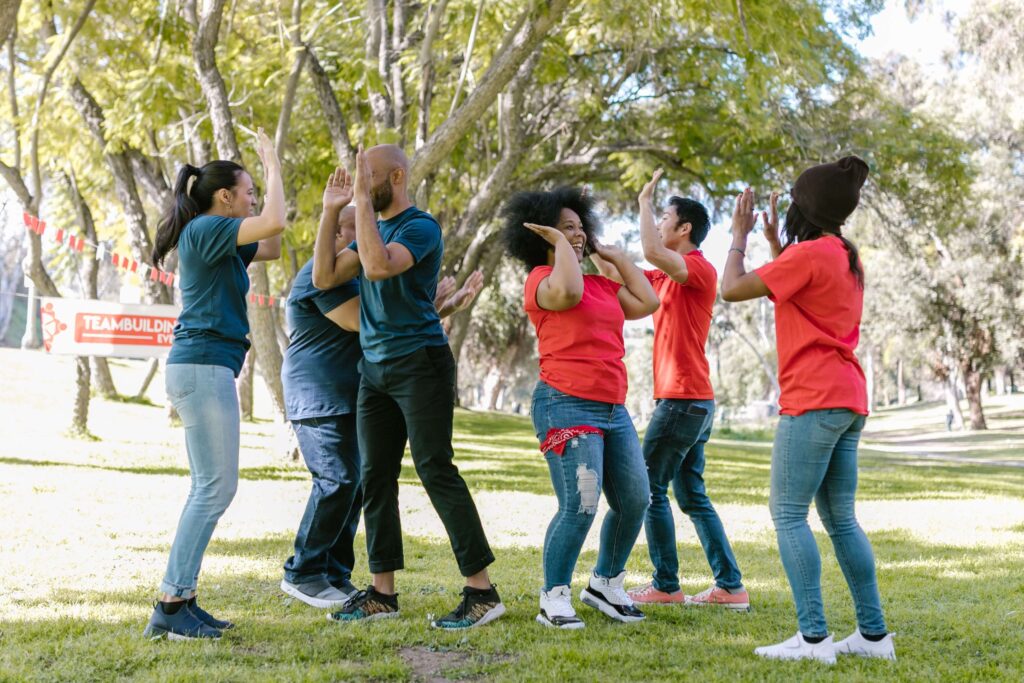
Team-building activities get a bad reputation — mention “team-building day” and most people picture an awkward trust fall or a forced game of charades nobody actually wanted to play. But when they’re chosen well, team-building exercises are one of the most effective, low-cost ways to build a stronger, more connected team. This guide covers 30 team-building exercises at work that genuinely hold up — organized by goal, tagged by group size, time, cost, and setting, so you can find the right fit whether you’re running a 10-minute icebreaker or planning a full offsite. We’ll also cover what actually makes these activities work, so your next session doesn’t fall flat.
What Are Team-Building Exercises?
Team-building exercises are structured activities designed to help a group of coworkers work better together. Unlike a regular meeting or a casual office party, a team-building exercise has a specific goal behind it — building trust, improving communication, sharpening problem-solving, or simply helping people genuinely enjoy each other’s company.
They can be as short as a 5-minute icebreaker at the start of a meeting or as involved as a full-day outdoor adventure course. Some are physical, some are purely conversational, and increasingly, many are built specifically for remote and hybrid teams who don’t share a physical office.
What connects all of them is intention. A team-building activity challenges isn’t just “something fun to do” — it’s a deliberate way to strengthen how a group communicates, solves problems, and trusts each other, with effects that are meant to carry back into everyday work.
Why Team-Building Exercises Are Important
The case for team building isn’t just a feel-good argument — it’s backed by real data.
According to Gallup research, teams with strong workplace relationships are 21% more productive and experience 41% fewer safety incidents than teams without them. Strong relationships don’t happen automatically just because people share a Slack channel or sit near each other — they’re built through shared experiences, and that’s exactly what team-building exercises are designed to create.
Beyond the numbers, well-run team-building activities also:
- Improve communication — many exercises are specifically built around passing information clearly under pressure, a skill that transfers directly to daily work
- Build trust — shared step challenges, especially ones with a bit of vulnerability built in, create bonds that a typical status meeting never will
- Reduce turnover — employees who feel genuinely connected to their team are far less likely to look elsewhere
- Boost morale — a well-chosen activity gives people a break from routine and something to genuinely look forward to
The key word throughout is well-run. Badly chosen or forced virtual team-building activities can do the opposite — creating eye-rolls instead of engagement. Which is exactly why picking the right activity matters as much as running one at all.
What Makes a Team Building Activity Actually Work
Not every team-building exercise delivers results. The difference between one that genuinely strengthens a team and one that becomes an office joke usually comes down to a few things:
1. Match the activity to a real goal. A trust-building exercise won’t do much for a team that actually struggles with communication. Get clear on what you’re trying to improve before picking an activity, not after.
2. Low-pressure beats high-pressure. A voluntary trust fall builds trust. A mandatory one builds resentment. The best team-building exercises give people the option to participate at their own comfort level.
3. A skilled facilitator matters more than the activity itself. Even a simple game can be a flop without someone guiding it well — and a great facilitator can make even a basic icebreaker genuinely land.
4. Follow-up is what makes it stick. The activity itself is only half the value. A short debrief afterward — what did we learn, how does this apply to how we work — is what turns a fun afternoon into an actual shift in how the team operates.
Best 30 Five Minute Team Building Activities
Icebreakers
Icebreakers are the simplest form of team-building exercises at work — quick, low-pressure activities that help people relax and start talking, especially useful with new teams or at the start of a meeting.
- Two Truths and a Lie
Free10 minIn-person / Remote-friendly
Each person shares two true facts and one lie about themselves. The rest of the group guesses which statement is false. Simple, low-pressure, and genuinely reveals fun, unexpected details about coworkers. - Would You Rather
Free5–10 minIn-person / Remote-friendly
Go around the group answering quick either-or questions. Works well as a warm-up before meetings, with zero prep required. - This or That
Free10 minIn-person / Remote-friendly
Rapid-fire preference questions — coffee or tea, mountains or beach — spark quick, easy conversation without going too deep. - One-Word Check-In
Free5 minIn-person / Remote-friendly
Everyone shares a single word describing how they’re feeling that day. Fast, surprisingly honest, and a good pulse-check before diving into a meeting. - Desert Island Bag
Free15 minIn-person / Remote-friendly
Each person shares three items they’d bring to a desert island and why. A playful way to reveal personality without any real stakes.
Trust-Building Exercises
Trust-building exercises ask a little more of participants — some physical, some emotional — but they consistently rank among the most physical team-building activities for creating psychological safety within a group.
- Trust Fall (voluntary, in pairs)
Free15 minIn-person
One person falls backward, trusting a partner to catch them. This only works well when genuinely voluntary — never make it mandatory, or it backfires completely. - Human Knot
Free20 minIn-person
The group links hands randomly, then works together to untangle themselves without letting go. Builds problem-solving and physical cooperation at the same time. - Minefield
Free20–30 minIn-person
One partner is blindfolded and must navigate an obstacle course using only the other’s verbal directions. A strong, memorable test of clear communication and trust. - Back-to-Back Drawing
Free30 minIn-person
Two people sit back to back; one describes a shape or image while the other draws it based only on verbal instructions. Highlights exactly how communication can break down — and how to fix it.
Communication Activities
These team-building exercises are built specifically around one skill: getting information across clearly, even under pressure or constraints.
- Survival Scenario
Free30 minIn-person / Remote-friendly
Teams rank a list of survival items by importance and must negotiate to reach a group consensus. Sparks real debate, negotiation, and collaborative decision-making. - Chinese Whispers (Telephone)
Free10 minIn-person / Remote-friendly
A message is passed quietly from employee to employee, then the final version is compared to the original. A fun, memorable way to show how easily messages distort without clarity. - Active Listening Pairs
Free20 minIn-person / Remote-friendly
One person talks for two minutes uninterrupted while their partner just listens, then summarizes what they heard. Builds a genuinely underrated workplace skill. - Feedback Circle
Free20 minIn-person / Remote-friendly
Team members take turns sharing one specific, genuine piece of positive feedback with a colleague. Normalizes giving employee recognition out loud, not just during formal reviews.
Problem-Solving Challenges
These team building activities for work put a group’s collaboration and quick thinking to the test — often the most memorable exercises on this entire list.
- Escape Room Challenge
Investment60 minIn-person
Teams solve puzzles and find clues to “escape” a themed room within a set time limit. Consistently rated one of the most effective activities for communication and quick decision-making under real pressure. - Egg Drop Challenge
Low-cost30–45 minIn-person
Teams build a contraption from limited materials to protect an egg from a fall. Combines creativity, basic engineering thinking, and genuine team problem-solving. - Marshmallow Spaghetti Tower
Low-cost20 minIn-person
Teams race to build the tallest freestanding structure using spaghetti, tape, string, and one marshmallow. A classic exercise for a reason — fast, hands-on, and surprisingly revealing about how a team actually operates under a deadline. - Virtual Puzzle Hunt
Low-cost45–60 minRemote-friendly
Teams solve a series of online clues and puzzles together over video call. Brings escape-room-style energy to fully remote teams.
Outdoor & Physical Activities
For teams that work well together in-person, outdoor and physical team-building exercises add energy and a genuine change of scenery.
- Scavenger Hunt
Low-cost60–90 minIn-person
Teams race to find items or complete fitness challenges around a location, often photographing proof along the way. Highly adaptable to any office, city, or budget. - Relay Race Challenges
Free30 minIn-person
Simple relay-style games — a three-legged race, an obstacle relay — that get people moving and laughing together outdoors. - Ropes or Adventure Course
Investment: Half-or full-day, in-person
Guided summer fitness challenges like low ropes, ziplines, or balance courses that build trust through shared, mildly out-of-your-comfort-zone experiences. - Team Sports Tournament
Low-costHalf dayIn-person
A friendly kickball, volleyball, or soccer tournament between departments. Builds camaraderie through shared competition and cheering each other on.
Creative & Social Activities
Not every effective team-building exercise needs a defined “challenge.” Sometimes the strongest bonds form through simple, shared enjoyment.
- Cooking Class Showdown
Investment2–3 hoursIn-person
Teams compete to prepare a dish within a time limit, then share the meal together. Combines creativity, coordination, and a genuinely satisfying shared outcome. - Team Trivia Night
Low-cost60 minIn-person / Remote-friendly
Compete in trivia teams on general knowledge or company-specific questions. Easy to run virtually with free quiz tools. - Volunteer Day
Low-costHalf or full dayIn-person
Teams work together on a community service project. Builds genuine bonds around shared purpose, not just shared tasks. - Office Olympics
Low-costHalf dayIn-person
A series of silly, low-stakes office-based games — chair races, paper airplane contests — run like a mini-Olympics with team scoring. - Show-and-Tell Fridays
Free15 min weeklyIn-person / Remote-friendly
A recurring slot where someone shares a hobby, personal project, or something they’re proud of. Builds ongoing connection over time, not just during a single event.
Virtual & Remote Team Activities
Remote and hybrid teams need team-building activities built specifically for distance — not just an in-person activity awkwardly moved to Zoom.
- Virtual Coffee Roulette
Free15 min, ongoingRemote-friendly
A tool randomly pairs coworkers for a casual video chat each week. Recreates the “run into each other” connection remote teams miss most. - Online Game Night
Free60 minRemote-friendly
Play browser-based games — Skribbl.io, online Codenames — together over video call. Zero setup, genuinely fun, works for any team size. - Remote Show-Your-Space Tour
Free15 minRemote-friendly
Each person gives a quick video tour of their home workspace or a favorite nearby item. A simple way to humanize remote coworkers you rarely “see.” - Collaborative Virtual Whiteboard Challenge
Free30 minRemote-friendly
Using a shared tool like Miro or Jamboard, teams brainstorm or solve a wellness challenge together in real time. Brings the energy of an in-person whiteboard session to distributed teams.
How to Choose the Right Activity for Your Team
With 30 options above, picking the right one comes down to four quick questions:
- What’s your actual goal? If your team struggles with trust, a trivia night won’t move the needle — a trust-building exercise will. Match the category to the problem you’re actually trying to solve.
- What’s your team size and format? Some team-building exercises work beautifully with 6 people and fall apart with 30. Others are built specifically for remote teams and won’t translate well to a room full of people. Check the setting tag on each activity before committing.
- How much time do you actually have? A 10-minute icebreaker before a meeting is a very different commitment than a full-day offsite. Be realistic about what your team can actually fit into a normal week.
- What’s your budget? Plenty of the most effective team-building exercises on this list — Trust Fall, Human Knot, Two Truths and a Lie — cost nothing at all. Investment-level activities like escape rooms or adventure courses deliver strong results too, but they’re not a requirement for effective team building.
Conclusion
The best team building activities aren’t the flashiest or most expensive ones — they’re the ones actually matched to what your team needs, run by someone who takes them seriously, and followed up with a real conversation about what was learned. Skip the mandatory trust falls and forced fun. Start with one goal, pick an exercise from the list above that fits it, and build from there. That’s what separates genuine team building from a forgettable afternoon everyone’s relieved to have survived.