


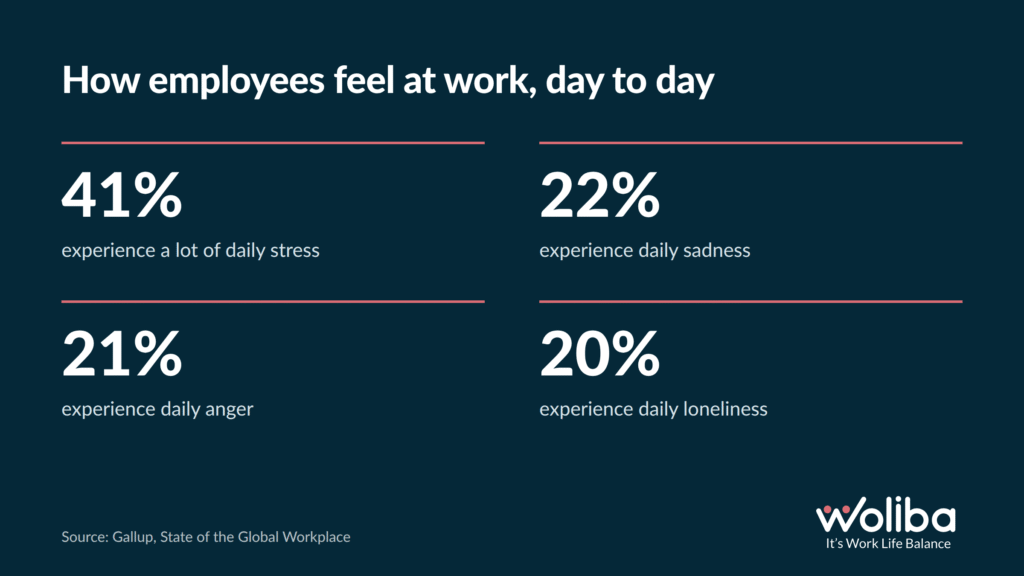
Ask employees how they felt at work yesterday, and many will tell you: stressed, lonely, frustrated. In Gallup’s State of the Global Workplace 2024 report, 41% of respondents said they experience daily stress, 22% daily sadness, 21% daily anger and 20% daily loneliness.
That’s emotional wellness in the workplace, or the lack of it, showing up every day. It affects how people collaborate, how they handle pressure, and whether they stay.
For years, the unwritten rule at work was “leave your feelings at the door.” That rule never worked, and today it’s actively costing companies. This guide explains what emotional wellness definition, why it matters, and the practical steps HR and People leaders can take to build a workplace wellness program where people feel steady, supported and connected.
Key takeaways
- Emotional wellness in the workplace is people’s ability to understand, express and manage their feelings at work, and to recover from setbacks.
- Emotions at work are information, not drama. Ignoring them doesn’t make them go away; it makes them show up as conflict, disengagement and turnover.
- Managers have the biggest influence on how people feel at work, so equip them first.
- Loneliness is a real risk, especially for remote teams. Connection has to be designed, not left to chance.
- Listen continuously with pulse surveys, then act on what you hear.
What is emotional wellness in the workplace?
Emotional wellness in the workplace is the ability of employees to recognize, express and manage their emotions at work, cope with stress and setbacks, and maintain healthy working relationships. It’s shaped by the individual, by managers and by the culture the organization creates every day.
In simple terms, emotional wellness is about how people feel and how well they handle those feelings. An emotionally well employee still has bad days. The difference is that they can name what they’re feeling, ask for help when they need it, and bounce back.
What is emotional wellness vs. mental wellness?
The two are closely related but not the same. Mental wellness in the workplace is broader: it covers how people think, cope and function, including conditions like anxiety and depression that may need professional care. Emotional wellness is one part of that picture, focused on feelings, emotional resilience and relationships.
Think of emotional wellness as the daily weather and mental health as the longer-term climate. Good emotional habits at work help protect mental health over time.
Why emotional wellness at work matters now
Emotional wellness matters because feelings at work directly shape performance. Stress, loneliness and frustration show up as lower engagement, more conflict, more sick days and more resignations. When people feel supported and connected, they collaborate better, adapt to change faster and stay longer.
The data makes this hard to ignore:
- 41% of employees experience a lot of daily stress (Gallup).
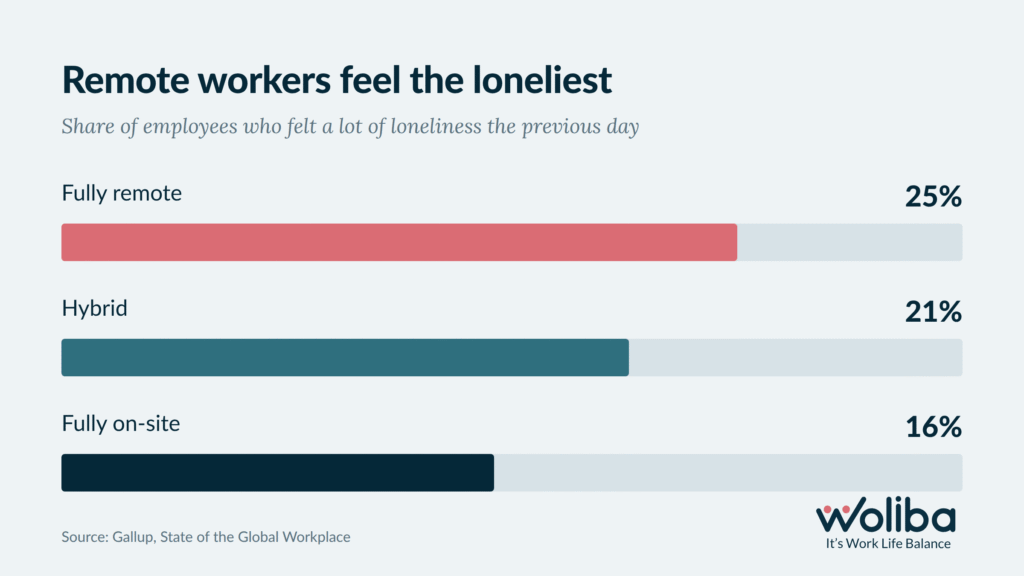
- 20% of employees experience daily loneliness, with loneliness higher among fully remote employees (25%) than fully on-site employees (16%), and hybrid workers in between (21%).
- Employees at companies with bad management practices are nearly 60% more likely to be stressed than people in well-managed environments.
- Managers account for 70% of the variance in team engagement.
That third point is the one to underline. Emotional wellness is not mainly about personal resilience. It’s heavily shaped by how people are managed and how work is organized, which means HR can influence it.
The myth of “leave your feelings at the door”
Most workplaces were built on the idea that emotions are unprofessional. The trouble is that people don’t stop feeling things when they log in. They just stop talking about them, and the feelings show up somewhere else: in short replies, missed deadlines, quiet disengagement or a sudden resignation.
Here’s the shift we’d encourage every HR leader to make: treat emotions at work as information, not interference. Frustration often points to a broken process. Anxiety often points to unclear expectations. Loneliness often points to a team that has lost its connection rituals. When people can say how they feel, leaders get early warning signals they’d otherwise miss.
This doesn’t mean turning every meeting into a therapy session. It means building a culture where saying “I’m overwhelmed” or “this change is stressing my team” is normal, safe and followed by action.
There’s another group that often gets overlooked: managers themselves. Gallup found that managers are more likely to be stressed, angry, sad and lonely than non-managers. They absorb pressure from above and emotions from below. If you want managers to support their teams’ emotional wellness, you have to support theirs too.
Signs of low emotional wellness at work
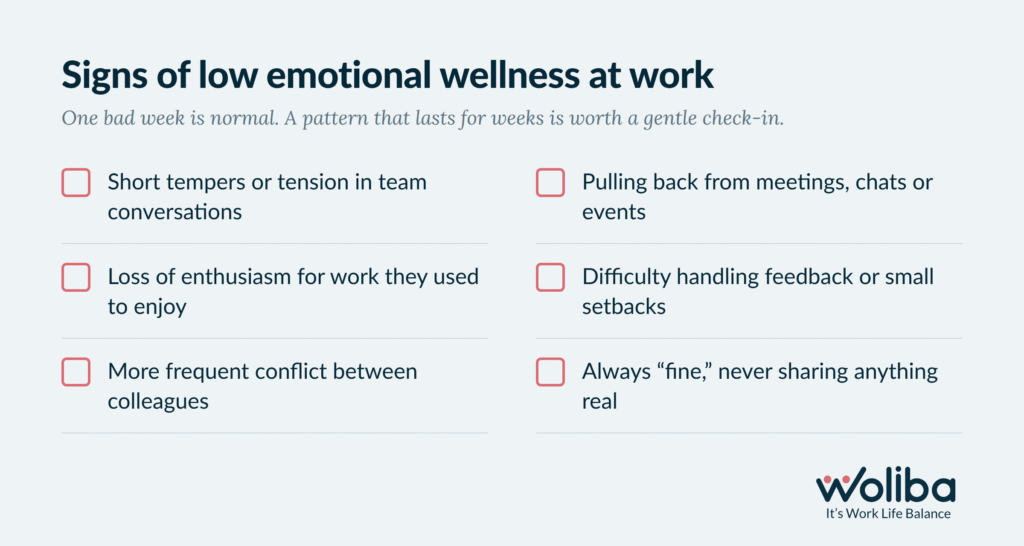
Low emotional wellness usually shows up as changes in mood, behavior or relationships: irritability, withdrawal, frequent conflict, loss of motivation, overreacting to small setbacks, or seeming “checked out.” One bad week is normal. A pattern that lasts for weeks is a signal worth a gentle check-in.
Watch for:
- Short tempers or tension in team conversations
- Pulling back from meetings, chats or team events
- Loss of enthusiasm for work someone used to enjoy
- Difficulty handling feedback or small setbacks
- More frequent conflict between colleagues
- Always “fine,” never sharing anything real
Managers don’t need to diagnose anything. Their job is to notice, ask “How are you really doing?”, listen, and point people to support when needed.
What shapes emotional wellness at work
Emotional wellness at work is shaped by everyday conditions: the relationship with one’s manager, whether effort is recognized, how connected people feel to their team, workload, how change is handled, and how isolated remote employees are. Most of these are within the organization’s control.
| Driver | When it helps | When it hurts |
|---|---|---|
| Manager relationship | Regular, supportive one-on-ones | Rare check-ins, unpredictable reactions |
| Recognition | Specific, frequent appreciation | Effort goes unnoticed |
| Belonging | People feel part of the team | Cliques, exclusion, isolation |
| Workload | Realistic, with room to recover | Constant overload |
| Change | Clear, honest communication | Surprise reorgs, rumors |
| Remote connection | Designed rituals and touchpoints | “Out of sight, out of mind” |
The good news is that each of these can be improved without a huge budget. It mostly takes attention and consistency.
How to improve emotional wellness in the workplace: 10 practical strategies
To improve emotional wellness in the workplace, make it normal to talk about how work feels, train managers to respond well, recognize people often, design connection for every work setup, and listen continuously. The most effective approaches are small, everyday habits, not one-time events.
1. Add a feelings check-in to team rituals
Start one-on-ones or team meetings with a quick “How’s everyone feeling this week, from 1 to 5?” It takes a minute and gives managers a real read on the team.
Action step: Add a one-question mood check to weekly team meetings.
2. Train managers in emotionally intelligent conversations
Emotional intelligence in the workplace starts with managers. Teach them to notice changes, ask open questions, listen without fixing, and follow up.
Action step: Run a short workshop on “How to respond when someone says they’re struggling.”
3. Give people words for their feelings
Many people struggle to explain what they’re feeling beyond “fine” or “stressed.” A shared vocabulary (overwhelmed, frustrated, disconnected, energized) makes honest conversations easier.
Action step: Share a simple feelings wheel in your wellbeing resources.
4. Recognize effort, not just results
Feeling unseen is one of the quietest drains on emotional wellness. Specific, timely recognition tells people their work matters.
Action step: Make peer-to-peer recognition a weekly habit, not an annual award.
5. Design connection, especially for remote teams
With remote workers reporting the highest loneliness, connection can’t be left to chance. Build regular touchpoints that aren’t about deadlines. This is where emotional wellness overlaps with social wellness.
Action step: Pair remote employees for monthly virtual coffee chats.
6. Build psychological safety
People manage emotions better when they can admit mistakes, ask questions and disagree without fear. Leaders set the tone by going first.
Action step: Ask leaders to share one lesson from a recent mistake in a team meeting.
7. Protect time to recover
Emotional energy runs out without recovery. After-hours messages, back-to-back meetings and skipped leave all chip away at it.
Action step: Set team norms for after-hours messages and encourage people to take their full leave.
8. Communicate honestly during change
Reorgs, new leadership and uncertainty trigger anxiety fast. Rumors fill silence. Clear, frequent, honest updates reduce that anxiety even when the news isn’t perfect.
Action step: During any big change, commit to a regular update rhythm, even if the update is “no news yet.”
9. Listen continuously with pulse surveys
Annual engagement surveys are too slow to catch emotional strain. Short, regular pulse surveys show how people feel now, and trends show where to act.
Action step: Run a monthly three-question pulse on stress, support and connection.
10. Make support easy to reach
Some people will need more than a check-in. Make sure everyone knows how to access your EAP, wellbeing resources and professional support, without having to ask.
Action step: Put a “Get support” link on your intranet homepage and in every HR newsletter.
How managers can support emotional wellness
Managers support emotional wellness by noticing changes, asking genuine questions, listening without judgment, taking action on what they can change, and referring people to support for what they can’t. A simple, repeatable approach helps managers feel confident instead of awkward.
Give managers this five-step approach:
- Notice. Look for changes in mood, energy or behavior over time.
- Ask. “You seem a bit stretched lately. How are you doing?” Ask privately and without pressure.
- Listen. Let them talk. Resist the urge to fix everything straight away.
- Act. Adjust what’s in your control: deadlines, workload, priorities or flexibility.
- Refer. Point to the EAP or other support if it’s beyond what you can help with.
Supporting employees’ emotional health also ties closely to occupational wellness, meaning how satisfied and fulfilled people feel in their work. When managers help people see progress and purpose in their work, emotional wellness usually follows.
Emotional wellness activities for the workplace
Good emotional wellness activities are simple, optional and regular. They help people pause, connect and process what they’re feeling, and they fit into the workday rather than adding to it.
Ideas to try:
- Gratitude walls: A digital or physical space where people post thank-yous to colleagues
- Walk-and-talk one-on-ones: Movement helps people open up, and it supports physical wellness at the same time
- Monthly “wins and lessons” sessions: Teams share what went well and what they learned
- Quiet hours: Protected no-meeting blocks for focus and recovery
- Journaling or reflection prompts: Shared in a wellness channel, done privately
- Learning circles: Small groups exploring topics like emotional intelligence, which also supports intellectual wellness
- Financial wellbeing workshops: Money worries are a major source of stress, so financial wellness support takes pressure off emotional wellness
- Purpose conversations: Optional sessions about values and meaning at work, linked to what spiritual wellness means in a non-religious sense
- Healthy team lunches: Shared meals build connection and bring nutritional wellness into the routine
- Workspace refresh: Better lighting, plants and quiet spaces support environmental wellness and mood
Emotional wellness is part of the bigger picture
Emotional wellness doesn’t exist on its own. It’s one of the 12 dimensions of wellness, and it’s affected by all the others. Poor sleep, money worries, isolation or a job that feels meaningless all show up as emotional strain.
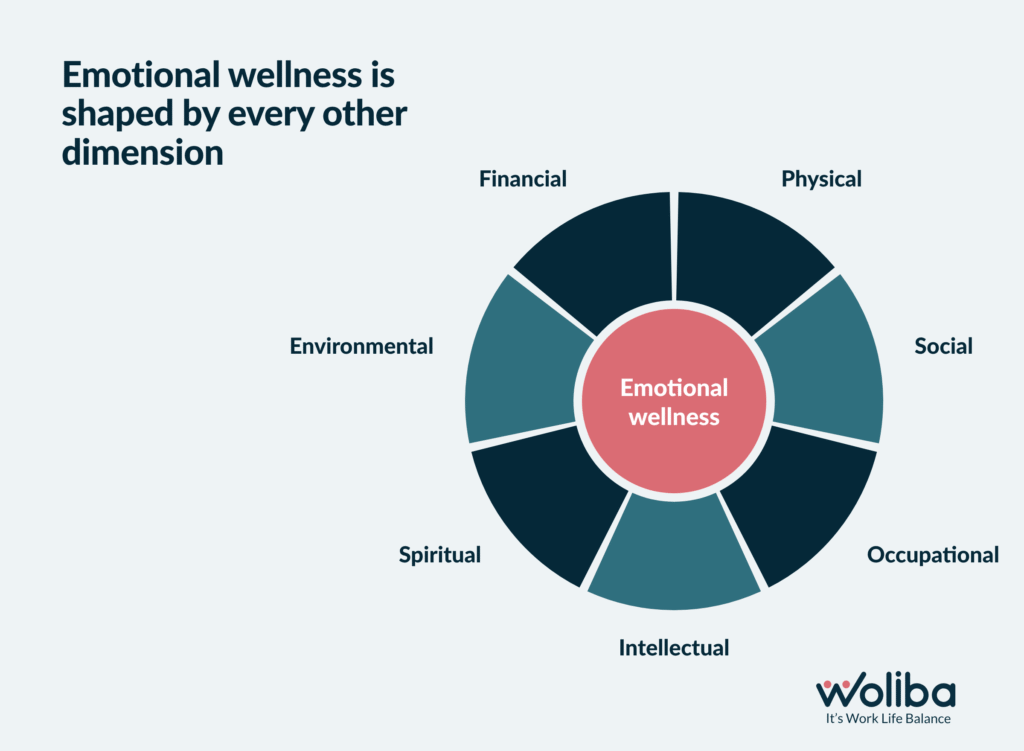
That’s why the strongest wellbeing programs don’t treat emotional wellness as a separate initiative. They support the whole person: body, relationships, finances, environment and sense of purpose. Each dimension you strengthen takes pressure off the others.
There’s a long-term payoff too. Research on wellness and longevity consistently links lower chronic stress and strong social connection to healthier, longer lives. For employers, that means a more resilient, experienced workforce that stays.
How to improve emotional wellness step by step: building a program
To build a wellness program, start by listening, choose two or three focus areas, equip managers first, launch small habits that repeat, and measure progress every quarter. Consistency matters far more than the size of the launch.
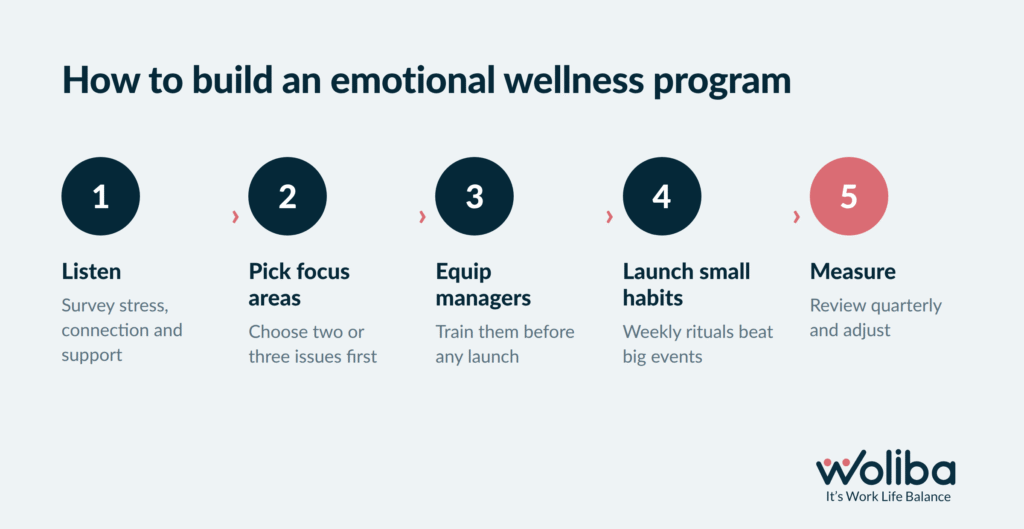
Step 1: Listen. Run a short anonymous survey on stress, connection, recognition and manager support. It shows where the real pressure points are.
Step 2: Pick focus areas. Choose two or three issues to tackle first, such as loneliness among remote staff or low recognition in frontline teams.
Step 3: Equip managers. Train managers before launching anything company-wide. They’ll carry most of the day-to-day work.
Step 4: Launch small habits. Weekly recognition programs, monthly pulse surveys and regular connection rituals beat a single big event.
Step 5: Measure and adjust. Review results quarterly, share what you’ve changed, and keep what works.
How to measure emotional wellness at work
To measure emotional wellness at work, combine regular pulse survey scores on stress, connection and support with outcome metrics like absenteeism, turnover and eNPS. Look at trends by team over several months rather than single snapshots.
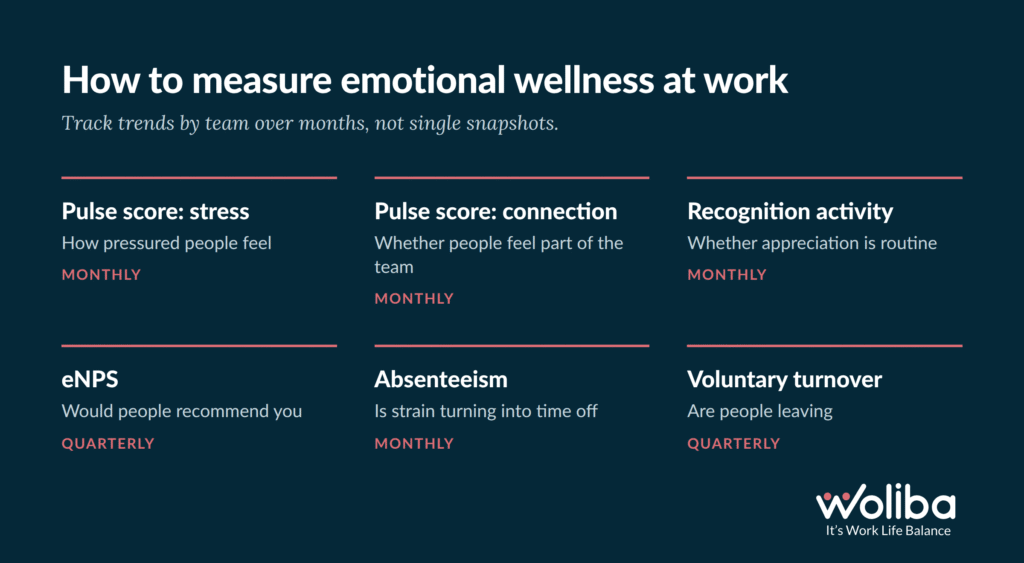
| Metric | What it tells you | How often |
|---|---|---|
| Pulse score: stress | How pressured people feel right now | Monthly |
| Pulse score: connection | Whether people feel part of the team | Monthly |
| Recognition activity | Whether appreciation is part of the routine | Monthly |
| eNPS | How likely people are to recommend you as an employer | Quarterly |
| Absenteeism | Whether strain is turning into time off | Monthly |
| Voluntary turnover | Whether people are leaving | Quarterly |
Break results down by team where you can. Emotional wellness often varies more between teams than between companies, and team-level data shows which managers need more support.
Common mistakes to avoid
The most common mistakes are treating emotional wellness as a one-time campaign, forgetting managers’ own emotional load, asking for feedback without acting on it, and assuming remote employees are fine because they’re quiet.
- One-off events. A single wellbeing day without follow-through feels like box-ticking. Build habits that repeat.
- Ignoring managers’ wellbeing. Stressed, isolated managers can’t support their teams well.
- Listening without acting. Surveys that lead nowhere damage trust faster than no survey at all.
- Assuming quiet means fine. Remote and introverted employees often struggle silently.
- Making it feel forced. Mandatory sharing backfires. Keep emotional check-ins optional and low-pressure.
How Woliba Supports Emotional Wellbeing at Work
Woliba is built to make wellbeing practical, proactive and personalized. With tools that span recognition, coaching, wellness content and real-time engagement insights, Woliba helps HR teams to:
- Monitor employee sentiment with pulse surveys
- Step Challenge and activity challenge
- Deliver relevant support with curated wellness resources
- Motivational Quotes and daily wellness tips
- Celebrate the behaviors that build emotional resilience
- Build a culture where wellbeing is simply part of how you do business
Whether you’re supporting remote workers, navigating change or trying to reduce burnout, Woliba helps your people stay emotionally strong, before problems take root.
Final thoughts
Emotional wellness in the workplace isn’t a soft issue. It shows up in engagement, conflict, sick days and resignations, and it’s shaped every day by how people are managed and how work feels.
You don’t need a big budget to start. Add a check-in to team meetings, train one group of managers, make recognition weekly, and start listening with short pulse surveys. Then act on what you hear. Over time, these small habits build a workplace where people can feel, cope and do their best work.