


Key takeaways
- Remote wellbeing is not office wellbeing delivered over Zoom. Isolation, sedentary workdays, blurred boundaries and time-zone spread are different problems and need different solutions.
- Most virtual employee wellness programs fail on scheduling, not on content. If everything is a live event, employees outside your headquarters’ time zone are structurally excluded — and attendance quietly collapses.
- Weight your program toward async. A rough mix of 60% async, 25% small-group live and 15% whole-team live gets far higher participation than a calendar full of group calls.
- Recognition counts as wellbeing. Remote employees consistently ask for tangible things — a note, a birthday card, snacks, a bonus, one real-life meetup a year — before they ask for another virtual class.
- Cover more than fitness. Programs built only on step counts reach the people who were already well. Spread activities across physical, mental, financial, social and nutritional support.
- Measure participation by region, not company-wide. A healthy average can hide an entire time zone nobody is serving.
- A well-designed program takes under an hour a month to run once automation handles the reminders, tracking and reporting.
What are virtual wellness activities?
Virtual wellness activities are digitally delivered programs that support employee health and wellbeing without requiring anyone to be in a shared physical space.
They cover physical, mental, emotional, social, financial, nutritional, and environmental wellbeing. Delivery happens through live sessions, on-demand content, app-based challenges, stipends, or peer programs, so employees can take part from anywhere.
Office wellness programs depend on people being in the same building. A fruit bowl works because employees walk past it. A lunchtime yoga class works because the room is close to their desk. A manager notices someone looks tired because they can see them.
None of that applies to a distributed team. Virtual employee wellness programs have to replace those built-in moments with intentional design. In practice, that means three things:
- Most activities should work asynchronously. Employees should be able to participate at 6am in Berlin or 9pm in Singapore.
- Participation has to be promoted actively. Nobody walks past a poster at home, so reminders, nudges, and channels do that work instead.
- The scope is broader. Because you are supporting someone in their home, remote wellness activities can include their chair, their lighting, their internet connection, and their working hours.
What counts as a virtual wellness activity
| Category | Examples |
|---|---|
| Live sessions | Fitness and yoga classes, guided meditation, cooking classes, lunch-and-learns, mental health workshops |
| On-demand content | Recorded class libraries, articles, recipes, learning modules, breathwork audio |
| Challenges and habits | Step, hydration, sleep, movement, and screen-free challenges |
| One-to-one support | Health and financial coaching, counselling and EAP access, nutritionist consultations |
| Stipends and benefits | Fitness, app, and ergonomic allowances, snack boxes, mental health days |
| Social and cultural | Buddy pairings, coffee chats, book clubs, wellbeing channels, virtual volunteering, peer recognition |
| Policy and time | No-meeting blocks, flexible hours, protected focus time, break norms |
Why remote employees need a different approach
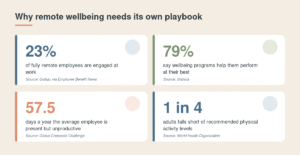
Four data points explain why remote wellbeing needs dedicated attention.
Engagement is lower. Only 23% of fully remote employees and 31% of hybrid employees report being engaged at work, according to Gallup data reported by Employee Benefit News.
Wellness programs do help. 79% of employees say their company’s wellbeing programs helped them perform at their most productive level (Statista).
Presenteeism is expensive. Employees take an average of four sick days a year but report being unproductive for 57.5 days, according to a Global Corporate Challenge survey. Presenteeism costs businesses around ten times more than absenteeism, and it is harder to spot in a remote team.
Activity levels drop. One in four adults worldwide does not meet recommended physical activity levels (World Health Organization). Removing the commute and the walk between meeting rooms makes this worse.
Mental health is affected too. Research from the American Psychiatric Association found that most employees working from home reported negative mental health effects, including isolation, loneliness, and difficulty disconnecting from work.
A UK survey reported by HR News found that 81% of younger workers felt more isolated at home, and 71% felt their colleagues were more distant.
The goal of remote wellness activities is to restore what an office provided automatically: movement, social contact, a clear end to the workday, and the feeling of being noticed.
How to choose the right format
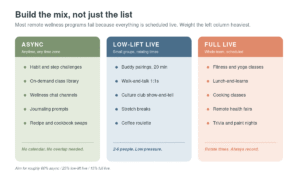
Low participation in virtual employee wellness programs is usually a format problem, not an interest problem.
The most common mistake is scheduling everything as a live event. When a program depends on a shared meeting time, employees outside the headquarters time zone either join outside working hours or stop joining at all. Rotating the time spreads the inconvenience rather than removing it.
Large group video calls also work poorly for connection. Fifteen people on a call is a broadcast, not a conversation. Small-group formats produce far more connection per minute.
Finally, wellness activities compete with meetings. Since most employees already spend a large share of their week in meetings, an optional wellness call is easy to skip.
Every activity below is tagged with one of three formats:
- [Async] — no shared time needed, works in every time zone. This should make up most of your program.
- [Small-group live] — two to six people, short, self-scheduled. High connection, easy to arrange.
- [Live] — whole-team and scheduled. Useful, but always record it and use it sparingly.
A useful target is 60% async, 25% small-group live, and 15% whole-team live.
34 wellness activities for remote employees
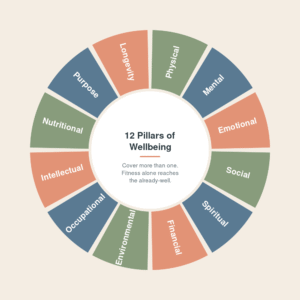
These are grouped by wellbeing dimension rather than by format, because the most common gap in remote wellness programs is covering only fitness.
Physical and movement
1. Step and movement challenges — [Async] Step challenges are the most common remote wellness activity because they need no shared time. Employees can hit a target at any hour. Run them in teams of two to four so people have a partner rather than a leaderboard, and keep them to four weeks or less.
2. On-demand fitness library — [Async] A library of recorded classes across formats and intensities: strength, mobility, dance, and low-impact options. On-demand content often gets more use than live classes because employees can try a beginner workout privately.
3. Live virtual fitness or yoga classes — [Live] Live classes help employees who need a calendar commitment to show up. Keep sessions to 30 minutes and record every one so it adds to your on-demand library.
4. Deskercise and stretch breaks — [Async] Short two-minute routines sent as reminders rather than meeting invites. Pair them with the American Academy of Ophthalmology’s 20-20-20 guidance: every 20 minutes, look at something 20 feet away for 20 seconds.
5. Walk-and-talk one-to-ones — [Small-group live] Employees take a recurring one-to-one by phone while walking. It costs nothing and requires no new tools. Managers usually need explicit permission before they will suggest it.
6. Fitness stipends and wearables — [Async] An annual allowance toward equipment, a fitness tracker, or a gym membership. Stipends work better than company-selected equipment because remote employees have very different space and budget constraints.
Mental and emotional
7. Guided meditation and mindfulness sessions — [Async and live] Offer both formats. Live sessions build the habit and signal that taking a break is acceptable. Recorded sessions are what employees use on a difficult afternoon.
8. Meditation and mental health app stipends — [Async] Meditation apps typically cost between $8 and $50 a month. Offering a stipend rather than one company-wide licence lets employees choose what suits them and avoids paying for unused seats.
9. Mental health days — [Async] The Mayo Clinic links planned mental health days to reduced burnout, better resilience, and fewer feelings of isolation. The policy is straightforward. Making it stigma-free is harder, and it requires leaders to take them visibly.
10. Virtual counselling and EAP access — [Small-group live] Employee assistance programs are common, but coverage across countries and time zones often is not. Check whether your provider offers appointments outside standard hours in every region where you employ people.
11. Mental health workshops — [Live] A 45-minute virtual session led by a specialist on a specific topic, such as sleep, workplace anxiety, or supporting a struggling colleague. Specific topics attract more signups than general awareness sessions.
12. Journaling and gratitude prompts — [Async] A weekly prompt delivered where employees already work, with no requirement to share responses. Completion rates are high because it is private and takes under two minutes.
13. Sound baths and breathwork — [Live] Audio-led sessions work well remotely because they do not require cameras on, which removes most of the reluctance employees feel about live wellness sessions.
Social connection
14. Buddy pairings and coffee chats — [Small-group live] Pair two employees from different locations every two weeks for a 20-minute self-scheduled catch-up. Gallup research shows 63% of women who strongly agree they have a best friend at work are engaged, compared with 29% of those who do not. Two people can find a time slot easily. Fifteen cannot.
15. Culture club sessions — [Small-group live or async] Employees share something specific to where they live: a local snack, a tradition, or a photo from their neighbourhood. This works as a rolling thread and turns a distributed team into an advantage.
16. Asynchronous games — [Async] Two truths and a lie, emoji story challenges, photo scavenger hunts, or guess-the-desk. Everyone contributes on their own schedule and results are shared in a single post.
17. A dedicated wellbeing channel — [Async] One place for recipes, walk photos, race results, book recommendations, and small wins. It costs nothing and connects your formal activities together.
18. Virtual volunteering — [Async and live] Online mentoring, skills-based nonprofit projects, or a team charity challenge. Purpose is an underused wellbeing driver and remote-friendly volunteering is now easy to find.
19. An annual in-person meetup — [Live] This is the most requested item among remote employees. If you can fund one gathering a year, virtual activities in between work better because employees are maintaining relationships rather than starting them.
Nutrition
20. Team cooking classes — [Live] An instructor, an ingredient list sent in advance, and 45 minutes. Cooking classes are one of the more reliable live formats because employees are doing something active rather than watching a screen.
21. A company cookbook — [Async] Collect recipes over a month and publish them internally with contributor names. It is low effort and employees keep using it long after the activity ends.
22. Healthy snack subscription boxes — [Async] These solve the problem that you cannot stock a shared kitchen for a remote team. Survey dietary needs and restrictions first.
23. Nutritionist consultations — [Small-group live] Individual virtual sessions, ideally with the same practitioner over time so progress is tracked. More effective than a one-off webinar for employees who want to make real changes.
Financial
24. Financial wellness webinars — [Live and recorded] Financial stress is a major and often unaddressed drain on focus. Cover practical topics such as pensions, debt, mortgages, and cross-border tax, and record sessions since employees often prefer to watch privately.
25. Budgeting and savings app subsidies — [Async] A small monthly contribution toward a budgeting or savings tool. Inexpensive, private, and it addresses a pillar most programs skip.
26. Hardship grants and emergency loans — [Async] A clear process for accessing a small interest-free advance during a crisis. Rarely used, but highly valued, and a strong signal about company values.
Intellectual and purpose
27. Virtual book club — [Async plus one live session] A 2024 study in the American Journal of Health Behavior linked workplace book clubs to stronger social connection, lower perceived stress, and better wellbeing. Reading is asynchronous and only the closing discussion needs to be live.
28. Lunch-and-learns — [Live and recorded] Employee-led 30-minute sessions on anything from sleep science to negotiation. Do not schedule them over lunch, and send remote employees a food delivery credit if you are catering for an office.
29. Goal-setting workshops — [Live or async] A structured session at the start of each quarter covering both work and personal goals. Inexpensive to run and it connects life outside work to capacity inside it.
Environmental and home office
30. Ergonomic assessments and equipment — [Async] A virtual assessment plus a budget for a chair, monitor riser, or keyboard. This is one of the highest-return items on the list. An employee with back pain needs equipment, not a yoga class.
31. Plants and better lighting — [Async] Subsidise a houseplant and a good desk lamp. Small changes to a room someone sits in for eight hours a day make a measurable difference to how it feels.
32. Internet and utilities allowance — [Async] A contribution toward internet, electricity, or cloud storage. Removing a daily frustration such as a call that keeps dropping supports wellbeing more than many activities labelled wellness.
Recognition and rest
33. Peer-to-peer recognition — [Async] Recognition is consistently what remote employees ask for first. Make it visible, frequent, peer-driven, and tied to specific work. It is one of the fastest-acting wellbeing tools and costs almost nothing.
34. No-meeting blocks and protected focus time — [Async] Giving employees time back is itself a wellness activity. Block one afternoon a week company-wide, enforce it from leadership down, and protect it.
Wellness challenges for remote workers
Wellness challenges for remote workers are the most popular format and the most frequently abandoned. A few design choices make the difference.
What works:
- Habit-based goals, not performance goals. Water, sleep hours, daily movement, screen-free evenings. Everyone can participate from day one.
- Teams of two to four. Small teams create accountability without a leaderboard that discourages the bottom half.
- Two to four weeks in length. Long enough to build a habit, short enough to finish. Challenges over six weeks tend to lose momentum by week three.
- Asynchronous tracking. Manual entry or a wearable sync, logged at any time.
- Rewards for completion, not for winning. Everyone who finishes receives something small.
- Rotating themes. Hydration in January, financial wellness in April, sleep in September. Rotation keeps challenges fresh and covers more wellbeing dimensions.
What does not work:
- Company-wide step leaderboards
- Challenges requiring a live weigh-in or check-in call
- Goals with a physical baseline that excludes employees with disabilities or chronic conditions
- Any format that makes non-participation visible
How to launch a program in 90 days
You do not need a large program to start. Three activities and a way to measure them is enough.
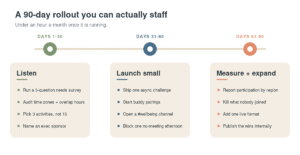
Days 1 to 30: Listen. Run a short survey asking which wellbeing area matters most, what employees would actually join, whether they prefer async or live, and what times work. Review your team’s real time zone overlap. Choose three activities. Name an executive sponsor who will take part visibly.
Days 31 to 60: Launch small. Start one async challenge, one round of buddy pairings, one wellbeing channel, and one no-meeting block. Announce it clearly once.
Days 61 to 90: Measure and expand. Report participation broken down by region. Drop anything with no uptake. Add one live format based on what employees asked for. Share results internally so the next round has momentum.
How to measure results
Most virtual employee wellness programs are judged on attendance at the last event, which says very little.
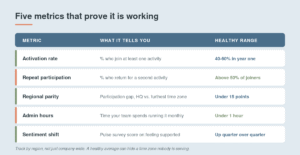
| Metric | What it tells you | Healthy range |
|---|---|---|
| Activation rate | Share of employees joining at least one activity | 40 to 60% in year one |
| Repeat participation | Share of participants who return for a second activity | Above 50% |
| Regional parity | Participation gap between HQ and your furthest time zone | Under 15 points |
| Admin hours | Time your team spends running the program monthly | Under 1 hour |
| Sentiment | Pulse survey score on feeling supported | Rising each quarter |
Regional parity is the metric most teams skip. A 45% company-wide activation rate looks healthy until you find it is 70% at headquarters and 12% in Asia-Pacific. That is a design issue, and a company-wide average will not show it.
Five mistakes to avoid
1. Scheduling everything live. This is the most common error and it excludes the employees who are already the most isolated.
2. Building the program only around fitness. Step challenges mostly reach employees who are already active.
3. Letting managers opt out. If leaders never take a mental health day or join a challenge, employees will not either.
4. Measuring attendance instead of repeat participation. Twenty people attending once is a weaker result than eight people attending five times.
5. Treating low turnout as failure. Some activities will reach 15% of your workforce. If those employees come back, the activity is working. Drop what nobody joins and keep what a smaller group values.
Getting started
The most effective remote wellness activities are usually the simplest ones: a two-minute stretch reminder, a hydration challenge with one teammate, a walk instead of a video call, or a note from a colleague in a channel where others can see it.
Getting the balance right matters more than the length of your activity list. Choose more async than live, more small groups than all-hands sessions, more wellbeing dimensions than fitness alone, and measure by region rather than by average.
Woliba combines engagement tools, wellness challenges across 12 pillars of wellbeing, recognition, and people analytics in one platform, so a program like this runs on automation rather than manual coordination.