

You’ve built a benefits package you’re proud of. Wellbeing programs, an EAP, recognition, rewards, maybe a mental health app. Then the utilization report lands, and most of it is sitting unused.
If you lead HR, benefits or employee experience, you already know the problem isn’t the benefits. It’s that employees can’t find them, don’t understand them, or forget they exist two weeks after open enrollment. This guide gives you a seven-step benefits communication strategy, a 12-month calendar, and a clear way to prove what’s working to leadership.
Key takeaways
- Most employees don’t fully understand their benefits, and most want messages tailored to them.
- Fragmentation, not lack of effort, is the main reason benefits go unused.
- One starting point, segmented messages, year-round timing and participation tracking close the gap.
- The right wellness platform turns communication into action and gives you one report for leadership.
The Benefits Awareness Gap is Bigger than Most HR Teams Think
MetLife’s 2025 Employee Benefit Trends Study found that only 57% of employees fully understand what their benefits cover, and 72% want communications tailored to their needs.
That means close to half your workforce may be making decisions about employee health, money and the 12 pillars of wellbeing with an incomplete picture. And when people don’t understand a benefit, they don’t value it. They also don’t factor it into whether they stay.
What the Gap is Actually Costing You
Unused benefits don’t just waste a line item. They quietly raise the real cost of every program you run.
Here’s a simple illustration. Say you spend $150,000 a year across nutritional wellbeing challenges, recognition ideas, rewards and an EAP for 1,000 employees. If only 30% use them, you’re paying $500 per engaged employee instead of $150. Lift participation to 60%, and that drops to $250 with no extra spend.
Low utilization also creates costs that don’t show up on the invoice:
- Retention risk: employees who undervalue their benefits underestimate their total compensation, which makes competing offers look better.
- HR time: every confusing message becomes a stream of repeat questions to your team.
- Weak budget conversations: when participation is low and data sits in five vendor dashboards, it’s hard to defend the program to your CFO.
Why Employee Benefits Communication Breaks Down
Your employees experience benefits in the middle of busy workdays. A message sent once during open enrollment is easy to miss. A resource buried in an unfamiliar portal is hard to find later.
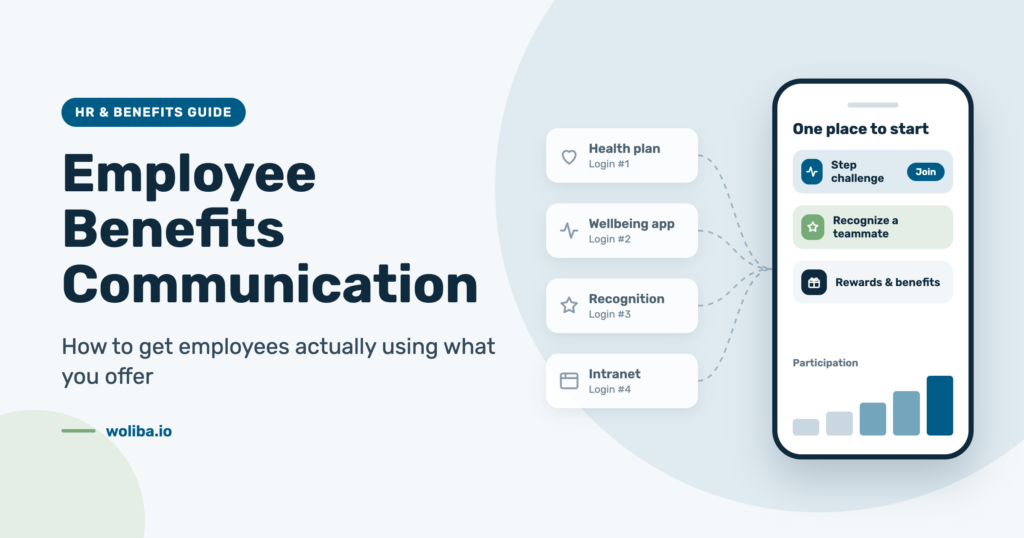
It gets harder when programs live with different vendors. To use what you offer, an employee may need to remember:
- one login for the health plan
- another app for wellbeing challenges
- a separate site for recognition or rewards
- an intranet page for everything else
Frontline, remote and office employees also get information through different channels, on different schedules. The result is a fragmented experience: the recognition programs exist, but people don’t use them.
That makes your data hard to read, too. When participation is low, you can’t tell whether the problem is the program, low awareness or a confusing sign-up process.
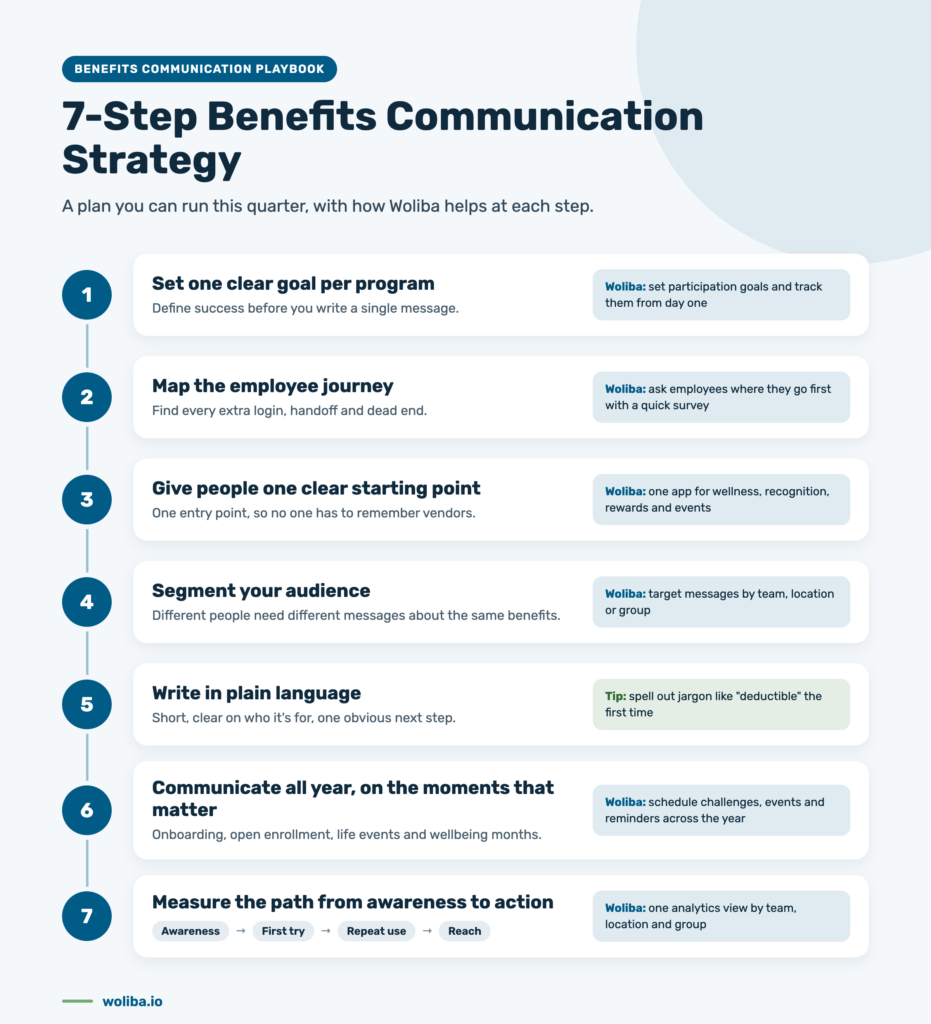
A 7-Step Benefits Communication Strategy
Use these steps as a plan you can run this quarter. Each step includes how Woliba helps, so you can see what it looks like in practice.
1. Set one clear goal per program
Decide what success looks like before you write a single message. “Raise EAP awareness to 80%” or “get 40% of employees into the social wellbeing challenge” gives you something to measure.
How Woliba helps: set up programs and personal challenges with participation goals and track progress against them from day one.
2. Map the employee journey
List every program you expect employees to use and the steps it takes to get into each one. Note every time someone has to switch platforms, re-enter information or search for instructions.
Then ask a few employees where they go first when they have a question. Their answers will show you friction that a vendor list never will.
How Woliba helps: a short Woliba survey can ask exactly this, and the results sit next to your participation data.
3. Give people one clear starting point
A single, easy-to-remember entry point removes the work of recalling which vendor does what. The test is simple: can any employee tell you where to start and what to do next?
How Woliba helps: Woliba brings 12 dimensions of wellness, recognition, rewards, surveys and events into one employee app, with links out to your carrier and benefits administration portals so employees still start in one place.
4. Segment your audience
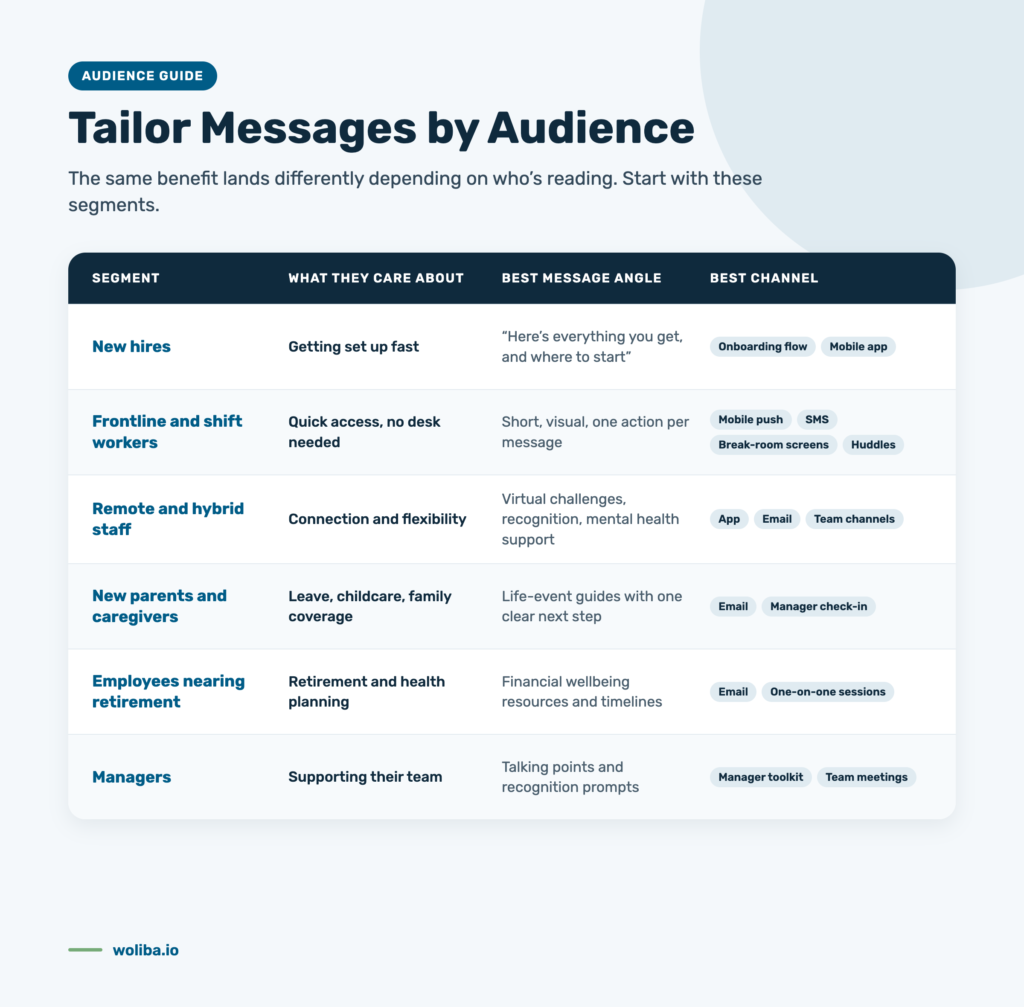
A 24-year-old new hire, a new parent and someone nearing retirement need different messages about the same benefits. So do a nurse on night shift and an analyst working from home. (See the segmentation table below.)
How Woliba helps: target messages, challenges and resources by team, location or group.
5. Write in plain language
Keep each message short, say who the program is for, and make the next step obvious. Spell out terms the first time, such as a deductible (the amount you pay before your plan starts paying).
6. Communicate all year, on the moments that matter
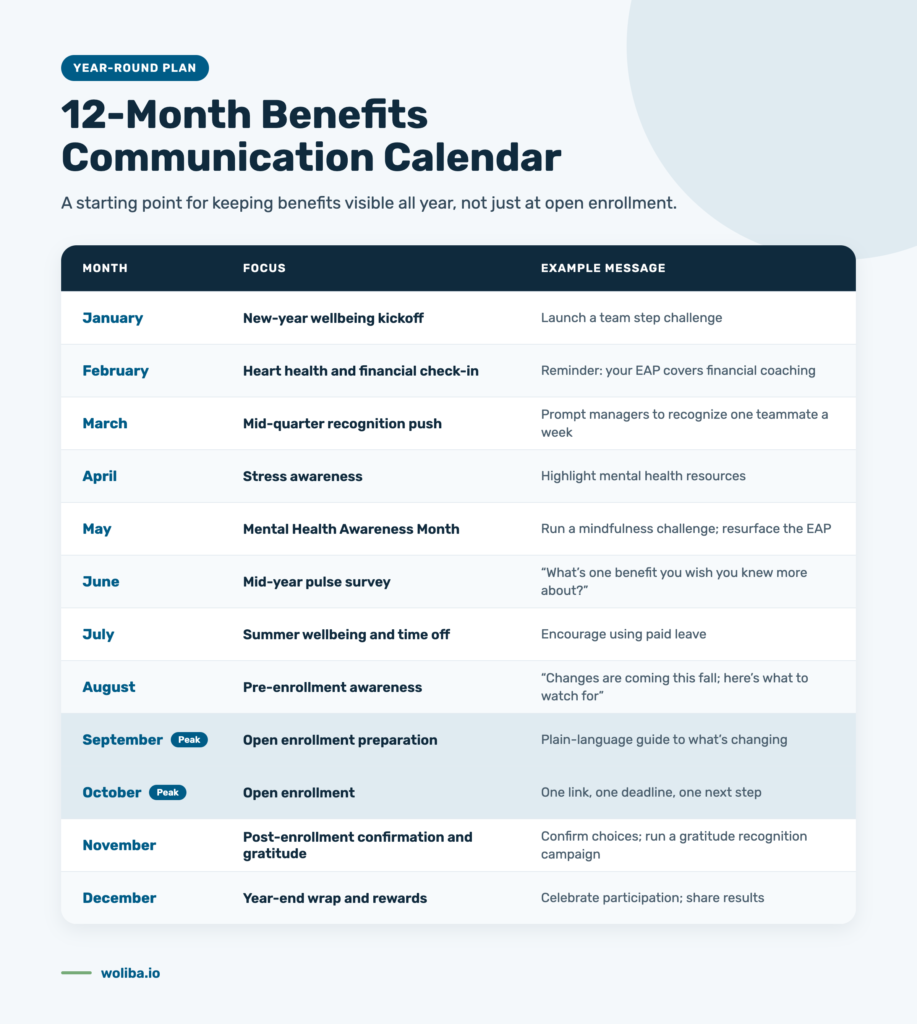
Tie messages to onboarding, open enrollment, life events, new quarters and wellbeing months. Repeat core information, because a message seen once is a message forgotten. (See the 12-month calendar below.)
How Woliba helps: schedule step challenges, events and reminders across the year so your calendar runs itself.
7. Measure the path from awareness to action
Delivery rates tell you a message was sent, not that it worked. Track what employees do next:
- Awareness: do employees know the program exists?
- First-time participation: how many tried it?
- Repeat use: how many came back?
- Reach: which teams, locations and shifts are taking part?
If awareness is high but participation is low, don’t send another reminder. Simplify enrollment or rethink the program. A short pulse survey can tell you why.
How Woliba helps: one analytics view shows participation by team, location and group, alongside survey questions & feedback, so you can see what’s landing and report it to leadership.
Team leaderboard
Example-
1. Operations 412,880
-
2. Finance 389,145
-
3. Customer Success 351,902
Steps this week
Tailor Messages by Audience
The same benefit lands differently depending on who’s reading. Start with these segments and adjust for your workforce.
Choose Channels Every Employee Can Reach
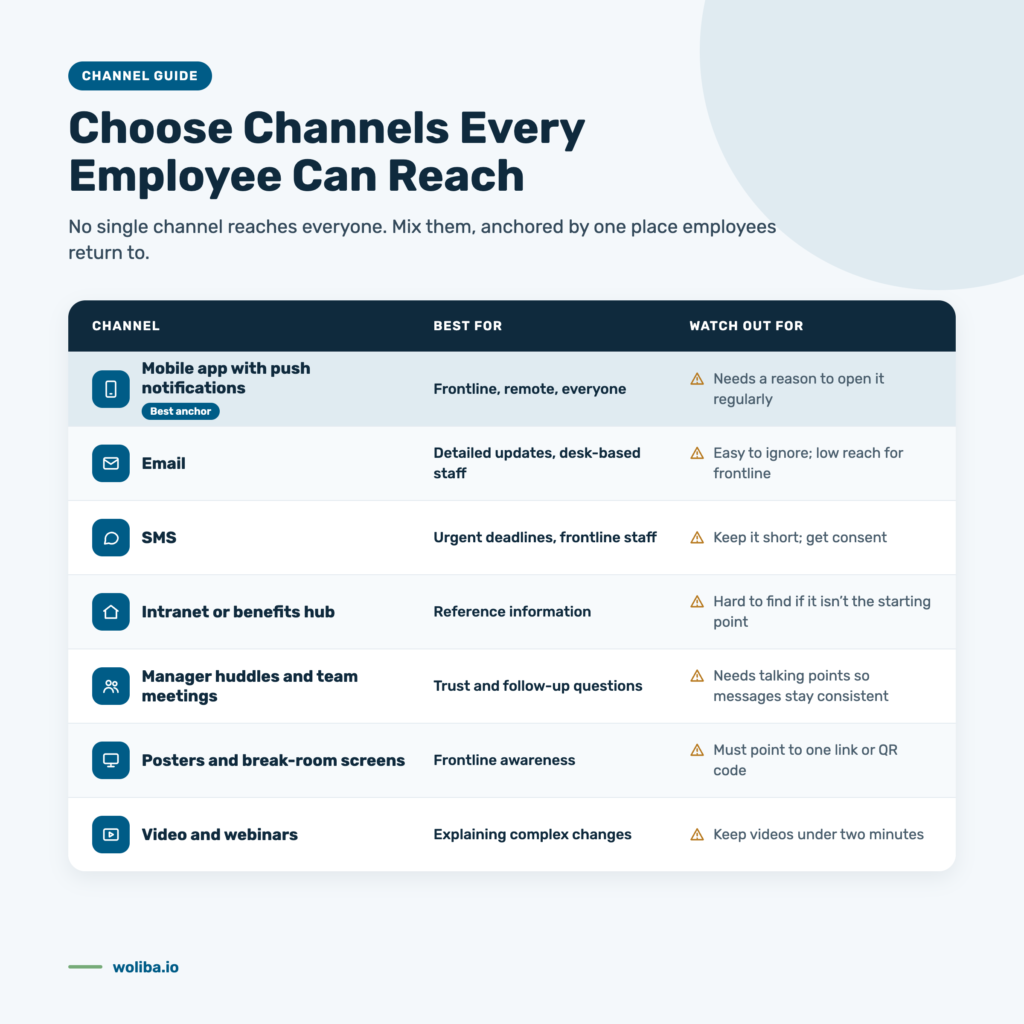
No single channel reaches everyone. A mix works best, anchored by one place employees always return to.
An app that employees already open for activity challenges, recognition and rewards is a natural anchor. People come back for the social side, and benefits messages ride along.
A 12-Month Benefits Communication Calendar
A good benefits communication strategy runs all year, not just for two weeks. Use this as a starting point.
Before and After: Rewriting a Benefits Message
Before:
Effective January 1, the HDHP option will include an HSA-eligible deductible of $1,600 for single coverage, and employer contributions will be deposited per pay period subject to plan eligibility requirements.
After:
Our lower-premium health plan is changing on January 1. You’ll pay the first $1,600 of covered care each year (your deductible), and we’ll add money to your health savings account every paycheck to help. Good fit if you’re generally healthy and want lower monthly costs. Next step: compare plans in the app by October 31.
The second version says who it’s for, what it costs, and what to do next. That’s the pattern for every message.
Equip Managers to Carry the Message
Employees often trust their manager more than a company-wide email. Give managers a short monthly note with two or three talking points, and make it easy for them to recognize people who take part. Recognition turns participation into something visible and social, which is what keeps people coming back.
Your Open Enrollment Communication Checklist
Before you send your next open enrollment message, check that it:
- Names one place to go, with one link
- Explains what’s changing this year in a sentence or two
- Says who each option is for, in plain words
- Gives a clear deadline and a single next step
- Reaches frontline and shift employees through a channel they actually use
- Tells people who to ask for help, by name
Watch for three common mistakes: one long email with every detail, unexplained plan jargon, and going quiet once enrollment closes.
What to Look for in a Benefits Communication Platform
If you’re comparing tools, use these questions to separate a communication channel from a platform that actually drives participation:
- One starting point: does it give employees one app for wellbeing, recognition, rewards and events, with links to everything else?
- Mobile-first reach: can frontline and shift workers use it without a desk or company email?
- Targeting: can you send different messages to different teams, locations and groups?
- Action, not just announcements: does each message lead to something employees can do right away, like join a challenge or recognize a colleague?
- Built-in feedback: can you run pulse surveys in the same place?
- One report: can you see participation by team, location and group in one view, ready for leadership?
- Predictable pricing: is pricing per employee and easy to forecast?
How Woliba Closes the Benefits Communication Gap
Woliba brings emotional wellness challenges, recognition, rewards, surveys, events and analytics into one employee engagement platform. Your employees get one place to start. You get one view of who’s taking part, by team, location and group.
- For employees: one mobile-friendly app, social challenges, peer and manager recognition, and rewards that make taking part worth it.
- For HR and benefits teams: targeted communication, scheduled programs, built-in surveys and one participation dashboard.
- For leadership: clear participation and engagement data to support your Total Rewards business case.
Woliba works alongside your benefits administration and carrier systems, as the engagement layer that gets employees to use them.
It also makes taking part social rather than solo. In Gallup’s study of more than 180,000 teams, the most engaged teams had 23% higher profitability and 78% lower absenteeism than the least engaged. That’s a correlation, not a promise, but it’s a good reason to invite people to join as a team.
Make the Next Step Easier to Find
Better employee benefits communication starts by removing friction. Set a goal, map the journey, give people one starting point, tailor the message, keep it going all year, and measure whether employees act.
Do that, and you’ll know whether your programs are reaching the people they’re meant to support. And you’ll have the numbers to prove it.