


Social wellness is the ability to build and keep healthy, supportive relationships. At work, it means employees feel connected to their coworkers, comfortable asking for help, and part of a team rather than just a name on an org chart.
For HR, social wellness at work has become harder to leave to chance. Hybrid schedules, distributed teams, and packed calendars mean many employees spend the day in meetings without ever really connecting with anyone.
This guide explains what social wellness looks like in the workplace, why it matters to the business, how to spot when it’s slipping, and eight practical ways HR and managers can strengthen it across in-office, remote, and frontline teams.
What Social Wellness Means in the Workplace
Social wellness is one of the core dimensions of wellness, alongside physical, emotional, and occupational wellbeing. In a workplace context, it’s less about being outgoing and more about having enough trusted relationships to feel supported.
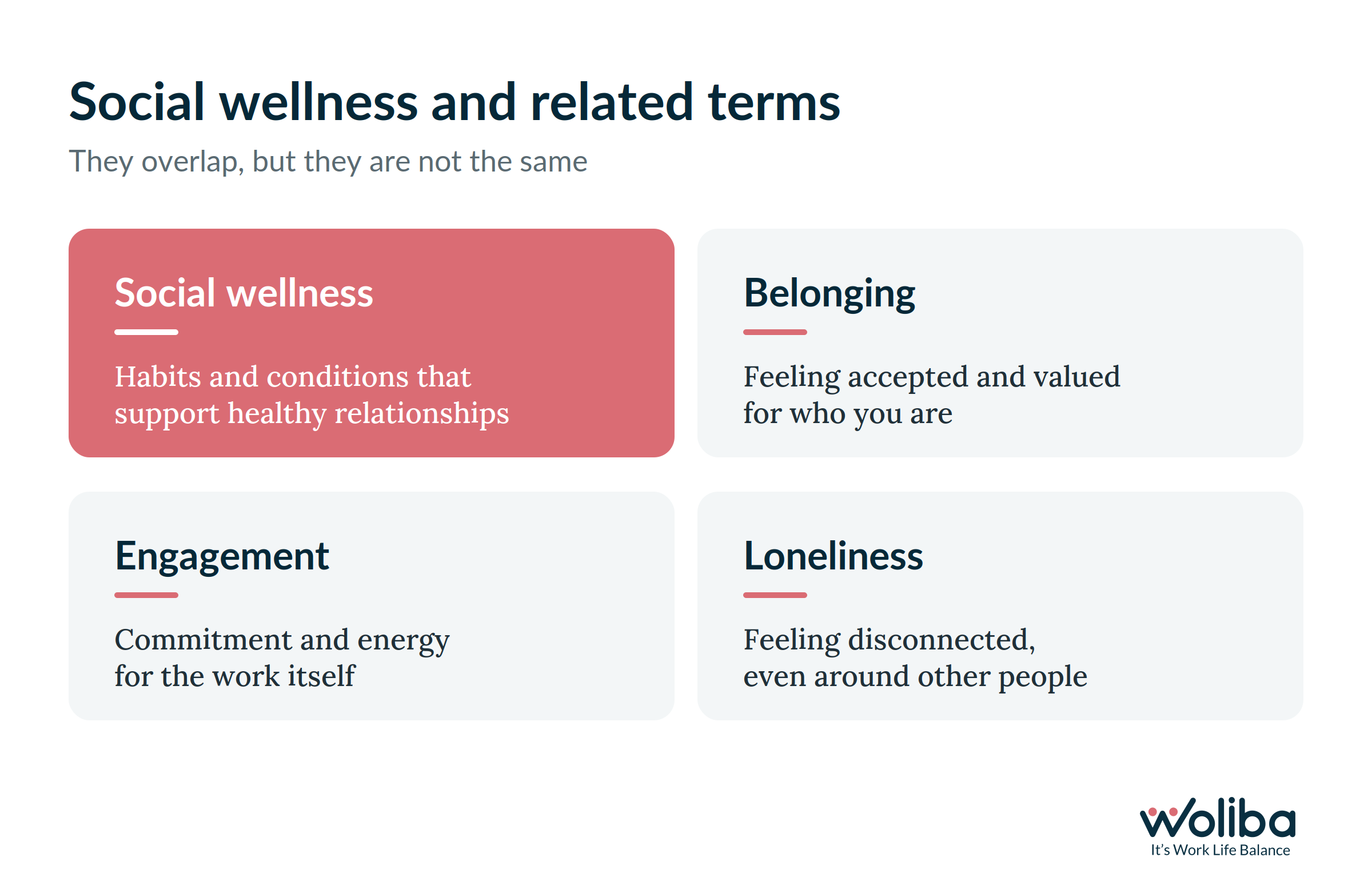
Several related terms come up in this conversation. They overlap, but they aren’t the same:
| Term | What it describes | At work, it looks like |
|---|---|---|
| Social wellness | The habits and conditions that support healthy relationships | Regular team rituals, peer support, time to connect |
| Belonging | Feeling accepted and valued for who you are | Employees speak up without worrying about fitting in |
| Engagement | Commitment and enthusiasm for the work itself | Discretionary effort and energy on the job |
| Loneliness | A feeling of being disconnected, even around other people | Someone who’s in every meeting but has no one to ask for help |
Social wellness doesn’t require everyone to become close friends. It means every employee has at least a few relationships at work that make the job easier and more human. Introverts, remote workers, and new hires all deserve that, even if what it looks like differs for each person.
The individual side of social wellbeing, like personal friendships and community ties, matters too. This guide focuses on what employers can do.
Why Social Wellness Matters for Employers
Social connection affects health, engagement, and retention. The research is clear that disconnection is common and costly.
| Finding | Source |
|---|---|
| About half of US adults reported measurable levels of loneliness, even before the COVID-19 pandemic | US Surgeon General Advisory, 2023 |
| Lacking social connection can increase the risk of premature death to a level comparable to smoking up to 15 cigarettes a day | US Surgeon General Advisory, 2023 |
| Stress-related absenteeism attributed to loneliness is estimated to cost employers $154 billion a year | US Surgeon General Advisory, 2023 |
| Only about 2 in 10 US employees say they have a best friend at work | Gallup survey, June 2022 |
Gallup has long tracked whether employees have a best friend at work, and its research links close work friendships to stronger engagement, safety, and performance. In earlier analysis, Gallup estimated that moving from 2 in 10 employees with a best friend at work to 6 in 10 could mean 36% fewer safety incidents, 7% more engaged customers, and 12% higher profit. These are estimates based on correlation, not a guaranteed return, but the direction is consistent.
The Surgeon General’s advisory also makes a direct recommendation to employers: make social connection a priority at every level, and respect off-time boundaries so people can maintain relationships outside of work too.
Signs of Low Social Wellness on a Team
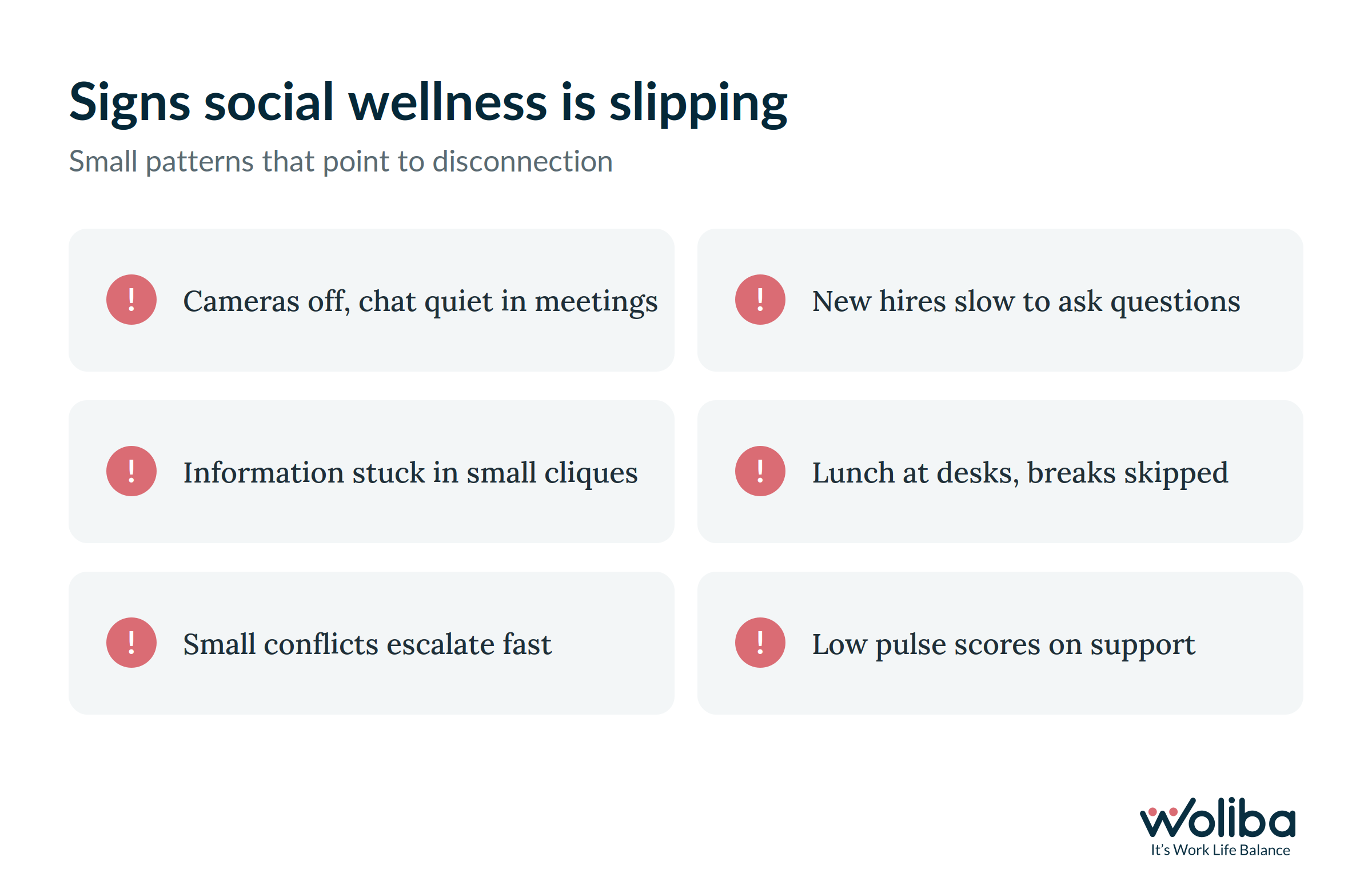
Low social wellness rarely announces itself. It tends to show up as small patterns:
- Cameras stay off and chat stays quiet in team meetings
- New hires take months to feel comfortable asking questions
- Information stays within small cliques or single departments
- People eat lunch at their desks or skip breaks entirely
- Conflicts escalate because coworkers don’t know each other well enough to assume good intent
- Pulse surveys show low scores on support, inclusion, or “I have someone to go to”
- Turnover is higher among remote employees or new hires
Disconnection also overlaps with employee burnout. When people feel they have to carry every problem alone, stress builds faster.
Social Wellness Examples at Work
Social wellness looks different depending on how a team works. These examples fit different work settings:
| Work setting | Social wellness examples |
|---|---|
| In-office | Walking 1:1s, shared team lunches, interest clubs, peer recognition on a shared wall or feed |
| Hybrid | Anchor days when the team is in together, rotating coffee chats across locations, hybrid-friendly team challenges |
| Fully remote | Virtual coffee pairings, camera-optional social channels, online team challenges, a short personal check-in at the start of meetings |
| Frontline and shift | Pre-shift huddles, recognition from supervisors on every shift, cross-shift team challenges, break rooms designed for conversation |
The common thread is that connection is built into the normal rhythm of work, not saved for an annual offsite.
How to Improve Social Wellness at Work: 8 Strategies
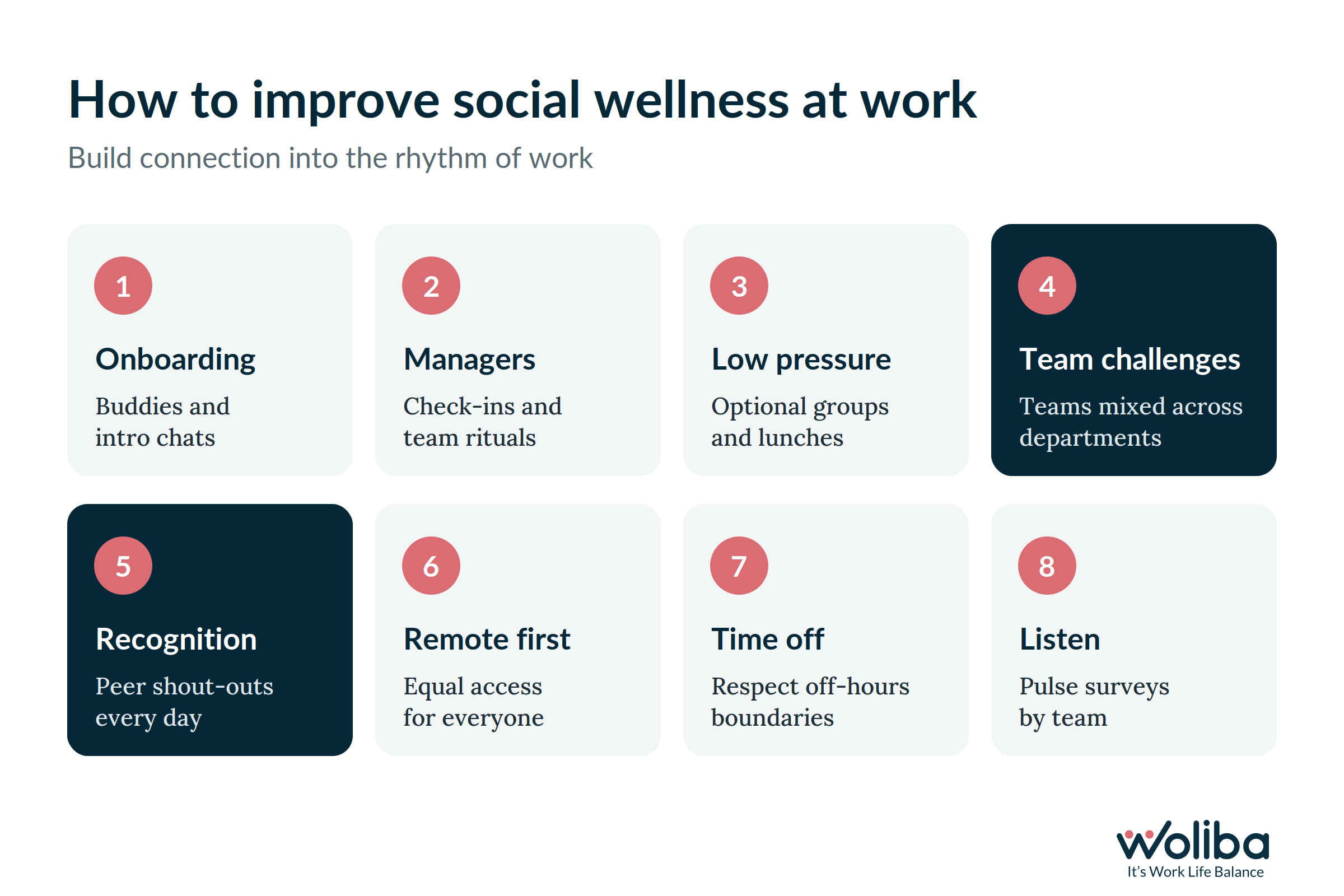
1. Make connection part of onboarding
The first few weeks shape whether someone feels like part of the team. Pair every new hire with a buddy outside their direct reporting line, schedule short intro chats with key colleagues, and include a team lunch or virtual welcome in the first week.
2. Equip managers to build connection
Managers set the social tone for their teams. Encourage them to open 1:1s with a personal check-in, create small team rituals like weekly wins, and notice when someone seems isolated. A short guide or training on these habits goes further than a company-wide memo.
3. Create low-pressure ways to connect
Not everyone wants a happy hour. Offer a mix of options: interest-based groups, lunch-and-learns, volunteer days, and casual chat channels. Keep everything optional and vary the time of day so caregivers and shift workers can join too. A list of employee engagement ideas can help you build a varied calendar.
4. Run team challenges that cross departments
Shared goals give people a natural reason to talk. Step, hydration, or kindness challenges with mixed-department teams connect people who wouldn’t otherwise work together.
E-J Electric, a nationwide electrical contractor with crews across job sites and offices, built friendly competition across departments through regular team challenges. Challenge participation grew from 14% to 38%, and the company expanded from 3 to 25 annual campaigns. As one employee put it: “I really just wanted to beat one other person that works for E-J.”
5. Build a habit of peer recognition
Recognition is one of the simplest social habits to scale. When employees can publicly thank each other, they notice each other’s work, and relationships grow from there. A culture of recognition turns appreciation into a daily habit rather than an annual event.
Gilsbar, an insurance services organization in Louisiana, saw social feed posts grow from 46 to 438 in its first year on Woliba, with employees recognizing peers through shout-outs and badges across departments and leadership levels.
6. Design for remote and hybrid employees
Remote employees often feel social disconnection first. Give them equal access to every social activity, assign hosts for hybrid events, and keep a camera-optional channel for casual conversation. More ways to keep remote employees engaged carry over directly.
Love & Company, a marketing agency with remote and hybrid staff, had no formal employee wellness program before launching Woliba. Through step and water challenges, live sessions, and recognition aligned with its company values, wellness became a recurring part of team conversations, creating more space to talk openly about stress and burnout.
7. Protect time off for relationships outside work
Social wellness isn’t only about relationships at work. The Surgeon General’s advisory specifically recommends that employers respect off-time boundaries. Limit after-hours messages, honor vacations, and avoid scheduling social events that eat into family time.
8. Listen and adjust
Ask employees how connected they feel, then act on the answers. A short employee pulse survey with two or three questions about support and belonging shows where connection is strong and where it’s slipping, by team, location, or shift.
Social Wellness Activities for Employees
These activities are easy to run and work for most teams:
- Virtual or in-person coffee pairings across departments
- Team walking or step challenges
- Gratitude walls or recognition feeds
- Volunteer days with a local charity
- Interest clubs, such as book, cooking, or running groups
- Lunch-and-learn sessions led by employees
- Team trivia or game breaks
- Peer mentoring circles
- Seasonal events, like Christmas team building activities
- Kindness challenges where teammates do small favors for each other
- Welcome lunches for new hires
- Wellness champions who organize local meetups
Recruiting wellness champions from different departments and shifts helps activities reach people that HR alone can’t.
How to Measure Social Wellness at Work
Social wellness is harder to measure than steps, but it’s not invisible. Track a mix of participation, sentiment and roi corporate wellness program:
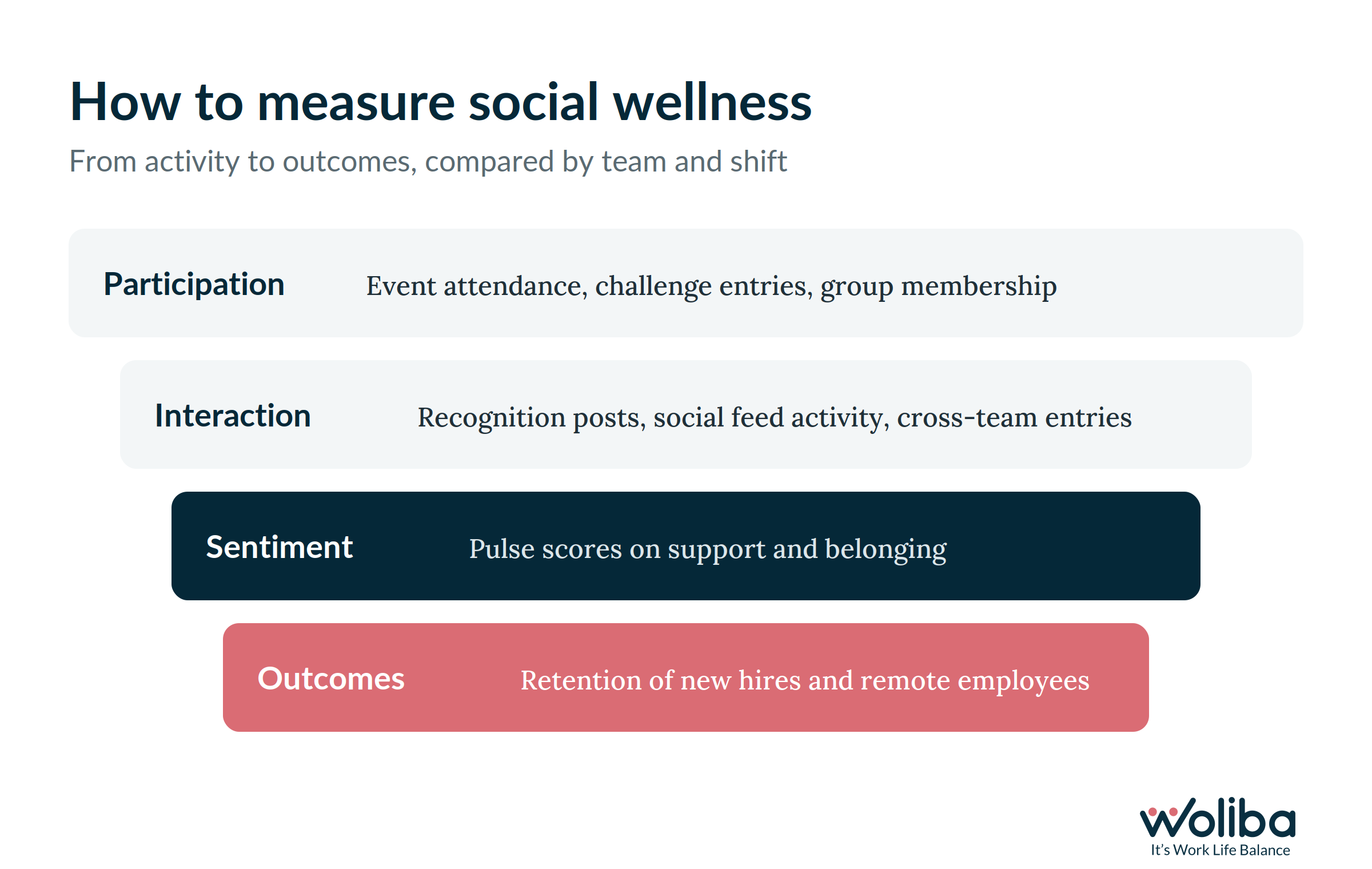
| What to track | Example measures |
|---|---|
| Participation | Attendance at social events, challenge participation, interest group membership |
| Interaction | Recognition posts, social feed activity, cross-department team entries |
| Sentiment | Pulse survey scores on support, belonging, and “I have someone to go to at work” |
| Outcomes | Retention among new hires and remote employees, time to productivity for new hires |
Compare results by team, location, and shift. A strong company average can hide a remote team or night shift that feels left out. The same segmented approach works for broader employee wellbeing metrics.
Build Connection Into the Way Your Team Works
Social wellness at work isn’t about forcing friendships or adding more events to the calendar. It’s about making sure connection is part of the normal rhythm of work, from onboarding to everyday recognition to the way remote teammates are included.
Start with one or two strategies, measure how connected people feel, and build from there. Social wellness also reinforces emotional wellness in the workplace and physical wellness at work, because the people we feel connected to are the people who help us through hard days.