

Longevity wellness is about living a long life and staying healthy for as much of it as possible. At work, it means helping employees build small, steady habits, like moving more, sleeping well, and staying connected, that keep them healthy and energized for years, not just for a few weeks.
Most companies already run some kind of corporate wellness program. The problem is that many programs start strong in January and fade by spring. Longevity wellness fixes that by focusing on habits that last.
This guide explains longevity wellness in simple terms. You’ll learn what it is, why it matters for your company, the habits that make the biggest difference, and a step-by-step plan to build a wellness program that keeps working year after year.
What Is Longevity Wellness?
Longevity means living a long life. Longevity wellness goes one step further. It means living a long life and staying healthy, active, and happy for most of it.
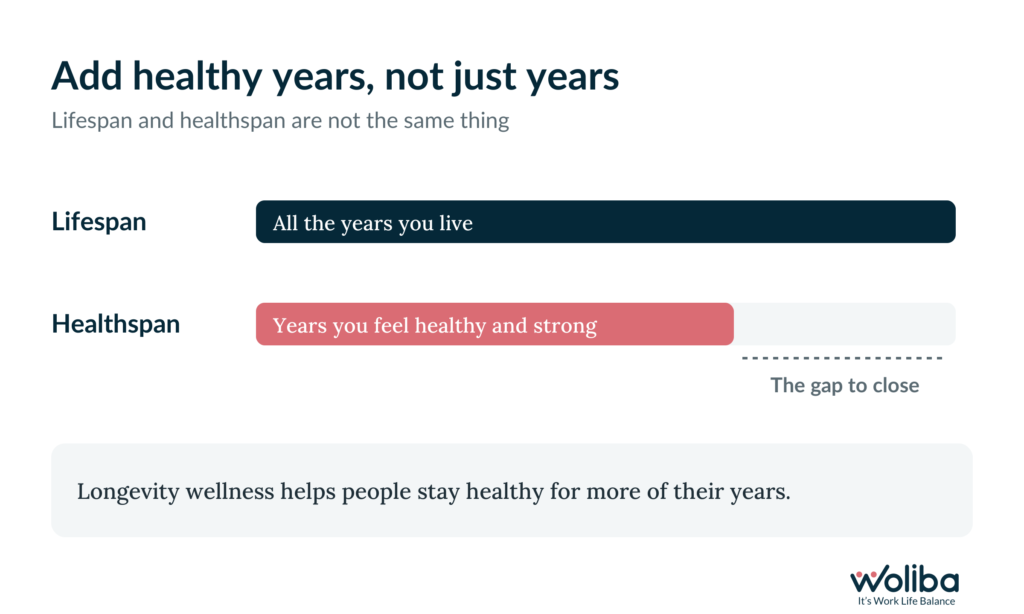
Experts often talk about two kinds of years:
| Term | What it means | Simple example |
|---|---|---|
| Lifespan | How many years you live | Living to 85 |
| Healthspan | How many of those years you feel healthy and strong | Feeling energetic and independent until 80 |
The goal of longevity wellness is to close the gap between the two. You want more healthy years, not just more years.
At work, longevity wellness is one of the core dimensions of wellness. In Woliba’s framework of 12 Pillars of Wellbeing, longevity is the pillar that ties all the others together. It’s what happens when good habits in movement, sleep, food, relationships, and purpose add up over time.
Longevity wellness is about habits, not quick fixes
Longevity isn’t built with one big event, like a health fair once a year. It’s built with small things people do every day:
- A short walk after lunch
- Going to bed at the same time each night
- Drinking water instead of a third coffee
- Talking to a friend at work
- Getting an annual checkup
None of these feel like much on their own. Over months and years, they make a big difference.
Why Longevity Wellness Matters at Work
Most adults spend a big part of their week at work. That makes the workplace one of the best places to build healthy habits, or one of the easiest places to lose them.
Here’s what the research shows about the health of US adults today:
| Finding | Source |
|---|---|
| About 1 in 2 US adults lives with a chronic disease | CDC |
| Only about 1 in 4 adults gets enough physical activity | CDC |
| About 30% of adults sleep less than 7 hours a night | CDC, 2024 data |
| Getting enough activity could prevent 1 in 12 cases of diabetes and 1 in 15 cases of heart disease | CDC |
| Lacking social connection can raise the risk of early death about as much as smoking up to 15 cigarettes a day | US Surgeon General, 2023 |
These numbers matter to employers for three simple reasons.
1. Healthier employees miss fewer days
When people sleep well, move often, and catch health problems early, they tend to feel better and show up with more energy. Many of these habits also support physical wellness at work.
2. Long-term habits protect health care costs
Chronic diseases like diabetes and heart disease often develop slowly over many years. Habits that help prevent them, like regular activity and checkups, work best when people keep them up for a long time. A program that only lasts a few weeks can’t do that.
3. People stay where they feel cared for
A company that helps employees stay healthy for the long run shows it cares about them as people. That kind of care builds trust and loyalty. It’s also one of the clearest benefits of employee wellness programs that last.
Try Woliba free
Plan your whole wellness year in one place
Schedule monthly challenges, events, and reminders so momentum never stops.
Start Free TrialThe Building Blocks of Longevity Wellness
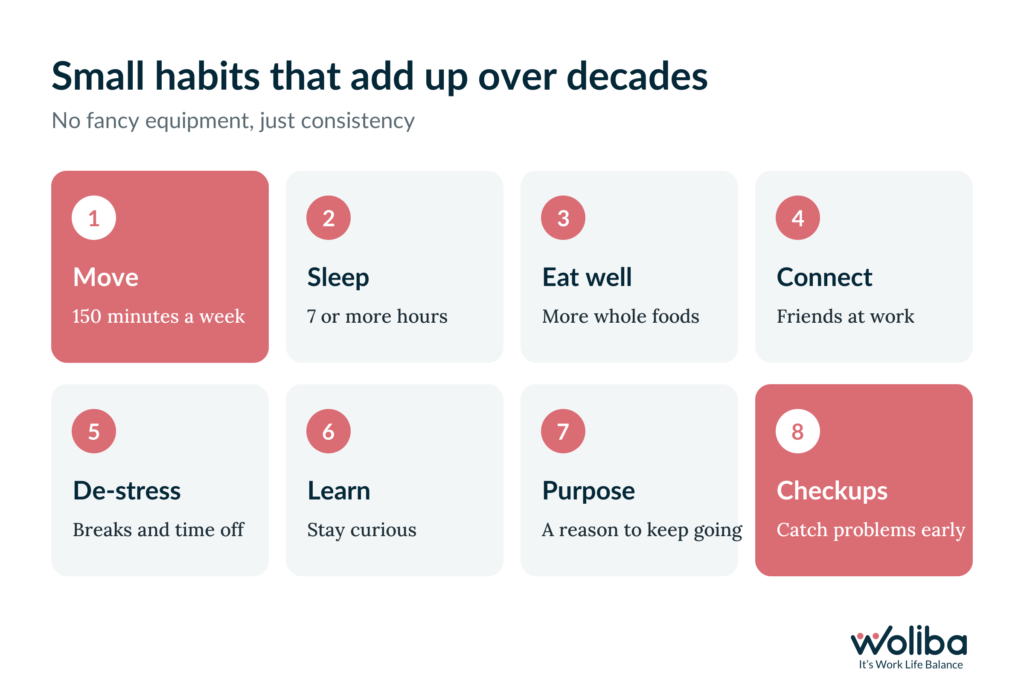
Longevity comes from a handful of everyday habits. You don’t need fancy equipment or expensive programs. You need consistency.
Move every day
Regular movement keeps your heart, muscles, and bones strong. Adults should aim for at least 150 minutes of moderate activity a week, like brisk walking, plus muscle-strengthening activities twice a week. That’s about 30 minutes, five days a week. Short walks count.
Sleep seven or more hours
Sleep is when your body repairs itself. Adults need at least seven hours a night. Going to bed and waking up at the same time each day helps. A team sleep challenge is an easy way to make better sleep a shared goal.
Eat mostly whole foods
You don’t need a strict diet. Eat more fruits, vegetables, whole grains, and water, and fewer sugary drinks and heavily processed snacks. At work, small changes help, like offering healthy snacks for work in the break room.
Stay connected
Friends and supportive coworkers are good for your health. Strong relationships help people handle stress and stay active as they age. That’s why social wellbeing is a big part of longevity.
Manage stress
Some stress is normal. Constant stress, with no time to recover, wears the body down. Breaks, time off, and reasonable workloads all help.
Keep learning and stay curious
Learning new skills keeps the mind sharp. Reading, taking a course, or trying a new hobby all count.
Find purpose
People who feel their life and work have meaning tend to stay more engaged and resilient. Purpose gives people a reason to keep their healthy habits going.
Get regular checkups
Many health problems are easier to treat when they’re caught early. Annual checkups and screenings are one of the simplest longevity habits. A short health risk assessment can also help people see where to focus.
Signs Your Wellness Program Isn’t Built for the Long Run
Many wellness programs look great on paper but don’t last. Here are common warning signs:
- Participation jumps in January, then drops by March
- Most activities are one-time events, like a single health fair
- The same few people join every challenge
- There’s nothing for remote, field, or shift workers
- Rewards stop, and so does participation
- No one tracks results from one year to the next
If you see these signs, you’re not alone. Many companies notice that culture initiatives fail after 90 days because they rely on excitement instead of habits.
The good news is that these problems are fixable. The next section shows you how.
Try Woliba free
Plan your whole wellness year in one place
Schedule monthly challenges, events, and reminders so momentum never stops.
Start Free TrialHow to Build Longevity Wellness at Work: 10 Simple Steps
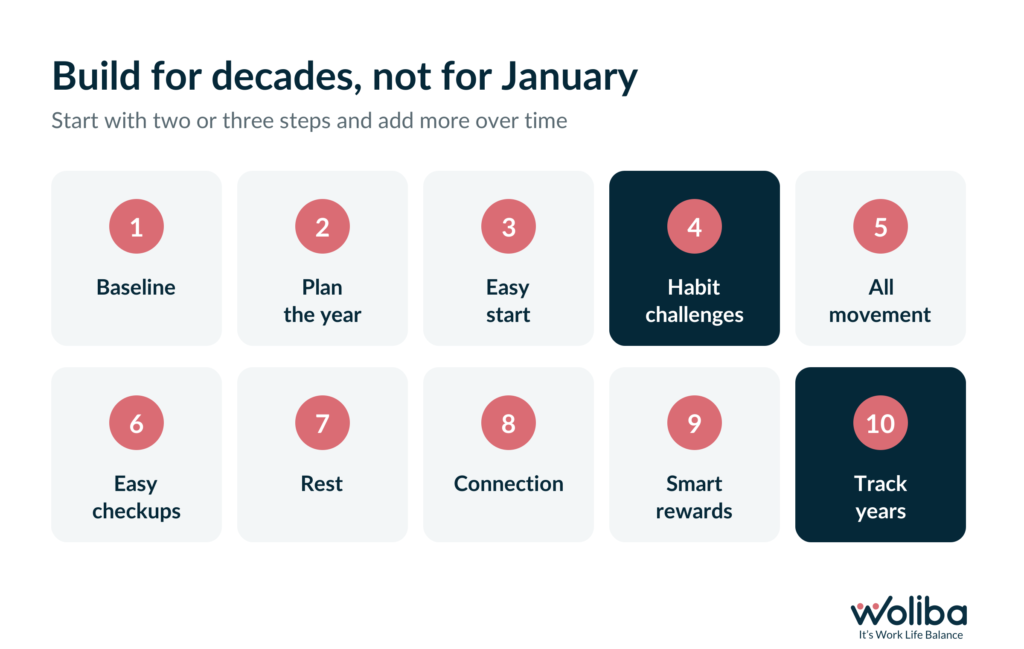
You don’t have to do all 10 steps at once. Start with two or three, then add more over time.
Step 1: Start with a baseline
Before you plan anything, find out where people are today. A short anonymous survey or health assessment can show which habits need the most help, like sleep, stress, or activity.
Keep the results anonymous and look only at group trends. Employees should never feel their personal health information is being watched.
Step 2: Plan for the whole year, not just January
Instead of one big push in January, spread your wellness activities across all 12 months. Pick one focus each month, like hydration in July or gratitude in November. This keeps things fresh and gives people a reason to come back.
Step 3: Make it easy to start
Long-term habits begin with tiny steps. A 10-minute walk is easier to stick with than a one-hour workout. Choose challenges that anyone can join, no matter their fitness level, age, or schedule.
Step 4: Run habit challenges, not just competitions
Competitions are fun, but they often reward the people who are already fit. Habit challenges reward consistency, like drinking water every day for a month or going to bed on time five nights a week. Well-designed habit challenges help people build routines that stick after the challenge ends.
Step 5: Count every kind of movement
Not everyone runs or goes to the gym. Make sure walking, stretching, gardening, dancing, and chair exercises all count. A team step challenge at work that counts any movement lets everyone join in.
Step 6: Make checkups easy
Give employees paid time for annual physicals and screenings. Remind them when their benefits reset. Small rewards for completing a checkup can help people stop putting it off. Focusing on preventive care is one of the smartest long-term investments a company can make.
Step 7: Protect rest and recovery
Longevity isn’t just about doing more. It’s also about resting enough. Limit after-hours emails, encourage people to use their vacation days, and watch for teams where overtime has become normal. These steps also help prevent employee burnout.
Step 8: Build connection into the workday
Lonely people are less likely to keep healthy habits. Team challenges, walking groups, lunch-and-learns, and peer recognition all help people feel connected. Connection also makes habits more fun, because people do them together.
Step 9: Use rewards wisely
Rewards can help people get started, but they shouldn’t be the only reason people participate. Use small, steady rewards for effort and consistency, not for outcomes like weight. Thoughtful wellness program incentives keep people engaged without creating pressure.
Step 10: Track progress over years, not weeks
Longevity is measured in years. Look at participation, habits, and how people feel from one year to the next. If participation keeps growing year after year, your program is working.
Longevity Wellness for Every Age and Stage
Longevity wellness isn’t just for older employees. Healthy habits built in your 20s and 30s pay off for decades. But people at different stages often need different kinds of support.
| Career stage | Common challenges | Helpful support |
|---|---|---|
| Early career | Irregular sleep, stress, building new routines | Habit challenges, financial wellness basics, mentoring |
| Mid-career | Busy schedules, caregiving, less time to exercise | Short workouts, flexible schedules, stress support |
| Later career | Joint health, preventive screenings, planning for the future | Low-impact activity, screening reminders, knowledge-sharing roles |
The key is to offer choices instead of one plan for everyone. Different generations often want different things, which is why wellness programs for Gen Z and millennials may look different from programs for employees closer to retirement.
Avoid assumptions based on age alone. A 60-year-old might run marathons, and a 25-year-old might have a chronic condition. Let people choose what fits them.
Remote, field, and shift workers
Longevity habits matter just as much for people who don’t sit in an office. Remote employees may move less and feel more isolated. Field crews may move a lot but struggle with rest and recovery. Shift workers often have trouble getting regular sleep.
Make sure every activity has a version that works for them. Use app-based challenges people can join from anywhere, schedule live sessions at different times, and send reminders that fit different work hours. Many wellness activities for remote employees can also be adapted for field and shift teams, so nobody is left out.
Try Woliba free
Wellness for every age, role, and schedule
Offer app-based challenges, on-demand content, and live sessions for office, remote, and shift teams.
Start Free TrialA Simple Year-Round Longevity Calendar
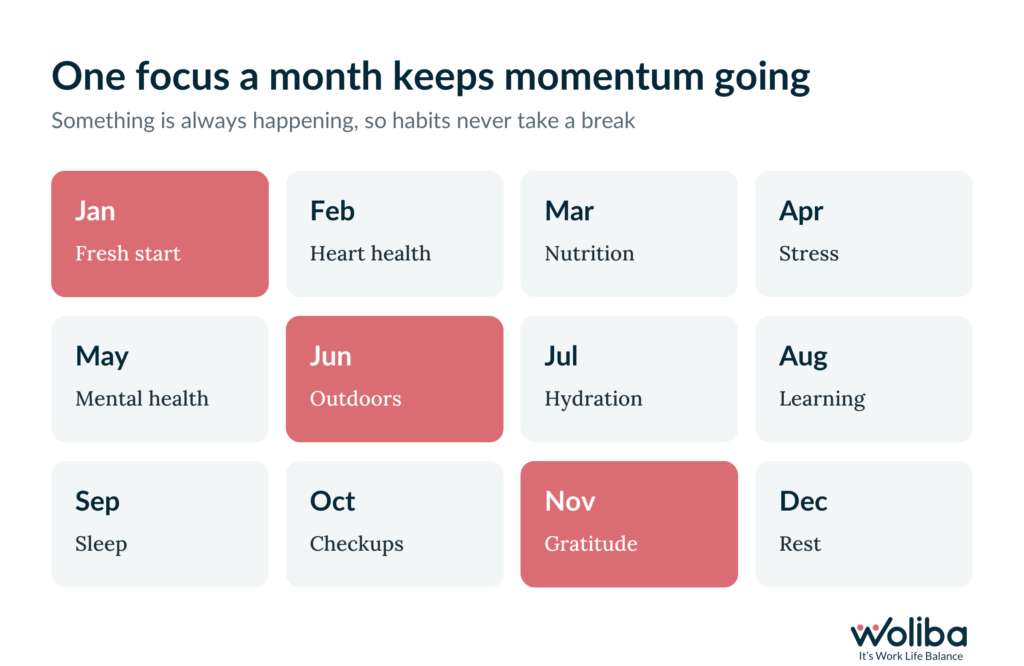
One of the easiest ways to keep a wellness program going all year is to give each month a focus. Here’s a simple calendar you can copy:
| Month | Focus | Easy activity |
|---|---|---|
| January | Fresh start | Set one small habit goal for the year |
| February | Heart health | Walking challenge with team totals |
| March | Nutrition | Add one vegetable a day challenge |
| April | Stress | Five-minute breathing breaks |
| May | Mental health | Share mental health resources and check-ins |
| June | Outdoors | Walking meetings and lunch outside |
| July | Hydration | 30-day water challenge |
| August | Learning | Learn a new skill challenge |
| September | Sleep | Consistent bedtime challenge |
| October | Preventive care | Screening and checkup reminders |
| November | Gratitude | Gratitude wall or 30-day gratitude challenge |
| December | Rest and reflection | Encourage time off and year-end reflection |
You can change the order to fit your company. What matters is that something is always happening, so healthy habits never take a long break.
Real Results: When Habits Last
Longevity wellness takes time, and the best evidence comes from companies that stick with it year after year.
Lyon Waugh Auto Group, a dealership group in the Boston area, started with fitness activities and challenges on Woliba. Active participation grew from 55% in 2024 to 67% in 2025, then reached 99% of employees in the first five months of 2026. Each year built on the one before.
Abacus Technology, a desk-focused technology team in Maryland, saw a similar pattern. Active employees grew from 62% in 2024 to 69% in 2025, and every employee was earning points in the first five months of 2026.
The lesson from both companies is simple: participation grows when a program stays consistent and keeps giving people new reasons to join.
Try Woliba free
Wellness, recognition and rewards in one app
Launch challenges, celebrate wins and run pulse surveys from a single platform your employees will actually use.
Start Free TrialHow to Measure Longevity Wellness
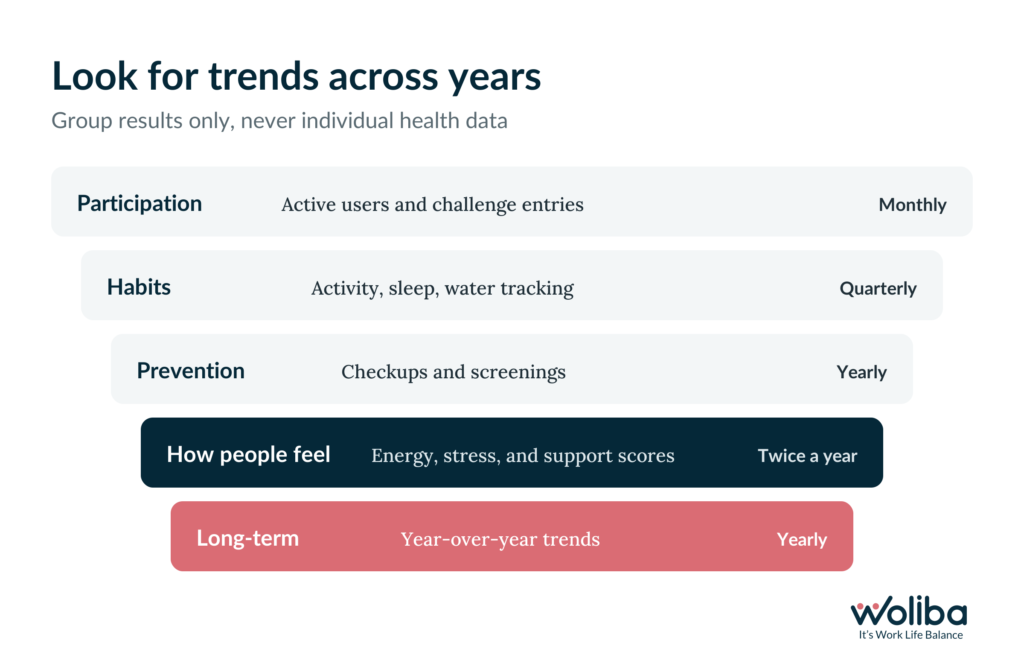
You can’t measure longevity in a single quarter. Instead, track a few simple things over time and compare each year to the last.
| What to track | Example measures | How often |
|---|---|---|
| Participation | Active users, challenge entries, event attendance | Monthly |
| Habits | Average activity, sleep challenge completion, water tracking | Quarterly |
| Prevention | Checkup and screening completion, health assessment completion | Yearly |
| How people feel | Survey scores on energy, stress, and support | Twice a year |
| Long-term results | Year-over-year participation, absence, and turnover trends | Yearly |
Always look at group results, never individual health data. Compare by team, location, and shift to find groups that need more support. Tracking simple employee wellbeing metrics each year shows whether your program is building habits that last.
How Longevity Connects to Other Dimensions of Wellness
Longevity is the result of all the other dimensions working together. Good sleep and movement come from physical wellness. Strong friendships come from social wellness. Purpose and growth at work come from occupational wellness.
Managing stress and emotions also plays a big role. When people feel calm and supported, they’re more likely to stick with healthy routines. That’s why emotional wellness in the workplace is part of any long-term plan.

Free HR playbook
12 Dimensions of Wellness at Work
Signs each dimension needs attention, practical HR actions, challenge ideas, a scorecard, and a 90-day plan. 17 pages, free.
Thanks! Your guide is ready.
Download the PDFFrequently Asked Questions About Longevity Wellness in the Workplace
What is longevity wellness?
Longevity wellness means living a long life and staying healthy, active, and happy for as much of it as possible. It focuses on everyday habits like movement, sleep, healthy eating, strong relationships, stress management, and regular checkups.
What is the difference between lifespan and healthspan?
Lifespan is the number of years you live. Healthspan is the number of those years you spend feeling healthy and strong. Longevity wellness aims to increase healthspan, so people enjoy more healthy years.
Why should employers care about longevity wellness?
Healthy habits help employees feel better, miss fewer days, and stay engaged. Because many chronic diseases develop slowly, habits that last for years have a bigger impact than short programs. Supporting long-term health also shows employees the company cares about them.
What are simple longevity habits for employees?
Simple longevity habits include walking every day, sleeping at least seven hours, drinking water, eating more fruits and vegetables, staying connected with friends and coworkers, taking breaks, learning new things, and getting regular checkups.
How do you keep a wellness program going all year?
Give each month a focus, use habit challenges that reward consistency, make activities easy for everyone to join, use small rewards, and track progress from year to year. Programs that offer something new each month keep people coming back.
Build a Wellness Program That Lasts
Longevity wellness isn’t about big changes. It’s about small, healthy habits that people keep doing for years. When companies make those habits easy, social, and part of the normal workday, employees feel better today and stay healthier for the long run.
Start small. Pick one or two steps from this guide, plan a simple year-round calendar, and track your progress from year to year. Over time, those small steps add up to healthier employees and a stronger company.
Try Woliba free
Build a wellness program that lasts
Run year-round habit challenges, reward consistency, share wellbeing content, and track progress from year to year in one platform. Try Woliba free for 21 days.
Start Free Trial