



Ask an employee what they earn and most will quote one number: their CTC. Ask them why they stay, and the answer is rarely that number. It is the manager who backs them, the health cover that paid for a parent’s surgery, the course the company funded, or the freedom to log off at 6 pm.
That gap between what people are paid and what actually keeps them is exactly what total rewards is designed to close.
In this guide you will learn:
- What total rewards means in HR, in plain language
- The five components of the WorldatWork total rewards model, with examples
- How total rewards differs from compensation, C&B and CTC
- A step-by-step method to build a total rewards strategy, even on a startup budget
- How to create a total rewards statement employees actually read
- The trends shaping reward & recognition programs in 2026
What Is Total Rewards in HR?
Total rewards is everything an employer offers employees in exchange for their time, skills and effort: pay, benefits, well-being support, career growth and recognition, planned and communicated as one package.
The idea is simple. Employees do not experience their job as five separate HR tools. They experience one deal. Total rewards asks HR to design that deal deliberately, so each part supports the others instead of competing for the same budget.
The framework most HR teams use comes from WorldatWork, a global association of rewards professionals. It has treated its Total Rewards Model as a professional standard since 2000 and updates it regularly to reflect changes in the workforce.
A quick way to remember it: compensation is what you pay; total rewards is what employees value.
Recognition, rewards and well-being in one platform.
No credit card required
Team leaderboard
Example-
1. Operations 412,880
-
2. Finance 389,145
-
3. Customer Success 351,902
Steps this week
The 5 Components of Total Rewards
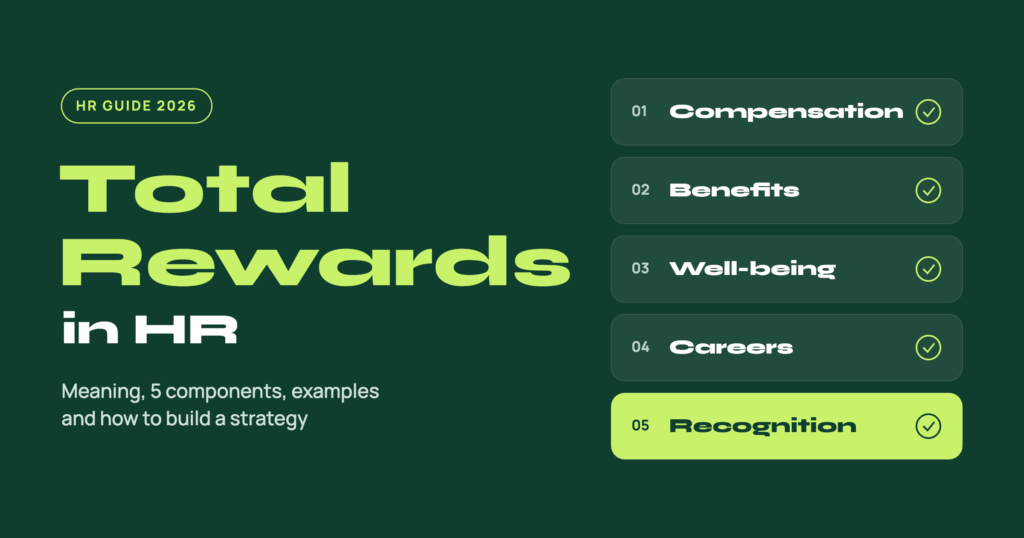
WorldatWork’s current model groups total rewards into five elements: compensation, benefits, well-being, careers and recognition. Older versions used labels like “work-life” and “performance and recognition”, so you will still see both in textbooks and job descriptions.
1. Compensation
Compensation is the cash an employee receives for their work. It has two layers:
- Fixed pay: basic salary, HRA, special allowance and other guaranteed components of CTC
- Variable pay: performance bonuses, sales commissions, retention bonuses, and long-term incentives such as ESOPs or RSUs
Compensation decisions rest on a pay philosophy. Do you pay at the market median, above it for critical roles, or below it while offering stronger equity? Writing this down is the first step to fair, explainable pay.
2. Benefits
Benefits protect employees and their families from financial risk and give them paid time away from work. In India, a typical package includes:
- Statutory benefits: Provident Fund, ESIC (where applicable), gratuity, maternity benefit
- Insurance: group health cover (often extended to parents), group term life, personal accident cover
- Retirement and savings: NPS employer contribution, voluntary PF
- Paid leave: earned leave, sick leave, casual leave, parental leave
3. Well-being
Well-being covers programs that support employees’ physical, mental and financial health, plus how and where they work. If you are starting from scratch, these strategies to improve employee wellbeing are a good place to begin. Examples:
- Employee Assistance Programs (EAP) with confidential counselling
- Hybrid or remote work, flexible hours, no-meeting days
- Annual health check-ups, gym or wellness allowances
- Financial wellness: tax-planning sessions, salary advances, loan support
4. Careers (Development)
This element is about helping people grow: in skills, responsibility and pay. Examples:
- Learning budgets, certifications, sponsored degrees
- Mentoring and coaching programs
- Clear career frameworks with defined levels and promotion criteria
- Internal job postings that let people move across teams
5. Recognition
Recognition acknowledges contribution, effort and behaviour, formally or informally. It costs little but is felt strongly. Examples:
- Spot awards and peer-to-peer recognition platforms
- Long-service awards
- Public shout-outs in town halls or Slack channels
- A simple, specific thank-you from a manager (see these employee appreciation ideas)
Tangible vs Intangible Rewards
Tangible rewards have a clear rupee value; intangible rewards do not, but often decide whether someone stays.
| Tangible (financial) rewards | Intangible (non-financial) rewards | |
|---|---|---|
| What it is | Rewards with a measurable monetary value | Rewards tied to experience, growth and respect |
| Examples | Salary, bonus, ESOPs, PF, insurance, allowances | Flexibility, recognition, meaningful work, culture, learning |
| How employees see it | Easy to compare across offers | Hard to compare, easy to feel |
| Cost to employer | Usually high and recurring | Often low, but depends on manager behaviour |
| Main effect | Attracts candidates | Retains and engages people |
A strong program needs both. Competitive pay gets candidates through the door; the intangibles stop them from looking for the next door.
Why Total Rewards Matters
Pay increases alone are not solving retention in India. Aon’s Annual Salary Increase and Turnover Survey 2026-27 found that salaries rose 9% in 2026 and are projected to rise 9.1% in 2027, yet attrition climbed to 18% in 2026, up from 16.2% in 2025.
When every employer raises salaries by roughly the same amount, salary stops being a differentiator. What separates employers is everything else in the package. A total rewards approach helps in five concrete ways:
- Better hiring: a clear package gives recruiters more to sell than a CTC figure, which matters when a candidate holds competing offers.
- Lower attrition: people who see a growth path, feel recognised and trust their benefits have fewer reasons to leave, and employee turnover is expensive.
- Smarter spending: instead of spreading a fixed budget thinly across raises, you can put money where employees actually see value, such as parental health cover or a learning budget.
- Fairness and trust: a documented pay philosophy makes it easier to explain why two people earn different amounts.
- Stronger employer brand: a well-communicated rewards story shows up in Glassdoor reviews, referrals and campus hiring.
Total Rewards vs Compensation & Benefits vs CTC
CTC sits inside compensation and benefits, and C&B sits inside total rewards. The three terms are often used interchangeably, but they describe different scopes.
| Term | What it covers | What it leaves out |
|---|---|---|
| CTC (Cost to Company) | Every rupee the employer spends on you in a year: salary, bonus, employer PF, gratuity, insurance premiums | Learning, career growth, recognition, flexibility, culture |
| Compensation & Benefits (C&B) | Pay structures, incentives, insurance, retirement and leave policies | Most non-financial rewards |
| Total Rewards | Compensation, benefits, well-being, careers and recognition together | Nothing the employee values from the job |
In many organisations, the C&B team has simply been renamed the Total Rewards team. The difference is real only when the team takes ownership of the non-financial elements too.
How to Build a Total Rewards Strategy (7 Steps)
A total rewards strategy is built from evidence about your people and your budget, not copied from another company. Follow these seven steps in order.
- Start with business goals. Are you scaling fast, cutting costs, or trying to hold on to a small group of specialists? A startup hiring 50 engineers needs a different mix from a manufacturing firm with a stable workforce.
- Audit what you already offer. List every reward across the five elements and what it costs per employee per year. Most companies discover they spend on benefits nobody knows about.
- Ask employees what they value. Run a short employee survey or focus groups by segment: freshers, mid-level managers, working parents, field staff. A 24-year-old and a 45-year-old rarely value the same things.
- Benchmark against the market. Use salary surveys, industry reports and offer-decline data to see where you lead, match or lag.
- Write your rewards philosophy. Decide where you will compete and, just as importantly, where you will not. For example: “We pay at market median but lead on learning and flexibility.”
- Design and budget the package. Shift spend toward what employees value most. Check compliance with the new labour codes, tax rules and statutory benefits.
- Communicate, measure and review. Launch with manager briefings and personalised total rewards statements. Track attrition, offer acceptance rate, engagement scores and benefit usage (these employee wellbeing KPIs help), and review the strategy every year.
Tip for small companies: you do not need a big budget. Flexible hours, a clear promotion framework and consistent recognition cost little and are often what employees mention first in exit interviews.
What Is a Total Rewards Statement?
A total rewards statement is a personalised, once-a-year summary that shows an employee the full value of what they receive, not just their take-home pay. Most employees underestimate their package because they only see the salary credited each month.
A good statement includes:
- Fixed pay and variable pay earned or targeted
- Employer contributions to PF, gratuity and NPS
- Insurance premiums paid on the employee’s behalf
- Leave entitlement and its value
- Learning, wellness and other perks used during the year
- A short note on career progress or recognition received
Sample Total Rewards Statement (illustrative figures)
| Reward | Annual value (₹) |
|---|---|
| Fixed salary (Basic ₹7,50,000 + HRA + allowances) | 12,00,000 |
| Target performance bonus | 1,20,000 |
| Employer PF contribution (12% of basic) | 90,000 |
| Gratuity provision (4.81% of basic) | 36,075 |
| Group health insurance (employee + family + parents) | 25,000 |
| Group term life insurance | 3,000 |
| Learning budget used | 30,000 |
| Wellness allowance and EAP | 12,000 |
| Total rewards value | 15,16,075 |
Basic is set at about 51% of CTC here, in line with the new labour codes’ rule that wages must make up at least half of pay.
In this example, an employee who thinks they earn ₹12 lakh actually receives over ₹15 lakh in value. Showing that gap clearly is the whole point of the statement.
Communication tips: send it individually, not as a group PDF; have managers walk through it in a one-on-one; and add a line on growth (“You completed two certifications and moved to Level 3 this year”) so it is not only about money. For more ideas, see our guide to employee benefits communication.
Total Rewards Examples from Companies in India
The strongest programs pick one or two elements to lead on, rather than trying to be generous everywhere. These published policies show what that looks like in practice (policies change, so check each company’s latest version).
| Company | Reward | Element |
|---|---|---|
| Eternal (formerly Zomato) | 26 weeks of flexible parental leave usable over three years, for biological, adoptive and surrogate parents, plus 10 days of annual period leave | Benefits, well-being |
| Plum Insurance | Sabbatical after two years of tenure, growing up to three months with service | Well-being, recognition of tenure |
| Diageo India | 26-week parental leave with full benefits and bonuses, regardless of gender or sexual orientation | Benefits |
| Vedanta | Up to 12 months’ sabbatical for mothers with job security, plus WFH or flexible hours after maternity leave | Well-being, careers |
| Adobe India | ₹7 lakh family-floater health cover with parents included, an Employee Assistance Program and 8 weeks of paternity leave | Benefits, well-being |
Notice the pattern: none of these examples is a salary increase. Each targets a specific life stage or need, which is why employees remember them.
Total Rewards Trends in 2026
The biggest change for Indian reward teams this year is regulatory: the labour codes have forced a redesign of salary structures. Alongside it, five other trends are reshaping packages.
- Salary restructuring under the labour codes. Wages (basic + DA) must now make up at least 50% of CTC, which raises PF and gratuity contributions and can lower monthly take-home pay even when CTC is unchanged. One analysis estimates the take-home reduction at up to ₹52,000 a year on a ₹15 lakh CTC (Angel One). Explaining this clearly, through total rewards statements, is now a core HR task.
- Targeted, not across-the-board, pay. With salary budgets steady at around 9%, employers are directing increases toward scarce skills and critical roles rather than spreading them evenly (People Matters, reporting Aon).
- Life-stage benefits. Parental leave for all genders, caregiver leave, period leave, fertility support and sabbaticals are moving from “startup perks” to mainstream policy.
- Mental health as a core benefit. EAPs, therapy cover in health insurance and manager training on burnout are now expected, not optional. Here is how to build a culture of care for mental wellness at work.
- Personalised and flexible benefits. Flexi-benefit plans and benefit wallets let employees pick what fits their life, instead of one package for everyone.
- Pay transparency and fairness. Published salary bands, pay-equity audits and clear promotion criteria are gaining ground, especially among younger employees who compare notes openly.
Common Challenges (and How to Handle Them)
Most total rewards programs fail on communication and measurement, not on design.
| Challenge | What it looks like | How to handle it |
|---|---|---|
| Employees don’t know what they get | Benefits go unused; people compare offers on CTC alone | Annual total rewards statements, benefit portals, onboarding walkthroughs |
| Limited budget | Leadership sees rewards only as cost | Shift spend to high-value, low-cost rewards; show attrition cost avoided |
| One size fits nobody | Freshers ignore parental benefits; senior staff ignore learning stipends | Segment surveys and flexi-benefit plans |
| Hard to prove ROI | No link between programs and outcomes | Track attrition, offer acceptance, eNPS and benefit usage before and after changes |
| Inconsistent managers | Recognition and flexibility depend on who your boss is | Manager training, clear policies, recognition nudges |
| Compliance changes | Labour code and tax rules reshape salary structures | Annual structure review with payroll and legal teams |
Proving ROI is the challenge reward leaders mention most. Read the new mandate for total rewards leaders for a practical approach, and use this 13-step guide to building a recognition program to make recognition consistent across managers.
Recognition, rewards and well-being in one platform.
No credit card required
Team leaderboard
Example-
1. Operations 412,880
-
2. Finance 389,145
-
3. Customer Success 351,902
Steps this week
Conclusion
Total rewards is not a bigger budget; it is a better-designed one. When salary increases look similar across employers, what wins and keeps people is the full package: fair pay, benefits that protect families, support for well-being, a visible career path and regular recognition.
Start small. Audit what you offer, ask employees what they value, and send every employee a clear total rewards statement this year. Those three steps alone will change how your people see their job.
Bring recognition, rewards and well-being together with Woliba. Woliba gives HR teams one platform for peer and manager recognition, points-based rewards and incentives, wellness challenges and pulse surveys, with one dashboard that shows what is working. Book a demo to see how it fits into your total rewards strategy.