



Spiritual wellness is the sense that your life and work have meaning, that your daily choices reflect your values, and that you’re connected to something bigger than yourself. At work, it has nothing to do with religion. It’s about purpose, values, reflection, and connection.
It’s also one of the most overlooked parts of an employee wellness program. Most programs focus on steps, sleep, and stress, but people who feel their work matters tend to bring more energy, resilience, and care to everything else.
This guide explains what spiritual wellness means at work, why it matters to employers, the signs it’s missing, and eight practical ways HR can support it, without making anyone uncomfortable.
Woliba Support 12 Pillars of Wellbeing in one Platform.
No credit card required
Team leaderboard
Example-
1. Operations 412,880
-
2. Finance 389,145
-
3. Customer Success 351,902
Steps this week
What Spiritual Wellness Means at Work
Spiritual wellness is one of the core dimensions of wellness. Researchers and wellness activities describe it in slightly different ways, but most agree on a shared core of purpose and meaning.
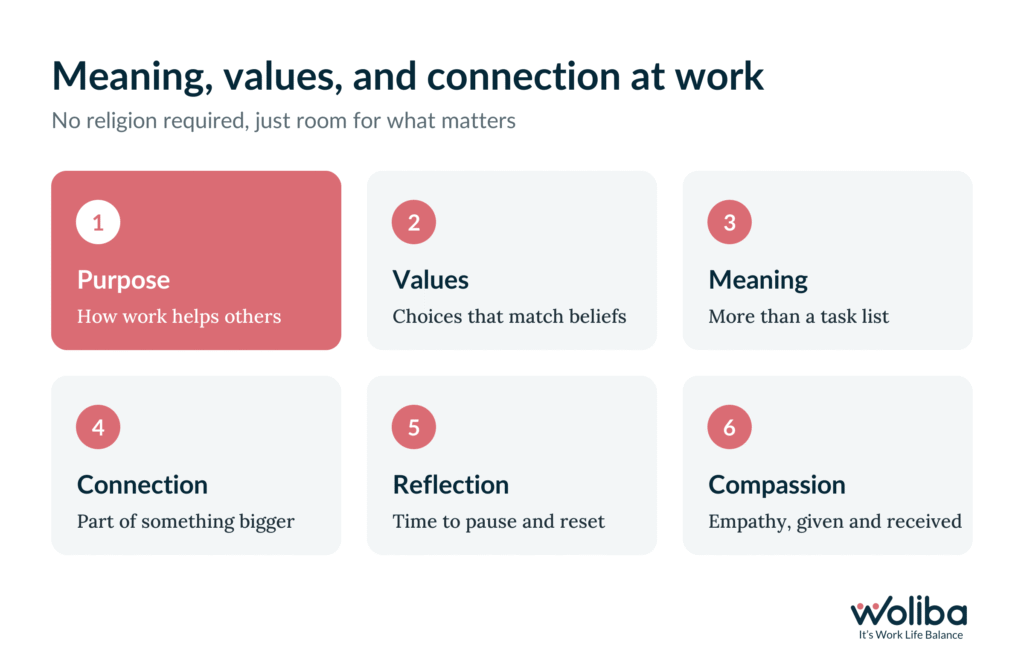
At work, spiritual wellness usually shows up in six ways:
| Element | What it looks like at work |
|---|---|
| Purpose | Knowing how your work helps customers, colleagues, or the community |
| Values | Feeling that your daily decisions match what you believe is right |
| Meaning | Seeing your work as more than a list of tasks |
| Connection | Feeling part of a team and a mission bigger than yourself |
| Reflection | Having moments to pause, think, and reset |
| Compassion | Treating colleagues with empathy and being treated that way in return |
What spiritual wellness is, and what it isn’t
| Spiritual wellness at work is | Spiritual wellness at work is not |
|---|---|
| Purpose, values, and meaning | Religious practice or belief |
| Optional reflection and gratitude | Required meditation or rituals |
| Respect for every belief system, including none | Promoting one belief over another |
| Small habits built into the workday | A one-time retreat or poster campaign |
Framing it this way matters. Many employees hear the word “spiritual” and assume it means religion. Clear language makes the topic welcoming for everyone.
Why Spiritual Wellness Matters to Employers
Spiritual wellness can sound abstract, but the research connects it to the outcomes HR already cares about.
| Finding |
|---|
| Among people who rated their spiritual health as good or very good, about two-thirds also reported good mental, social, and physical health. Among those with poor spiritual health, fewer than 20% reported good mental health |
| Younger respondents rated spiritual health as more important than older respondents did |
| Only about 1% of health studies reviewed by the McKinsey Health Institute focused on spiritual health, compared with 75% on physical health |
| About 70% of employees said their sense of purpose is largely defined by their work |
These are correlations, not proof that one causes the other. But the pattern is consistent: people who feel a sense of meaning tend to report better health across the board. And because younger employees place more weight on purpose, spiritual wellness is becoming part of how the next generation chooses where to work.
For employers, the practical takeaway is simple. When people understand why their work matters and feel their values fit the workplace, they’re more likely to stay engaged through difficult stretches.
Signs Spiritual Wellness Is Missing on a Team
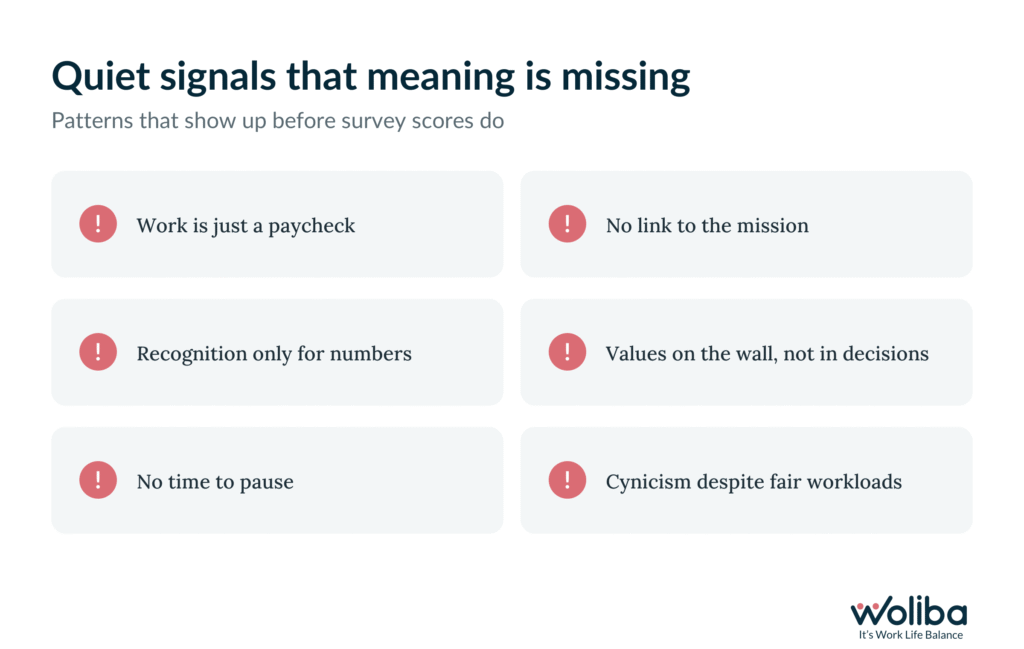
Low spiritual wellness rarely shows up in a survey score first. It tends to look like this:
- People describe work as “just a paycheck” or say they’re going through the motions
- Few employees can explain how their role connects to the company’s mission
- Recognition focuses only on numbers, never on how people work or who they help
- Values on the wall don’t match how decisions get made
- There’s no time or space to pause during the day
- Burnout and cynicism rise even when workloads are manageable
Woliba Activity Challenges
Turn gratitude and giving into team habits
Run gratitude challenges and charity challenges where every step unlocks a donation.
How to Support Spiritual Wellness at Work: 8 Practical Steps
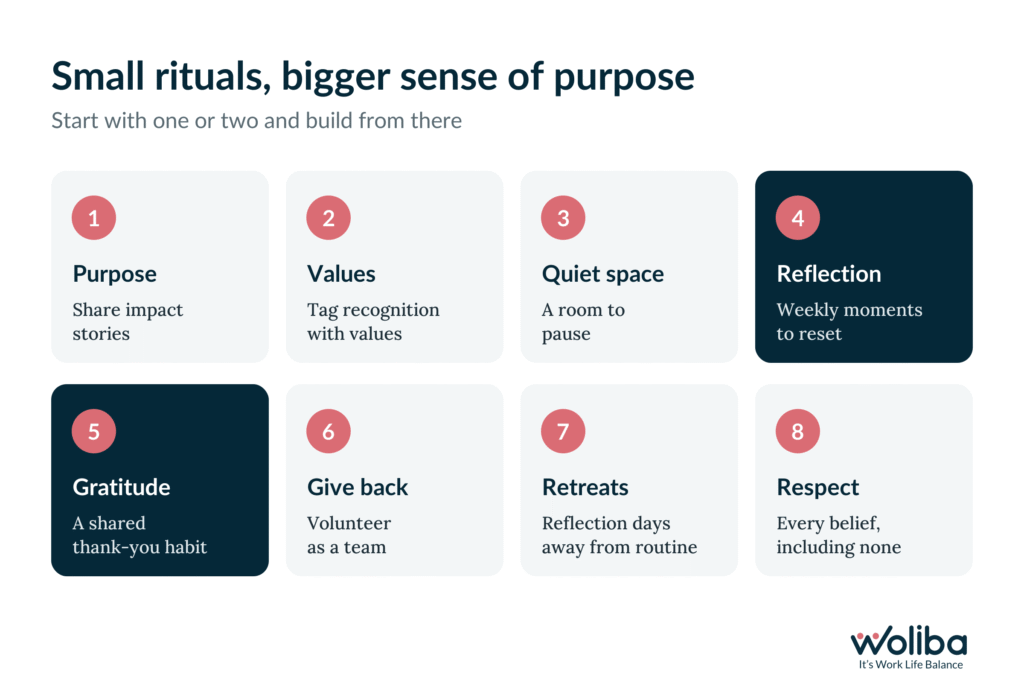
You don’t need a big budget or a culture overhaul. Start with one or two of these steps and build from there.
1. Connect everyday work to purpose
Share real stories about how your products, services, or teams help people. Invite customers or colleagues to explain the difference someone’s work made. When people can see the impact, routine tasks feel more meaningful, which is the heart of purpose at work.
Try this: open one team meeting a month with a short story about a customer or colleague your team helped.
2. Make values visible in recognition
Tie recognition to your company values, not just results. When people see teammates celebrated for honesty, kindness, or teamwork, the values become real. A strong culture of recognition reinforces what the company stands for every day.
Love & Company, a marketing agency with remote and hybrid staff, aligned peer recognition on Woliba with its internal company values, giving employees an easy way to spotlight wins that reflect what the team cares about.
Try this: add a values tag to every peer shout-out.
3. Create quiet spaces to pause
A calm, non-denominational space gives people a place to reflect, breathe, or simply rest for a few minutes. A dedicated wellness room at work can serve this purpose, with soft lighting, comfortable seating, and a clear “quiet zone” sign.
Try this: convert one underused room and label it as a quiet space open to everyone.
4. Build reflection into the workweek
Short, regular moments of reflection work better than occasional big events. A few minutes at the start or end of the week to set intentions or note what went well helps people reconnect with what matters. Mindful Monday ideas, like setting one intention for the week, are an easy way to start.
Try this: end Friday stand-ups with one question: “What made this week meaningful?”
5. Practice gratitude together
Gratitude shifts attention from stress to what’s going well. It’s simple, inclusive, and works for in-office and remote teams. A team 30-day gratitude challenge turns it into a shared habit.
Try this: create a gratitude channel or wall where anyone can post one thing they’re thankful for.
6. Give back as a team
Volunteering connects people to something bigger than their daily tasks. Team volunteer days, donation drives, or a charity challenge where activity unlocks donations all give employees a shared sense of purpose.
Try this: offer one paid volunteer day per quarter, and let teams choose the cause.
7. Offer reflection days or retreats
Time away from routine helps people rest and regain perspective. A half-day reflection session or a full corporate wellness retreat with nature walks, storytelling, and quiet time can reset a team’s energy.
Try this: plan one optional half-day reflection session before a busy season.
8. Respect every belief, including none
Spiritual wellness should never feel like pressure. Keep every activity optional, avoid promoting any one belief, and accommodate religious holidays and practices. These choices are part of building an inclusive culture at work.
Try this: review your holiday calendar and time-off policy to make sure they work for people of all faiths.
Spiritual Wellness Activities for Employees
These activities are easy to run and work for most teams:
- Guided breathing or short mindfulness sessions
- Gratitude circles or a gratitude wall
- Journaling prompts shared each week
- Nature walks or device-free walking breaks
- Purpose and values workshops
- Book or discussion clubs on meaning and purpose
- Peer-led talks where employees share what motivates them
- Team volunteer days and kindness challenges
Most take less than 15 minutes, and the full set of spiritual wellness activities includes step-by-step setup for each.
Supporting remote and hybrid employees
Remote employees can join most of these activities on video or on their own schedule. Share journaling prompts in a team channel, host virtual gratitude circles, and send quiet-time reminders. Many wellness activities for remote employees adapt easily to a spiritual wellness theme.
How to Handle Skepticism
Some employees may be wary of anything labeled “spiritual.” That’s normal, and it’s easy to address:
| Instead of saying | Try saying |
|---|---|
| Spiritual exercise | Reflection moment |
| Meditation session | Five-minute reset |
| Spiritual retreat | Team reflection day |
| Finding your spiritual purpose | What makes your work meaningful |
Keep everything optional, explain the “why” in plain language, and let employees suggest activities. Ideas that come from the team tend to get more participation than ideas handed down.
How to Measure Spiritual Wellness at Work
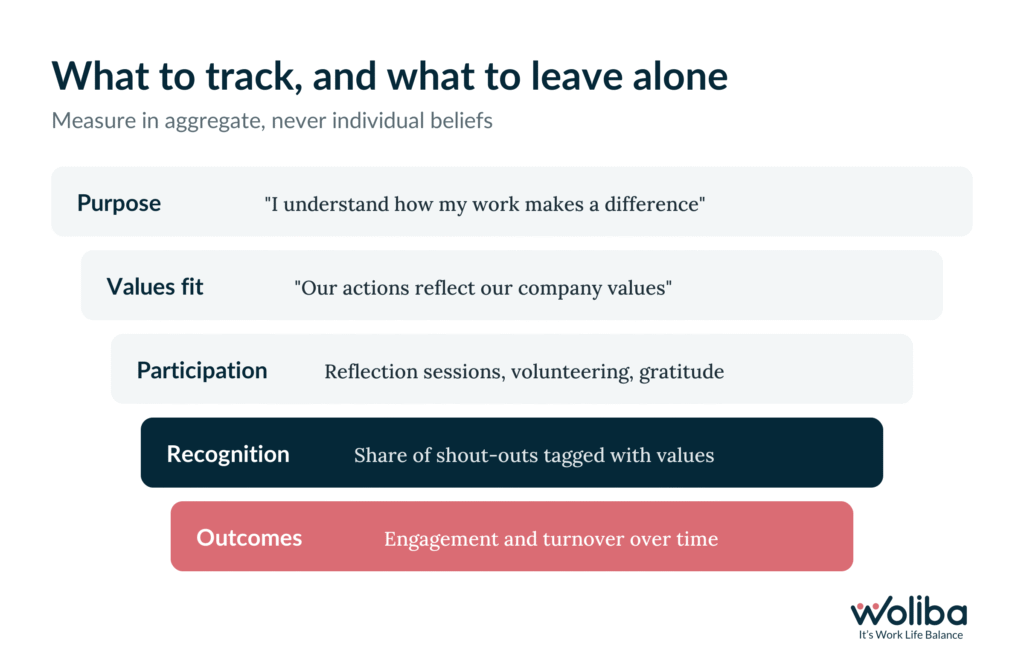
Spiritual wellness is personal, so measure it gently and only in aggregate:
| What to track | Example measures |
|---|---|
| Purpose | Pulse items like “I understand how my work makes a difference” |
| Values fit | “My team’s actions reflect our company values” |
| Participation | Attendance at reflection sessions, volunteer days, and gratitude activities |
| Recognition | Share of recognition posts tagged with company values |
| Outcomes | Engagement and voluntary turnover trends over time |
A short employee pulse survey with two or three of these items each quarter is enough to see trends. Never track individual beliefs or practices.
How Spiritual Wellness Connects to Other Dimensions
Spiritual wellness supports almost every other part of wellbeing. A sense of meaning helps people handle stress, which ties it to emotional wellness in the workplace.
Purpose and values fit are at the heart of occupational wellness. And shared rituals like gratitude and volunteering build social connection across teams.

Free HR playbook
12 Dimensions of Wellness at Work
Signs each dimension needs attention, practical HR actions, challenge ideas, a scorecard, and a 90-day plan. 17 pages, free.
Thanks! Your guide is ready.
Download the PDFFrequently Asked Questions About Spiritual Wellness in the Workplace
What is spiritual wellness?
Spiritual wellness is the sense that your life has meaning and purpose, that your actions match your values, and that you’re connected to something larger than yourself. It can include religious faith, but it doesn’t have to.
Is spiritual wellness at work religious?
No. At work, spiritual wellness focuses on purpose, values, reflection, gratitude, and connection. Activities should be optional, inclusive, and respectful of every belief system, including people who aren’t religious.
What are examples of spiritual wellness at work?
Examples include gratitude circles, quiet reflection rooms, journaling prompts, purpose workshops, values-based recognition, volunteer days, nature walks, and short mindfulness breaks.
How do you practice spirituality in the workplace?
Start small: reflect on what makes your work meaningful, take short pauses during the day, practice gratitude, and look for ways to help colleagues or your community. Employers can support this with quiet spaces, reflection time, and purpose-focused recognition.
How can employers support spiritual wellness?
Employers can connect work to purpose, make values visible in recognition, create quiet spaces, build reflection into the workweek, encourage gratitude, organize team volunteering, offer reflection days, and respect every belief and practice.
Make Room for Meaning at Work
Spiritual wellness at work isn’t about belief. It’s about helping people see why their work matters, live their values, and find moments to pause and reconnect. Start with one or two simple steps, keep everything optional, and let your team shape what works.
Over time, those small rituals add up to a workplace where people feel connected, purposeful, and more likely to stay.