


Most employees do not wake up thinking about hitting a specific step count. However, the moment a coworker passes them on a live company leaderboard, engagement becomes personal. That is the core power of step challenges at work, they turn daily movement into friendly competition that drives genuine participation across remote, hybrid, and in-office teams.
When structured correctly, a corporate step challenge boosts daily physical activity, strengthens team connection, and reinforces broader corporate wellness challenges. This comprehensive guide covers everything HR and People Ops leaders need to design, launch, and manage a high-engagement step challenge in 2026.
What is a Step Challenge at Work?
A step challenge at work is a structured corporate wellness program where employees track daily physical activity, measured primarily in steps, and compete individually or in teams over a defined period. Rather than focusing on workout intensity, activity challenges reward consistent daily movement and inclusive participation.
Unlike traditional fitness initiatives that may cater primarily to active individuals, workplace personal challenges are designed for universal participation, whether an employee is a marathon runner, a remote worker taking desk-walking breaks, or someone rebuilding daily health habits, step challenge apps provide an accessible entry point to social wellbeing.
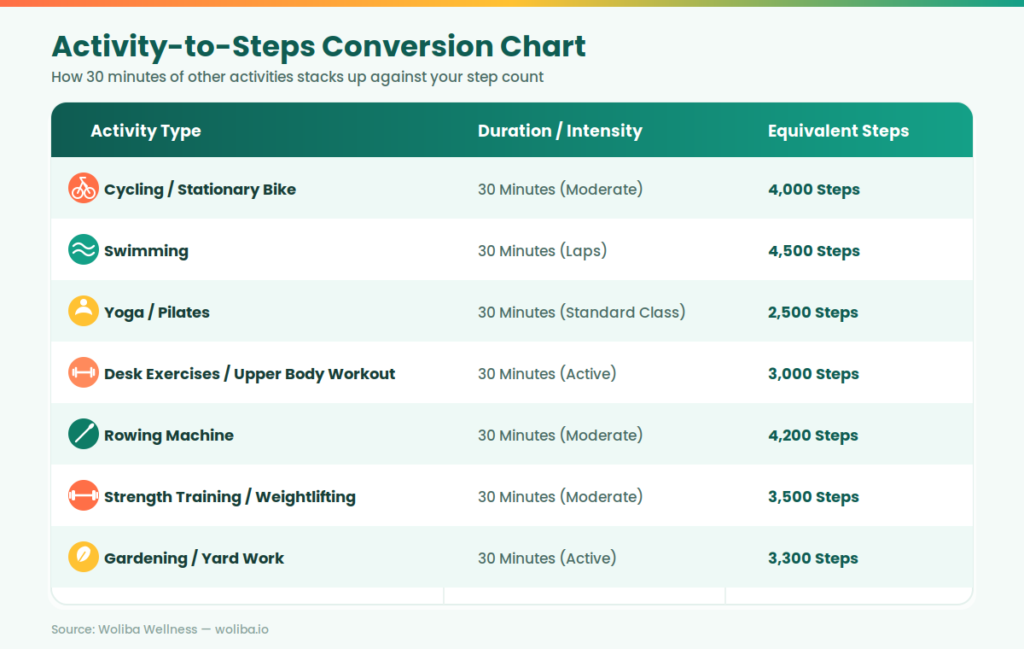
Activity-to-Steps Conversion Chart (Inclusive Fitness)
To ensure total inclusivity for employees with mobility restrictions, injuries, or non-walking exercise routines, convert non-step fitness activities into equivalent step totals. Use the industry-standard conversion chart below:
Standard Rules and Guidelines for Workplace Step Challenges
Clear governance prevents confusion and maintains fair play across all participating teams. Incorporate these core rules into your official challenge launch packet:
- Automatic Syncing Preferred: Encourage all participants to connect wearable devices (Apple Watch, Fitbit, Garmin, Google Fit) to an automated employee wellness platform to eliminate manual entry errors.
- Fair Averaging for Teams: Team rankings must be determined by the average step count per active member rather than total volume, preventing team size disparities.
- Manual Entry Caps: If manual logging is permitted for converted non-step activities, cap daily manual limits at 25,000 steps per participant to ensure athletic integrity.
- Syncing Timeframes: Require all participants to sync their devices at least once every 48 hours to maintain an accurate real-time leaderboard.
- Inclusive Accommodations: Provide adaptive conversion criteria for employees with physical disabilities or medical conditions upon request to HR.
How to Set Up a Step Challenge at Work
Setting up a corporate step challenge requires more than telling employees to start walking—it demands a deliberate execution strategy to maximize enrollment, prevent mid-challenge drop-off, and prove organizational ROI. Follow this step-by-step roadmap to plan and execute a seamless challenge from start to finish:
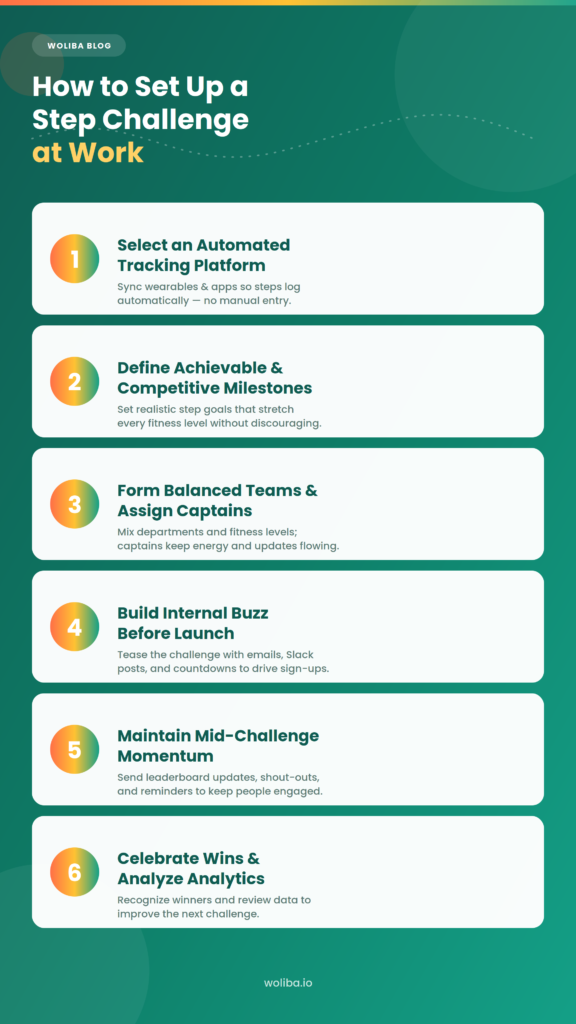
1. Select an Automated Tracking Platform
Manual spreadsheets, screenshot uploads, and paper log sheets drain HR bandwidth and destroy momentum due to unverified entry friction and delayed updates.
- Wearable Hardware Compatibility: Ensure the software offers direct 1-click API syncing with Apple Health, Google Fit, Garmin, Fitbit, and Samsung Health so step counts flow automatically.
- Cross-Device Accessibility: The platform must feature fast, lightweight iOS and Android mobile apps so field-based and deskless workers can participate without friction.
- Privacy & Security Standards: Verify that the platform complies with corporate data privacy standards (SOC 2, GDPR, HIPAA compliance) so employee personal movement data remains strictly confidential and secure.
- Real-Time Social Syncing: Look for integrated team feeds where participants can like, comment, and post workout photos directly alongside real-time step leaderboards.
2. Define Achievable & Competitive Milestones
Flat 10,000-step goals often backfire: they intimidate sedentary workers into opting out while giving marathon runners an unearned advantage. Use tiered milestone brackets to ensure 100% inclusivity across all fitness levels.
- Tiered Step Brackets (Individual Path):
- Bronze (Beginner Baseline): 5,000–6,000 steps/day (Focuses on desk-bound employees building new daily habits).
- Silver (Intermediate Goal): 7,500–8,500 steps/day (Encourages active walking breaks and post-lunch movement).
- Gold (Advanced Target): 10,000+ steps/day (Pushes active participants and fitness enthusiasts).
- Bronze (Beginner Baseline): 5,000–6,000 steps/day (Focuses on desk-bound employees building new daily habits).
- Alternative Scoring Metrics:
- Consistency Metrics: Award bonus points for hitting a 5-day streak rather than purely rewarding total step volume.
- Percentage Improvement: Calculate scores based on an individual’s personal baseline increase (e.g., growing from 4,000 to 6,000 steps/day = higher score multiplier than staying flat at 10,000).
- Consistency Metrics: Award bonus points for hitting a 5-day streak rather than purely rewarding total step volume.
- Challenge Duration Window: Keep the challenge length strictly between 21 to 30 days. Under 14 days is too brief to form lasting habits; over 30 days causes participant burnout.
3. Form Balanced Teams and Assign Captains
Peer accountability is the single strongest driver of challenge completion. Structuring teams strategically prevents siloed participation and boosts social engagement across departments.
- Roster Size & Department Mix: Cap team sizes at 5 to 8 members. Mix remote employees with on-site staff and cross-pollinate departments (e.g., Sales + Engineering + HR) to break down operational silos.
- Average Step Scoring: Rank team leaderboards by Average Steps Per Member so smaller departments compete fairly against larger divisions.
- Designate “Challenge Captains”: Appoint enthusiastic culture champions or department leads to send daily reminders, organize group walks, and keep team spirit high in internal communication tools.
- Executive Participation: Secure at least 2–3 C-suite executives or VPs to join teams as active walkers. When executive leadership posts step updates, overall employee participation increases by up to 40%.
4. Build Internal Buzz Before Launch
Treat your fitness challenge like an internal product launch. Building excitement 10–14 days prior to the start date ensures high day-one sign-up rates.
- 14 Days Out (Teaser Phase): Send an executive video broadcast or C-suite email announcing the challenge theme, charity partner, and high-level prizes.
- 10 Days Out (Registration Open): Launch registration inside your employee portal. Share platform download guides, smartwatch connection FAQs, and video tutorials.
- 7 Days Out (Team Captain Rally): Host a 15-minute briefing with team captains to distribute communication templates and team name ideas.
- 3 Days Out (Swag & Countdown): Distribute launch kits—digital posters, Slack/Teams custom emojis, water bottles, or athletic swag bags—and publish a live countdown timer on internal channels.
5. Maintain Mid-Challenge Momentum
Participation naturally dips during week two (“the mid-challenge slump”). Counteract fatigue with surprise incentives, dynamic updates, and social recognition.
- Weekly Leaderboard Broadcasts: Send a Monday morning digest highlighting the Top 3 Teams, Most Improved Individual, and Best Workout Photo of the week.
- Flash “Sprint” Challenges: Introduce 24-to-48-hour mini-contests (e.g., “The Wednesday Step Surge: The team with the highest average steps today wins coffee gift cards”).
- Raffle Incentive Days: Randomly enter anyone who logs 7,000+ steps on a employee engagement activities (like a rainy Tuesday) into a flash prize drawing, keeping non-leaderboard leaders motivated.
- Social Spotlights & High-Fives: Encourage employees to use your platform’s social wall to tag colleagues, post pet-walking selfies, and celebrate personal milestones.
6. Celebrate Wins and Analyze Analytics
The conclusion of the challenge is an opportunity to reinforce company culture, distribute rewards, and prove tangible HR ROI to senior leadership.
1. Pulse Survey Sentiment Shift: Conduct a 2-question post-challenge survey measuring changes in daily energy, team connection, and workplace satisfaction.
2. Host a Hybrid Awards Ceremony: Celebrate challenge completion during a company all-hands or virtual happy hour. Award trophies, custom digital badges, and prizes for diverse categories:
- Overall Team Champion (Highest Average Steps)
- Most Consistent Walker (Longest Daily Streak)
- Best Team Name & Best Photo Upload
- Most Improved Department
3. Automated Reward Distribution: Ensure points, digital gift cards, or corporate perks credit instantly to winners’ wallets inside your wellness software without manual voucher handling.
4. Extract & Report HR ROI Metrics: Pull platform analytics to build an executive summary report covering:
5. Overall Participation Rate: Target >60% of total workforce enrollment.
6. Total Distance & Calories: Total company steps converted into miles/kilometers walked (e.g., “Our team walked around the globe 1.5 times!”).
Engagement Consistency: Percentage of users who remained active through Week 4.
Top 10 Creative Step Challenge Ideas for the Workplace
Generic “walk 10,000 steps” goals often lead to engagement ideas drop-offs by week two. To maintain high participation, structure your initiative around compelling themes and story lines:
- Virtual Walk Across the Globe: Map cumulative individual or team steps to a real-world route (e.g., walking from your US headquarters to a global office location, or climbing the cumulative height of Mount Everest).
- Department vs. Department Battle: Pit Marketing against Sales or Operations against HR. Calculate rankings based on average steps per participant so larger departments do not hold an unfair advantage.
- Daily Step Streak Challenge: Shift focus from total volume to consistency. Reward employees who hit a reasonable threshold (e.g., 7,000 steps) every day for 21 consecutive days.
- The 10k Daily Club Sprint: A high-intensity 14-day challenge designed to encourage participants to reach or exceed 10,000 steps each day.
- Mystery Walk & Escape Route: Set weekly unlockable milestones. When the company reaches a collective step threshold, unlock internal perks, charity donations, or casual Fridays.
- Remote vs. Office Relay: Connect dispersed workforces by matching remote team members with on-site colleagues in paired step relays.
- Weekend Warrior Cup: Focus on maintaining movement over Saturdays and Sundays, when sedentary behavior often spikes among desk workers.
- Steps for Good (Charity Walkathon): Convert employee step totals into company-funded financial contributions to a selected non-profit or community charity.
- Lunchtime Lap Sprint: Encourage employees to log a dedicated 15-minute walking break during the workday to combat afternoon burnout.
- Seasonal Holiday Stride: Run short, targeted nutrition challenges during traditionally low-activity periods, such as late autumn or early January.
Incentives and Rewards That Work
Incentives keep motivation high throughout the program duration. Effective reward structures combine physical rewards with cultural recognition:
- Tangible Company Rewards: Branded athletic apparel, premium fitness challenge ideas, extra PTO hours, or healthy catered team lunches.
- Gift Cards & Points Systems: Integrate digital wellness point catalogs allowing employees to redeem earned steps for customizable gift cards or charitable contributions.
- Recognition & Trophies: Traveling department trophies, digital achievement badges, and executive shout-outs during company all-hands meetings.
Conclusion & Next Steps for HR Leaders
A well-executed step challenge at work transforms passive wellness initiatives into an active, connected, and highly engaged workplace culture. By establishing clear rules, integrating inclusive conversion options, leveraging automated tracking tools like Woliba, and framing the competition around creative themes, HR leaders can deliver measurable health improvements and stronger team cohesion.