


Most total rewards strategies look complete on paper. Salary is benchmarked, the insurance plan is renewed, there is a learning budget and a recognition program. Yet employees still say they feel stretched thin, and a large share of the well-being budget goes unused. A corporate wellness coach closes that gap. Instead of adding another perk, a coach helps people actually use the rewards you already pay for, and turns the well-being pillar from a line item into a lived experience.
This guide explains what a corporate wellness coach does, where coaching fits inside a total rewards framework, the seven things it adds, how it compares to an EAP or a wellness app, and how to roll it out and measure it.
What Is a Corporate Wellness Coach?
A corporate wellness coach is a trained professional who works with employees, one-on-one or in small groups, to set and sustain healthy habits. Typical focus areas include stress, sleep, movement, nutrition, energy, work-life balance and financial habits. Coaches are usually certified in health and wellness coaching and use methods like motivational interviewing and goal setting.
A coach is not a therapist or a doctor. They do not diagnose or treat conditions. Their job is behaviour change: helping someone move from “I know I should” to “I actually do”. When an issue needs clinical care, a good coach refers the employee to the right benefit, such as the EAP, a mental health provider or the health plan.
Coaching can be delivered by an external provider, by in-house coaches, or through a digital platform that pairs live sessions with self-guided content. Many employers now use a hybrid model so every employee has some level of access.
Where Wellness Coaching Fits in Total Rewards
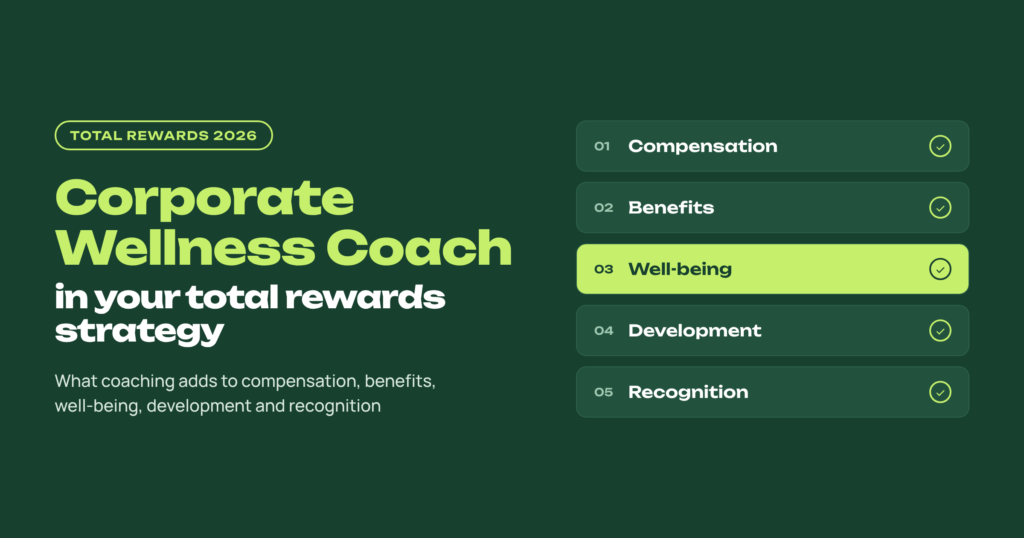
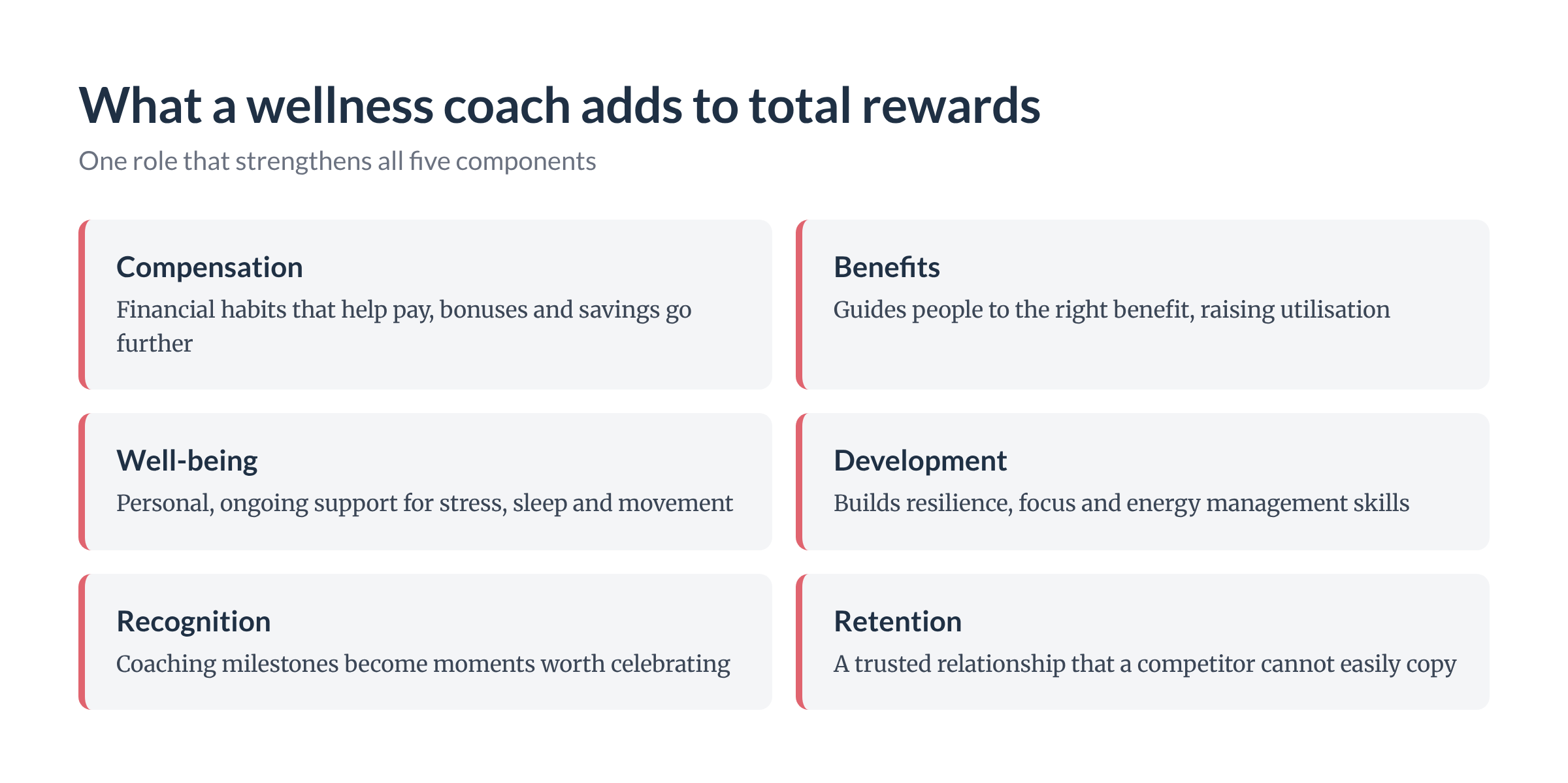
Most total rewards models group what employees get from work into five components: compensation, benefits, well-being, development and recognition. Wellness coaching sits squarely in the well-being pillar, but it also strengthens the other four. That is what makes it different from a single-purpose perk.
| Total rewards component | What a wellness coach adds |
|---|---|
| Compensation | Financial wellness habits help employees get more value from pay, bonuses and savings plans. |
| Benefits | Coaches guide people to the right benefit at the right time, which raises utilisation of plans you already fund. |
| Well-being | Personal, ongoing support for stress, sleep, movement and nutrition instead of one-off campaigns. |
| Development | Skills like resilience, focus and energy management that make people better at their jobs. |
| Recognition | Milestones reached through coaching become moments worth celebrating and rewarding. |
7 Things a Corporate Wellness Coach Adds to Your Total Rewards Strategy
1. Higher use of the benefits you already pay for
Low benefit utilisation is one of the biggest leaks in any rewards budget. Employees often do not know what is covered, or they forget until a crisis. A coach acts as a guide: when someone mentions back pain, sleep problems or money stress, the coach points them to the physiotherapy cover, the EAP or the financial planning session that already exists. Pair this with clear employee benefits communication and you get far more value from the same spend.
2. A well-being pillar that feels personal
Generic wellness campaigns treat everyone the same. A coach starts with the individual: their role, schedule, health goals and constraints. A night-shift nurse, a remote developer and a sales manager on the road all get a plan that fits their week. That personal touch is what makes employees perceive well-being as a real reward rather than a poster in the break room. For more wellness challenge ideas for personalising support, see our guide on improving employee wellbeing.
3. Earlier support for stress and burnout
Coaches often hear about pressure long before it shows up in absence data. Regular check-ins help employees build routines for recovery, set boundaries and spot warning signs early. This complements, rather than replaces, your mental wellness in the workplace efforts and gives people a low-stigma first step before they need clinical help.
4. Better managers, not just healthier employees
Managers shape the day-to-day experience more than any policy. Group coaching for people leaders can cover how to talk about workload, how to model healthy behaviour, and how to have supportive conversations about emotional wellness. When managers feel equipped, the rest of the total rewards package lands better with their teams.
5. A development benefit employees can feel
Energy, focus and resilience are performance skills. Coaching builds them in a practical, week-by-week way, which is why many employees see it as personal growth rather than a health program. Positioning coaching under both well-being and development also strengthens your employer brand with candidates who care about growth.
6. Better data on what is working
Coaching programs generate useful, anonymised signals: participation, goals set, goals achieved, common themes and satisfaction. Combined with pulse surveys and your existing well-being data, this helps HR see which parts of the rewards package are working and where money should move next year.
7. A visible reason to stay
Pay can be matched by a competitor. A relationship with a coach who knows your goals and has helped you sleep better, move more or get your finances under control is much harder to replace. When coaching is shown clearly in the total rewards statement, employees can see the full value of staying.
Recognition, rewards and well-being in one platform.
No credit card required
Team leaderboard
Example-
1. Operations 412,880
-
2. Finance 389,145
-
3. Customer Success 351,902
Steps this week
Corporate Wellness Coach vs EAP vs Wellness App
Coaching does not replace your other well-being benefits. Each tool solves a different problem, and the strongest strategies use them together.
| Wellness coach | EAP | Wellness app | |
|---|---|---|---|
| Main purpose | Build healthy habits and reach goals | Short-term counselling and crisis support | Self-guided content, tracking and challenges |
| Format | Ongoing 1:1 or group sessions | A limited number of confidential sessions | On-demand, self-paced |
| Best for | Stress, energy, sleep, movement, nutrition, money habits | Personal or emotional difficulties that need a counsellor | Daily nudges and engagement at scale |
| Typical usage pattern | Steady, relationship-based | Spikes during difficult periods | High reach, variable depth |
| How it fits total rewards | Makes the well-being pillar personal | Safety net within benefits | Always-on layer that keeps people engaged |
A practical setup is a wellness platform as the always-on layer, coaching for people who want deeper support, and the EAP as the confidential safety net. If you are comparing digital options, our list of mental wellness apps is a good starting point.
Coaching Delivery Models to Choose From
There is no single way to work with a corporate wellness coach. Most employers mix two or three of these models based on budget, workforce size and locations.
- One-on-one coaching: The deepest support. Best for employees with specific goals or for high-pressure roles. Highest cost per person.
- Group coaching: Small cohorts working on a shared theme such as sleep, stress or new parents. Builds peer support and costs less per head.
- Leader coaching: Sessions for managers on workload, boundaries and supportive conversations. High leverage because it shapes team culture.
- Live workshops and events: Coach-led sessions open to everyone, a good way to introduce coaching. Woliba helps you run and promote wellness events like these.
- Digital and hybrid coaching: Live sessions combined with app-based programs, challenges and check-ins, so support continues between sessions.
How to Add a Corporate Wellness Coach to Your Total Rewards Strategy
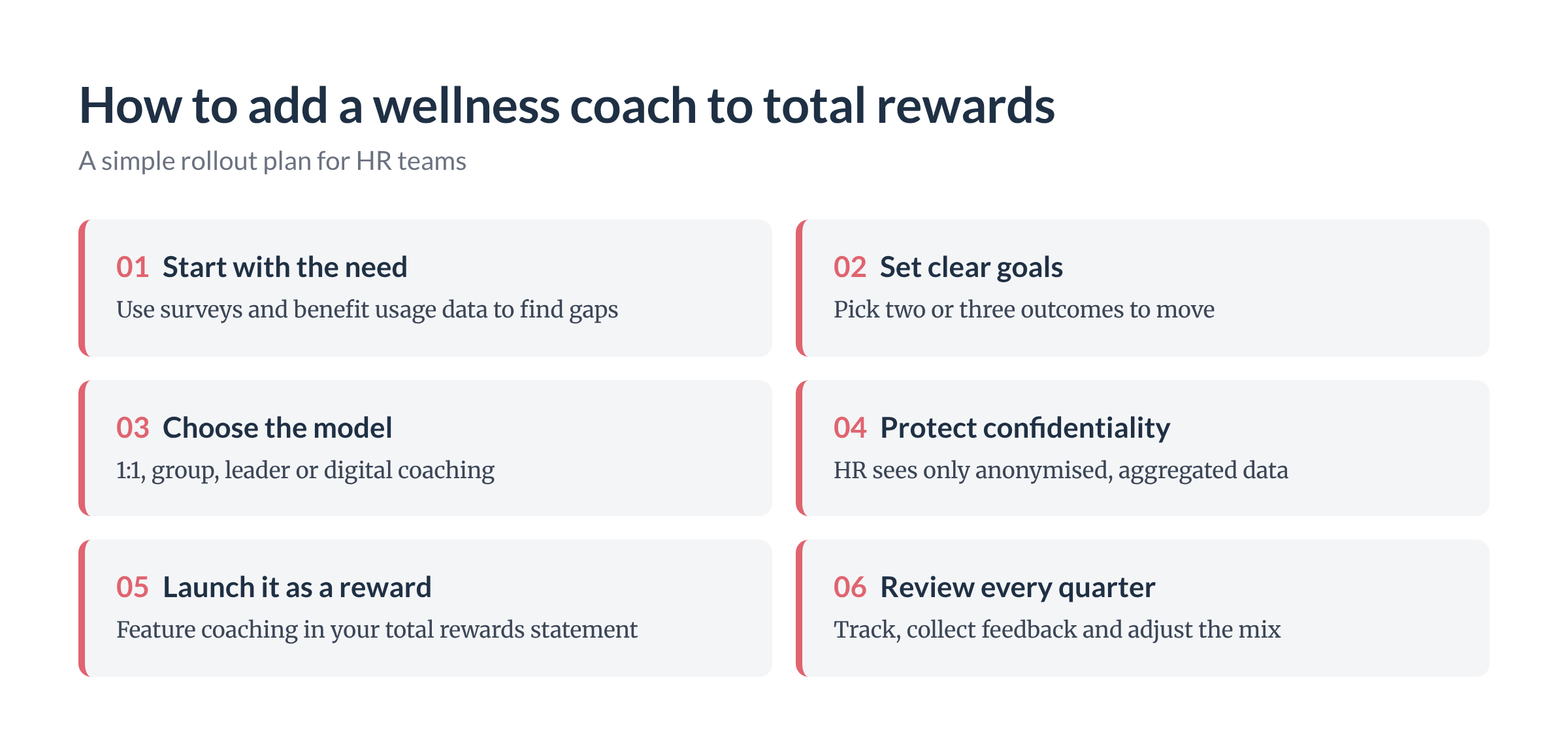
- Start with the need. Use pulse surveys and benefit utilisation data to find the biggest gaps. Our employee survey questions guide has ready-made questions on stress, energy and work-life balance.
- Set clear goals. Pick two or three outcomes, such as higher benefit utilisation, lower self-reported stress or better retention in a high-turnover team.
- Choose the delivery model. Match 1:1, group, leader or digital coaching to your workforce, budget and locations.
- Protect confidentiality. Make it clear that what employees share with a coach stays private, and that HR only sees anonymised, aggregated data.
- Launch it as a reward, not a fix. Present coaching in your total rewards statement and onboarding as an investment in people, not a program for those who are struggling.
- Connect it to recognition. Celebrate milestones reached through coaching and challenges. A rewards and incentives layer and a strong employee recognition program keep momentum going.
- Review every quarter. Track participation and outcomes, collect feedback and adjust the mix.
How to Measure the Impact of Wellness Coaching
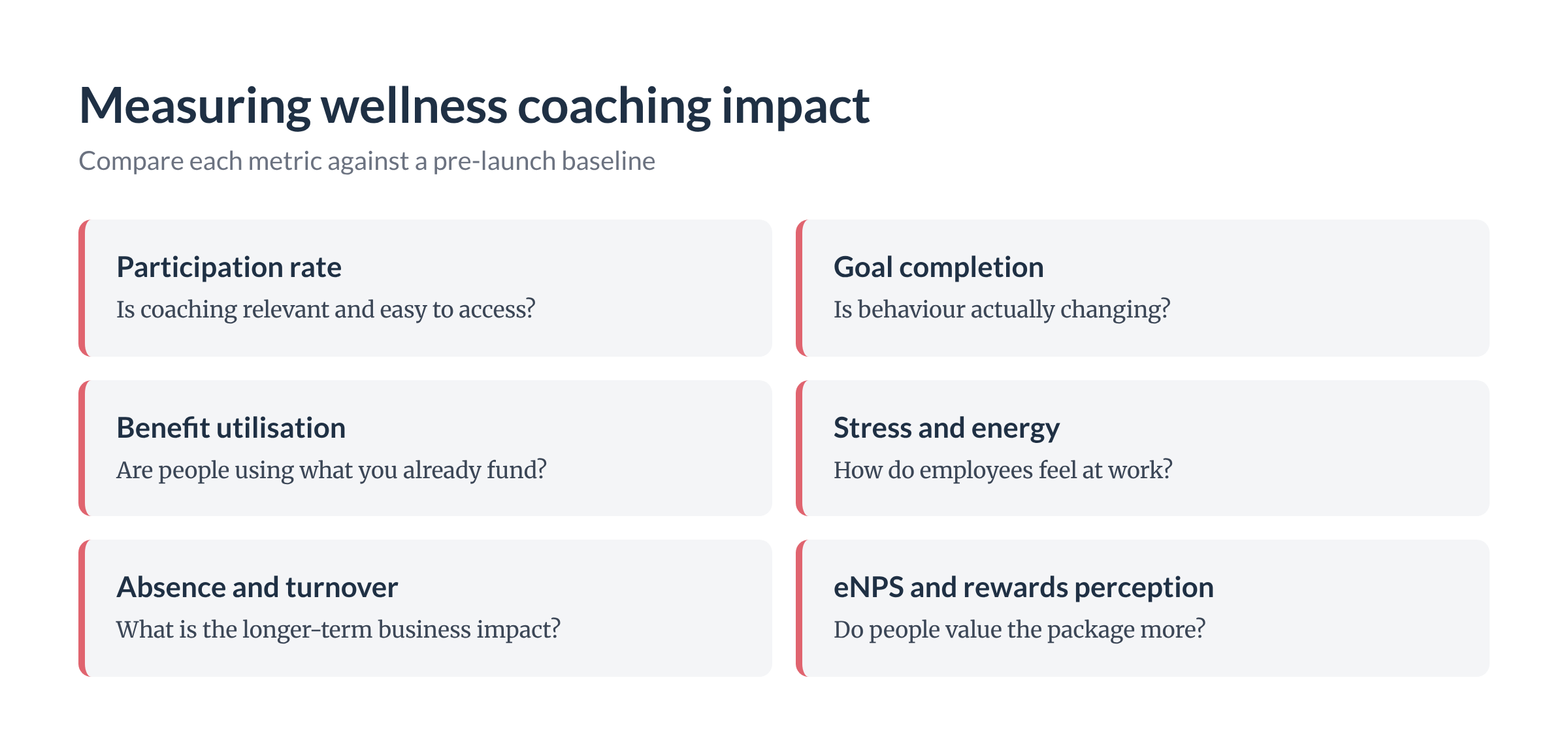
Measure your corporate wellness coach program the way you measure any other reward: by participation, experience and business outcomes. Use the same baseline before and after launch so you can compare like for like.
| Metric | What it tells you | Where to get it |
|---|---|---|
| Participation rate | Whether employees find coaching relevant and easy to access | Coaching provider or platform dashboard |
| Goal completion | Whether coaching is driving real behaviour change | Anonymised coaching reports |
| Benefit utilisation | Whether coaches are steering people to the right benefits | Benefits provider and EAP reports |
| Self-reported stress and energy | Changes in how people feel at work | Employee surveys before and after |
| Absence and turnover | Longer-term business impact | HRIS data, compared with a baseline |
| eNPS and rewards perception | Whether employees value the total rewards package more | Annual engagement survey |
For a deeper list of indicators and how to track them, see our guide to employee wellbeing metrics.
Common Mistakes to Avoid
- Treating coaching as a stand-alone perk. A corporate wellness coach works best when it is linked to benefits, recognition and development.
- Launching quietly. If employees do not know coaching exists or how to book a session, uptake will stay low. Repeat the message across channels.
- Blurring coaching and therapy. Be clear about what coaches do and when they will refer someone to clinical care.
- Measuring only cost. Look at utilisation, retention and experience, not just spend per head.
- Ignoring frontline and remote staff. Offer virtual sessions and flexible times so everyone has access, not only office workers.
Bring Coaching Into a Connected Well-being Experience
A corporate wellness coach is most powerful when employees have support between sessions. Woliba brings wellness programs, challenges, live events, health resources, surveys, and rewards and recognition into one platform, so the habits people build with a coach are reinforced every day and celebrated when they stick. For more ideas on where well-being is heading, read our roundup of corporate wellness trends.
Recognition, rewards and well-being in one platform.
No credit card required
Team leaderboard
Example-
1. Operations 412,880
-
2. Finance 389,145
-
3. Customer Success 351,902
Steps this week
Conclusion
A corporate wellness coach does not add another line to your rewards budget so much as it makes the rest of the budget work. It raises benefit use, makes well-being personal, supports managers, builds performance skills and gives employees a reason to stay that a competitor cannot easily copy. Start with a clear need, protect confidentiality, launch coaching as a reward, and measure it like any other part of your total rewards strategy.