


Key Takeaways
- Educator burnout is at crisis level: 53% of K-12 teachers report burnout (RAND, 2025), and 59% face frequent job stress — nearly double the rate of all working adults.
- Turnover is the hidden budget line: replacing a single teacher costs $11,860–$24,930, and 30% of first-year teachers leave their school — making retention the strongest ROI case for wellness.
- Employee wellness in education covers five dimensions: physical, mental, financial, social, and occupational — not just an annual health fair.
- What works is a pairing: individual resources (challenges, EAPs, recognition) combined with organizational fixes (protected planning time, reduced admin load). One without the other falls flat.
- Timing matters: map initiatives to the education calendar — kickoff challenges in fall, recognition during the mid-semester slump, recovery support around exams, real disconnection in summer.
- Measure from day one: track participation, engagement, absences, and retention each semester — unproven programs are the first cut in a education budget.
Here’s a fun paradox of the education world: schools have wellness weeks for students, counselors for students, mindfulness corners for students — and for the teachers, a coffee machine from 2011 and an inspirational poster of a cat hanging from a branch.
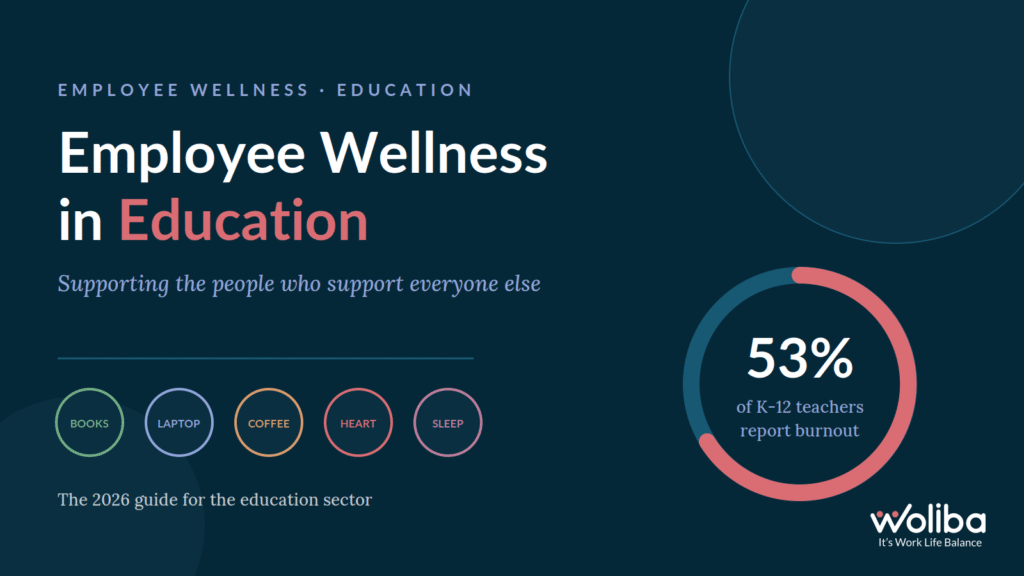
Meanwhile, the adults actually running the building are quietly running on empty. According to RAND’s 2025 State of the American Teacher survey, 53% of K-12 teachers report burnout, and 59% experience frequent job-related stress — nearly double the rate of all working adults. Teachers now hold the unfortunate distinction of being one of the most burned-out professions in the workforce, ahead of nurses, retail workers, and, yes, even people who work in HR.
Employee wellness in education is the overdue answer to that. Not a pizza party. Not a “Wellness Wednesday” email that gets archived faster than a fire drill announcement. A real, structured program that supports the physical, mental, financial, and social health of teachers, administrators, and school staff — the same way a well-run employee wellness program works in any other industry, just built for the realities of a school calendar.
In this guide, we’ll cover what is employee wellness in education actually means, why the education sector needs it more urgently than almost any other, what a great program includes, and how to measure whether it’s working.

Bring Wellness in Your Schools, Universities
The wellness platform employees actually use — launched in days, not months.
What Is Employee Wellness in Education?
Employee wellness in education refers to structured programs and policies that support the wellbeing of the adults working in schools — teachers, principals, administrative staff, counselors, coaches, and support staff. It covers five core dimensions:
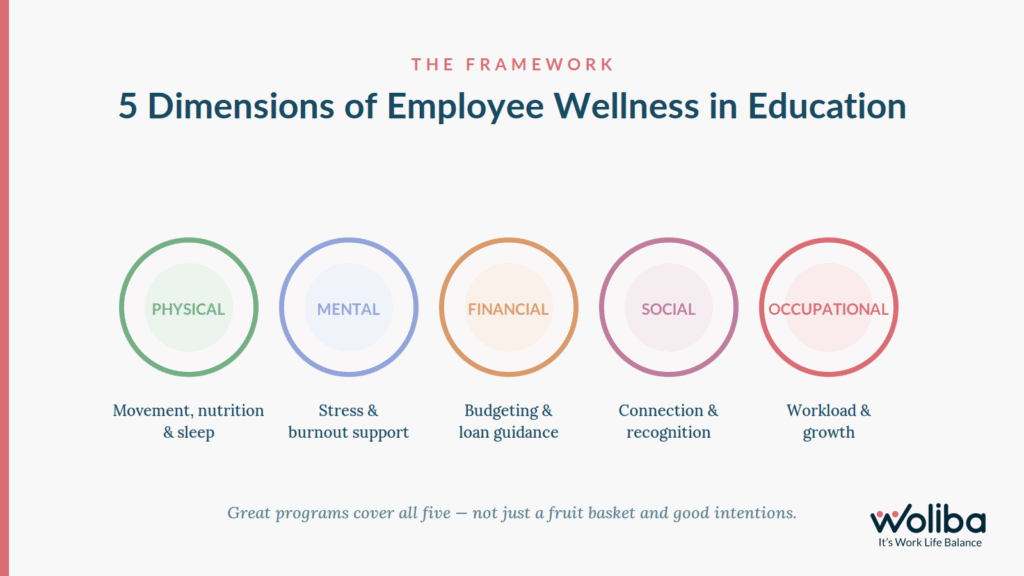
- Physical wellness — movement, nutrition, sleep, and preventive health (because “walking to the copier” is not a fitness routine, no matter how many times a day it happens).
- Mental & emotional wellness — stress management, counseling access, burnout prevention, and psychological safety.
- Financial wellness — budgeting support, retirement education, and student loan guidance for a profession that famously buys its own classroom supplies.
- Social wellness — peer connection, recognition, and a staff culture that extends beyond nodding at each other in the hallway between periods.
- Occupational wellness — sustainable workload, autonomy, and professional growth.
The key distinction: this is different from wellness education (teaching students about health) and different from student wellness programs. This is about the employees. It’s the difference between a school that says “our people are our greatest asset” and a school that actually budgets like it.
Why the Education Sector Needs Wellness Programs More Than Anyone
Every industry talks about burnout. Education has the receipts.
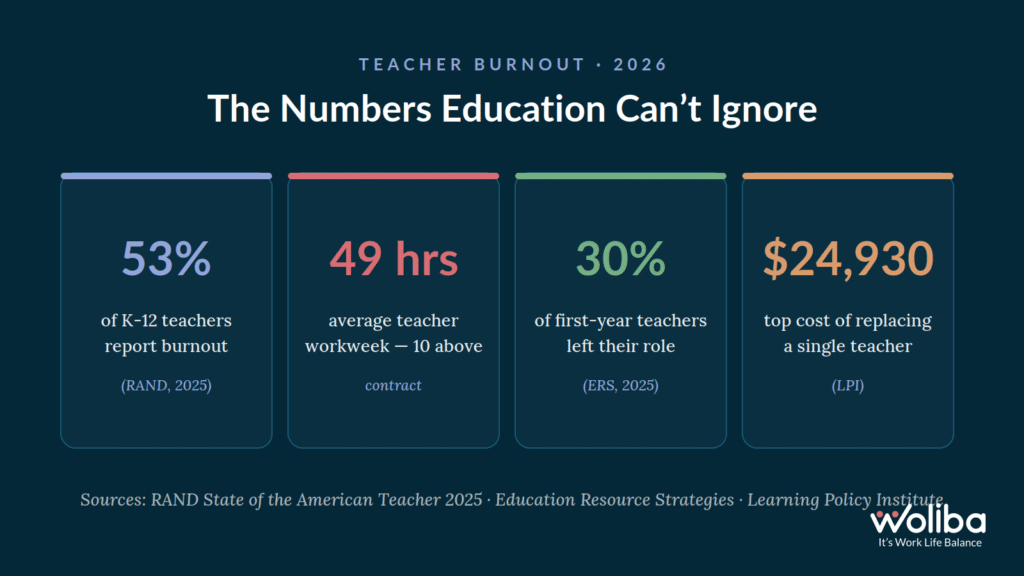
- 53% of K-12 teachers report burnout (RAND, 2025)
- 49 hrs average teacher workweek — about 10 hours above contract
- $24,930 top-end cost of replacing a single teacher (Learning Policy Institute)
1. The workload never clocks out
Teachers average around 49 hours a week — roughly 10 hours beyond their contracts — with grading, lesson planning, and parent emails bleeding into evenings and weekends. Research also points to a roughly 40% jump in digital workload since remote and hybrid teaching became standard. The laptop closes; the job doesn’t.
2. Emotional labor is the job description
Around 78% of teachers say students’ mental health needs have risen — and teachers absorb that weight daily while managing their own. It’s a profession where “leave your problems at the door” applies to everyone in the room except the person at the whiteboard.
3. Turnover is expensive and contagious
Per the Learning Policy Institute, replacing one teacher costs districts between $11,860 and $24,930 — covering separation, recruitment, hiring, and training. And per Education Resource Strategies’ 2025 analysis, 30% of first-year teachers left their school in a single recent school year. Every departure piles more work onto whoever stays, which accelerates the next departure. Burnout, it turns out, is the one thing in a school that spreads faster than a rumor about a surprise assembly.
4. Support hasn’t caught up
Only 29% of teachers felt their school provided adequate support for managing stress and burnout, per a 2024 survey. That’s a gap you could drive a school bus through.
The bottom line: teacher burnout isn’t a personal resilience problem — it’s an organizational one. And organizational problems need organizational solutions, not just a mindfulness app license and good vibes.
Bring Wellness in Your Schools, Universities
The wellness platform employees actually use — launched in days, not months.
What a Great Education Wellness Program Includes
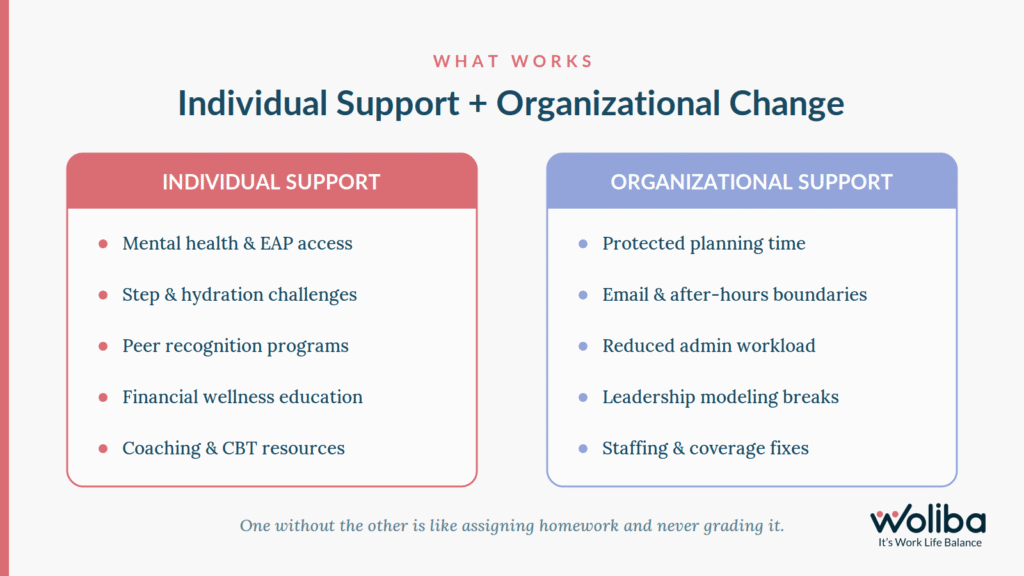
The research here is refreshingly clear. A 2021 meta-analysis found that workplace-based interventions produce measurable reductions in teacher burnout, and a 2020 study found that organizational interventions reducing workload stressors improved wellbeing scores by 15%. The pattern: individual support + structural change. One without the other is like assigning homework and never grading it.
Individual-level support
- Mental health resources — EAP access, counseling stipends, and CBT-informed programs (which evidence reviews link to real improvements in educator anxiety).
- Physical activity challenges — a schoolwide step challenge or hydration challenge that staff can join between periods. Bonus: teachers are naturally competitive. Nobody wants to lose a step challenge to the librarian.
- Recognition programs — peer-to-peer shoutouts and milestone celebrations, because “Teacher Appreciation Week” shouldn’t be the only week.
- Financial wellness education — retirement planning, loan forgiveness navigation, budgeting workshops.
Organizational-level support
- Protected planning time — planning periods that don’t get cannibalized to cover an unfilled vacancy.
- Email and communication boundaries — no expectation of replies at 9 PM. (Radical, we know.)
- Reduced administrative load — streamlining paperwork and duplicate reporting; some districts now use AI tools that save teachers close to 6 hours a week on admin tasks.
- Leadership modeling — principals who take their own breaks give everyone else permission to.
How to Build an Employee Wellness Program for Your School or District
Step 1: Start with a health risk assessment
Before launching anything, understand what your staff actually needs. A health risk assessment gives you an anonymized picture of stress levels, physical health, and lifestyle risks across your workforce — so you build a program based on data, not on whatever the last conference keynote recommended.
Step 2: Form a wellness committee (with actual teachers on it)
Include classroom teachers, support staff, and administrators. A wellness program designed exclusively by the district office has roughly the same success rate as a seating chart designed by the students.
Step 3: Pick initiatives that fit a school calendar
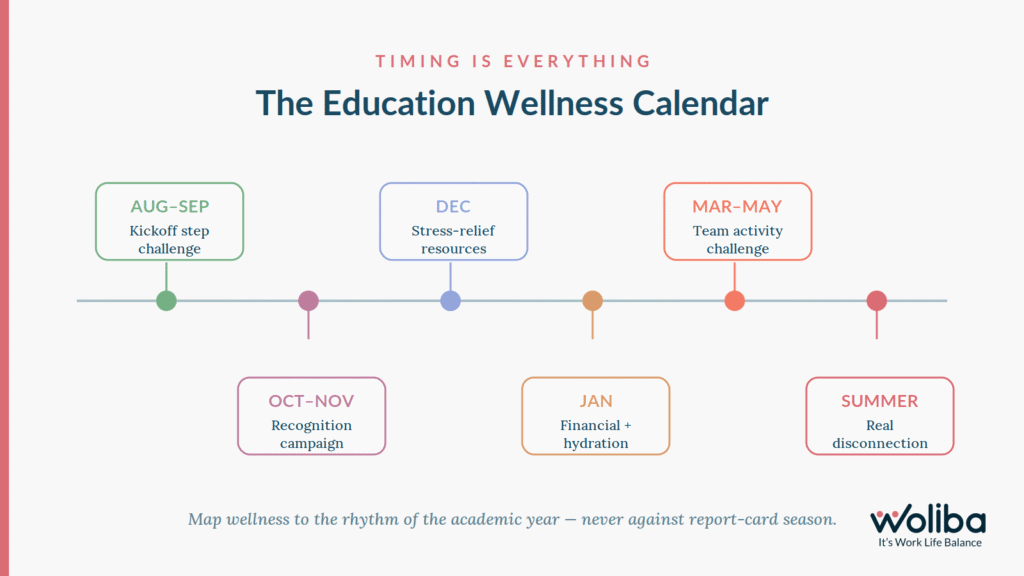
Schools run on bells, semesters, and exam seasons — your program should too. Launch wellness challenges during calmer months, dial intensity down during report card season, and plan recovery-focused activities around exam weeks.
Step 4: Make participation ridiculously easy
Teachers have, on average, 25 minutes of lunch and 4 minutes of free will per day. Anything requiring a separate login, a printed form, or a lunchtime seminar will die quietly. Mobile-first platforms with challenges, recognition, and resources in one app meet staff where they are: in the hallway, between periods, on their phone.
Step 5: Measure, report, repeat
Track participation, engagement survey scores, absence rates, and retention. Share wins with staff and leadership every semester — visibility keeps budgets alive.
| School Calendar Moment | Wellness Initiative That Fits |
|---|---|
| Back-to-school (Aug–Sep) | Kickoff step challenge + wellness platform onboarding |
| Mid-semester slump (Oct–Nov) | Gratitude & recognition campaign, mental health check-ins |
| Exam/grading season | Stress-management resources, no-meeting weeks, meal support |
| New year (Jan) | Financial wellness workshops + hydration challenge |
| Spring stretch (Mar–May) | 5 Minutes Team Building Activities, outdoor walking meetings |
| Summer | Genuine disconnection. Yes, really. Put it in writing. |
10 Employee Wellness Program Ideas for School Staff
Frameworks are useful, but sometimes you just need a list you can bring to Monday’s leadership meeting. Here are ten ideas that work with real school constraints — meaning limited budgets, limited time, and a staff room microwave that has seen things.
- Staff step challenge. Team-based, four weeks, department vs. department. Low cost, high trash-talk, surprisingly effective at getting people moving during hall duty.
- Duty-free, device-free lunches. Protect at least two lunches a week where staff aren’t supervising, covering, or answering emails. An actual break, not a “working break.”
- Peer recognition wall (digital or physical). Let staff shout each other out for covering classes, mentoring, or surviving parent-teacher night. Recognition from peers consistently outperforms top-down awards.
- Walking meetings. One-on-ones and PLC check-ins on foot around the track. Same agenda, more steps, fewer fluorescent lights.
- Financial wellness workshops. Sessions on retirement plans, budgeting, and loan forgiveness navigation — the paperwork equivalent of an escape room, best attempted with a guide.
- No-meeting Wednesdays. One protected afternoon a week for planning and grading. Meetings that disappear are rarely missed; planning time that disappears always is.
- Hydration challenge. Simple daily water goals through an app. Teachers famously ration water to avoid needing a bathroom break they can’t take — this one pairs well with a coverage policy that actually allows breaks.
- Wellness stipend. Even $100–$200 a year toward a gym membership, therapy copays, or running shoes signals that wellbeing is budgeted, not just mentioned.
- Gratitude campaign during the mid-semester slump. October and November are when morale dips hardest — schedule appreciation deliberately, not just during the official appreciation week.
- Summer digital detox policy. A written norm that staff are not expected to check email over summer break. Free to implement, priceless in effect.
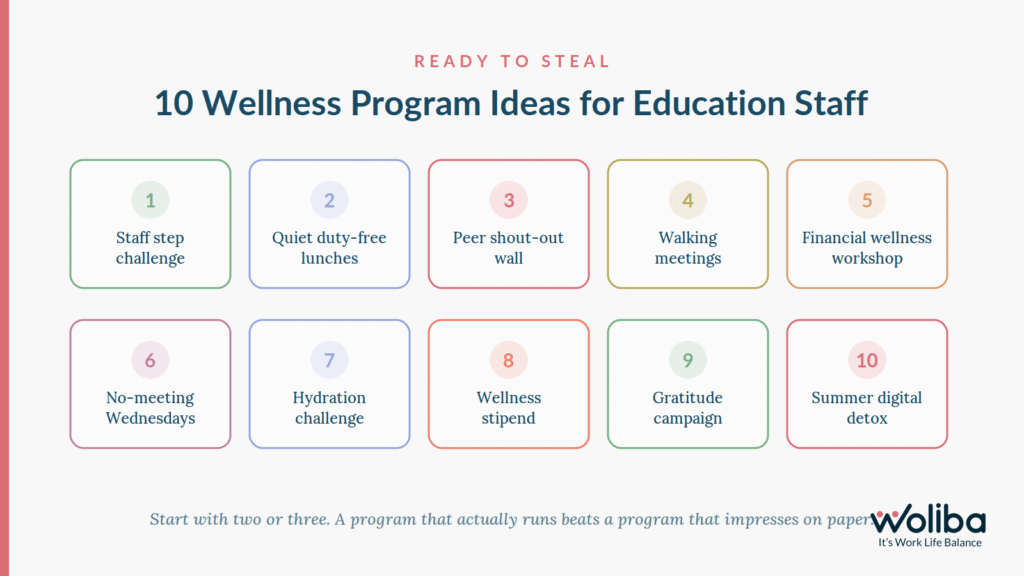
Start with two or three and run them well. A modest program with 70% participation beats an ambitious one with a beautiful PDF and an audience of six.
Common Mistakes Schools Make with Employee Wellness (and How to Avoid Them)
Plenty of schools have tried wellness initiatives before. If yours did and it fizzled, one of these culprits was probably involved.
Mistake #1: Treating wellness as an event, not a system
A one-off yoga session during in-service week is a nice gesture — and by October, nobody remembers it happened. Wellbeing improves through consistent, year-round programming with regular touchpoints, not annual gestures. Think curriculum, not assembly.
Mistake #2: Offering self-care while ignoring workload
Research on individual resilience training — mindfulness apps, stress workshops — shows modest effects at best when workload stays untouched. Handing a teacher working 49-hour weeks a meditation app is like handing someone a bucket on a sinking ship and calling it a maritime safety program. Pair every individual resource with at least one structural fix: protected time, reduced paperwork, or realistic coverage.
Mistake #3: Designing without asking
Programs built purely by administrators tend to reflect administrator schedules. Run an anonymous needs survey or a health risk assessment first, and put classroom teachers on the wellness committee. The people closest to the problem write the best solutions — a principle teachers apply in classrooms every day.
Mistake #4: Making participation another task
If joining the wellness program requires a desktop login, a printed form, and attending a lunchtime seminar, you haven’t created a benefit — you’ve created homework. For adults. Who already grade homework. Keep everything mobile, opt-in, and under two minutes to engage with.
Mistake #5: Not measuring anything
Without baseline data and regular check-ins, the program can’t prove its value — and unproven line items are the first cut in a school budget. Track participation, engagement scores, absences, and retention from day one, and report them each semester.
Quick self-test: if your current wellness offering can be fully described as “we have an EAP and we did a thing in August,” there’s room to grow. The good news: every mistake on this list is fixable within one school year.
Bring Wellness in Your Schools, Universities
The wellness platform employees actually use — launched in days, not months.
Measuring ROI: Making the Case to Your District
Wellness budgets in education compete with textbooks, technology, and roof repairs — so the business case has to be sharp. Fortunately, the math is on your side.
If replacing one teacher costs up to $24,930, a wellness platform that helps retain even two or three teachers a year pays for itself across an entire district — before counting reduced substitute costs, lower absenteeism, and improved staff engagement. Intervention research backs this up: studies consistently report stress and burnout reductions in the 12–18% range from structured workplace wellness efforts.
Metrics that convince a school board: teacher retention rate, first-year teacher retention, substitute/absence costs, staff engagement scores, program participation rate, and EAP or benefits utilization. Present them the way teachers present grades — with a clear rubric and no surprises.
Frequently Asked Questions
What are the 7 pillars of wellness?
The seven commonly referenced pillars are physical, mental, emotional, social, occupational, environmental, and spiritual wellness. Some frameworks add financial wellness as an eighth dimension.
Why is wellness important in education?
Wellness directly affects how well students learn and how effectively teachers can teach. Poor physical, mental, or emotional health lowers academic performance for students and increases burnout and turnover among staff, while strong wellness support improves both.
What is wellness in physical education?
In a physical education context, wellness refers to teaching students the habits and knowledge needed to maintain lifelong physical health — movement, nutrition, and body awareness — as part of a broader wellness curriculum rather than just sports skills.
How can schools improve staff wellness on a limited budget?
Low-cost approaches include recognition programs, flexible scheduling where possible, simple wellness challenges, designated quiet spaces for breaks, and consistent, genuine communication from leadership about workload and support.
What’s the difference between student wellness and staff wellness programs?
Student wellness programs typically focus on curriculum, counseling access, and healthy habits during the school day. Staff wellness programs focus on workload management, recognition, mental health support, and long-term retention — but both work best when addressed together as part of one school-wide culture.
Bring Wellness in Your Schools, Universities
The wellness platform employees actually use — launched in days, not months.
Final Thoughts
Wellness in education isn’t a single program you launch and check off a list — it’s a culture you build gradually, through leadership commitment, consistent small actions, and genuine investment in the people who make a school run. Whether you’re starting with one wellness challenge or building a full district-wide strategy, the schools that treat well-being as core infrastructure — not an extra — are the ones that see it pay off in retention, performance, and culture for years to come.