


A virtual wellness program is a set of digital health and wellbeing activities that employees can join from anywhere, whether they work from home, split time with the office, or sit in a different time zone from their manager. Done well, it gives remote and hybrid teams the same access to support, connection, and healthy habits that office-based employees often get by default.
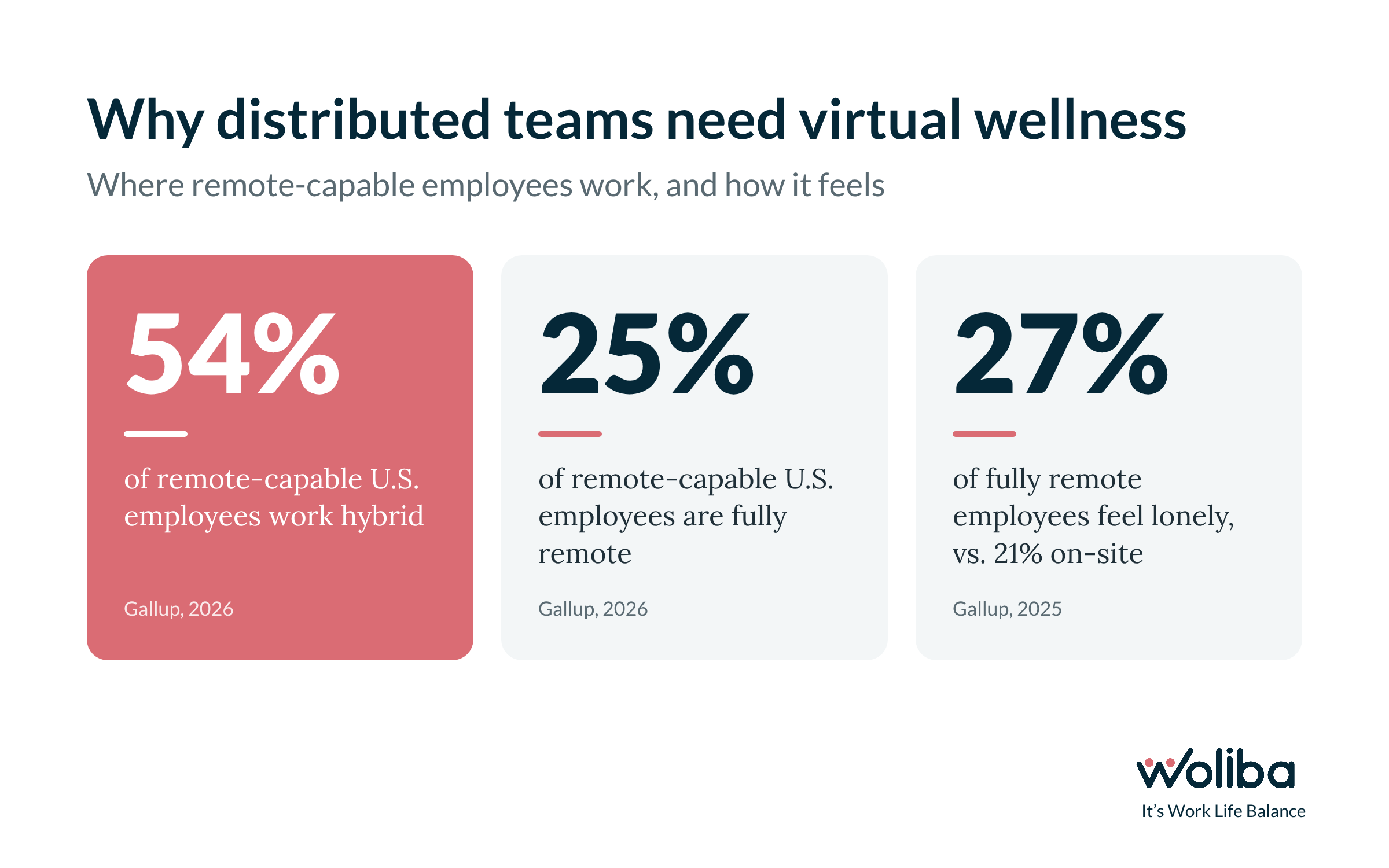
That access matters more every year. In Gallup’s latest tracking, 54% of U.S. employees with remote-capable jobs work hybrid, and another 25% are fully remote. Yet many wellness programs were still designed for a single office: a gym discount, an on-site flu clinic, a lunch-and-learn in the break room. Employees outside that building quietly miss out.
This guide covers what a virtual wellness program includes, why it matters for distributed teams, 15 ideas you can run this quarter, a step-by-step launch plan, and how to measure whether it’s working.
What Is a Virtual Wellness Program?
A virtual wellness program is an employee wellbeing program delivered mainly through digital channels: a wellness app or platform, live and on-demand video sessions, workplace challenges, chat communities, and telehealth or coaching. Employees take part on their own schedule and from their own location, and HR can track participation across the whole workforce in one place.
It isn’t just an in-office program moved onto Zoom. A strong virtual program is designed around how remote and hybrid people actually work, with asynchronous options, time zone–friendly scheduling, and activities that build connection between people who rarely share a room.
| Traditional (office-based) program | Virtual wellness program | |
|---|---|---|
| Access | Employees near an office or site | Every employee, wherever they work |
| Format | On-site classes, clinics, events | App, live and on-demand video, online challenges |
| Timing | Fixed times during office hours | Live plus self-paced, across time zones |
| Connection | Happens naturally in the building | Designed in through teams, feeds, and events |
| Measurement | Sign-up sheets, annual surveys | Real-time participation and pulse data |
Why Remote and Hybrid Teams Need a Virtual Wellness Program
Remote work removes a commute and adds flexibility, but it also removes many of the small moments that keep people healthy and connected. Here’s what tends to slip without a deliberate program.
Loneliness and isolation rise
Gallup’s State of the Global Workplace research found that 27% of fully remote employees feel lonely a lot of the time, compared with 21% of on-site employees. Remote workers can be highly engaged in their work and still feel cut off from their team. If you want to go deeper into the 12 pillars of wellbeing, see our guide to social wellness at work.
Work and home blur together
When the laptop lives on the kitchen table, the workday rarely has a clear end. Longer hours, skipped breaks, and late-night messages are early warning signs of burnout, and they’re much harder for a manager to notice over video.
People move less
No walk to the train, no stroll to a meeting room. Many remote employees sit for most of the day without realizing it. Movement challenges and stretch reminders do a lot of quiet work here.
Benefits feel uneven
When the free fitness class, the wellness fair, and the healthy snacks all live at headquarters, remote and hybrid employees notice. A virtual program is one of the simplest ways to make sure everyone gets the same support.
The business case follows the same logic as any employee wellness program: healthier, more connected employees tend to be more engaged and more likely to stay. Our breakdown of the ROI of employee wellness programs covers how to estimate that return.
Core Components of a Virtual Wellness Program
Most effective virtual programs cover several dimensions of wellbeing, not just fitness. Use these six pillars as a checklist when you design yours.
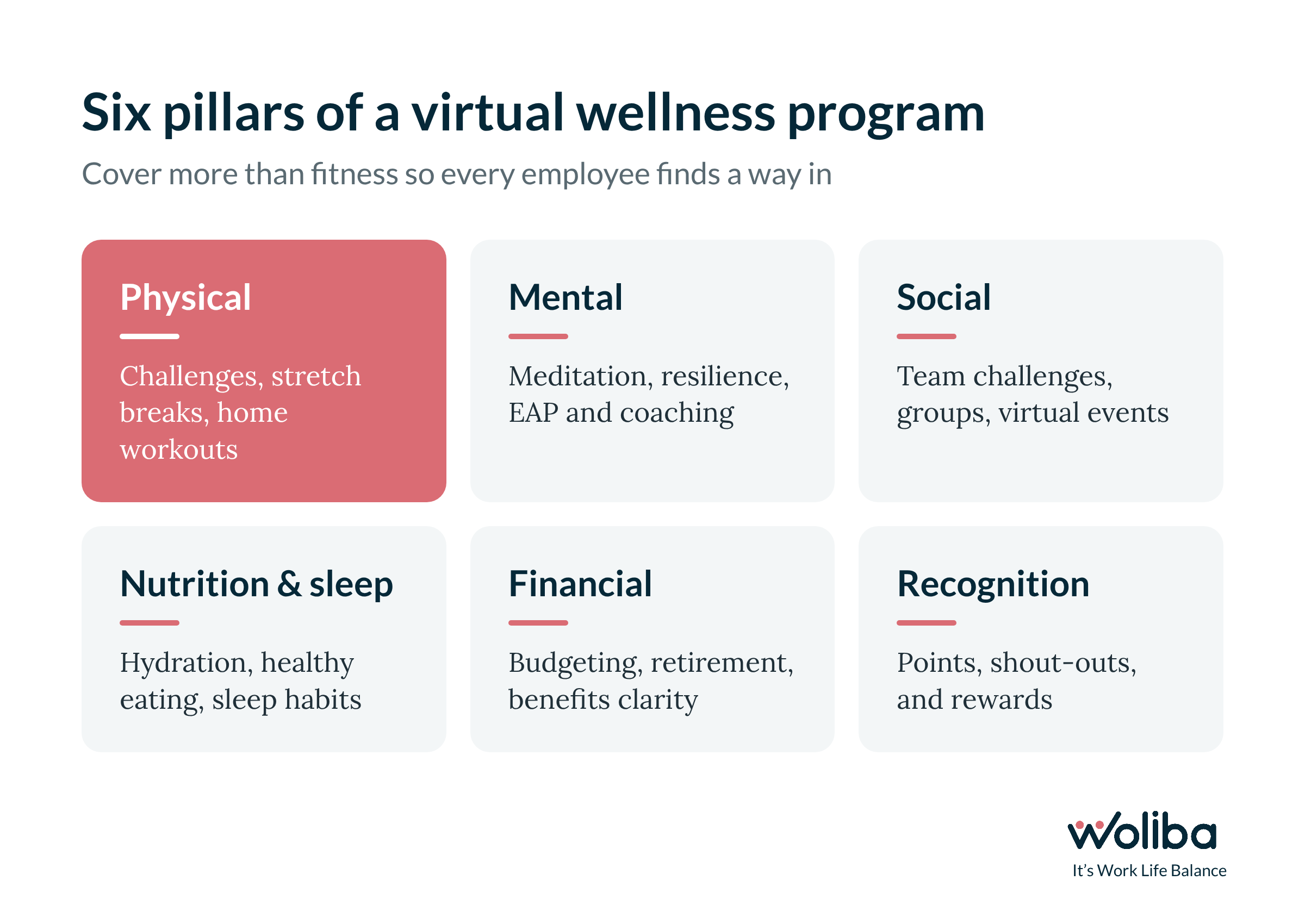
- Physical wellness: step and activity challenges, guided stretch breaks, at-home workouts, and ergonomics tips for home offices.
- Mental and emotional wellness: meditation and breathing sessions, stress and resilience content, and clear routes to EAP, therapy, or coaching. See our guide to mental wellness in the workplace.
- Social connection: team challenges, interest-based groups, a social feed, and virtual events that bring remote and office employees together.
- Nutrition and sleep: hydration and healthy-eating challenges, sleep habit programs, and simple recipes people can actually cook at home.
- Financial wellness: budgeting workshops, retirement planning sessions, and easy access to benefits information.
- Recognition and rewards: points, peer shout-outs, and incentives that reward healthy habits and keep participation going.
For a deeper look at how these pieces fit together, read our article on the components of employee wellness programs.
15 Virtual Wellness Program Ideas for Remote Employees
You don’t need to launch all of these at once. Pick three or four that match what your employees say they want, run them well, then add more each quarter.
Physical wellness ideas
- Company-wide step challenge. Teams sync their fitness trackers and compete on total steps over two to four weeks. It’s simple, inclusive, and works across every location. Our step challenge guide walks through setup.
- Five-minute stretch breaks. Short on-demand videos people can do between calls, ideally scheduled as a recurring calendar nudge.
- Virtual fitness classes. Live yoga, pilates, or HIIT sessions, recorded so employees in other time zones can join later.
- Home office ergonomics check. A quick self-assessment and checklist, paired with a small stipend for a chair, monitor stand, or keyboard.
Mental and emotional wellness ideas
- Guided meditation series. A 10-minute weekly session led live, with recordings in the platform for anyone who missed it.
- Meeting-free focus blocks. One protected afternoon a week with no internal meetings, so people can work deeply and log off on time.
- Mental health workshops. Expert-led sessions on stress, burnout, or sleep, plus a reminder of how to reach your EAP.
- Digital detox challenge. Small daily goals such as no email after 7 p.m. or a phone-free lunch, tracked as a team.
Social connection ideas
- Cross-team wellness challenges. Mix employees from different departments and locations into teams so remote staff meet new colleagues. Browse more wellness challenge ideas.
- Virtual coffee pairings. Randomly pair employees for a 20-minute chat every two weeks. No agenda required.
- Interest-based groups. Running, cooking, gardening, parenting, or book clubs that live in a shared feed and meet online once a month.
- Peer recognition feed. A public place to thank colleagues and celebrate wellness wins, so effort is visible even when no one is in the same room.
Lifestyle and financial wellness ideas
- Hydration or healthy-lunch challenge. Daily check-ins with a team leaderboard. Easy to join and surprisingly sticky.
- Financial wellness webinars. Sessions on budgeting, debt, or retirement planning, recorded for on-demand viewing.
- Volunteer and giving challenges. Virtual volunteering or step-for-charity goals that connect wellness to a shared purpose.
How to Launch a Virtual Wellness Program in 7 Steps
A virtual program succeeds or fails on planning and communication. Use this roadmap to go from idea to a program people actually use.
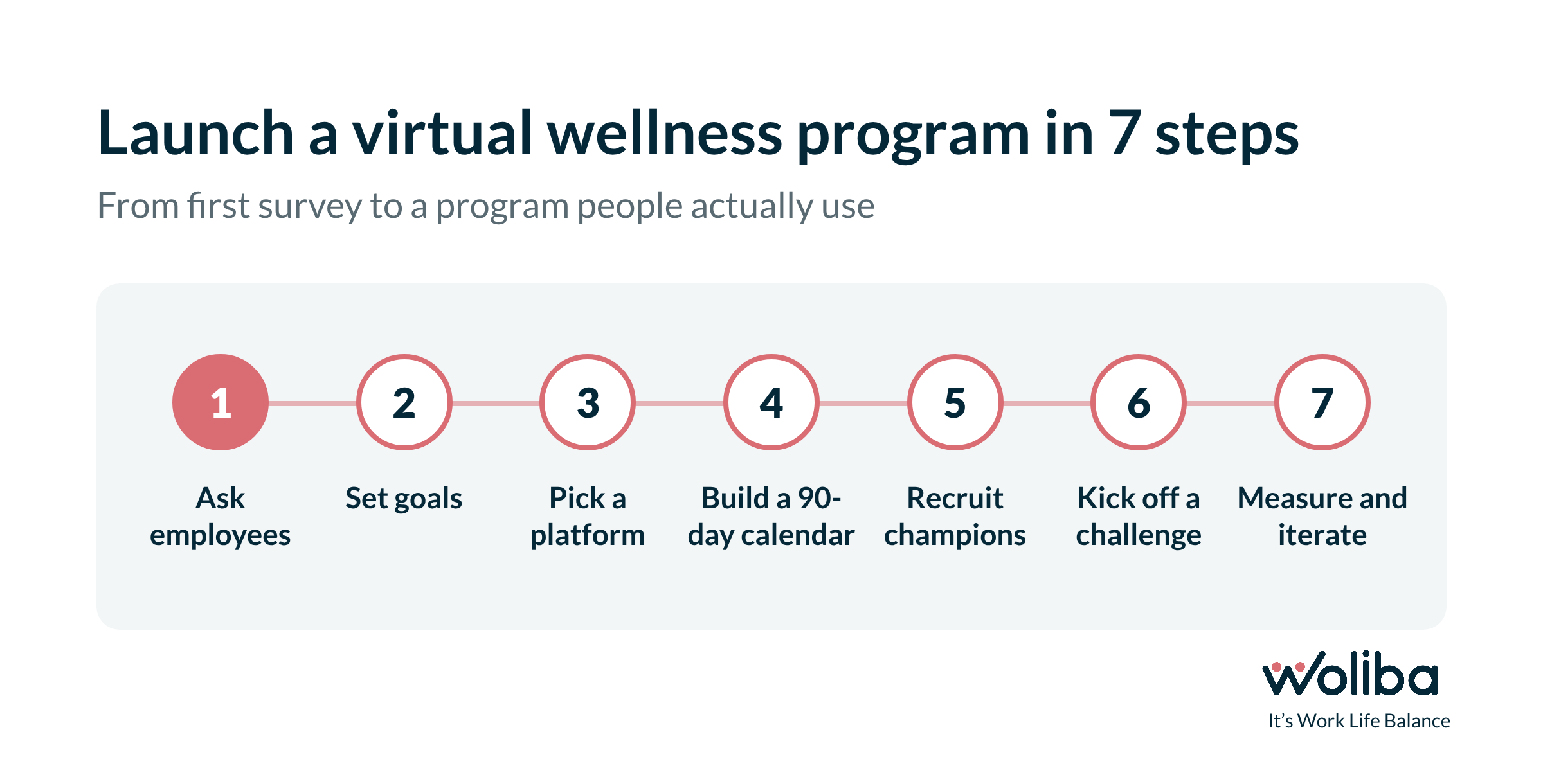
1. Ask employees what they need
Start with a short survey covering stress, sleep, activity, connection, and the topics people want help with. Ask about time zones and preferred formats too. Our list of employee survey questions is a good starting point.
2. Set clear goals
Pick two or three outcomes you want to move in the first six months, such as participation, pulse survey scores on stress or belonging, or retention among remote employees. Clear goals make it easier to secure budget and show results later.
3. Choose the right platform
Look for one place where employees can join challenges, watch sessions, connect with colleagues, and earn rewards, with mobile apps, tracker integrations, and reporting for HR. Juggling five separate tools is one of the fastest ways to lose participation.
4. Build a 90-day calendar
Plan a mix of always-on resources and time-bound moments: one team challenge per month, a recurring live session each week, and a few themed weeks tied to events like Mental Health Awareness Month.
5. Recruit wellness champions
Ask a few volunteers from different teams, locations, and time zones to promote activities, start conversations in the feed, and share honest feedback. Peer invitations get far more sign-ups than HR emails alone.
6. Launch with a kickoff challenge
Open with something easy and social, like a two-week step or hydration challenge, so people see value in the first few days. Announce it in Slack or Teams, in all-hands meetings, and through managers.
7. Measure, share results, and iterate
Review participation and feedback monthly, share the highlights company-wide, and drop or redesign what isn’t landing. Small improvements every quarter add up quickly.
How to Keep Remote Employees Engaged in Wellness
Launch-week excitement fades fast. These habits keep participation steady over the long term.
- Make it easy to join. One login, a mobile app, and activities that take minutes rather than hours.
- Respect time zones. Rotate live session times and always provide recordings.
- Offer choice. Not everyone wants a step challenge. Mix physical, mental, social, and financial options.
- Use meaningful incentives. Points, gift cards, extra time off, or charity donations. Our wellness challenge prize ideas offer plenty of options.
- Get leaders involved. When executives and managers join challenges and post in the feed, participation rises.
- Keep it voluntary and private. Never tie wellness activity to performance, and be clear about what data HR can and can’t see.
How to Measure the Success of a Virtual Wellness Program
Track a balanced set of metrics so you can show both participation and real impact. Pull them from your wellness platform, pulse surveys, and HR systems.
| Metric | What it tells you | How to track it |
|---|---|---|
| Enrollment rate | How many employees signed up | Platform sign-ups ÷ total headcount |
| Active participation | Whether people keep coming back | Monthly active users, challenge completion |
| Wellbeing scores | Changes in stress, energy, and belonging | Quarterly pulse surveys |
| Remote vs. on-site gap | Whether every location gets equal value | Participation split by work arrangement |
| Retention and absence | Longer-term business impact | HRIS turnover and sick-day trends |
| Employee feedback | What to keep, change, or drop | Post-event polls and open comments |
For more ideas on what to track, see our guide to employee wellbeing metrics.
Common Virtual Wellness Program Mistakes to Avoid
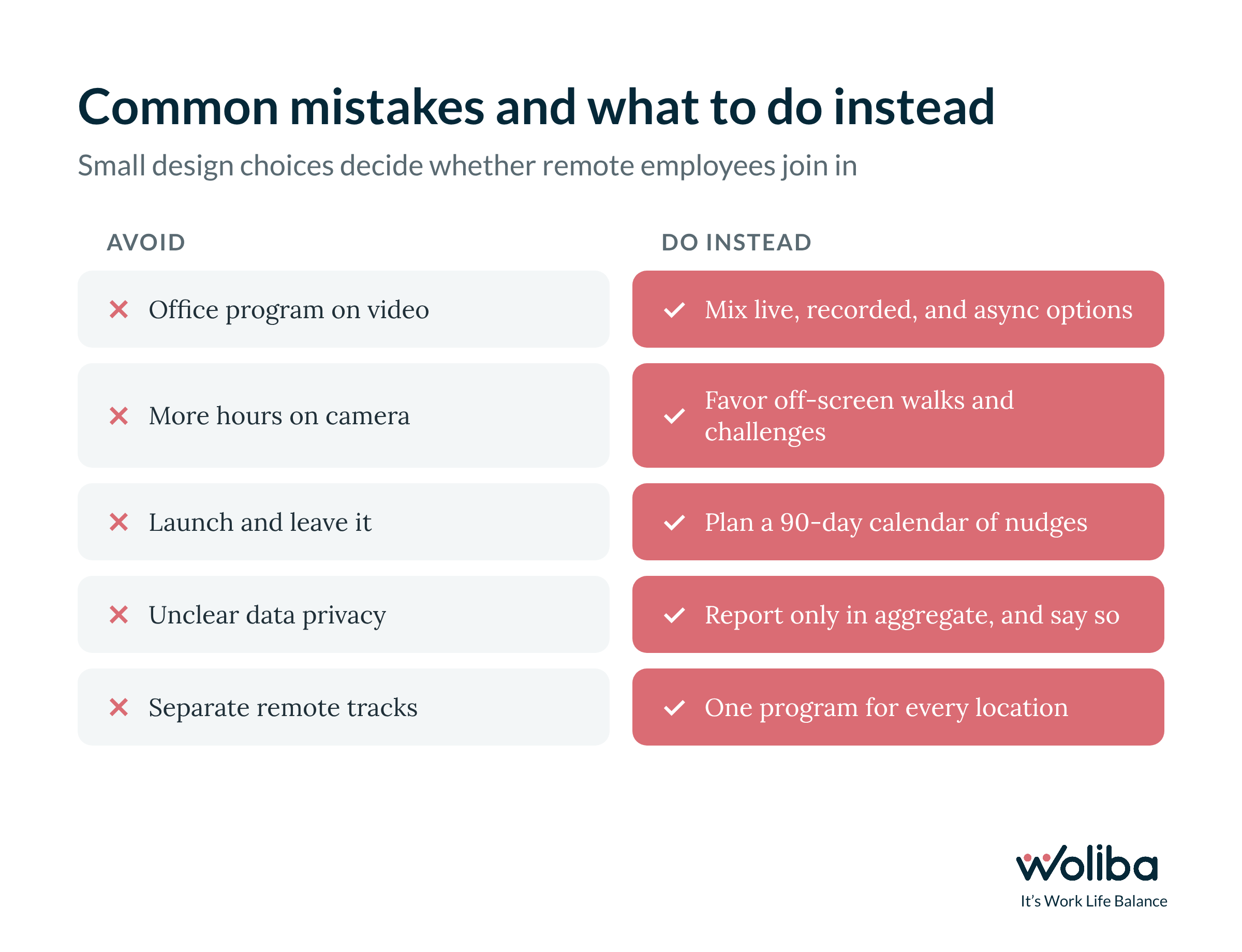
- Copying the office program onto video. A one-hour live lunch-and-learn at noon headquarters time excludes half your team.
- Adding more video calls. If people are already on camera all day, favor asynchronous, off-screen activities like walks and challenges.
- Launching and leaving it. Programs without a calendar and regular communication fade within a couple of months.
- Ignoring privacy. Employees need to trust that personal health data stays private and is only reported in aggregate.
- Forgetting hybrid employees. Make sure in-office and remote employees join the same challenges and events, not separate tracks.
What to Look for in a Virtual Wellness Platform
The right platform does most of the heavy lifting for a distributed team. Before you choose one, check that it offers:
- Team and individual challenges with wearable and fitness tracker integrations
- Live and on-demand content across physical, mental, nutrition, and financial wellness
- A social feed, groups, and peer recognition to build connection
- Built-in rewards and incentives that are easy to manage
- Mobile step challenge apps and integrations with Slack or Microsoft Teams
- Real-time reporting, pulse surveys, and segmentation by location or team
- Strong data privacy and security practices
Woliba brings wellness challenges, recognition, events, rewards, and real-time surveys into one platform, so remote, hybrid, and on-site employees get the same experience. If you support a mixed workforce, our guide to building a hybrid employee health and wellness program is a helpful next read.
Make Wellness Work for Every Employee, Wherever They Work
Remote and hybrid work is here to stay, and wellness programs need to meet employees where they are. Start by asking what your people need, pick a few high-impact activities, choose a platform that brings everything together, and measure what changes. A thoughtful virtual wellness program helps every employee feel healthier, more connected, and supported, no matter where they log in.