


Vantage Fit has long been a popular choice for employee step tracking, but modern People Ops leaders are actively seeking Vantage Fit alternatives that deliver deeper social connection and year-round participation. While basic step tracking is a start, industry data shows that over 80% of employees lose interest in single-feature wellness apps within 30 days. To build long-term healthy habits, organizations need comprehensive platforms that unite physical activity with mental health, peer recognition, and automated reward catalogs.
Whether you are looking for advanced fitness tracking, richer retail rewards, seamless wearable integrations, or a global gym network, choosing the right corporate wellness software is critical for maximizing ROI and reducing employee burnout. This guide breaks down the top alternative platforms, including Woliba, Wellhub, GoJoe, and Advantage Club—to help you find the perfect operational fit for your workforce in 2026.
Why Look Beyond Vantage Fit?
Vantage Fit is a solid corporate wellness solutions — it offers step challenges, activity tracking, health assessments, and a reward-based engagement model. But depending on your company’s size, geography, or wellness philosophy, you might find it falling short in areas like:
- Gym network access — global employees need on-the-ground fitness options
- Mental health coverage — stress, burnout, and EAP tools are increasingly non-negotiable
- Rewards breadth — generic vouchers don’t cut it for a motivated workforce
- Customisation & integrations — HR systems, wearables, and SSO flexibility matter at scale
- Pricing transparency — opaque enterprise-only pricing makes budgeting harder
The good news? The wellness tech market is booming, and you have genuinely excellent choices.
What is the best Vantage Fit alternative?
| Platform | Fitness Challenges | Mental Health | Gym Network | Rewards | Best Market |
|---|---|---|---|---|---|
| Vantage Fit | ✅ Strong | ⚡ Basic | ❌ No | ⚡ Moderate | India / APAC |
| Woliba | ✅ Strong | ✅ Good | ⚡ Basic | ✅ Strong | Global / US |
| Wellhub | ✅ Strong | ✅ Strong | ✅ 50,000+ | ⚡ Moderate | Global |
| Gojeo | ✅ Strong | ⚡ Basic | ❌ No | ✅ Good | UK / Global |
| Advantage Club | ⚡ Moderate | ⚡ Basic | ❌ No | ✅ Excellent | India / APAC |
| Virgin Pulse / Personify | ✅ Strong | ✅ Strong | ❌ No | ✅ Strong | US Enterprise |
| Limeade | ⚡ Moderate | ✅ Excellent | ❌ No | ⚡ Moderate | US Enterprise |
| Wellable | ✅ Strong | ✅ Good | ❌ No | ⚡ Moderate | US / Global |
| MoveSpring | ✅ Strong | ❌ No | ❌ No | ⚡ Basic | US / Global |
| Thrive Global | ⚡ Basic | ✅ Excellent | ❌ No | ⚡ Moderate | US / Global |
| Vitality | ✅ Strong | ⚡ Moderate | ⚡ Partial | ✅ Excellent | UK / US / AU |
| TELUS Health | ⚡ Moderate | ✅ Excellent | ❌ No | ⚡ Moderate | Global |
| Reward Gateway | ⚡ Moderate | ⚡ Basic | ❌ No | ✅ Excellent | UK / Global |
| Leapsome | ⚡ Basic | ✅ Good | ❌ No | ⚡ Moderate | Europe / US |
| Sprout At Work | ✅ Strong | ✅ Good | ❌ No | ✅ Strong | Canada / NA |
| CoreHealth | ✅ Strong | ✅ Good | ❌ No | ✅ Strong | US / Canada |
| Headspace for Work | ❌ No | ✅ Excellent | ❌ No | ⚡ Basic | Global |
Top Vantage Fit Alternatives & Competitors in 2026
1. Woliba
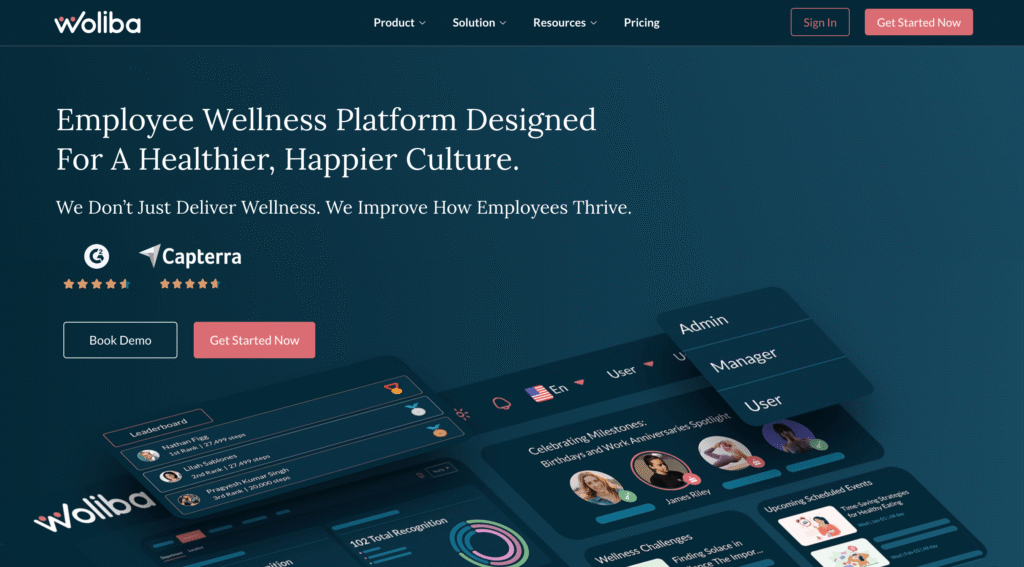
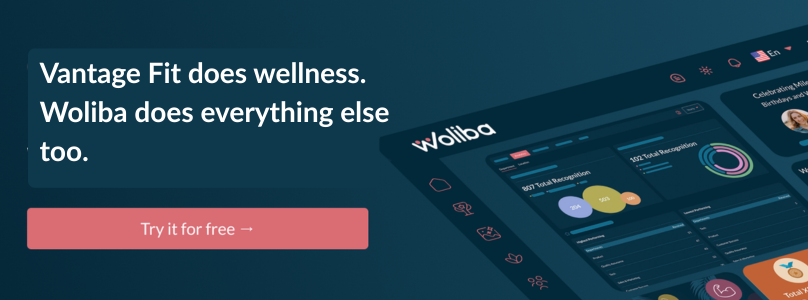
Woliba stands out as one of the most comprehensive corporate wellness platforms available today. Beyond standard fitness challenges, it weaves together employee recognition, team-building activities, mental wellness resources, and rich analytics — all within a single, beautifully designed platform. Companies love Woliba for its ability to connect wellness with broader employee engagement strategies, making it especially powerful for HR teams that want to do more than just push step-count competitions.
The platform includes nutrition guidance, sleep tracking integrations, mindfulness exercises, and automated recognition workflows. Admins get real-time dashboards showing participation rates, health risk trends, and ROI metrics. Woliba also supports custom challenges tailored to company culture — from virtual hikes to hydration competitions.
🔍 Why Woliba Works Across Industries
Technology: Supports remote-first cultures with async challenges and Slack/Teams integrations that fit how tech teams actually work.
Government: HIPAA-compliant, secure, and configurable for union-based or agency-wide wellness mandates across large public sector workforces.
Manufacturing: Reaches shift workers and deskless employees with mobile-first tools that don’t require constant screen time to participate.
Hospital: Addresses caregiver burnout head-on with mental wellness tools, stress management resources, and resilience challenges.
Financial Services: High-stress environment focus — combines mindfulness, financial wellbeing content, and recognition for performance-driven teams.
Construction: Physical safety culture alignment — pairs fitness and nutrition challenges with safety recognition for field and office workers alike.
Education: Helps school districts and universities reduce staff burnout with flexible, low-friction participation that works around demanding schedules.
Logistics: Keeps distributed drivers and warehouse teams connected to company culture through mobile-first wellness and peer recognition.
Pros & Cons
| Pros | Cons |
| Holistic wellness + recognition in one tool | No physical gym network access |
| Strong analytics and reporting suite | |
| Highly customisable challenges and branding | |
| Excellent customer support and onboarding | |
| Integrates with Slack, Teams, and major HRIS |
🎯 Best for: Mid-size to large companies across technology, healthcare, manufacturing, restaurant, and more — wanting a culture-first wellness strategy with built-in engagement tools and deep industry-specific customisation.
2. Vitality
Vitality, developed by South Africa’s Discovery Group, operates on a fundamentally different model than most wellness platforms: it links healthy behaviours directly to reduced insurance premiums, cashback, and lifestyle rewards from major partners like Apple, Amazon, and Garmin. Employees earn Vitality points by exercising, completing health screenings, and hitting wellness goals — and those points translate into tangible financial savings.
This incentive model is uniquely powerful at driving sustained behavioural change. When skipping a gym session costs you money rather than just points on a leaderboard, participation rates tell a different story. Vitality operates across the UK, US, Australia, and several other markets through insurer partnerships.
Pros & Cons
| Pros | Cons |
| Real financial incentives drive genuine behaviour change | Requires insurer partnership — not standalone |
| Premium Apple Watch subsidy corporate wellness program is hugely popular | Complex to configure for smaller employers |
| Backed by robust actuarial data | Less flexible for purely software-first wellness |
| Partners with major gyms and wellness brands | |
| Proven across multiple global markets |
🎯 Best for: Employers who offer group health insurance and want to tie wellness participation to meaningful, money-saving incentives for employees.
TELUS Health (formerly LifeWorks)
TELUS Health (formerly Morneau Shepell / LifeWorks) is one of the world’s leading Employee Assistance Program providers, and its digital platform has evolved into a comprehensive total wellbeing solution. It combines EAP services (counselling, crisis support, legal and financial helplines) with digital mental health tools, wellbeing challenges, and recognition — all in a single app available in 160+ countries and 40+ languages.
The mental health capabilities are genuinely clinical-grade: employees can access therapists, psychiatrists, and coaches through the platform, with proactive support tools that identify risk early. For multinational companies needing a consistent wellbeing offering across geographies, TELUS Health is among the very best.
Pros & Cons
| Pros | Cons |
| World-class EAP with clinical-grade mental health support | Wellness challenge features are secondary to EAP |
| Available in 160+ countries, 40+ languages | UI is functional but not the most engaging |
| Covers physical, mental, financial & social wellbeing | Premium pricing reflects its clinical depth |
| Strong crisis support and counselling access | |
| Excellent for complex multinationals |
🎯 Best for: Multinationals and large enterprises that need a globally consistent EAP plus mental health support, not just wellness challenges.
3. Reward Gateway
Reward Gateway is one of the UK’s most established employee engagement platforms, combining employee discounts, peer-to-peer recognition, manager rewards, and wellness tools under a single branded hub. Over 4,000 companies use it to improve employee satisfaction and retention — particularly through its SmartSpending™ discount engine that saves employees real money on everyday purchases like groceries, dining, and travel.
Its wellness module covers challenges, mental health signposting, and an employee assistance portal, while its communications hub lets HR teams publish news, celebrate milestones, and run surveys alongside the wellness content. It’s an excellent all-in-one engagement platform for companies that see wellness as part of a broader retention strategy.
Pros & Cons
| Pros | Cons |
| Powerful employee discounts & savings | Wellness tools are not the primary focus |
| Strong recognition and milestone tools | Fitness challenge depth is limited |
| Branded employee hub drives daily engagement | Can feel sprawling — many features to configure |
| Good internal comms tools built-in | |
| Established UK market leader with global reach |
🎯 Best for: UK-based or globally-minded companies wanting to combine employee perks, discounts, recognition, and wellness in one platform.
4. Leapsome
Leapsome is primarily a people enablement platform — covering OKRs, performance reviews, learning, and engagement surveys — but its wellbeing module has become a standout feature. Rather than treating wellness as a separate program, Leapsome embeds it into the performance and engagement workflow: managers can see team wellbeing scores alongside performance data, enabling earlier interventions before burnout becomes an issue.
The platform’s engagement survey tools are particularly sophisticated, with AI-powered analytics that surface themes from open-text responses and benchmark results against industry peers. For HR teams that already use Leapsome for performance management, adding wellness creates a holistic picture of the employee experience in one system.
Pros & Cons
| Pros | Cons |
| Wellbeing embedded in performance data | Not a standalone wellness platform |
| AI-driven engagement analytics are exceptional | Fitness challenge tools are basic |
| Excellent for continuous listening culture | Best value only if using the full Leapsome suite |
| Connects wellbeing to OKRs and learning paths | |
| Modern, intuitive interface |
🎯 Best for: Companies already using or considering a holistic people enablement platform who want wellbeing woven into performance management.
5. Sprout At Work
Sprout At Work is a Canadian-built corporate wellness platform with an unusually deep focus on health data and biometric integration. It enables companies to run comprehensive health risk assessments, track biometric improvements over time, and connect wellness engagement to measurable health outcomes. The platform covers all seven dimensions of wellness — physical, emotional, social, occupational, financial, environmental, and spiritual — giving it a more rounded scope than many competitors.
Sprout’s rewards engine is highly configurable, letting employers define exactly what behaviours earn points and what those points unlock. Its team building activities tools work well for distributed workforces, and the admin dashboard provides some of the richest health population analytics available in the mid-market segment.
Pros & Cons
| Pros | Cons |
| 7-dimension wellness framework is genuinely holistic | Less known outside Canada / North America |
| Strong biometric and health data tracking | UI is functional but less polished than US competitors |
| Highly configurable rewards engine | Implementation can be slower for complex configs |
| Rich population health analytics | |
| Good for Canadian and North American employers |
🎯 Best for: North American employers wanting comprehensive health data, biometric tracking, and a genuinely multi-dimensional wellness approach.
6. CoreHealth
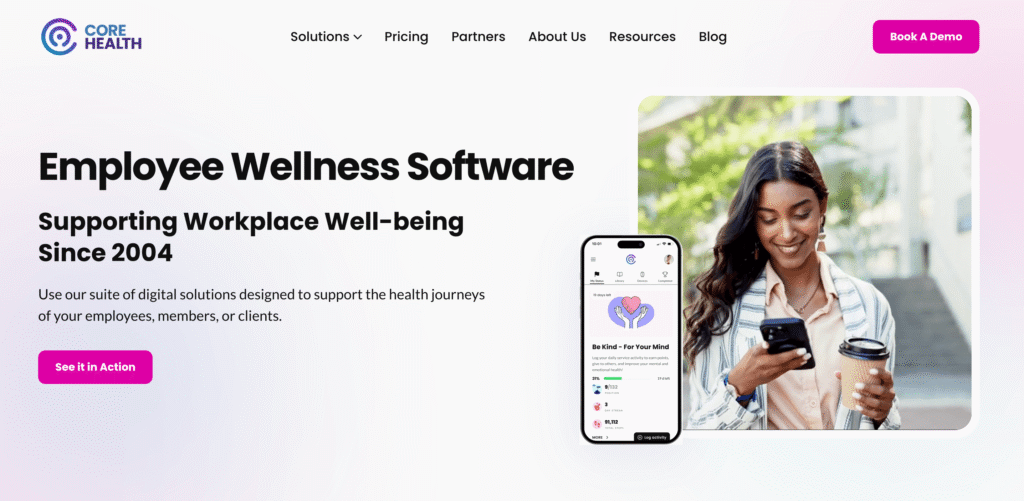
CoreHealth by Carebook stands apart from other wellness platforms by offering a fully white-labelled, configurable wellness solution that HR teams and benefits consultants can shape entirely to their brand and requirements. Rather than a fixed feature set, CoreHealth provides a flexible framework for building wellness programs with custom content, challenges, health assessments, biometrics, coaching workflows, and rewards — without needing to compromise on any aspect of the experience.
It’s particularly popular among wellness vendors, consultants, and large employers who want to run branded wellness portals. The platform’s modular architecture means you pay for and deploy only what you need, and scale as your program matures.
Pros & Cons
| Pros | Cons |
| Unmatched configurability and white-labelling | Requires more setup time than out-of-the-box tools |
| Modular — build exactly what you need | Not ideal for companies wanting a quick launch |
| Strong for wellness vendors & consultants | Best suited to larger or more sophisticated buyers |
| Supports complex custom challenge logic | |
| Enterprise-grade security and compliance |
🎯 Best for: Large enterprises, benefits consultants, or wellness program vendors wanting full control over branding, features, and workflows.
7. Headspace for Work
Headspace for Work brings the world’s most recognised meditation and mindfulness app into the corporate wellness space with a purpose-built team offering. Employees get full access to Headspace’s extensive library of guided meditations, sleep tools, focus music, and mental fitness exercises — while HR teams gain visibility into adoption, engagement, and wellbeing trends across their workforce.
Following its merger with Ginger (a therapy and coaching platform), Headspace Health now also provides on-demand coaching and therapy options — making it a credible mental health platform, not just a meditation app. For companies where employee stress, anxiety, and focus are primary wellbeing concerns, it’s one of the most trusted and highest-adoption solutions available.
Pros & Cons
| Pros | Cons |
| Brand trust drives extremely high employee adoption | No fitness challenge or step-tracking tools |
| World-class meditation and sleep content | Not a comprehensive wellness platform on its own |
| Coaching and therapy now included (Ginger merger) | Works best as a complementary tool alongside a full platform |
| Simple, beautiful app UX employees genuinely enjoy | |
| Available in multiple languages |
🎯 Best for: Companies prioritising mental health and mindfulness — either as a standalone benefit or layered on top of a broader wellness platform.
8. Gojeo
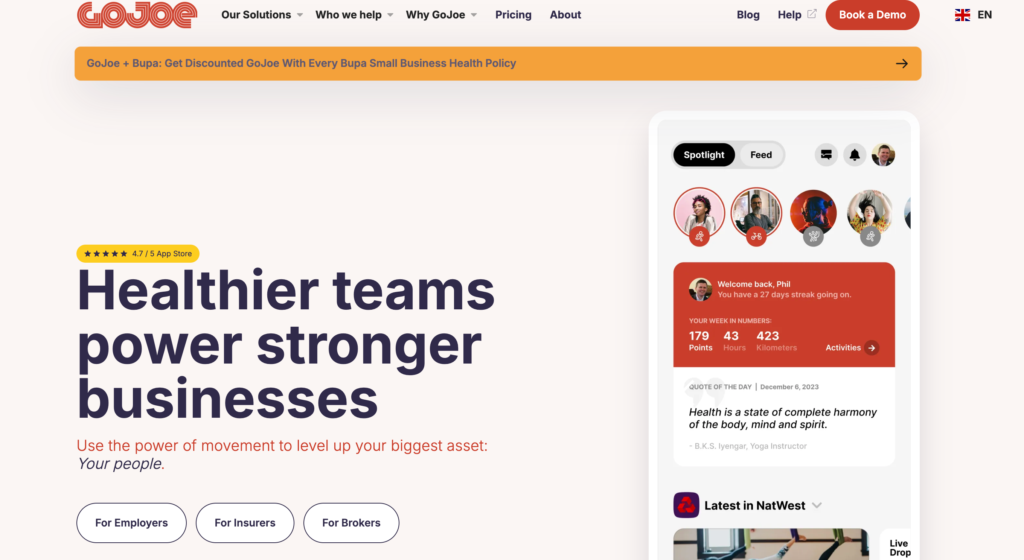
Gojeo takes a refreshingly game-forward approach to corporate wellness. It wraps fitness challenges in team competitions, leaderboards, and achievement systems that drive participation rates most platforms can only dream of. Rather than passively tracking steps, Gojeo turns wellness into a team sport — employees form squads, compete in challenges, and earn redeemable rewards that actually excite them.
The platform works well for companies that have struggled with low wellness program adoption. Its challenge engine supports everything from walking and cycling to mindfulness streaks and sleep goals, making it genuinely multi-dimensional. Integrates smoothly with wearables like Fitbit, Garmin, and Apple Watch.
| Pros | Cons |
| High participation through gamification | Less focus on mental health or EAP tools |
| Excellent team challenge mechanics | Smaller platform — fewer enterprise features |
| Strong wearable integrations | Reward catalogue could be broader |
| Intuitive, fun UI that employees enjoy | |
| Good for remote team bonding |
🎯 Best for: Companies struggling with low wellness participation and wanting to make fitness genuinely fun and competitive.
9. Advantage Club
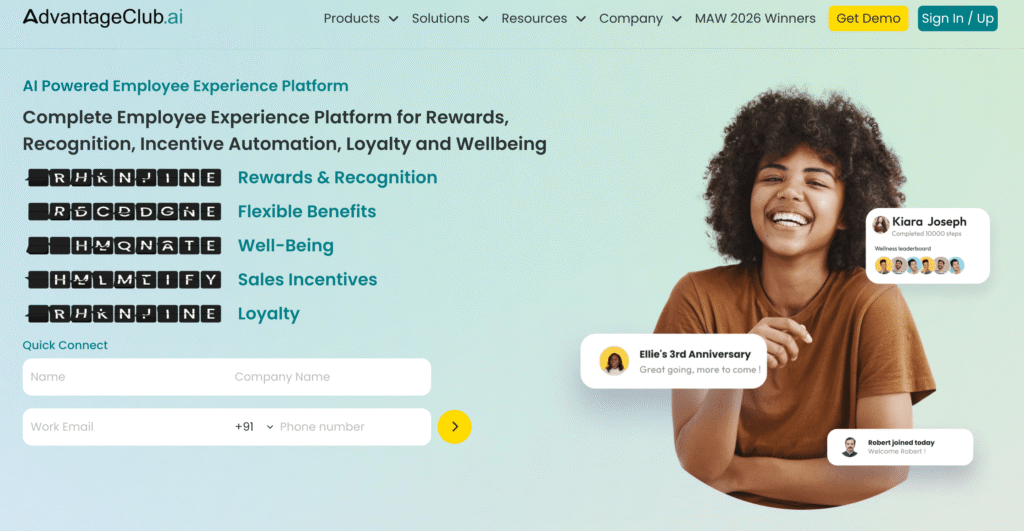
Advantage Club blurs the line between employee wellness, rewards, and financial wellbeing. Originally built as an employee perks and discount platform, it has evolved into a comprehensive wellness hub that covers health challenges, recognition programs, earned wage access, and retail perks — all under one roof.
The platform is particularly popular in Asia-Pacific and India, where it has deep merchant partnerships that offer genuine, high-value discounts on everyday spending. For HR teams that want to tie wellness outcomes to tangible financial benefits, Advantage Club is hard to beat. It also features peer-to-peer recognition and anniversary/milestone rewards.
| Pros | Cons |
| Excellent rewards & discounts marketplace | Fitness challenge tools less advanced |
| Financial wellness + earned wage access | Limited mental health coverage |
| Strong in India & APAC markets | Less suited for US/European-first companies |
| Peer recognition built-in | |
| Highly configurable reward programs |
🎯 Best for: Companies in India/APAC wanting to combine wellness incentives with financial perks and employee recognition.
10. Virgin Pulse
Formerly Virgin Pulse and now rebranded as Personify Health following a major merger, this platform is the go-to for large enterprises with complex health benefit ecosystems. It combines wellness challenges with health navigation, chronic condition management, biometric screening, and claims data analysis — essentially functioning as a full population health management tool.
For employers with self-insured health plans, Personify Health can connect wellness behaviour to actual healthcare cost data, providing unparalleled ROI reporting. It’s complex, premium-priced, but extraordinarily capable.
| Pros | Cons |
| Full population health management | Overkill and over-priced for SMBs |
| Deep integration with health plans | Complex implementation timelines |
| Strong clinical & biometric capabilities | UI feels dated compared to newer rivals |
| Peer recognition built-in | |
| Trusted by Fortune 500 companies |
🎯 Best for: Large enterprises (1,000+ employees) with self-insured plans wanting data-driven, clinical-grade wellness management.
11. Limeade
Limeade takes a science-backed, whole-person approach to employee wellbeing, drawing from positive psychology research. The platform measures employee wellbeing across multiple dimensions — physical, mental, financial, and purpose — and helps HR teams understand how wellbeing connects to inclusion, manager effectiveness, and organisational culture.
Its listening tools (employee pulse surveys, wellbeing assessments) are among the best in class, providing rich data that goes beyond activity tracking to reveal the deeper drivers of employee experience. Limeade is part of the WebMD Health Services family.
| Pros | Cons |
| Science-backed wellbeing framework | Less gamified than competitors |
| Excellent listening & survey tools | No built-in gym network |
| Links wellbeing to culture & inclusion | UI feels dated compared to newer rivals |
| Peer recognition built-in | Pricing is enterprise-tier |
| Strong enterprise integrations |
12. MoveSpring
MoveSpring is laser-focused on doing one thing exceptionally well: running fun, competitive step and activity challenges that employees actually want to join. Its challenge engine supports individual, team, and company-wide competitions with virtual map routes, milestone unlocks, and social feeds that create genuine excitement. Integrates with all major wearables and phone pedometers so nobody gets left out.
While MoveSpring doesn’t try to be everything, it’s an excellent entry point for companies launching their first wellness program or looking to reinvigorate a stagnant one. The admin setup takes hours, not weeks, and the user experience is clean enough that adoption is rarely a problem.
| Pros | Cons |
| Extremely easy to set up and launch | Limited to physical activity — no mental health tools |
| Delightful challenge UX — high adoption rates | No rewards or recognition system built-in |
| Supports all major wearables and phones | Not suitable as a primary enterprise wellness platform |
| Virtual map journeys are a crowd-pleaser | |
| Affordable for SMBs |
🎯 Best for: Companies wanting to launch a quick, fun, and high-participation step challenge with minimal setup effort.
13. Thrive Global
Thrive Global is built on the premise that sustainable high performance requires managing energy, not just time. Its platform combines micro-learning, science-backed habit formation tools, and stress resilience programs into a behaviour change engine that helps employees adopt healthier patterns around sleep, focus, and recovery — addressing the root causes of burnout rather than just its symptoms.
Thrive is notable for its “Thrive Reset” micro-steps — 60-second evidence-based actions employees can take throughout the day to reset their stress response. It’s also one of the few wellness platforms that seriously addresses manager wellbeing and leadership resilience, recognising that culture starts at the top.
| Pros | Cons |
| Science-backed behaviour change approach | Less focus on fitness / physical activity tracking |
| Uniquely strong on burnout & resilience | Premium pricing limits SMB access |
| Addresses manager and leadership wellbeing | Lighter on gamification and social features |
| High-quality content from credible experts | |
| Strong brand — employees trust it |
🎯 Best for: High-pressure industries (finance, tech, healthcare) dealing with employee burnout and wanting to invest in sustainable performance.
Pro Tip: What to Ask Before You Switch
Before requesting demos, align internally on these three questions:
- What’s your #1 pain point? Low participation → Gojeo. Gym access → Wellhub. Recognition + wellness together → Woliba.
- Who are your employees? Remote-first, hybrid, global, or office-based teams each have different needs.
- What does success look like? Define your KPIs first — participation rate, health risk reduction, NPS — then find a platform that measures them natively.
How to Choose the Right Platform
There’s no universally “best” Vantage Fit alternative — the right choice depends on your unique workforce. Here’s a quick decision framework:
1. Company Size Matters
Smaller companies (under 200 employees) will often get more value from focused, affordable tools like Woliba or Gojeo than from complex enterprise platforms. Larger organisations with dedicated HR teams and benefits budgets should seriously evaluate Wellhub or Personify Health.
2. Geography is Critical
If you have employees across multiple countries, gym network coverage becomes crucial — and Wellhub is the clear winner here. For India-focused or APAC-heavy companies, Vantage Fit and Advantage Club both offer strong local merchant networks and regional relevance.
3. Mental Health: Table Stakes in 2025
A corporate wellness platform that only tracks steps is falling behind. Look for platforms that genuinely integrate mental health resources — therapy access, mindfulness tools, resilience training — not just a token meditation app tucked into a menu nobody opens.
4. Think ROI from Day One
The best platforms make it easy to prove the business case for wellness. Look for participation tracking, health risk trending, and — if you’re self-insured — claims data correlation. Platforms like Personify Health and Limeade excel here, while newer entrants are quickly building out their analytics suites.
Our Verdict
For most mid-size companies: Woliba is our top pick — it strikes the best balance of wellness, engagement, recognition, and analytics without the complexity of enterprise platforms.
For physical fitness access: Wellhub is unmatched. If your team has asked for gym memberships, this is the answer.
For low-participation teams: Gojeo’s gamified approach will revive your wellness program engagement faster than anything else on this list.
For rewards-led culture: Advantage Club wins in India/APAC with its deep perks and recognition ecosystem.
Bottom line: The corporate wellness market has matured significantly. Whatever Vantage Fit isn’t giving you, there’s a specialist platform that does it brilliantly.