


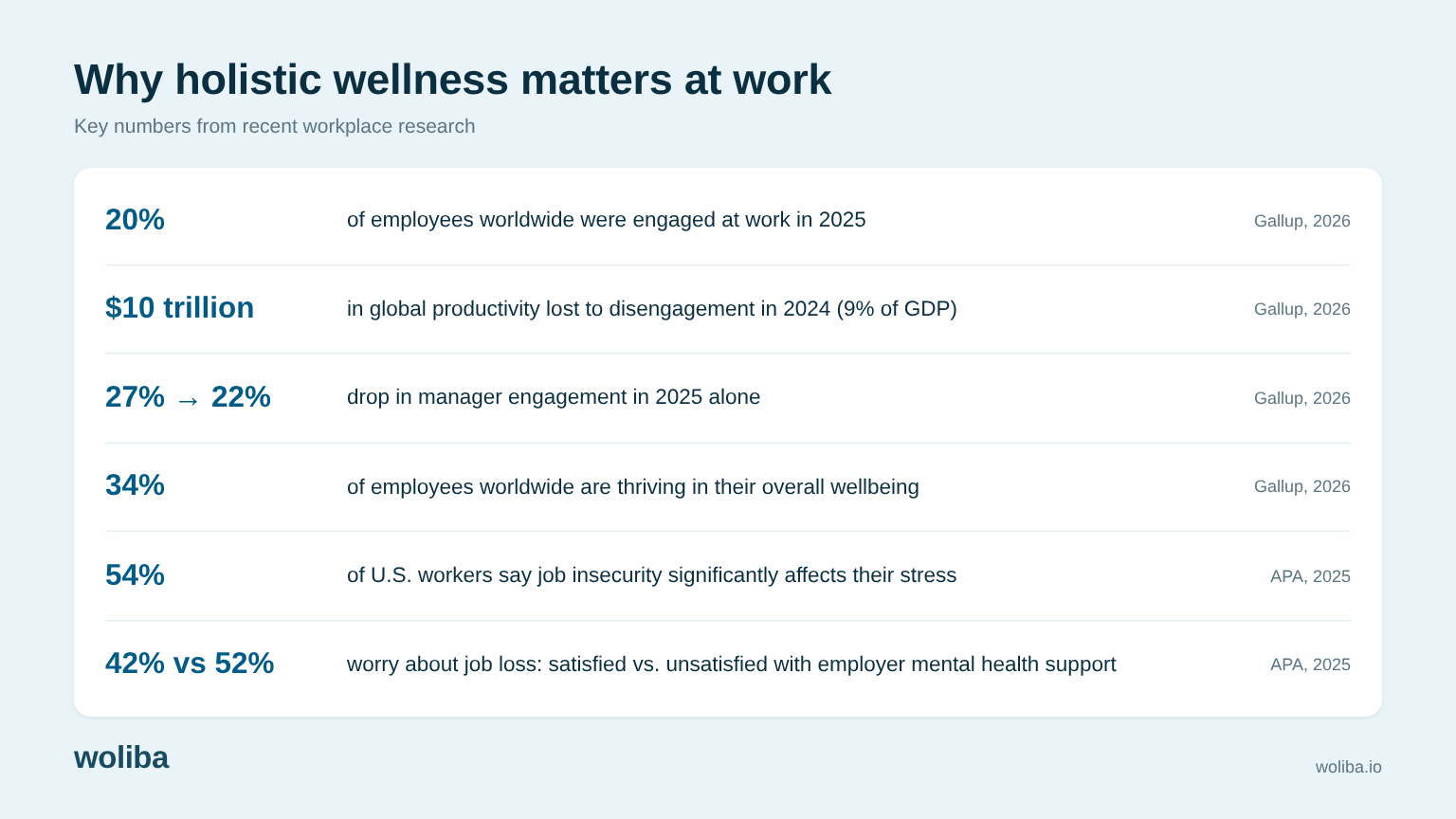
Holistic wellness activities help employees feel better in body, mind, relationships, finances and sense of purpose, all at once. That matters more than ever: Gallup’s State of the Global Workplace report found that global employee engagement fell to just 20% in 2025, and it estimates disengagement cost the world economy about $10 trillion in lost productivity in 2024.
A gym stipend or a once-a-year step challenge can’t fix that on its own. People don’t leave their money worries, loneliness or stress at the door when they log in. That’s why the most effective wellness programs take a whole-person approach.
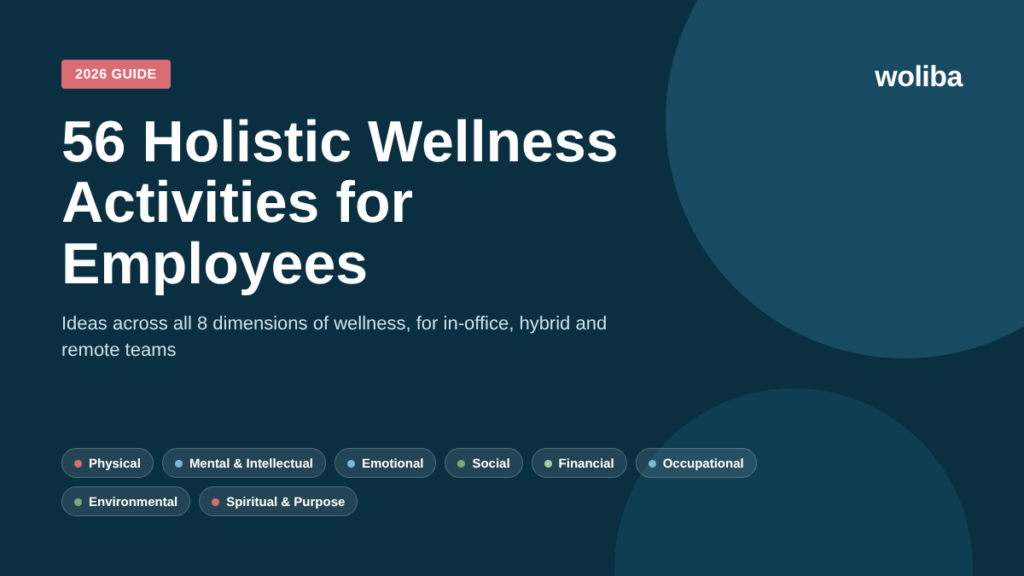
In this guide, you’ll find 56 holistic wellness activities for the workplace, organized by wellness dimension and tagged by format, effort and time. You’ll also learn how to build a year-round program around them and how to measure whether it’s working.
What Is Holistic Wellness?
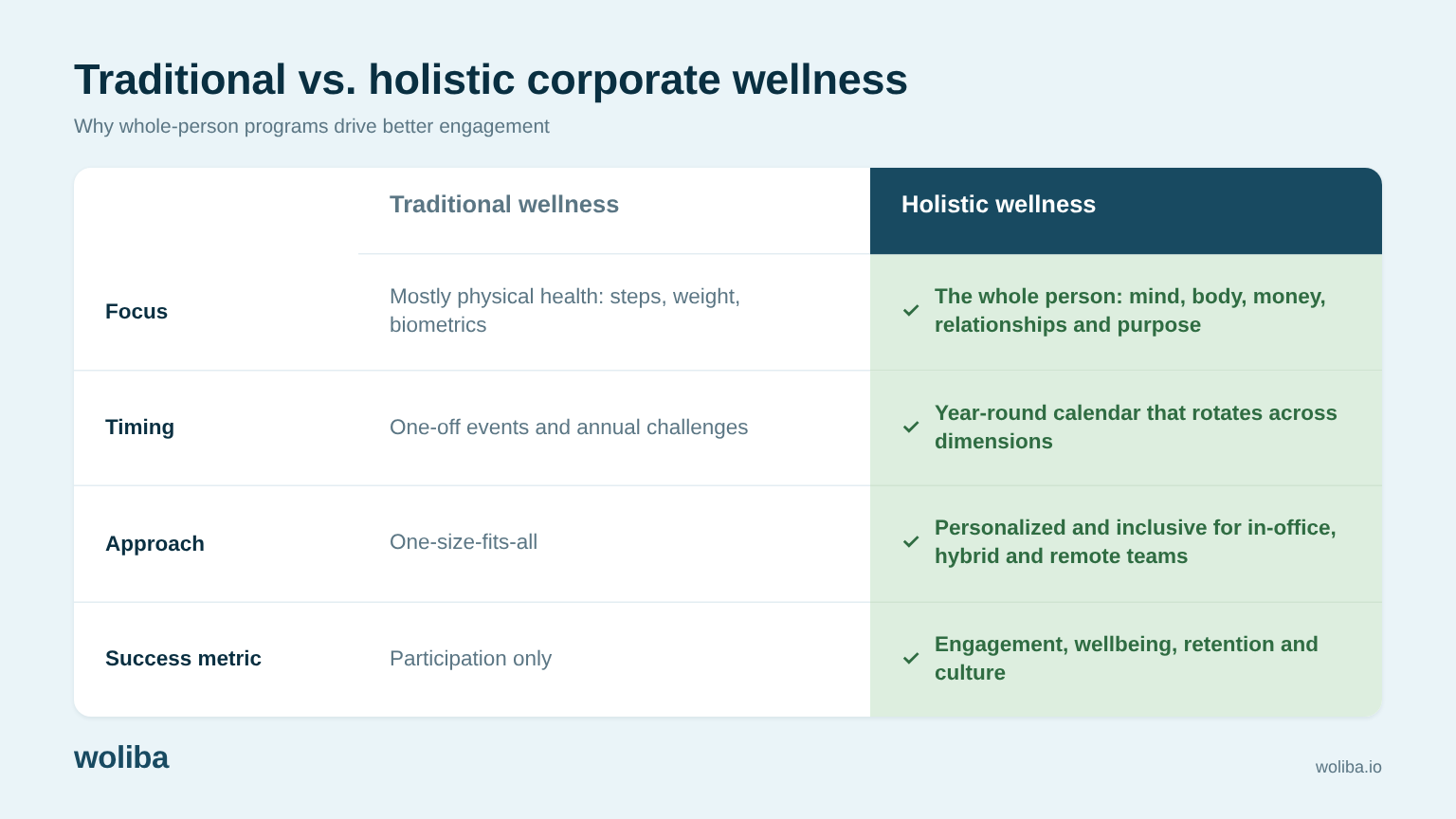
Holistic wellness is an approach to health that treats a person as a whole, not as a set of separate parts. Instead of focusing only on physical fitness, it looks at how physical, mental, emotional, social, financial, occupational, environmental and spiritual wellbeing affect one another.
For example, financial stress can disrupt sleep, poor sleep lowers focus, and low focus increases work stress. Holistic wellness activities break that cycle by supporting several dimensions at the same time.
Holistic Wellness vs. Traditional Corporate Wellness
Why Holistic Wellness Activities Matter at Work
Employee wellbeing and business performance are closely linked. Here’s what recent research shows:
- Engagement is slipping. Only 20% of employees worldwide were engaged in 2025, down from 23% in 2022.
- Managers are struggling too. Manager engagement dropped from 27% to 22% in 2025 alone, and managers are the people employees rely on most for support (Gallup).
- Stress is high. 54% of U.S. workers say job insecurity has a significant impact on their stress levels.
- Support makes a difference. In the same APA survey, workers who were satisfied with their employer’s mental health support were less likely to worry about losing their job (42% vs. 52%).
Holistic wellness activities give employees practical, everyday ways to manage stress, build connection and feel supported. For a deeper look at the payoff, see our guides to the benefits of employee wellness programs and the ROI of employee wellness programs.
Turn wellness ideas into a program people love
Woliba helps you launch holistic wellness challenges, recognition and surveys in minutes, so every employee gets support for body, mind and more.
Start Free Trial21-day free trial. No credit card needed.
The 8 Dimensions of Holistic Wellness
Most holistic wellness frameworks are built around the 8 dimensions of wellness. Each one is a different area of life that affects how people feel and perform at work:
- Physical: movement, sleep, nutrition and preventive care
- Mental and intellectual: focus, learning, creativity and cognitive rest
- Emotional: managing stress, processing feelings and building resilience
- Social: belonging, connection and healthy relationships
- Financial: confidence and control over money
- Occupational: growth, meaning and satisfaction at work
- Environmental: safe, pleasant and sustainable surroundings
- Spiritual and purpose: values, meaning and contribution
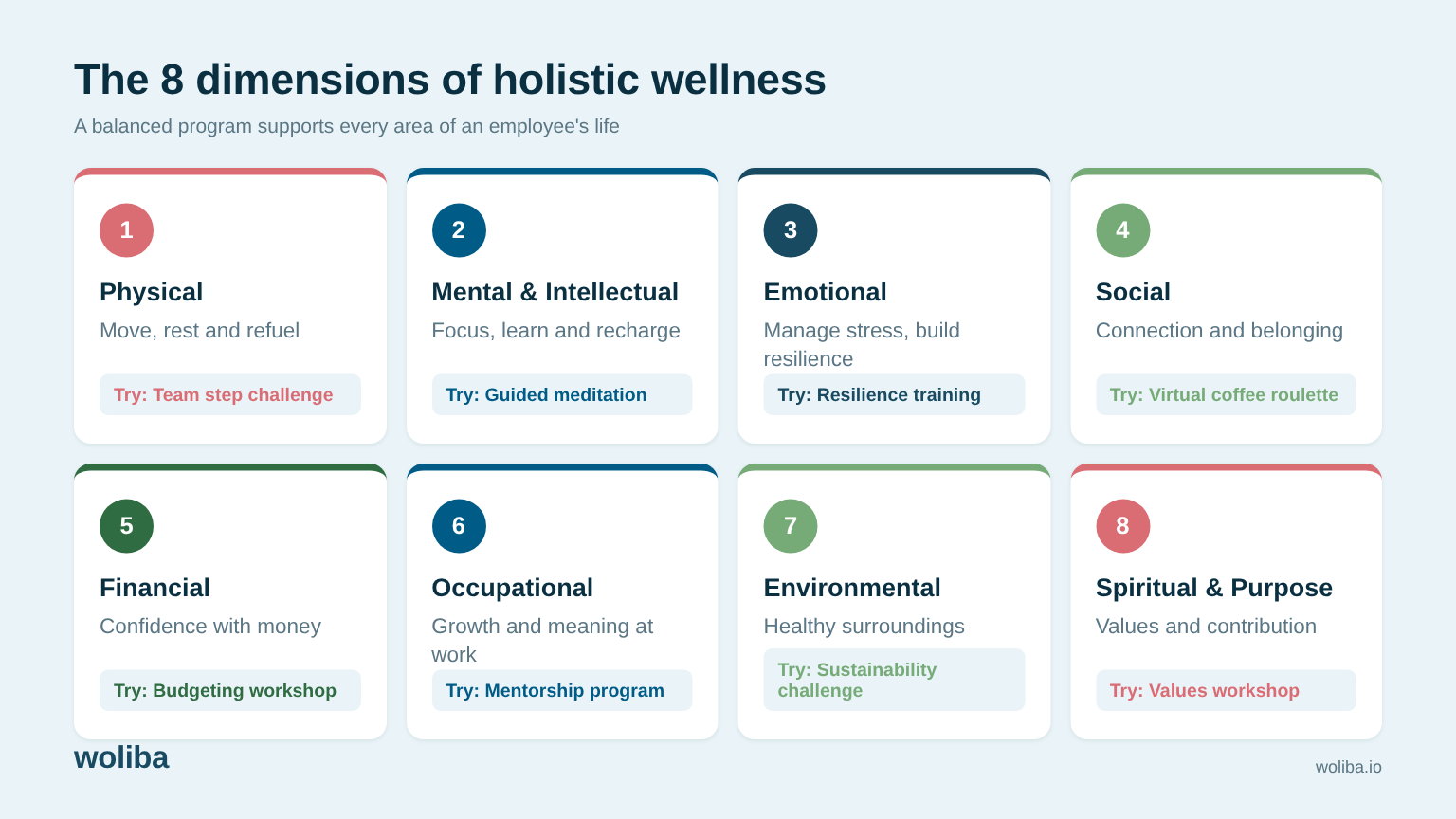
The activities below are grouped by these dimensions so you can build a balanced program instead of over-investing in just one area.
56 Holistic Wellness Activities for the Workplace
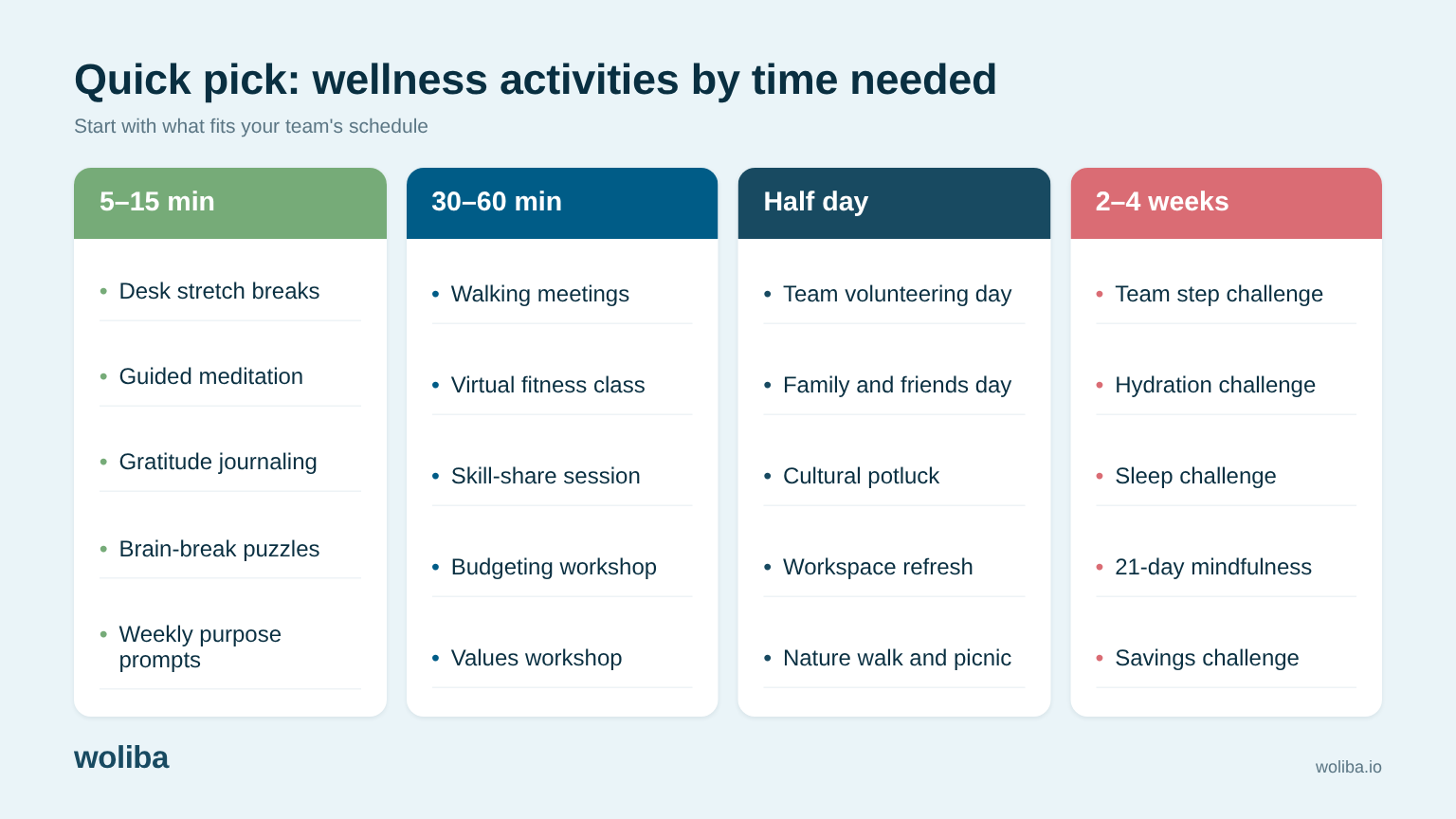
Each activity is tagged with its format (in-office, remote or both), the effort to organize it, and roughly how much time it takes.
Physical Wellbeing: Move, Rest and Refuel
Physical wellness is often the easiest place to start because results are visible and participation is easy to track. Learn more in our guide to physical wellness at work.
- Team step challenge: Teams compete to hit a shared step goal over two to four weeks. Leaderboards and small prizes keep momentum high. See our tips for running a step challenge at work. (Both · Low effort · 2–4 weeks)
- Walking meetings: Swap one-on-ones and small check-ins for a walk, outdoors or on a call with headphones. (Both · Low effort · 20–30 min)
- Desk stretch breaks: Schedule five-minute guided stretch breaks mid-morning and mid-afternoon to ease stiffness from sitting. (Both · Low effort · 5 min)
- Hydration challenge: Employees log daily water intake for 21 days. Branded water bottles make a simple reward. (Both · Low effort · 21 days)
- Sleep challenge: Encourage a consistent bedtime and a screen-free wind-down routine, with tips on sleep hygiene shared each week. (Both · Low effort · 2–4 weeks)
- Healthy cooking demo: Host a live or virtual demo with a nutritionist or chef featuring quick, healthy lunches. (Both · Medium effort · 45 min)
- Ergonomic assessments: Offer workstation checks for office and home setups to prevent back, neck and wrist pain. (Both · Medium effort · 20 min per person)
- Virtual fitness classes: Offer weekly yoga, Pilates or HIIT sessions that employees can join from anywhere. (Remote · Medium effort · 30 min)
- Take-the-stairs challenge: Track flights of stairs climbed per team over a month. It is a great fit for multi-floor offices. (In-office · Low effort · 1 month)
Mental and Intellectual Wellbeing: Focus and Learn
These activities help employees protect their focus, rest their minds and keep learning. For more, read our guide to mental wellness in the workplace.
- Guided meditation sessions: Run short, guided meditations at the start of the day or after lunch. (Both · Low effort · 10–15 min)
- No-meeting focus blocks: Protect two to three hours a week, company-wide, for deep work with no meetings. (Both · Low effort · Weekly)
- Digital detox hour: Pick one hour a day, such as lunch, with no Slack, email or notifications. (Both · Low effort · 1 hour)
- Brain-break puzzles: Share a weekly crossword, riddle or logic puzzle with a leaderboard. (Both · Low effort · 10 min)
- Workplace book club: Read one book a month on wellbeing, habits or leadership and discuss it over lunch. (Both · Low effort · Monthly)
- 21-day mindfulness challenge: Employees complete one short mindfulness exercise a day and check in on progress. (Both · Low effort · 21 days)
- EAP awareness session: Many employees don’t know what their Employee Assistance Program covers. A 20-minute walkthrough helps them use it. (Both · Low effort · 20 min)
- Learning hour: Give employees one hour a week to learn something new, work-related or not. (Both · Low effort · Weekly)
Emotional Wellbeing: Manage Stress and Build Resilience
Emotional wellness activities help employees recognize and manage stress before it turns into burnout. Explore more ideas in our list of emotional wellness activities for employees.
- Stress management workshop: Bring in an expert to teach practical techniques such as box breathing, reframing and boundary-setting. (Both · Medium effort · 60 min)
- Mental health days: Offer dedicated days off for rest, separate from sick leave, and encourage leaders to take them too. (Both · Low effort · Ongoing)
- Peer support circles: Create small, confidential groups where employees can talk about shared challenges, such as caregiving or new parenthood. (Both · Medium effort · Monthly)
- Resilience training: Run a short series on handling change, setbacks and uncertainty. (Both · Medium effort · 4 x 45 min)
- “How are you really?” check-ins: Train managers to open one-on-ones with a genuine wellbeing check-in, not just a status update. (Both · Low effort · Weekly)
- Gratitude journaling: Encourage employees to write down three good things each day for two weeks, with optional sharing in a team channel. (Both · Low effort · 5 min a day)
- Creative expression session: Host an art, music or writing session where the goal is relaxation, not skill. (Both · Medium effort · 60 min)
Social Wellbeing: Build Connection and Belonging
Belonging is one of the strongest drivers of engagement. These activities build real connection across teams. Learn more about social wellness at work.
- Team volunteering day: Volunteer together at a local food bank, cleanup or charity. (In-office · Medium effort · Half day)
- Buddy program: Pair new hires with a buddy for their first 90 days to speed up connection and onboarding. (Both · Low effort · 90 days)
- Interest-based clubs: Support clubs for running, gaming, cooking, gardening or anything else employees love. (Both · Low effort · Ongoing)
- Virtual coffee roulette: Randomly pair employees across teams for a 15-minute coffee chat every two weeks. (Remote · Low effort · 15 min)
- Peer recognition wall: Give employees a public space to thank and celebrate each other. (Both · Low effort · Ongoing)
- Team-based wellness challenges: Turn individual goals into team goals so colleagues encourage each other. Get inspired by these wellness challenge ideas. (Both · Low effort · 2–4 weeks)
- Cultural celebration potluck: Invite employees to share food and traditions from their cultures. (In-office · Medium effort · 90 min)
- Family and friends day: Invite families to the office or a virtual event so they can see where their loved ones work. (Both · High effort · Half day)
Run all 56 activities from one platform
Launch step, hydration and mindfulness challenges, celebrate wins with peer recognition and track participation, all inside Woliba.
Start Free Trial21-day free trial. No credit card needed.
Financial Wellbeing: Reduce Money Stress
Money is one of the top sources of stress for employees, yet it is often missing from wellness programs.
- Budgeting workshop: Teach a simple budgeting method, such as the 50/30/20 rule, with a downloadable template. (Both · Medium effort · 60 min)
- Retirement planning 101: Explain retirement accounts, employer matches and compound growth in plain language. (Both · Medium effort · 60 min)
- Savings challenge: Employees set a personal savings goal and track progress over 30 days. (Both · Low effort · 30 days)
- One-on-one financial coaching: Offer confidential sessions with a certified financial coach. (Both · High effort · 45 min per session)
- Benefits deep dive: Walk employees through the benefits they already have, including insurance, HSAs and discounts, so they use them fully. (Both · Low effort · 45 min)
- No-spend week: A friendly challenge to skip non-essential purchases for a week and share what was saved. (Both · Low effort · 1 week)
Occupational Wellbeing: Grow at Work
Occupational wellness is about finding growth and meaning in work itself.
- Learning stipends: Provide an annual budget for courses, certifications or conferences. (Both · Medium effort · Ongoing)
- Skill-share sessions: Employees teach each other a skill in a 30-minute session, from Excel tricks to photography. (Both · Low effort · 30 min)
- Mentorship program: Match employees with mentors outside their direct reporting line. (Both · Medium effort · 6 months)
- Career path conversations: Hold a dedicated growth conversation twice a year, separate from performance reviews. (Both · Low effort · 45 min)
- Job crafting workshop: Help employees reshape parts of their role around their strengths and interests. (Both · Medium effort · 90 min)
- Stretch projects: Let employees spend part of their time on a cross-functional project that builds new skills. (Both · Medium effort · Ongoing)
Environmental Wellbeing: Improve Your Surroundings
Surroundings shape mood and energy, whether employees work in an office, on a site or at home.
- Plant the office day: Bring in plants for desks and shared spaces, and let employees adopt one. (In-office · Low effort · 1 hour)
- Sustainability challenge: Teams compete to cut waste, energy use or single-use plastics for a month. (Both · Low effort · 1 month)
- Workspace refresh: Ask employees how to improve shared spaces, then act on the top ideas. (In-office · Medium effort · Ongoing)
- Outdoor lunch breaks: Encourage employees to take lunch outside once a week, ideally in a green space. (Both · Low effort · 30–60 min)
- Home office setup audit: Share a checklist covering lighting, noise, air quality and ergonomics for remote workers. (Remote · Low effort · 20 min)
- Declutter day: Set aside an hour for everyone to clear their physical and digital workspaces. (Both · Low effort · 1 hour)
Spiritual Wellbeing: Find Meaning and Purpose
Spiritual wellness at work isn’t about religion. It’s about values, meaning and contribution. Read more in our guide to spiritual wellness in the workplace.
- Values workshop: Help employees identify their personal values and connect them to their work. (Both · Medium effort · 60 min)
- Weekly purpose prompts: Share a weekly reflection question, such as “What did you do this week that mattered?” (Both · Low effort · 5 min)
- Quiet or reflection room: Create a calm, distraction-free space for prayer, meditation or simply a pause. (In-office · Medium effort · Ongoing)
- Community giving campaign: Run a donation drive, and consider matching employee contributions to causes they choose. (Both · Medium effort · 2–4 weeks)
- Nature walks: Organize mindful group walks in a park or green space. (In-office · Low effort · 45 min)
- Impact storytelling: Share stories of how the company’s work has helped customers or communities. (Both · Low effort · Monthly)
Holistic Wellness Activities for Remote and Hybrid Teams
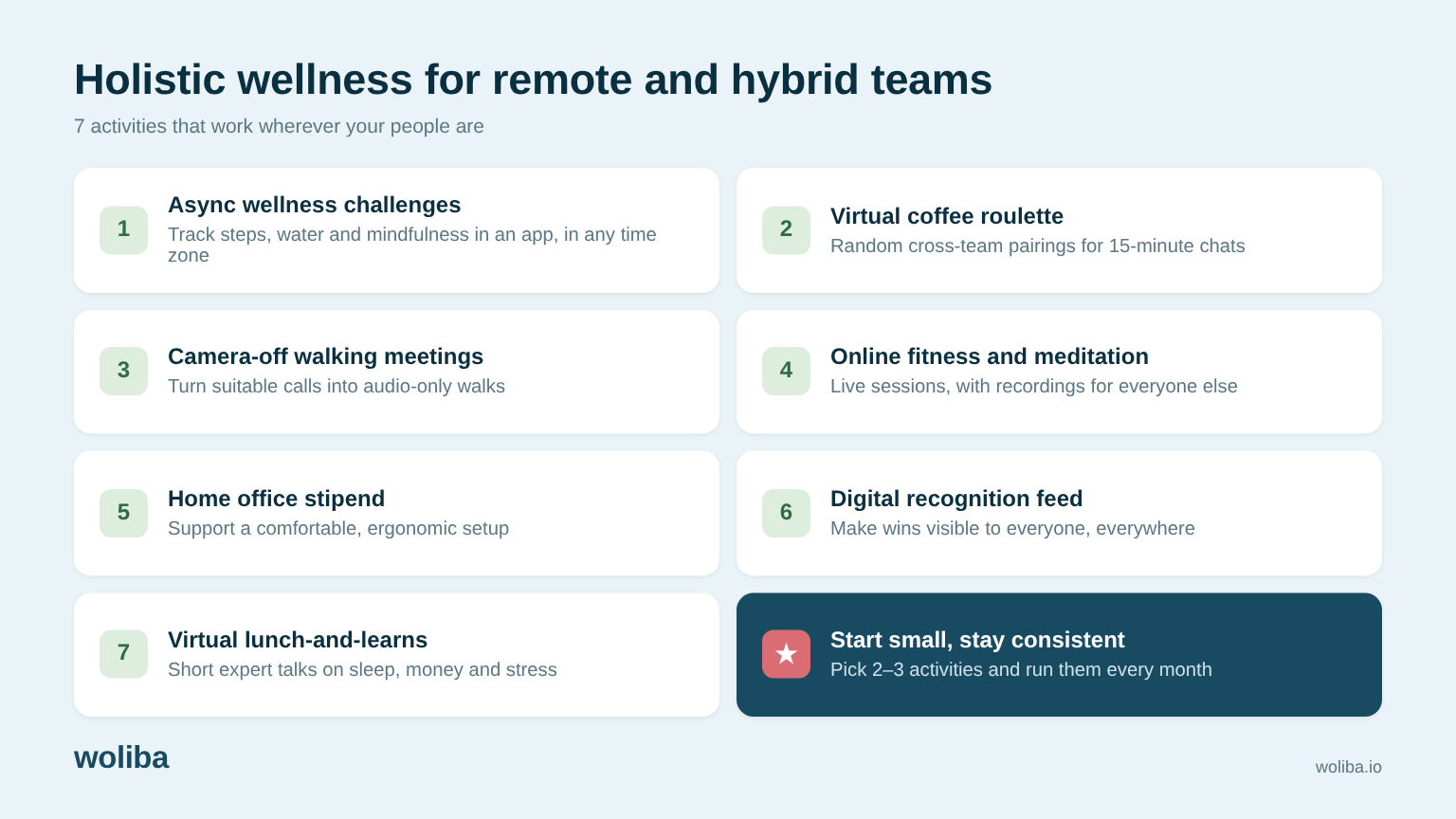
Remote and hybrid employees can feel left out of wellness programs that are designed around the office. These activities work well for distributed teams:
- Async wellness challenges: Step, hydration and mindfulness challenges tracked in an app, so time zones don’t matter.
- Virtual coffee roulette: Random cross-team pairings for short video chats.
- Camera-off walking meetings: Turn suitable calls into audio-only walks.
- Online fitness and meditation classes: Live sessions with recordings for those who can’t attend.
- Home office stipend: Help employees create a comfortable, ergonomic setup.
- Digital recognition feed: A shared space where wins are visible to everyone, wherever they work.
- Virtual lunch-and-learns: Short expert sessions on sleep, nutrition, money or stress.
For more ideas, see our full list of wellness activities for remote employees and our guide to virtual wellness programs.
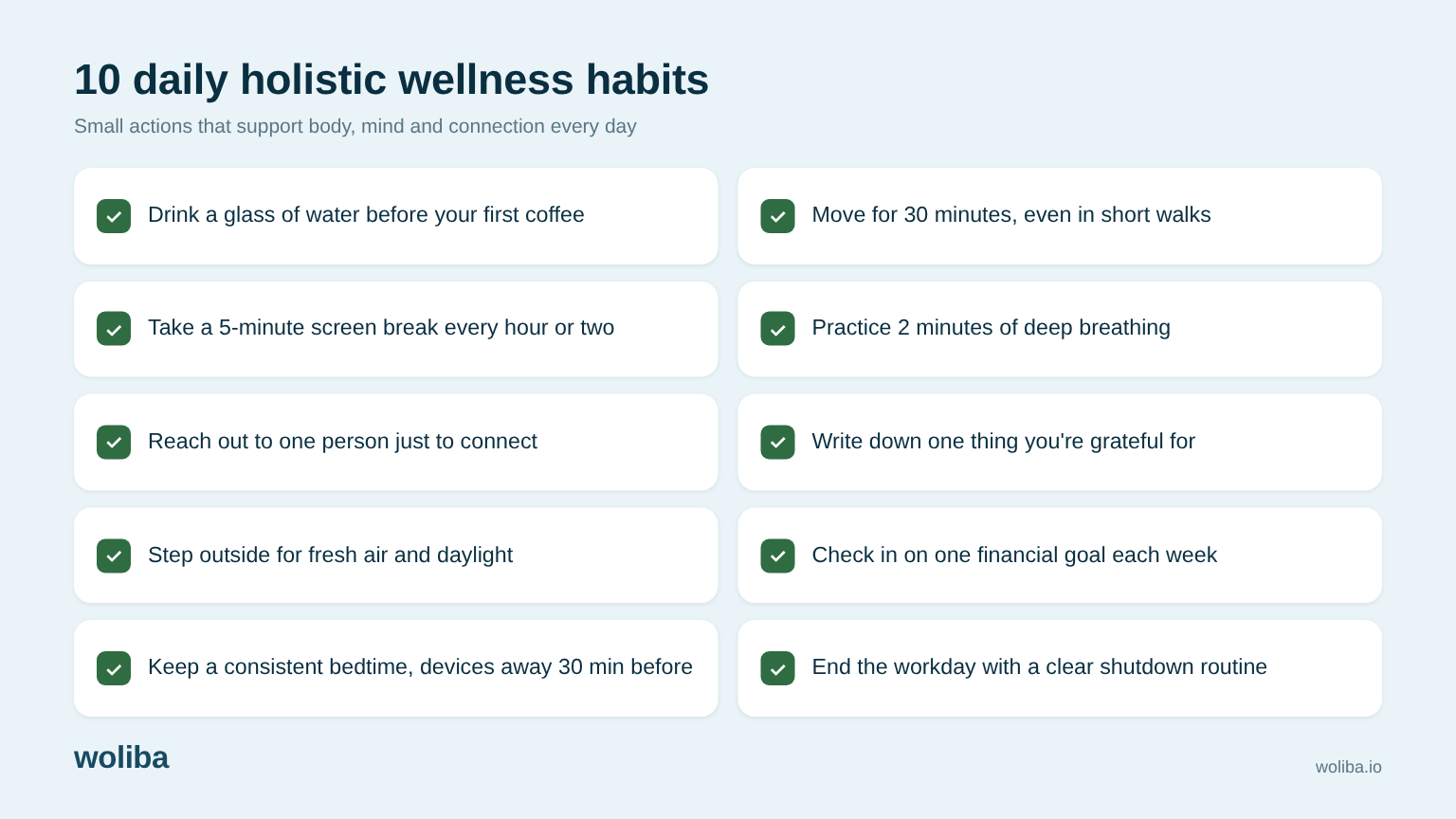
10 Daily Habits Employees Can Start Today
Not all holistic wellness activities need to be company events. Encourage employees to build small daily habits that cover several dimensions at once:
- Drink a glass of water before your first coffee.
- Move for at least 30 minutes, even if it’s split into short walks.
- Take a five-minute screen break every hour or two.
- Practice two minutes of deep breathing or meditation.
- Reach out to one colleague or friend just to connect.
- Write down one thing you’re grateful for.
- Step outside for fresh air and natural light.
- Check in on one financial goal each week.
- Keep a consistent bedtime and put devices away 30 minutes before sleep.
- End the workday with a clear shutdown routine.
How to Build a Holistic Wellness Program Around These Activities
Running a list of holistic wellness activities isn’t the same as running a program. Here’s how to turn these ideas into a structured, year-round initiative. For a complete walkthrough, see our guide to employee wellness programs.
1. Survey Employees First
Start with a short needs assessment. Ask employees which areas of wellbeing they struggle with most, which activities interest them, and when and how they prefer to participate. Use the results to prioritize your dimensions instead of guessing.
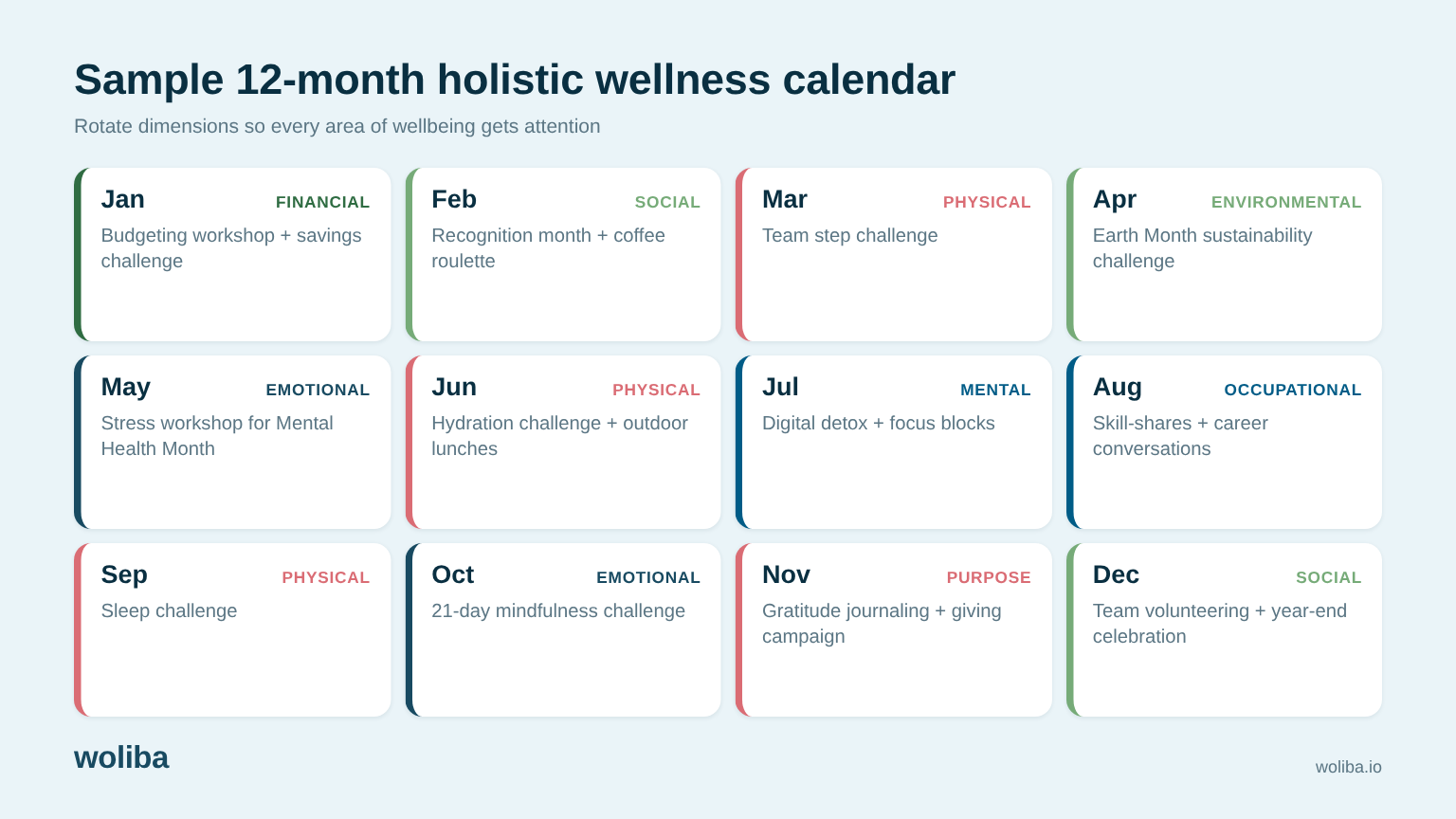
2. Build a 12-Month Activity Calendar
Rotate your focus across dimensions so every area gets attention during the year. Here’s a sample calendar you can adapt:
3. Use Challenges and Incentives to Drive Participation
Friendly competition, team goals and meaningful rewards keep participation high. Points, badges and small prizes work well, especially when employees can choose their own rewards. Need ideas? Browse our list of wellness challenge prize ideas.
4. Get Leaders Involved
Employees take their cue from leadership. When managers join challenges, take mental health days and block focus time, it signals that wellbeing is a real priority, not just a perk.
5. Make Activities Inclusive
Offer a mix of low-impact and high-energy options, in-office and remote formats, and sessions across time zones. Avoid activities that center on alcohol, weight loss or assumptions about family life, and always make participation voluntary.
Launch your wellness calendar in minutes
Use Woliba’s ready-made challenges, rewards and surveys to run a year-round holistic wellness program without the spreadsheets.
Start Free Trial21-day free trial. No credit card needed.
How to Measure the Impact of Your Program
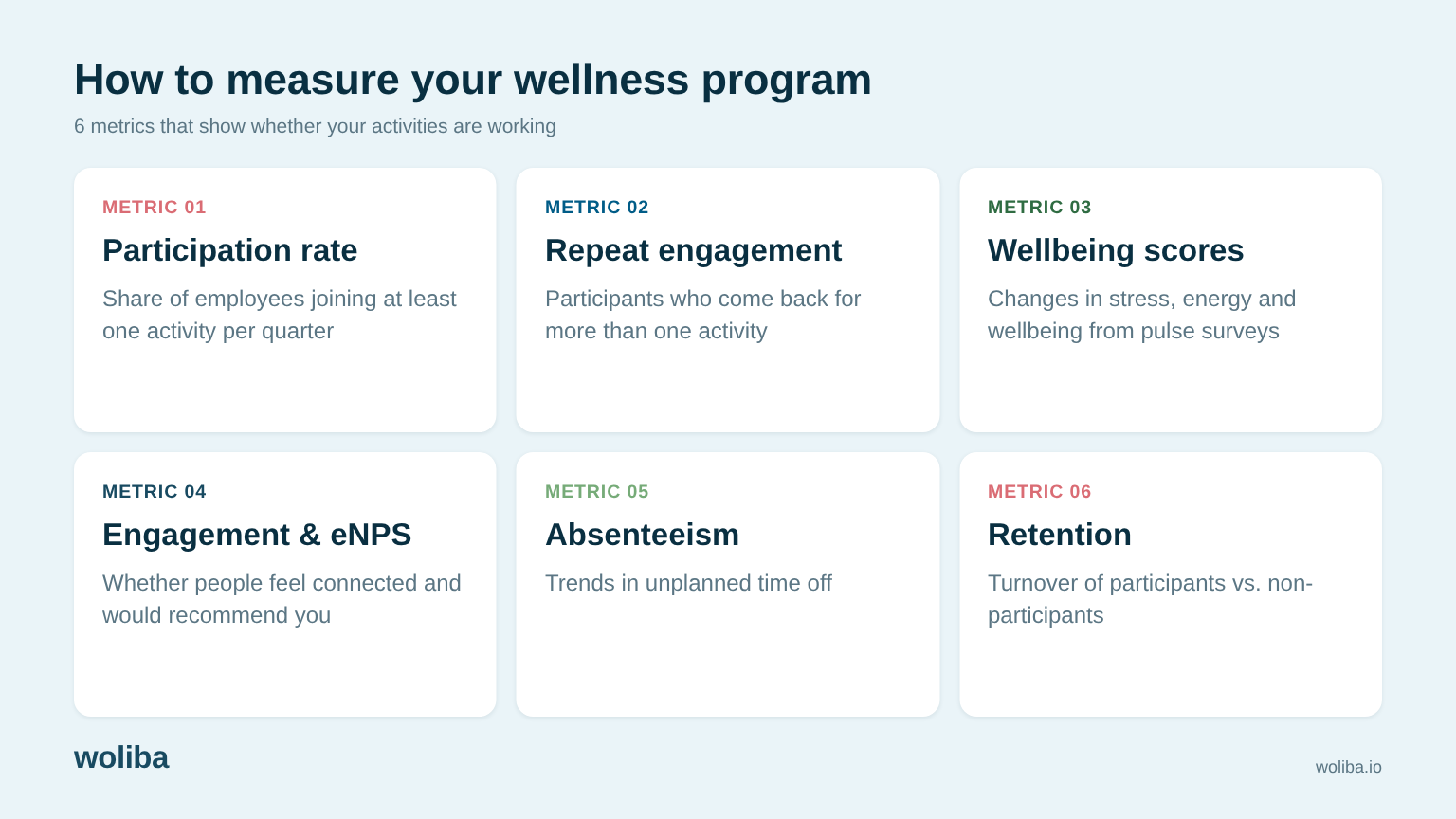
Tracking results helps you prove value and improve your program over time. Focus on these metrics:
- Participation rate: The share of employees who join at least one activity each quarter.
- Repeat engagement: How many participants come back for more than one activity.
- Wellbeing scores: Changes in self-reported stress, energy and wellbeing from pulse surveys.
- Employee engagement and eNPS: Whether employees feel more connected and would recommend your company as a place to work.
- Absenteeism: Trends in unplanned time off.
- Retention: Turnover among program participants compared with non-participants.
Learn more about choosing the right employee wellbeing metrics.
How Woliba Helps You Run Holistic Wellness Programs
Planning, promoting and tracking 50+ activities across eight dimensions is a lot to manage with spreadsheets and email. Woliba brings it all together in one employee wellbeing platform:
- Wellness challenges: Launch step, hydration, mindfulness and team challenges in minutes.
- Employee recognition: Build social wellness with peer-to-peer shout-outs.
- Employee surveys: Run needs assessments and pulse surveys to measure wellbeing over time.
- Wellness coaching and wellness resources: Give employees expert support and content across every dimension.
- Rewards and incentives: Motivate participation with rewards employees actually want.
Ready to build a holistic wellness program your employees will love?
Bring challenges, recognition, coaching and surveys together in one platform and support every dimension of employee wellbeing.
Start Free Trial21-day free trial. No credit card needed.
Conclusion
Employees are whole people, and their wellbeing doesn’t fit neatly into a single category. By offering holistic wellness activities across all eight dimensions, from physical and emotional to financial and purpose-driven, you create a workplace where people can do their best work and feel their best doing it.
Start small: pick three or four activities from this list, run them consistently, and measure the results. Then build from there. If you want a platform that makes it easy.